
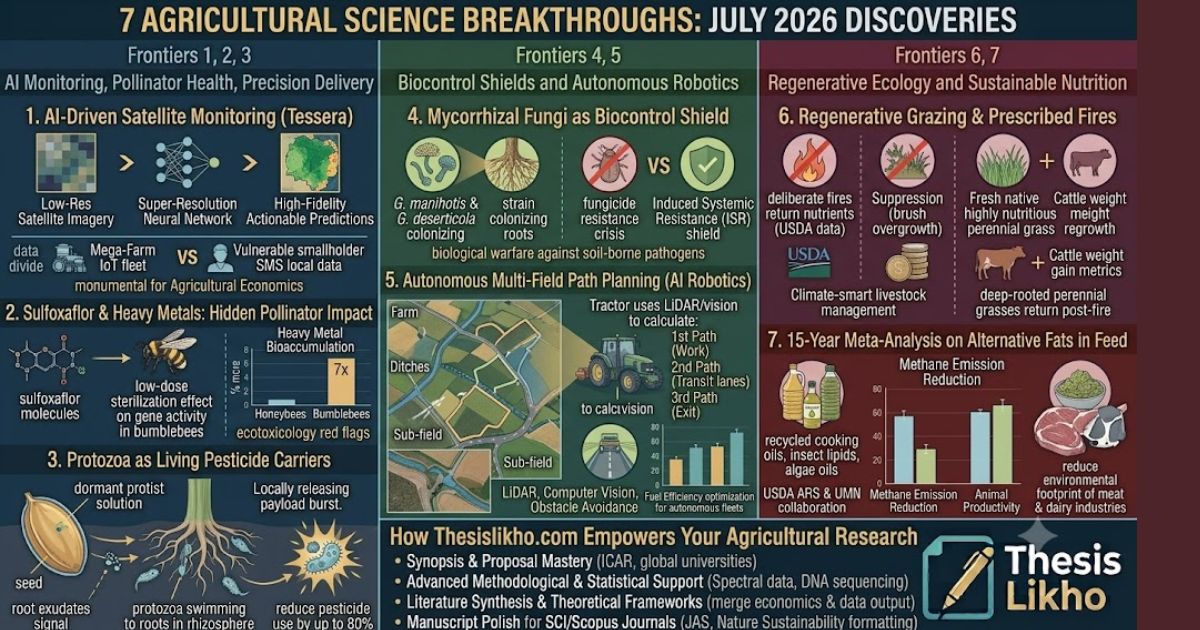
In the first week of July 2026, the scientific community witnessed a flurry of groundbreaking publications in top-tier SCI-indexed journals, ranging from the Journal of Agricultural Science to Nature Sustainability and ScienceDaily reports. These latest discoveries are not just theoretical concepts—they are highly actionable innovations currently transforming the fields of agronomy, ecotoxicology, and smart farming.
For doctoral scholars, agritech researchers, and environmental scientists, keeping pace with this week’s literature is critical. This comprehensive 3,000-word deep dive explores the seven most significant agricultural breakthroughs published in the last 7 days. We will break down their methodologies, their significance to the global food system, and how you can leverage these frontiers for your own high-impact academic research.
1. AI-Driven Satellite Monitoring for the World’s Vulnerable Farms (The Tessera System)
The Research Context
One of the most significant disparities in modern agriculture is the "data divide." While mega-farms in the Global North utilize fleets of drones and IoT soil sensors, smallholder farmers in vulnerable regions (such as Sub-Saharan Africa and Southeast Asia) often lack basic meteorological data. On July 7, 2026, researchers from the Department of Computer Science and Technology at the University of Cambridge published a landmark paper introducing Tessera, an advanced AI tool designed to bridge this gap.
The Innovation and Methodology
Tessera is a machine learning framework that analyzes low-resolution, free satellite imagery (like that provided by the European Space Agency’s Sentinel satellites) to predict crop yields and monitor food security in highly fragmented, vulnerable farming regions.
Historically, satellite monitoring struggled with smallholder farms because the individual plots of land were smaller than the pixel resolution of the satellite. Tessera overcomes this by utilizing a novel super-resolution neural network. The AI takes fuzzy, low-resolution satellite data and cross-references it with local topographical, meteorological, and historical yield data to generate high-fidelity, actionable predictions.
Research Significance for Scholars
This discovery is monumental for researchers in Agricultural Economics and Climate-Smart Agriculture.
- Application: Researchers can now use Tessera to track the impact of localized droughts or floods on regional food supply chains in real-time.
- Thesis Potential: A PhD student could design a thesis around integrating Tessera’s AI predictions with behavioral economic models—studying how providing this localized satellite data via SMS text messages changes the planting behaviors of smallholder farmers. Publications in this domain are highly sought after by journals like Global Food Security and Computers and Electronics in Agriculture.
2. Ecotoxicology Alert: The Hidden Impact of Sulfoxaflor and Heavy Metals on Pollinators
The Research Context
The global decline of pollinator populations is a critical threat to food security, given that over 75% of global food crops rely on animal pollination. For years, the agricultural industry has been phasing out neonicotinoids due to their devastating effect on honeybees, replacing them with "next-generation" pesticides like sulfoxaflor. However, twin studies published in the second week of July 2026 have raised massive red flags regarding our new chemical interventions.
The Discoveries
- The Sulfoxaflor Threat (July 10, 2026): Researchers discovered that even low-dose, sub-lethal exposure to sulfoxaflor significantly alters the gene activity in bumblebees, specifically targeting tissues involved in reproduction. This indicates that while the pesticide might not kill the bee outright, it sterilizes the colony over time.
- The Heavy Metal Accumulation (July 7, 2026): A separate ecotoxicology study revealed a shocking physiological difference between bee species. When foraging in the exact same environments, bumblebees collect up to seven times more toxic heavy metals than honeybees. This hidden pollution severely reduces their foraging efficiency and reproductive success.
Research Significance for Scholars
These discoveries represent a massive opportunity for scholars in Entomology and Environmental Toxicology.
- The Flaw in Current Testing: These papers highlight a systemic flaw in how agricultural chemicals are approved. Regulatory bodies typically test pesticides solely on honeybees (Apis mellifera), assuming all pollinators react similarly.
- Thesis Potential: There is a desperate need for research that maps the varying toxicological pathways of different native pollinators (like solitary bees or bumblebees). Designing a study that tracks the bioaccumulation of heavy metals in specific pollinator species across varying agricultural landscapes is a guaranteed pathway to publication in high-impact journals like Environmental Pollution or Science of the Total Environment.
3. Precision Biological Delivery: Using Protozoa as "Living Carriers" for Pesticides
The Research Context
One of the most persistent problems in traditional agriculture is pesticide runoff. When farmers spray chemicals on a field, a significant percentage is washed away by rain, polluting local waterways and degrading soil health. The holy grail of agrochemistry is finding a way to deliver active ingredients exactly where they are needed—at the root zone—without contaminating the surrounding environment.
The Innovation and Methodology
Recent patent literature and research out of the University of Connecticut highlight a revolutionary approach: using natural protozoa as living microscopic carriers for agrochemicals.
Instead of spraying a chemical blindly, researchers coat seeds with a solution containing dormant protists (microscopic single-celled organisms) engineered to carry specific pesticide payloads.
Once the seed is planted and the soil moistens, the protists activate. They are naturally drawn to the chemical signals (root exudates) released by the growing plant. As the protists swim through the soil (the rhizosphere) toward the roots, they carry the pesticide directly to the site of potential pest attacks, releasing the chemical in a highly localized, concentrated burst.
Research Significance for Scholars
This sits at the cutting edge of Biotechnology and Nanoscale Agriculture.
- Environmental Impact: This targeted delivery system could reduce total pesticide usage by up to 80%, drastically minimizing environmental toxicity.
- Thesis Potential: Agronomy researchers can explore the symbiotic relationships between various protozoan carriers and different crop root systems. For instance, testing how soil pH, moisture levels, or the presence of native soil microbiomes affect the motility and payload-delivery efficiency of these protists. This interdisciplinary research merges microbiology with agricultural engineering, perfect for journals like Nature Food or Pest Management Science.
4. Mycorrhizal Fungi as a Biocontrol Shield (G. manihotis and G. deserticola)
The Research Context
Soil-borne fungal pathogens—such as Fusarium or Rhizoctonia—cause billions of dollars in crop losses annually. For decades, the standard response was heavy applications of chemical fungicides. However, in 2026, we are facing a crisis of fungicide resistance, where pathogenic fungi mutate to survive these chemicals, forcing farmers to apply ever-higher, toxic doses.
The Innovation and Methodology
To combat this, leading agritech firms like Groundwork BioAg are shifting toward competitive biological warfare. The latest research focuses on highly specific mycorrhizal fungi—specifically, a formulated mixture of Glomus manihotis and Glomus deserticola.
These beneficial fungi form a symbiotic relationship with the plant’s roots. They physically colonize the root system, creating a biological shield that prevents pathogenic fungi from entering. Furthermore, these specific strains have been shown to trigger the plant’s Induced Systemic Resistance (ISR), essentially acting as a vaccine that primes the plant’s immune system to fight off future infections.
Research Significance for Scholars
For scholars in Plant Pathology and Agroecology, the shift from chemical eradication to biological management is the most fertile ground for modern research.
- Thesis Potential: A highly publishable thesis could focus on the efficacy of these mycorrhizal mixtures under drought stress conditions (which are becoming more common). Since mycorrhizal fungi also help plants absorb water, researchers could design field trials to measure both disease resistance and water-use efficiency simultaneously. Publications analyzing biological control mechanisms are currently dominating the European Journal of Plant Pathology and Applied Soil Ecology.
5. Autonomous Multi-Field Path Planning for Next-Gen Farm Machinery
The Research Context
The concept of a "self-driving tractor" is no longer novel; GPS-guided tractors have been following straight lines in massive, uniform fields for years. However, real-world farming is rarely that simple. Farms are often composed of multiple, irregularly shaped sub-fields divided by public roads, ditches, and waiting zones. Until now, autonomous machinery required constant human intervention to navigate between these fields.
The Innovation and Methodology
Recent developments by corporations like Kubota have introduced advanced multi-field path-planning AI. This new generation of processors doesn't just map a single field; it maps entire regional ecosystems.
The algorithm calculates a "first path" (for the actual agricultural work like plowing or harvesting), a "second path" (navigating public or private transit lanes to reach the next sub-field), and subsequent paths for exiting zones when work is complete. The system relies on real-time LiDAR, computer vision, and predictive obstacle avoidance to safely move massive machinery across complex, populated farm landscapes without human oversight.
Research Significance for Scholars
This is the absolute frontier of Agricultural Engineering and Robotics.
- Thesis Potential: Researchers can move beyond the mechanical engineering aspect and focus on the system optimization of these autonomous fleets. For example, using operations research algorithms to calculate the most fuel-efficient routing for a fleet of three autonomous harvesters working across ten fragmented fields. Studies focusing on the energy efficiency and economic viability of fully autonomous multi-field systems are highly sought after by Biosystems Engineering and Computers and Electronics in Agriculture.
6. Regenerative Grazing: Integrating Prescribed Fires for Ecosystem Health
The Research Context
Livestock farming has faced intense scrutiny regarding its carbon footprint and environmental degradation. However, Regenerative Agriculture is proving that when managed correctly, livestock can actually restore degraded ecosystems. On July 8, 2026, researchers from the USDA Agricultural Research Service (ARS) in Miles City, Montana, published compelling data on a seemingly counterintuitive practice: deliberately setting fires to improve cattle nutrition.
The Innovation and Methodology
The research focuses on the integration of prescribed fires into rotational grazing management on rangelands. Historically, fires were suppressed, leading to an overgrowth of woody shrubs and invasive, nutrient-poor grasses.
The USDA researchers demonstrated that carefully timed, low-intensity prescribed burns clear out this dead, invasive brush. The ash returns vital nutrients to the soil immediately, triggering a rapid regrowth of native, highly nutritious perennial grasses. When cattle are then introduced to graze on this fresh growth, their weight gain and overall health metrics improve significantly compared to cattle grazing on unburned land.
Research Significance for Scholars
For scholars in Animal Science and Rangeland Ecology, this research provides empirical data to support ancient, indigenous land-management practices.
- Thesis Potential: A doctoral candidate could conduct a multi-year study tracking the soil microbiome biodiversity in burned vs. unburned grazing plots, or map the exact carbon sequestration rates of the deep-rooted perennial grasses that return post-fire. This research aligns perfectly with the global push for climate-smart livestock management and is highly publishable in Rangeland Ecology & Management or Agriculture, Ecosystems & Environment.
7. A 15-Year Meta-Analysis on Alternative Fats and Oils in Livestock Feed
The Research Context
The formulation of livestock feed is a massive driver of global agricultural economics and environmental impact. Traditional feeds rely heavily on soybeans and corn, which require massive amounts of land and water to cultivate. Finding sustainable, alternative energy sources for livestock diets is a top priority for reducing the environmental footprint of the meat and dairy industries.
The Innovation and Methodology
On July 6, 2026, a monumental comprehensive review was published, resulting from a 15-year collaboration between the USDA ARS and the University of Minnesota. The researchers synthesized a decade and a half of data regarding the use of alternative fats and oils (such as recycled cooking oils, insect-derived lipids, and algae oils) in livestock feed.
The meta-analysis evaluated how these alternative lipid sources affect animal productivity, meat quality, and methane emission reductions in ruminants (cattle and sheep). The findings definitively prove that specific formulations of alternative fats not only maintain or improve growth rates but can also significantly alter the microbial fermentation process in a cow's rumen, directly reducing enteric methane production—a major greenhouse gas.
Research Significance for Scholars
This 15-year dataset is a goldmine for researchers in Livestock Nutrition and Sustainable Food Systems.
- Thesis Potential: Researchers can use this foundational data to investigate the exact biochemical pathways through which specific algae oils inhibit methanogenic archaea in the rumen. Alternatively, scholars can conduct lifecycle assessments (LCA) to determine the true carbon footprint of sourcing insect-derived lipids versus traditional soy-based feeds. This highly impactful research fits perfectly within the scope of the Journal of Dairy Science or Animal Feed Science and Technology.
Elevating Your Agricultural Research with Thesislikho.com
The agricultural science breakthroughs of July 2026 clearly demonstrate that modern farming is no longer just about seeds and soil—it is a highly complex matrix of artificial intelligence, molecular biology, robotics, and climate modeling.
Whether you are a master’s student seeking to map the ecotoxicology of next-generation pesticides on native pollinators, or a PhD candidate writing code for autonomous multi-field tractor routing, the journey from raw field data to a published, high-impact manuscript is fraught with methodological and administrative hurdles.
Unlike purely laboratory-based sciences, agricultural research requires scholars to balance rigorous statistical analysis of chaotic, real-world field data with clear, actionable implications for farmers and policymakers. This is where many brilliant field studies falter—not due to a lack of insight, but due to challenges in structuring complex arguments, executing multivariate data analysis, or navigating the stringent formatting requirements of international peer review.
Thesislikho.com serves as your premier academic partner, providing the specialized scaffolding necessary to elevate your research in Agricultural Science:
How We Empower Your Academic Journey:
- Synopsis and Proposal Mastery: Securing admission into premier agricultural institutes (such as ICAR institutes in India, or top global universities) requires a proposal that is both novel and meticulously structured. Our consultants help you define clear research questions, ensuring your proposal highlights critical gaps in the current 2026 literature—whether in climate-smart agriculture or AI-driven crop monitoring.
- Advanced Methodological & Statistical Support: Modern agricultural science demands empirical rigor. If your research involves complex mixed-methods—such as analyzing satellite spectral data, interpreting soil microbiome DNA sequencing, or running multivariate ANOVAs on multi-year crop yield data—our technical team provides the analytical support required to ensure your findings are robust and statistically valid.
- Literature Synthesis & Theoretical Frameworks: The sheer volume of agricultural publications can be overwhelming. We assist in synthesizing massive volumes of literature into a coherent, defensible theoretical framework. If you are struggling to merge the economics of smallholder farming with the data outputs of the Tessera AI system, our academic experts guide you in building a logical, unassailable foundation for your thesis.
- Manuscript Polish for SCI/Scopus Journals: The difference between rejection and acceptance in top-tier agricultural journals (like the Journal of Agricultural Science or Agronomy for Sustainable Development) often comes down to narrative clarity and strict adherence to formatting guidelines. We provide comprehensive structural editing to ensure your research communicates its agronomic and environmental significance powerfully to a global academic audience.
Your research has the potential to influence global food security, revolutionize farming practices, and protect our fragile ecosystems from collapse. Do not let the complexities of academic writing or statistical modeling hinder your contribution to this vital field.
Partner with the experts at Thesislikho.com to ensure your academic journey culminates in research that is recognized, respected, and published at the highest levels of the scientific community.
As we look toward the future of food production, do you believe the increasing reliance on Artificial Intelligence and autonomous robotics will ultimately empower smallholder farmers, or will it widen the technological divide and concentrate agricultural power in the hands of massive corporations?
Call / WhatsApp: +91 96438 02216
Website:www.ThesisLikho.com