Today’s researchers are no longer confined to the dusty archives of classic novels; they are analyzing the linguistic burstiness of digital subcultures, employing artificial intelligence to decode complex phonetic variations, and using literature to map the psychological impacts of the climate crisis.
Conferences such as the 2026 International Conference on Literary Studies and Creative Writing and recent publications in the Journal of New Trends in English Language Learning (JNTELL) and English Language & Linguistics (Cambridge) highlight a fundamental shift. The English language is no longer just a subject of study—it is recognized as a living vehicle of cultural exchange, cognitive representation, and technological interface.
For master's and doctoral scholars, the demand for innovative, mixed-methods research has never been higher. Getting published in top-tier Scopus-indexed and SSCI (Social Sciences Citation Index) journals now requires scholars to blend deep critical theory with robust computational, socio-linguistic, or pedagogical analysis.
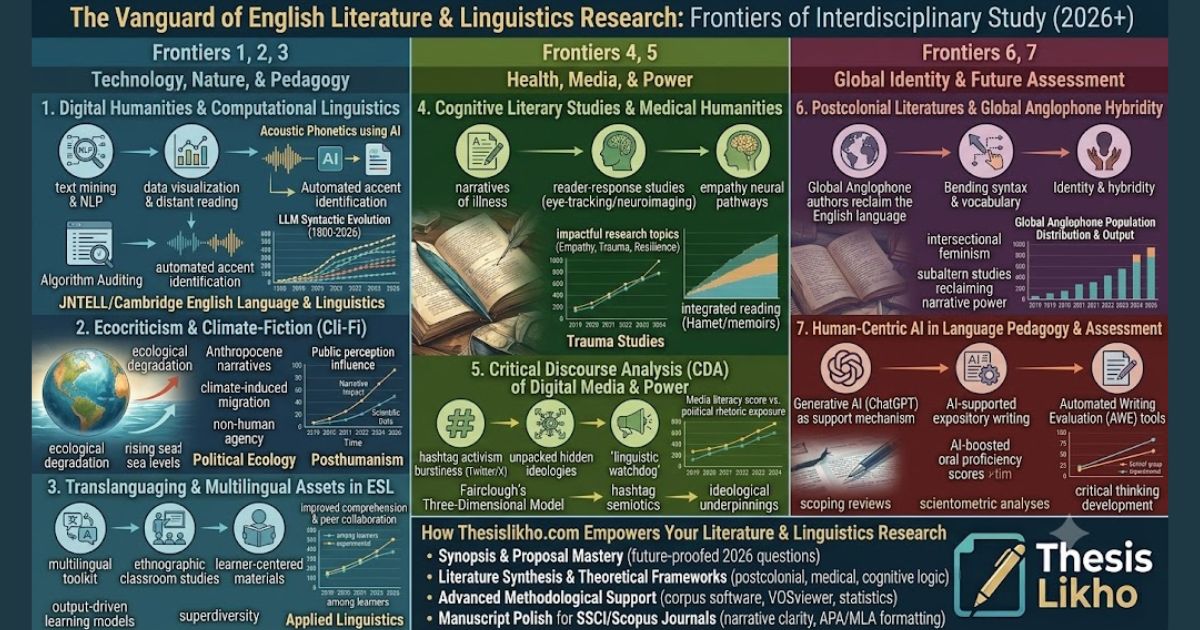
Below is an expansive, evidence-based deep dive into the seven most critical areas of English Literature and Linguistics research currently defining the academic landscape.
1. Digital Humanities and Computational Linguistics
The integration of advanced computational technology into the study of language and literature has birthed the rapidly expanding field of Digital Humanities. We are firmly in the "Age of AI," and the impact of predictive algorithms on literary analysis and language modeling is a paramount concern.
The Research Context
In 2026, the use of Large Language Models (LLMs) and advanced natural language processing (NLP) has revolutionized how we interact with texts. Scholars are using text mining, data visualization, and corpus linguistics to analyze massive bodies of text with a precision that was previously impossible. Recent publications in English Language & Linguistics focus on "Lexical multidimensional analysis," using computational tools to identify hidden discourses and ideologies across centuries of writing.
Methodological Approach and Significance
Research in this domain frequently employs a combination of algorithmic auditing, distant reading (analyzing thousands of novels simultaneously rather than close reading a single text), and acoustic phonetics using AI. For instance, universities are currently probing the phonological representations of LLMs and using AI tools like Whisper to analyze non-native speaker phonetic realizations and provide automated accent identification.
- Significance: By mapping the evolution of literary themes across centuries or analyzing the syntactic structures generated by AI, researchers are answering fundamental questions about human creativity and linguistic evolution. Studies that successfully integrate machine learning with traditional literary theory are highly prized in journals like Digital Scholarship in the Humanities and Corpus Linguistics and Linguistic Theory.
2. Ecocriticism and Climate-Fiction (Cli-Fi)
As the physical realities of global warming become impossible to ignore, literature has responded with a surge of narratives grappling with environmental collapse. Ecocriticism has moved from the margins to the absolute center of literary theory in 2026.
The Research Context
Modern ecocriticism goes far beyond analyzing nature poetry. It asks urgent questions: How do narratives influence public perception of ecological crises? Can literature inspire tangible environmental activism? The rise of "Cli-Fi" (Climate Fiction) bridges environmental science with cultural critique. Scholars are analyzing how contemporary authors depict the Anthropocene, climate-induced migration, and the "slow violence" of ecological degradation.
Methodological Approach and Significance
Researchers in this domain utilize interdisciplinary frameworks, combining literary analysis with political ecology and posthumanism. They study how literature decentralizes the human experience, giving agency to non-human entities (animals, oceans, forests) within the narrative structure.
- Significance: Understanding how the climate crisis is narrated is essential for shaping public policy and environmental empathy. A thesis that explores the intersection of postcolonialism and ecocriticism—such as how Global South authors narrate the disproportionate impact of climate change—provides vital cultural context to scientific data. This research is a staple in top-tier journals like ISLE: Interdisciplinary Studies in Literature and Environment.
3. Translanguaging and Multilingual Assets in ESL
The field of English as a Second Language (ESL) and Applied Linguistics is experiencing a paradigm shift. The antiquated "English-only" classroom model is being dismantled in favor of translanguaging, an approach that treats a learner’s native linguistic repertoire as an asset rather than a deficit.
The Research Context
According to recent bibliometric reviews published in F1000Research (2026), the fundamental principle of modern ELT (English Language Teaching) curriculum design emphasizes a dual focus on linguistic competence and learners' social-cognitive development. Translanguaging allows students to draw on their full linguistic toolkit, reading in English while discussing in their native language (L1). The linguistic superdiversity of today’s classrooms demands dynamic, learner-centered materials that integrate cultural and interactive dimensions.
Methodological Approach and Significance
Scholars are conducting ethnographic classroom studies, qualitative research synthesis, and empirical assessments of output-driven learning models. Research focuses on how translanguaging improves comprehension, critical thinking, and peer collaboration among ESL learners.
- Significance: This research is fundamentally reshaping institutional pedagogy globally. By proving that multilingual approaches yield higher oral proficiency and deeper cognitive engagement, scholars provide the data required to rewrite national language education policies. High-impact journals like Applied Linguistics and TESOL Quarterly are actively seeking manuscripts that empirically evaluate translanguaging practices.
4. Cognitive Literary Studies and Medical Humanities
The trauma of the early 2020s fundamentally reshaped how we understand the relationship between narratives, the human brain, and physical health. The intersection of literature, cognitive science, and medicine has birthed the flourishing field of Medical Humanities.
The Research Context
Current research—highlighted by 2026 publications on "Trauma Studies in Contemporary Fiction"—examines narratives of illness, healing, and medical ethics. Cognitive literary studies investigate how reading specific texts activates neural pathways related to empathy, memory, and spatial reasoning. For example, researchers are integrating Freudian psychoanalysis with cognitive science to perform integrated readings of classic tragedies (like Hamlet) and contemporary trauma memoirs.
Methodological Approach and Significance
Methodologies often involve a hybrid of close reading, psychological profiling, and sometimes empirical reader-response studies (using eye-tracking or neuroimaging to see how readers process metaphors or narrative shock).
- Significance: This research bridges the gap between the humanities and the hard sciences. By analyzing how society narrates illness (e.g., the "battle" metaphor of cancer vs. the "journey" metaphor), literature scholars provide healthcare professionals with critical insights into patient psychology and empathy. Journals such as Literature and Medicine and Journal of Medical Humanities are the prime targets for this impactful research.
5. Critical Discourse Analysis (CDA) of Digital Media and Power
In an era dominated by rapid media consumption, "fake news," and digital echo chambers, the linguistic analysis of power and representation is a critical necessity. Critical Discourse Analysis (CDA) is being deployed to unpack the hidden ideologies within our daily digital diets.
The Research Context
Recent studies in the International Journal of English Language and Linguistics Research (2026) have utilized CDA to analyze print and digital media depictions of women's involvement in terrorism, the framing of global pandemics, and the linguistic construction of political identities. Language is never neutral; it is a tool of power. Scholars are analyzing how specific lexical choices, passive voice constructions, and syntactic framing are used to marginalize specific communities or legitimize state violence.
Methodological Approach and Significance
Researchers utilize frameworks like Fairclough’s Three-Dimensional Model, combining textual analysis with socio-political critique. With the rise of digital media, scholars are also applying CDA to social media platforms, analyzing the "burstiness" of Twitter/X hashtags, hashtag activism, and the semiotics of internet memes.
- Significance: CDA research acts as an academic watchdog. By exposing the ideological underpinnings of mainstream media and political rhetoric, linguists provide the tools for media literacy and democratic accountability. This research is vital for journals like Discourse & Society and Critical Discourse Studies.
6. Postcolonial Literatures and Global Anglophone Hybridity
The study of English literature is no longer centered solely on the British and American canons. The field has rapidly expanded to embrace Global Anglophone literature, focusing heavily on themes of migration, diaspora, and neo-colonialism.
The Research Context
As global migration reaches unprecedented levels due to conflict and climate change, the literature of displacement has taken center stage. Current research in cultural studies frequently examines Indigenous storytelling traditions, identity and hybridity in postcolonial societies, and the representation of marginalized voices (including Queer theory and LGBTQ+ literature). The focus is on how authors from the Global South reclaim the English language, bending its syntax and vocabulary to reflect local realities.
Methodological Approach and Significance
Scholars employ postcolonial theory, intersectional feminism, and subaltern studies to analyze contemporary fiction. Research asks how narratives challenge neo-colonial influences in global media and how displaced communities construct "home" through language.
- Significance: This area of research continues to provide profound insights into power structures, cultural resilience, and the politics of representation. It ensures that the academic study of literature reflects the diverse, polyphonic reality of the global English-speaking population. Publications in The Journal of Commonwealth Literature and Postcolonial Text help define our understanding of modern global identities.
7. Human-Centric AI in Language Pedagogy and Assessment
While AI's role in computational linguistics focuses on analysis, its role in Applied Linguistics focuses on education. The integration of Generative AI (like ChatGPT) into the classroom is the most hotly debated topic in linguistics education in 2026.
The Research Context
According to recent systematic reviews in Research Synthesis in Applied Linguistics (2026), the focus has shifted toward "Human-Centric AI"—using technology as a support mechanism rather than a replacement for human instructors. Researchers are investigating the impact of AI-supported expository writing on the critical thinking skills of ESL learners. Furthermore, there is massive interest in the use of Automated Writing Evaluation (AWE) tools and AI-driven adaptive assessments that adjust difficulty in real-time.
Methodological Approach and Significance
This field heavily utilizes empirical control-group studies, scoping reviews, and scientometric analyses. Researchers are measuring whether relying on LLMs for grammar correction hinders a student's intrinsic language acquisition or frees up cognitive load for higher-order pragmatic skills (like email etiquette and intercultural communication).
- Significance: As educational institutions struggle with academic integrity in the AI era, this research provides the necessary pedagogical frameworks for integrating technology ethically and effectively. Studies proving that AI can boost oral proficiency or self-regulated learning provide the data needed for institutional curriculum redesign. High-impact journals like Computer Assisted Language Learning and System are actively publishing this cutting-edge research.
Elevating Your Literature and Linguistics Research with Thesislikho.com
The scope of research in English Literature and Linguistics is vast, intellectually demanding, and increasingly interdisciplinary. Whether you are conducting a bibliometric review on ELT curriculum development, applying cognitive theory to Victorian novels, or running algorithmic sentiment analysis on political speeches, the journey from raw concept to a published, high-impact manuscript is fraught with methodological and administrative hurdles.
Unlike the hard sciences, research in literature and linguistics requires scholars to balance profound theoretical abstraction with rigorous textual or empirical evidence. This is where many brilliant ideas falter—not due to a lack of insight, but due to challenges in structuring complex arguments, executing qualitative data analysis, or navigating the stringent formatting requirements of international peer review.
Thesislikho.com serves as your premier academic partner, providing the scaffolding necessary to elevate your research:
- Synopsis and Proposal Mastery: Securing admission into premier PhD programs requires a proposal that is both novel and meticulously structured. Our consultants help you define clear research questions, ensuring your proposal highlights critical gaps in the current 2026 literature, whether in ecocriticism or forensic phonetics.
- Literature Synthesis & Theoretical Frameworks: We assist in synthesizing massive volumes of literature into a coherent, defensible theoretical framework. If you are struggling to merge postcolonial theory with medical humanities, our academic experts guide you in building a logical, unassailable foundation for your thesis.
- Advanced Methodological Support: Modern linguistics often demands empirical rigor. If your research involves corpus linguistics software (like AntConc or Sketch Engine), bibliometric mapping (VOSviewer), or statistical analysis of ESL test scores, our technical team provides the analytical support required to ensure your findings are robust and valid.
- Manuscript Polish for SSCI/Scopus Journals: The difference between rejection and acceptance in top-tier journals often comes down to narrative clarity and strict adherence to formatting guidelines (APA, MLA, Harvard, etc.). We provide comprehensive structural editing to ensure your research communicates its significance powerfully, free of grammatical inconsistencies, to a global academic audience.
Your research has the potential to influence language policy, preserve cultural narratives, and redefine how we interact with both human and artificial intelligence. Do not let the complexities of academic writing hinder your contribution. Partner with the experts at Thesislikho.com to ensure your academic journey culminates in research that is recognized, respected, and published at the highest levels.
As we look toward the future of language and narrative, do you believe the integration of AI in literary creation and analysis will ultimately dilute human cultural expression, or will it serve as a revolutionary tool that unlocks new dimensions of linguistic diversity and storytelling?
Website: www.thesislikho.com
Call / WhatsApp: +9196438 02216