Introduction
For every PhD scholar in India, thesis submission represents the culmination of years of hard work, research, analysis, and writing. However, before a thesis can be approved and sent for evaluation, it must satisfy one critical requirement: plagiarism compliance.
In recent years, Indian universities have become increasingly strict about research integrity. The introduction of plagiarism regulations, mandatory similarity checks, and advanced plagiarism detection software such as Turnitin, iThenticate, and Ouriginal has made originality a crucial aspect of academic research.
As a result, one of the most frequently asked questions among doctoral scholars is:
"What is the acceptable plagiarism percentage for a PhD thesis in India?"
The answer is not always straightforward. Many students assume that plagiarism and similarity scores are the same thing, while others focus solely on reducing percentages without understanding how plagiarism reports are interpreted.
This comprehensive guide explains acceptable plagiarism percentages, UGC regulations, similarity reports, common misconceptions, and practical ways to ensure your PhD thesis meets academic integrity standards in 2026.
Understanding Plagiarism in Academic Research
Before discussing acceptable percentages, it is important to understand what plagiarism actually means.
Plagiarism occurs when a researcher presents another person's work, ideas, words, data, or findings as their own without proper acknowledgment.
Plagiarism can take several forms:
Direct Plagiarism
Copying content word-for-word from a source without citation.
Mosaic Plagiarism
Combining copied phrases from multiple sources while making minor changes.
Improper Paraphrasing
Changing a few words but keeping the original structure and meaning.
Self-Plagiarism
Reusing previously published work without disclosure.
Source-Based Plagiarism
Providing incorrect or misleading citations.
In all cases, plagiarism undermines academic integrity and can result in serious consequences.
Plagiarism vs Similarity Score: Understanding the Difference
One of the biggest misconceptions among PhD scholars is that a similarity score automatically represents plagiarism.
This is incorrect.
What Is a Similarity Score?
A similarity score indicates how much text in your thesis matches existing sources in a plagiarism detection database.
These sources may include:
- Research articles
- Books
- Websites
- Conference papers
- Student submissions
- Institutional repositories
What Is Plagiarism?
Plagiarism occurs when matching content is used without proper citation or acknowledgment.
Therefore:
- High similarity does not always mean plagiarism.
- Low similarity does not guarantee originality.
The context of the matching content matters far more than the percentage itself.
Why Indian Universities Check Plagiarism
Universities conduct plagiarism checks to:
- Maintain academic integrity
- Ensure originality
- Protect research quality
- Comply with UGC regulations
- Prevent academic misconduct
Today, most Indian institutions require a plagiarism report before thesis submission.
UGC Regulations on Plagiarism
The University Grants Commission (UGC) introduced regulations aimed at promoting academic integrity and preventing plagiarism in higher education.
These regulations apply to:
- PhD theses
- MPhil dissertations
- Research papers
- Project reports
- Academic publications
Universities generally follow UGC guidelines while also implementing institution-specific policies.
Because policies may be updated periodically, scholars should always consult their university's latest regulations before submission.
Why There Is No Universal Percentage
Different universities use different plagiarism policies.
Factors influencing acceptance include:
Discipline
Engineering, medicine, law, and humanities often have different expectations.
Nature of Research
Some subjects require standardized terminology that naturally increases similarity.
University Regulations
Each institution may establish its own threshold.
Supervisor Requirements
Supervisors often recommend stricter standards than minimum university requirements.
Therefore, scholars should prioritize originality rather than focusing solely on a numerical target.
How Turnitin Calculates Similarity Scores
Turnitin is one of the most commonly used plagiarism detection tools in India.
When a thesis is uploaded, Turnitin compares it against a massive database containing:
- Academic journals
- Books
- Websites
- Student papers
- Institutional repositories
The software then generates a Similarity Report.
This report highlights matching text and calculates an overall similarity percentage.
Importantly, Turnitin does not determine plagiarism—it only identifies textual similarities.
What Contributes to Similarity Scores?
Many legitimate elements can increase similarity.
Reference Lists
Bibliographies often contain standard formatting and publication details.
Technical Terms
Scientific and technical terminology cannot always be paraphrased.
Methodology Sections
Standard research procedures frequently use similar wording.
Common Academic Phrases
Widely used expressions may appear in multiple documents.
Properly Quoted Material
Direct quotations contribute to similarity even when correctly cited.
Therefore, not all matches are problematic.
UGC Plagiarism Levels Explained
Many universities classify plagiarism into levels based on similarity percentages.
Level 0
Minimal overlap.
Generally considered acceptable.
Level 1
Moderate overlap requiring attention.
Minor corrections may be recommended.
Level 2
Significant overlap requiring substantial revision.
Level 3
Severe overlap that may lead to penalties or rejection.
Exact thresholds vary by institution.
Always verify the latest university policy.
What Parts of a Thesis Are Usually Excluded?
Most plagiarism checks allow certain exclusions.
References
Reference sections are often excluded.
Bibliography
Bibliographic entries typically contain unavoidable matches.
Quoted Material
Correctly quoted text may be excluded.
Small Matches
Minor matches involving a few words are often ignored.
These exclusions help create a more meaningful assessment of originality.
Common Causes of High Similarity Scores
Understanding these causes can help scholars reduce similarity effectively.
Poor Paraphrasing
Changing only a few words while retaining the original structure.
Copy-Pasting Literature Review Content
Excessive reliance on source material.
Missing Citations
Using ideas without acknowledgment.
Self-Plagiarism
Reusing previous publications.
Improper Quotations
Failing to distinguish direct quotations properly.
Is a 15% Similarity Score Bad?
Not necessarily.
A 15% similarity score may be perfectly acceptable if:
- Sources are cited correctly.
- Matches come from references.
- Similarity arises from technical terminology.
- Overlap involves properly quoted content.
Conversely, a 5% similarity score may still contain plagiarism if copied passages are uncited.
The quality of the matches matters more than the number.
How to Reduce Plagiarism in a PhD Thesis
1. Improve Paraphrasing Skills
Focus on rewriting ideas rather than replacing individual words.
Example
Instead of changing a few terms, restructure the entire sentence while preserving meaning.
2. Cite Every Source
Whenever you use:
- Ideas
- Data
- Findings
- Statistics
- Models
provide appropriate citations.
3. Use Reference Management Tools
Popular options include:
- Zotero
- Mendeley
- EndNote
These tools help maintain accurate citations.
4. Avoid Excessive Quotations
Use direct quotations only when necessary.
Most thesis content should be paraphrased and synthesized.
5. Check Similarity Early
Do not wait until final submission.
Review plagiarism reports throughout the writing process.
6. Review Self-Plagiarism
Cite your previously published papers if you reuse content.
Can a Thesis Be Rejected Due to Plagiarism?
Yes.
Universities may:
- Require revisions
- Delay evaluation
- Reject submissions
- Impose disciplinary actions
The consequences depend on:
- Severity of overlap
- Institutional policy
- Evidence of intent
Maintaining originality is therefore essential.
How Supervisors View Similarity Scores
Experienced supervisors rarely focus solely on percentages.
Instead, they evaluate:
Nature of Matches
Are the matches legitimate?
Citation Quality
Have sources been acknowledged properly?
Research Contribution
Does the thesis demonstrate original thinking?
Academic Writing Quality
Is the content genuinely scholarly?
A low-quality thesis with a low similarity score is not necessarily superior to a high-quality thesis with moderate similarity.
Common Myths About Plagiarism Percentages
Myth 1: Zero Percent Similarity Is Required
False.
Some similarity is unavoidable.
Myth 2: Similarity Equals Plagiarism
False.
Similarity simply indicates matching text.
Myth 3: Changing Words Eliminates Plagiarism
False.
Poor paraphrasing can still be considered plagiarism.
Myth 4: References Increase Plagiarism
References may increase similarity but generally do not constitute plagiarism.
Myth 5: Turnitin Decides Academic Misconduct
False.
Human reviewers interpret reports.
The Impact of AI Writing Tools on Similarity Scores
In 2026, AI tools are increasingly used in academic writing.
While they can assist with:
- Grammar
- Structure
- Brainstorming
they also create risks.
Potential issues include:
- Repeated AI-generated phrasing
- Inaccurate citations
- Generic academic language
Researchers should always review and personalize AI-assisted content.
Best Practices Before Final Thesis Submission
Review Every Similarity Match
Do not focus only on percentages.
Verify Citations
Ensure every source is acknowledged.
Run Multiple Checks
Review updated reports after revisions.
Consult Supervisors
Seek guidance on problematic sections.
Prioritize Original Analysis
Your contribution should remain the central focus of the thesis.
Future of Plagiarism Detection in India
Academic integrity technologies continue evolving rapidly.
Future developments may include:
AI-Powered Similarity Analysis
Detection of conceptual overlap rather than exact text matches.
Citation Verification
Automated validation of references.
Integrated Research Integrity Platforms
Combining:
- Plagiarism detection
- AI detection
- Citation checking
- Data validation
Researchers must adapt to increasingly sophisticated evaluation systems.
Conclusion
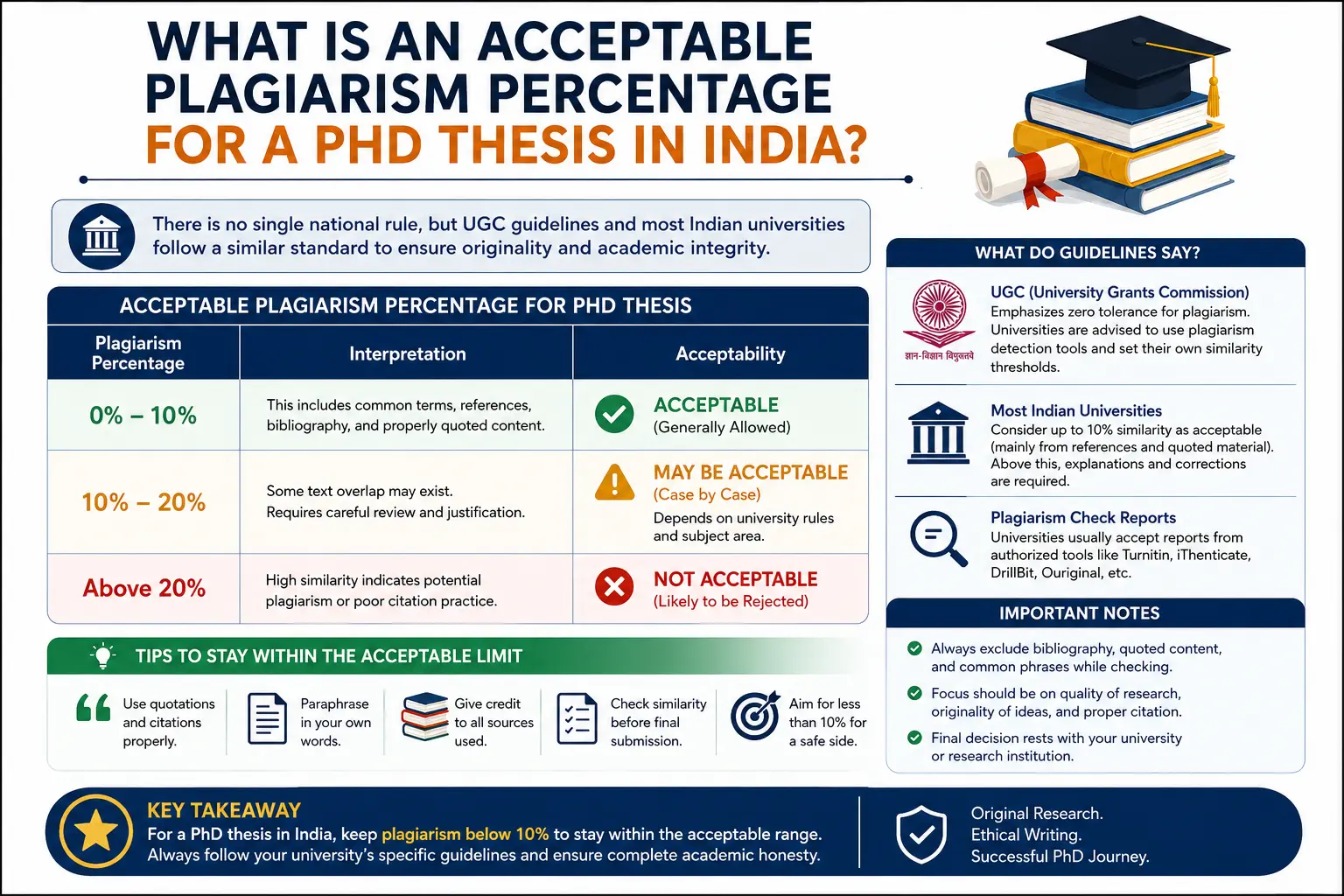
The acceptable plagiarism percentage for a PhD thesis in India depends on university policies, disciplinary requirements, and the context of the similarity report. While many institutions prefer similarity scores below 10–15%, there is no universal percentage that guarantees acceptance.
What matters most is not the numerical score but the quality of the research, proper citation practices, ethical writing, and original scholarly contribution. A thesis with moderate similarity and excellent referencing may be perfectly acceptable, whereas a thesis with low similarity but uncited copied content may still violate academic integrity standards.
PhD scholars should focus on understanding plagiarism, improving paraphrasing skills, citing sources accurately, and using plagiarism reports as tools for improvement rather than merely chasing lower percentages.
Ultimately, originality, transparency, and research integrity remain the true foundations of successful doctoral research.
Frequently Asked Questions (FAQs)
What is the acceptable plagiarism percentage for a PhD thesis in India?
Many universities prefer similarity scores below 10–15%, though requirements vary by institution.
Does UGC specify a fixed plagiarism percentage?
UGC provides regulations and plagiarism levels, but implementation may vary across universities.
Can a thesis with 15% similarity be accepted?
Yes, depending on the nature of the matches and university guidelines.
Is similarity the same as plagiarism?
No. Similarity indicates matching text, while plagiarism involves improper use of that content.
Can Turnitin detect self-plagiarism?
Yes. It can identify overlap with previously submitted or published work.
How can I reduce plagiarism in my thesis?
Use proper citations, improve paraphrasing, avoid copying text, and review plagiarism reports before submission.
Contact ThesisLikho Today
Call / WhatsApp: +91 96438 02216
Visit: ThesisLikho.com