
If you were taught that academic writing must always be passive — "the data was collected" instead of "I collected the data" — you were taught an outdated rule. Current academic style guidance has genuinely shifted, and understanding exactly when to use active versus passive voice in thesis writing will make your writing clearer, more direct, and more aligned with how examiners and journals actually expect to see it written today.
The Basic Difference
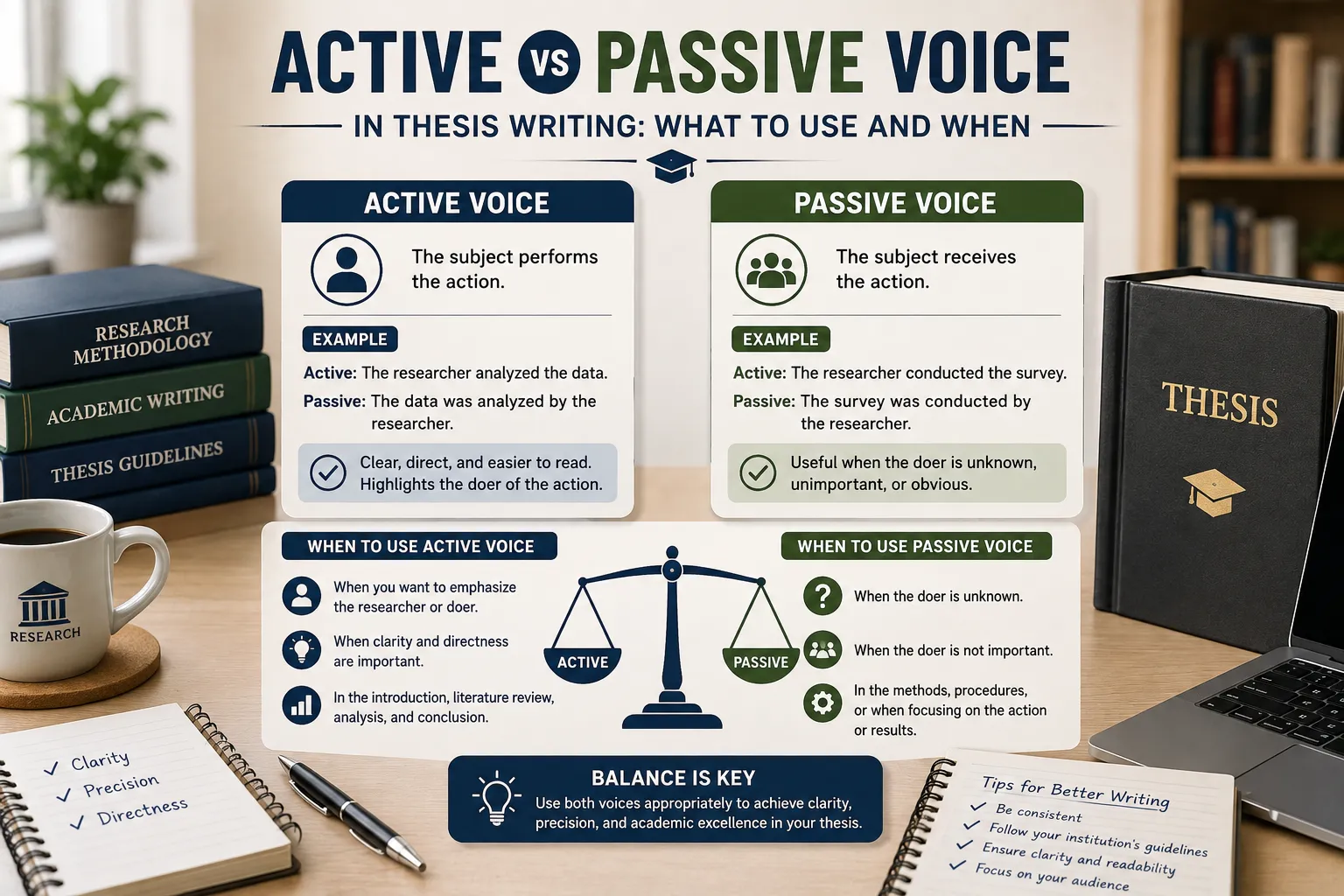
In active voice, the subject performs the action, following a straightforward structure: Subject + Verb + Object. "We measured the samples" is active — "we" is doing the measuring. In passive voice, the subject receives the action instead, with the actor optional or entirely omitted: Subject + form of "to be" + Past Participle (+ by + Actor). "The samples were measured" is passive — the sentence doesn't require naming who did the measuring at all.
Neither voice is a grammar error. The choice is stylistic, governed by disciplinary convention and by what you want to emphasize in a given sentence — not a fixed rule that always favors one over the other.
The Rule Has Genuinely Changed
APA Style (7th edition) explicitly states that writers should "use the active voice as much as possible to create direct, clear, and concise sentences," especially when writing about the actions of people. This is a significant, deliberate shift from older APA editions — and from what many current thesis writers may have been previously trained to believe about academic writing requiring passive voice throughout.
APA specifically supports using first-person pronouns — "I" or "we" — in active constructions, rather than avoiding them through impersonal passive phrasing. If your instinct is to avoid saying "I analyzed the results" in favor of "the results were analyzed," current APA guidance is directly telling you that instinct is outdated.
Why the Old Passive-Only Convention Existed — And Why It Changed
The traditional justification for passive voice throughout scientific writing was a belief that it creates objectivity by removing the researcher from the narrative — the idea that "the experiment was conducted" sounds more neutral and less subjective than "I conducted the experiment." This was long considered standard, especially in the sciences, but the consensus has now shifted substantially toward active voice as the default.
The practical reasons for this shift are genuinely compelling. Active voice reduces sentence length, eliminates unnecessary auxiliary verbs, makes clear who performed each action, and produces a more direct narrative flow. Readers — including peer reviewers and thesis examiners — process active sentences more quickly and with less cognitive effort, which also reduces the risk of ambiguity in your writing.
Where Passive Voice Still Genuinely Belongs
Despite this broad shift toward active voice, passive voice remains appropriate — and often still preferred — specifically in Methods sections, where the procedure itself is the focus rather than who performed it. This is a genuinely persistent exception reflected across current guidance, including APA Style and the author instructions of most high-impact journals. "Blood samples were collected at 0, 30, and 60 minutes" keeps the focus on the procedure, which is exactly the point in a methods description.
Section-by-Section Guidance for Your Thesis
Rather than picking one voice for your entire thesis, match your voice choice to what each section is actually doing:
Use active voice for:
- Your Introduction, when stating your study's aims ("This study examines the relationship between X and Y")
- Your Discussion and Conclusion sections, when interpreting your findings ("Our results suggest that...")
- Any sentence where the actor is genuinely important to the meaning — describing your own actions as the researcher, or the actions of specific participants in your study
Use passive voice for:
- Your Methods section specifically, where the procedure is the focus rather than the researcher ("Data were collected..." rather than "I collected data...")
- Parts of your Results section describing what was found, measured, or observed, where the object of study matters more than who was doing the observing
This section-by-section approach means most well-written theses genuinely mix both voices deliberately, rather than committing to one throughout — the mix itself is a sign of considered, purposeful writing, not inconsistency.
Use Active Voice to Be Specific About Who Did What
Active voice is specifically recommended for describing your own actions as the researcher — using "I" when referring to yourself alone, or "we" when part of a research group — and for recognizing the participants in your study, establishing clearly how research subjects completed specific actions. This specificity about who did what is one of active voice's core clarity advantages, and it's directly relevant whenever your thesis describes a step someone specifically took, rather than a general process.
How to Convert Passive Sentences to Active Voice
A practical, repeatable four-step process:
- Identify the actor — who or what is performing the action, often found in a "by" phrase or implied by context
- Move that actor to the subject position, at the start of the sentence
- Remove the auxiliary verb and use the main verb in its active form
- Place the original subject (now the object) after the verb
For example: "The data were analyzed by our team" becomes "Our team analyzed the data." The meaning is identical; the second version is shorter, clearer, and immediately tells the reader who did the analyzing.
Signs You're Writing in Passive Voice
While self-editing, watch for two specific signals:
- Past tense of "to be" combined with a past participle — "This study was conducted," "Findings were distributed"
- The verb preceding the actor, even when the actor is named — "The study was conducted by Rogers (2016)" should become "Rogers (2016) conducted the study," which places the actor in the subject position where active voice requires it
These two patterns are the fastest way to scan your own draft and flag sentences worth reconsidering.
Step-by-Step: Auditing Your Thesis for Voice
- Read through each chapter and identify its primary function (stating aims, describing procedure, reporting findings, interpreting results)
- Default to active voice for your Introduction, Discussion, and Conclusion chapters
- Allow — and expect — passive voice in your Methods section, and in parts of your Results describing measurements or observations
- Scan for the two passive voice signals (past "to be" + past participle; verb before actor) throughout your draft
- Apply the four-step conversion process to any passive sentence where the actor's identity genuinely matters to the meaning
- Confirm you're using "I" or "we" for your own actions as researcher, rather than avoiding first person through unnecessary passive phrasing
- Re-read each converted sentence to confirm the active version reads naturally, not awkwardly forced
Practical Checklist: Is Your Voice Usage Appropriate Throughout Your Thesis?
- Introduction uses active voice when stating the study's aims
- Methods section appropriately uses passive voice where the procedure is the focus
- Results section uses passive voice for measurements/observations, active voice where the researcher's specific action matters
- Discussion and Conclusion sections use active voice when interpreting findings
- First-person pronouns ("I," "we") are used naturally for the researcher's own actions, not avoided through unnecessary passive phrasing
- Passive sentences have been scanned for using the two key signals (past "to be" + participle; verb before actor)
- Any passive sentence where the actor's identity matters has been converted using the four-step process
- Overall voice usage reflects deliberate section-by-section choice, not a single voice applied uniformly throughout
Two Practical Scenarios
Scenario 1 — Converting an Overly Passive Discussion Section
A scholar's discussion chapter was written almost entirely in passive voice, including sentences like "It is suggested by these findings that managerial support influences retention." Reviewing current APA guidance, the scholar revised this and similar sentences to active voice: "These findings suggest that managerial support influences retention." The revised version was shorter, more direct, and matched current guidance for Discussion sections specifically favoring active voice when interpreting results.
Scenario 2 — Correctly Preserving Passive Voice in a Methods Section
A scholar, having just learned that active voice is now generally preferred, began converting their entire Methods section to active voice, including procedural descriptions like "We collected blood samples at 0, 30, and 60 minutes." After reviewing section-specific guidance, the scholar recognized this particular sentence was appropriately passive as originally written — "Blood samples were collected at 0, 30, and 60 minutes" — since the procedure itself, not the researcher performing it, was the actual point of the sentence, and reverted it back to passive voice.
Common Mistakes Thesis Writers Make With Voice
- Assuming academic writing must always be passive, based on an outdated convention that current style guides have explicitly moved away from.
- Converting Methods sections entirely to active voice, when passive remains appropriate and often preferred there specifically.
- Avoiding first-person pronouns entirely, when current APA guidance explicitly supports "I" and "we" in active constructions.
- Applying one voice uniformly throughout the entire thesis, rather than matching voice choice to each section's specific function.
- Missing passive voice signals during self-editing, particularly sentences where the verb precedes a named actor.
Frequently Asked Questions
What is the difference between active and passive voice in thesis writing, and when should each be used?
Active voice makes the subject perform the action and is now generally preferred for clarity and directness — especially in Introduction, Discussion, and Conclusion sections. Passive voice makes the subject receive the action and remains appropriate specifically in Methods sections, where the procedure is the focus rather than who performed it.
Why does the choice between active and passive voice matter for a thesis?
Overusing passive voice throughout an entire thesis, based on an outdated convention, can make writing longer, less direct, and harder for examiners to follow — while appropriately mixing both voices by section reflects current academic style guidance and improves overall clarity.
How does voice choice affect a thesis's overall readability?
Active voice reduces sentence length and cognitive load for the reader, while passive voice appropriately used in Methods and parts of Results keeps focus on procedure and findings rather than the researcher — using each in its right place produces clearer, more professional writing overall.
When should you use passive voice specifically in a thesis?
Primarily in your Methods section, where the procedure itself is the focus, and in parts of your Results section describing what was measured or observed, where the object of study matters more than who performed the observation.
Is professional help available for active vs passive voice in thesis writing?
Yes. ThesisLikho's PhD-qualified mentors have guided 10,000+ scholars through academic writing style review, voice and tone editing, and complete thesis writing assistance tailored to current style guide standards.
Get Expert Guidance on Your Thesis Writing Style
Getting voice usage right throughout your thesis — active where clarity and directness matter, passive where procedure is the focus — takes careful, section-by-section attention during editing. If you'd like expert input on reviewing your thesis's voice and overall academic style, ThesisLikho's PhD-qualified team offers writing style review, voice and tone editing, and complete thesis writing assistance. If you need expert guidance with your academic writing, style, or overall thesis structure, you can explore our Thesis Writing Assistance service.
Talk to a Thesis Expert → https://thesislikho.com/writing-services/thesis-writing
Email: support@thesislikho.com
Mobile No.: +91-9289068414 , +91-9643802216