Introduction
Artificial Intelligence (AI) has transformed academic research in unprecedented ways. From literature reviews and language editing to data analysis and content generation, AI-powered tools are becoming a part of the everyday workflow of researchers worldwide. In India, PhD scholars are increasingly using tools such as ChatGPT, Gemini, Claude, Grammarly AI, and other writing assistants to improve productivity and academic writing quality.
However, as AI usage grows, universities, journals, supervisors, and research institutions have become more cautious about maintaining academic integrity. This has led to the widespread adoption of AI detection tools designed to identify whether portions of a research paper were generated by artificial intelligence.
For Indian PhD scholars in 2026, understanding AI detection has become just as important as understanding plagiarism. A thesis, dissertation, journal article, or conference paper flagged for excessive AI-generated content can lead to delays, revisions, rejection, or even disciplinary action in some cases.
This guide explains everything Indian researchers need to know about AI detection, how it works, its limitations, and how to use AI responsibly without risking their academic reputation.
What Is AI Detection?
AI detection refers to the process of analyzing a piece of text to determine whether it was written by a human or generated by an AI system.
Unlike plagiarism detection, which compares text against existing sources, AI detection tools look for patterns commonly found in machine-generated writing.
These tools evaluate factors such as:
- Sentence structure
- Predictability of language
- Vocabulary patterns
- Repetition
- Writing consistency
- Probability distributions of words
The result is usually a percentage score indicating how likely the text is to have been generated by AI.
For example, a report may state:
- 5% AI-generated: Likely human-written
- 40% AI-generated: Mixed content
- 90% AI-generated: Strong AI indicators
However, these scores are not always accurate and should be interpreted carefully.
Why AI Detection Matters for Indian PhD Scholars
Indian universities are becoming increasingly aware of AI-related academic challenges.
Several institutions now require:
- Original research writing
- Ethical AI disclosure
- Plagiarism checks
- Academic integrity declarations
In 2026, many supervisors and journals use AI detection software alongside plagiarism detection tools before approving submissions.
Reasons include:
Maintaining Academic Integrity
A PhD is expected to represent the scholar's independent intellectual contribution.
Excessive reliance on AI-generated writing may raise concerns about originality.
Ensuring Research Authenticity
Universities want to verify that research findings, interpretations, and discussions genuinely reflect the scholar's understanding.
Preventing Misconduct
AI can sometimes fabricate references, generate incorrect facts, or create misleading interpretations.
Detection tools help institutions identify potentially problematic sections.
Meeting Journal Requirements
Many international journals now require authors to disclose AI usage during manuscript submission.
Failure to comply can result in rejection.
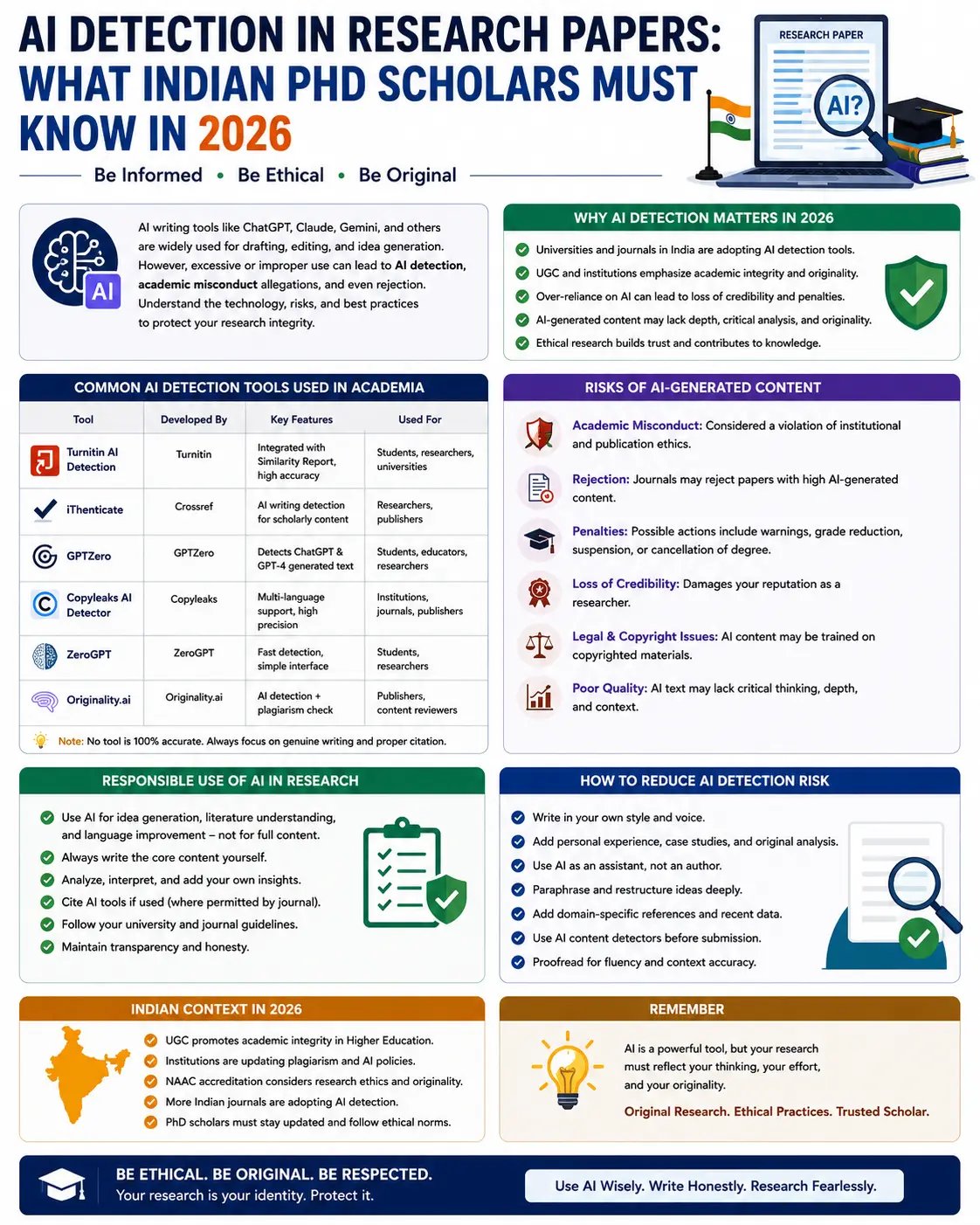
Popular AI Detection Tools Used in 2026
Many academic institutions and publishers use AI detection software.
Turnitin AI Writing Detection
Turnitin remains one of the most widely used tools in universities.
Features include:
- AI-generated text estimation
- Integration with plagiarism reports
- Academic-focused analysis
- Institutional access
Many Indian universities now use Turnitin for thesis evaluation.
GPTZero
GPTZero was specifically designed to detect AI-generated text.
It evaluates:
- Perplexity
- Burstiness
- Writing variability
Researchers often use it for self-checking before submission.
Copyleaks AI Detector
Copyleaks has gained popularity among journals and institutions.
It supports:
- Multiple languages
- Academic documents
- AI content analysis
Originality.ai
Originally developed for publishers and content creators, it is now used in academic environments as well.
Writer AI Detector
A simple tool that estimates AI-generated content percentages.
How AI Detection Tools Actually Work
Many scholars believe AI detectors can perfectly identify AI-written content.
This is not true.
Most tools rely on statistical analysis.
Perplexity
Perplexity measures how predictable a text is.
AI-generated content tends to be highly predictable because language models choose statistically likely words.
Example:
"Research is important because it helps generate knowledge."
This sentence is highly predictable.
Human writers often introduce unique phrasing and variation.
Burstiness
Burstiness measures sentence variation.
Humans naturally mix:
- Short sentences
- Long sentences
- Complex ideas
- Informal transitions
AI-generated content often maintains a consistent style.
Pattern Recognition
AI detectors identify repetitive linguistic structures commonly produced by language models.
Examples include:
- Repetitive transitions
- Uniform paragraph lengths
- Predictable conclusions
- Formulaic explanations
Can AI Detection Tools Make Mistakes?
Yes. AI detectors are far from perfect.
False positives and false negatives occur regularly.
False Positives
A false positive happens when human-written content is incorrectly identified as AI-generated.
This often affects:
- Non-native English speakers
- Academic writing
- Technical papers
- Structured reports
Indian PhD scholars are particularly vulnerable because academic writing tends to follow formal patterns.
False Negatives
A false negative occurs when AI-generated content passes as human-written.
Edited AI content often becomes difficult to detect accurately.
Challenges for Indian Researchers
Language Style Issues
Many Indian scholars write in highly formal English.
Unfortunately, AI detectors often associate formal language with machine-generated text.
Technical Writing Patterns
Research papers naturally follow standardized structures:
- Introduction
- Literature Review
- Methodology
- Results
- Discussion
These sections can appear algorithmic even when written by humans.
Disciplinary Differences
Fields such as:
- Engineering
- Computer Science
- Physics
- Mathematics
often use concise and predictable language, increasing false AI detection risks.
What Happens If Your Thesis Gets Flagged?
Being flagged does not automatically mean misconduct.
Most universities investigate further.
Possible outcomes include:
Request for Clarification
Supervisors may ask how AI tools were used.
Revision Requirement
You may need to rewrite sections identified as highly AI-generated.
Additional Review
The department may conduct a manual assessment.
Documentation Request
Researchers may be asked to provide:
- Draft versions
- Notes
- Research logs
- Writing history
Maintaining records of your writing process is becoming increasingly important.
Acceptable Use of AI in Research Writing
Most institutions do not completely ban AI.
Instead, they encourage responsible use.
Generally acceptable uses include:
Grammar Checking
Using AI to improve grammar and sentence structure.
Language Refinement
Improving clarity and readability.
Brainstorming
Generating research ideas and discussion points.
Outline Creation
Developing article structures and chapter frameworks.
Summarization
Condensing large volumes of literature for understanding.
These applications assist the researcher rather than replace them.
Unacceptable Use of AI
Problems arise when AI becomes the primary author.
Examples include:
Writing Entire Chapters
Submitting AI-generated chapters without substantial human contribution.
Generating Fake References
AI frequently invents citations.
Including fabricated references can seriously damage credibility.
Creating Research Findings
AI should never generate research results.
Writing Discussion Sections Without Verification
Research interpretation must come from the scholar.
How to Use AI Safely During Your PhD
Use AI as an Assistant, Not an Author
Treat AI as a productivity tool.
Your intellectual contribution should remain central.
Verify Every Statement
Always cross-check:
- Facts
- Statistics
- Citations
- References
Never trust AI-generated information blindly.
Keep Research Notes
Maintain:
- Drafts
- Literature review notes
- Data analysis records
- Revision histories
These documents demonstrate genuine authorship.
Edit Thoroughly
If AI helps generate text:
- Rewrite it
- Add personal insights
- Incorporate research findings
- Modify structure
Human editing significantly improves authenticity.
Follow University Policies
Different institutions have different AI guidelines.
Always check:
- University regulations
- Departmental policies
- Journal requirements
before submission.
AI Disclosure: A Growing Requirement in 2026
Many publishers now require authors to disclose AI usage.
Typical disclosure examples include:
"The author used AI-assisted language editing tools to improve grammar and readability. All interpretations, analyses, and conclusions remain the author's original work."
Transparency is becoming a standard academic expectation.
Future of AI Detection in Indian Higher Education
By 2026 and beyond, AI detection is expected to become more sophisticated.
Emerging trends include:
Integrated Academic Integrity Platforms
Future systems may combine:
- Plagiarism detection
- AI detection
- Citation verification
- Reference authentication
AI Usage Disclosure Frameworks
Universities may require standardized AI declarations.
Research Process Verification
Institutions may increasingly evaluate:
- Draft histories
- Research notebooks
- Data collection records
rather than relying solely on detection scores.
Balanced AI Policies
Most experts believe the future lies in responsible AI use rather than outright prohibition.
Best Practices for Indian PhD Scholars in 2026
To stay safe and maintain academic credibility:
- Use AI for assistance, not authorship.
- Verify all AI-generated content.
- Maintain detailed research records.
- Rewrite and personalize AI-assisted text.
- Follow university guidelines.
- Disclose AI usage when required.
- Never fabricate references.
- Keep multiple draft versions.
- Prioritize original thinking.
- Consult supervisors about acceptable AI use.
Conclusion
Artificial Intelligence is reshaping academic research, and Indian PhD scholars can benefit greatly from its capabilities. However, AI detection tools are becoming a standard part of thesis evaluation, journal publishing, and academic quality assurance.
The key is not avoiding AI altogether but using it responsibly and ethically. Universities and publishers are increasingly focused on transparency, originality, and intellectual contribution rather than simply detecting AI-generated text.
A successful PhD in 2026 will require scholars to balance technological assistance with genuine academic effort. Researchers who understand AI detection, follow ethical practices, and maintain clear authorship records will be well-positioned to thrive in the evolving research landscape.
Ultimately, your ideas, analysis, methodology, and critical thinking—not AI—should remain the foundation of your research journey.
Frequently Asked Questions (FAQs)
Can Indian universities detect AI-written thesis content?
Yes. Many universities use AI detection tools such as Turnitin AI Detection and other academic integrity platforms.
Will AI-generated text automatically lead to thesis rejection?
Not necessarily. Institutions usually conduct manual reviews and consider the extent and purpose of AI usage.
Is using ChatGPT for grammar correction allowed?
In most cases, yes. Grammar improvement and language editing are generally considered acceptable uses of AI.
Can AI detectors be 100% accurate?
No. AI detection tools can produce false positives and false negatives.
Should PhD scholars disclose AI usage?
Increasingly, yes. Many journals and universities encourage or require disclosure of AI-assisted writing support.
What is the safest way to use AI during a PhD?
Use AI for brainstorming, language improvement, and organization while ensuring that all research ideas, analysis, interpretations, and conclusions remain your own original work.
Contact ThesisLikho Today
Call / WhatsApp: +91 96438 02216
Visit: ThesisLikho.com