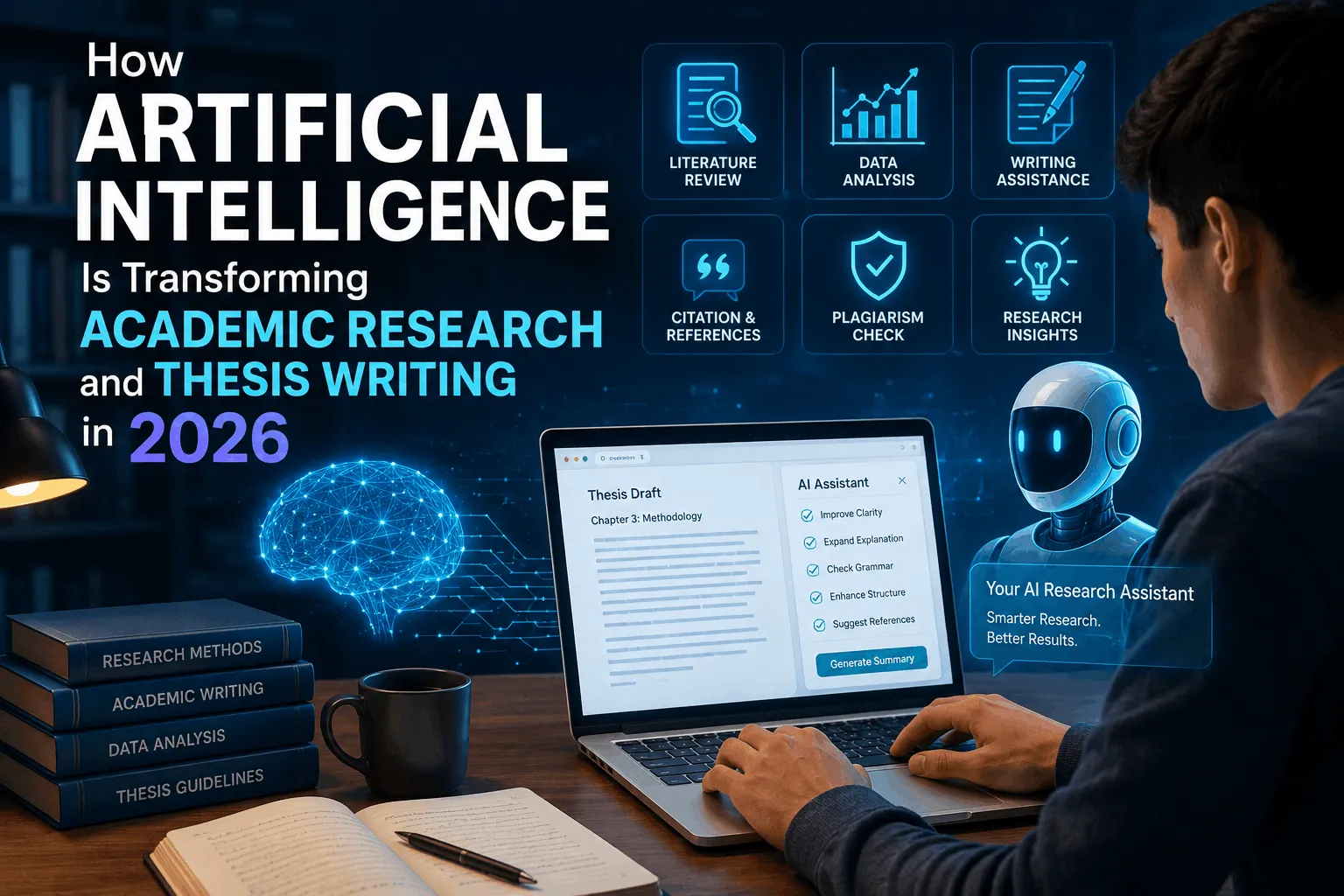
Three years ago, using AI in academic work meant quietly asking ChatGPT to fix a clunky sentence and hoping nobody noticed. In 2026, that world barely exists anymore. Surveys of UK undergraduates now put AI use for assessed academic work at 94%, and the conversation among researchers, supervisors, and publishers has shifted almost entirely — from whether AI belongs in scholarship to how it should be disclosed, verified, and governed. AI in academic research now touches nearly every stage of the doctoral and research lifecycle: finding relevant literature across millions of papers, drafting outlines and full sections, checking statistical choices, and even flagging weaknesses in an argument before a supervisor or reviewer does. At the same time, AI for thesis writing has introduced genuinely new risks — fabricated citations, blurred authorship, and university integrity policies that are rewriting themselves month to month. This article walks through exactly how artificial intelligence is changing academic research and thesis writing in 2026, which uses are broadly accepted, which carry real risk, and how to build a workflow that gets the productivity benefits without gambling your academic standing.
How Is AI Transforming Academic Research and Thesis Writing? A Direct Answer First
Artificial intelligence is transforming academic research and thesis writing by compressing tasks that once took weeks — literature discovery, evidence synthesis, first-draft structuring, and citation management — into hours, while simultaneously forcing universities, publishers, and funders to build entirely new disclosure and verification systems around AI use. Researchers now commonly use AI research tools to search across hundreds of millions of peer-reviewed papers by concept rather than exact keyword, extract and compare findings across dozens of studies at once, and generate structured first drafts of literature reviews or thesis chapters that a human then verifies, restructures, and takes ownership of. The transformation isn't simply "AI writes your thesis" — in almost every legitimate framework, AI functions as an accelerant for research tasks that still require human judgment, verification, and final responsibility for accuracy and originality.
This distinction matters enormously in 2026, because it's also exactly where most of the risk and most of the policy activity is concentrated. The shift from a near-universal "AI is prohibited" stance to a "undisclosed AI use is the actual violation" standard has become the dominant policy model at research universities worldwide, meaning the central question for any PhD student or researcher today isn't whether AI use is allowed, but whether you can specifically say what you used, for what purpose, and confirm you've verified the output yourself.
AI Research Tools Are Changing How Literature Reviews Get Built
Literature review used to mean manually reading, note-taking, and cross-referencing a stack of papers large enough to genuinely threaten a thesis timeline — and the sheer volume of new research being published each year has made that manual approach increasingly unsustainable on its own. AI-powered discovery and synthesis tools now let researchers search across large peer-reviewed corpora by describing a concept or research question in plain language, rather than relying purely on exact keyword matches, and then extract and compare specific findings, methods, or claims across many papers simultaneously.
This matters most in the earliest, most overwhelming stage of doctoral research: figuring out what's already been studied and where the genuine gaps are. Tools built specifically for evidence extraction can pull out sample sizes, methodologies, and reported effect sizes from dozens of papers into a single comparison view, which used to require hours of manual spreadsheet-building. The practical benefit isn't that AI replaces critical reading — a researcher still has to interpret whether a claim is well-supported, contextually relevant, and methodologically sound — but it dramatically reduces the volume of purely mechanical searching and cross-referencing that used to consume weeks of otherwise unproductive time.
The tooling landscape itself has also consolidated meaningfully. Where researchers in 2024 commonly stitched together five or six separate point tools for discovery, note-taking, citation management, and writing, the more common 2026 pattern is a single integrated research workspace supplemented by one or two specialized free tools — a shift researchers report saves several hours a week simply by eliminating repeated uploading and re-formatting of the same papers across disconnected platforms.
What AI Research Tools Are Genuinely Good At — and Where They Fall Short
Literature Discovery: AI research tools can quickly identify conceptually related studies, even when they don't share the exact keywords used in your search. However, you should always verify whether each paper is truly relevant to your research question and evaluate its methodology, quality, and credibility before relying on it.
Evidence Extraction: AI can rapidly extract information such as sample sizes, research methods, key findings, and study characteristics into organized comparison tables. Even so, every extracted figure, statistic, and conclusion should be checked against the original research paper to ensure accuracy.
Drafting Outlines and Initial Content: AI is highly effective at generating structured outlines, summaries, and first drafts based on the information you provide. However, researchers must verify every claim, interpretation, and argument to ensure the final content is accurate, original, and academically sound.
Citation Management: AI tools can automatically insert citations and organize references when connected to reliable literature databases. Nevertheless, authors should confirm that every citation refers to a real publication, is correctly attributed, and genuinely supports the statement being cited.
Grammar and Clarity Editing: AI can significantly improve grammar, sentence structure, readability, and overall writing flow in a matter of seconds. Before accepting these edits, carefully review the text to ensure that technical terminology, scientific meaning, and research nuances have not been unintentionally altered.
Data Pattern Detection: AI can efficiently identify trends, anomalies, and potential relationships within large datasets, helping researchers uncover patterns that deserve further investigation. However, any statistical conclusions or interpretations should always be validated using appropriate analytical methods and sound research methodology before being included in a publication.
AI for Thesis Writing: From Blank Page to Structured First Draft
For many PhD students, the hardest part of writing a chapter isn't the ideas — it's the blank page and the intimidating question of how to structure months of research into a coherent argument. AI for thesis writing tools now directly address this by generating structured outlines, full first-draft sections, or even reorganized versions of existing rough writing based on a research question and supporting source material. Some platforms can now produce lengthy first-draft documents with citations applied from a linked academic corpus and direct compatibility with tools like LaTeX, Overleaf, and Zotero that many doctoral students already use for formatting and reference management.
Used well, this genuinely changes the psychology of drafting: instead of confronting an empty document, a student edits, restructures, and strengthens an imperfect but complete starting point — a task most people find considerably less paralyzing than generating original text from nothing. AI drafting and editing tools can also identify gaps in an argument, inconsistent terminology, or unclear transitions between sections, functioning similarly to an always-available first-pass editor before a chapter ever reaches a supervisor.
The risk sits precisely where the line between "drafting assistance" and "content generation" gets blurry, and this is exactly where most current university and publisher policies focus their disclosure requirements. A materially AI-generated section that a student edits lightly and submits as fully original work is treated very differently, under nearly every current institutional policy, than a student using AI to restructure their own already-written material for clarity. Understanding — and honestly documenting — which category your own use falls into is one of the single most important practical skills for a PhD student working with these tools in 2026.
The New Reality of AI Disclosure Policies in Higher Education
AI in higher education policy has moved through several distinct phases in a remarkably short time. What began, in the earliest period after generative AI tools became widely available, as a near-universal instinct toward outright prohibition has evolved into a fragmented, institution-by-institution and often course-by-course patchwork — ranging from strict bans in certain departments to mandatory AI-literacy requirements in others. Research tracking policy at leading global universities found that the vast majority updated their AI-related academic integrity policies within just the past year and a half, reflecting how quickly institutional thinking has had to adapt.
The clearest throughline across this fragmented landscape is the shift toward disclosure as the central enforcement mechanism, replacing blanket prohibition as the default assumption. Under this model, using AI isn't automatically a violation — failing to disclose substantive AI use is. For thesis and dissertation work specifically, a growing number of graduate policies now require a formal disclosure statement identifying which tools were used, the nature and extent of that use, and which specific sections or tasks were affected, alongside an explicit student affirmation of responsibility for the accuracy and originality of the final submission.
This has real practical implications for how a PhD student should be working day to day, not just what they write in a disclosure paragraph at submission. Universities increasingly expect students to be able to reconstruct their process if asked — which means keeping drafts, version history, and even AI chat logs or prompts as a matter of routine practice, not just when a problem arises. Notably, some of the more carefully written institutional policies explicitly state that allegations of AI misuse should be evaluated using the full context of available evidence rather than relying on automated AI-detection software alone, in direct response to documented concerns about detector reliability.
A Practical Disclosure Checklist for PhD Students
Building disclosure habits into your regular workflow, rather than reconstructing them under pressure at submission time, is the single most protective practice available to any student using AI tools in their research.
- Keep a running log of which AI tools you used, for which specific tasks, and roughly when
- Save drafts and version history at meaningful stages, not just a final polished version
- Distinguish clearly between grammar/clarity assistance and substantive content generation in your own notes
- Check your specific program's, department's, or target journal's current AI policy before relying heavily on any tool — policies vary significantly even within the same university
- Verify every AI-suggested citation against the actual source before it enters your reference list
- When in doubt about whether a specific use requires disclosure, ask your supervisor or graduate coordinator directly rather than guessing
The Real Risks: Citation Fabrication, Detection Limits, and Overreliance
The single most serious, well-documented risk in AI-assisted academic writing is citation fabrication — AI tools generating references to studies that sound plausible but don't actually exist, or misattributing real findings to the wrong source. A recent large-scale audit of PubMed-indexed papers found that roughly one in every 277 papers published in early 2026 referenced a nonexistent study, a finding significant enough that publishers have since increased scrutiny of citation verification as part of standard submission review. This risk is exactly why AI research tools that ground citations in a real, searchable corpus of papers are meaningfully safer to rely on than general-purpose language models generating references purely from training data — but even corpus-grounded tools still require a human to verify that a cited claim actually says what the AI claims it says.
AI-detection software carries its own well-documented limitations that are important for both students and supervisors to understand. False positives — legitimate, human-written work incorrectly flagged as AI-generated — affect a meaningful share of submissions, with non-native English speakers disproportionately affected due to detectors' tendency to flag simpler or more formulaic sentence structures as suspicious. This is a major reason the more carefully constructed 2026 institutional policies now explicitly discourage relying on detection software alone as evidence of misconduct, favoring a fuller evidentiary review that includes drafts, version history, and direct conversation with the student.
Beyond fabrication and detection issues, the subtler long-term risk is overreliance — using AI so extensively for synthesis and drafting that a researcher's own critical engagement with the literature and their own argument genuinely thins out. Guidance from major research universities increasingly names this explicitly: AI use should accelerate a researcher's own thinking and verification process, not substitute for it, and unpredictability, bias, and factual inconsistency remain real, current limitations of these tools rather than solved problems. Attempting to disguise AI-generated content to evade detection — sometimes marketed as "humanizing" a draft — is a practice worth actively avoiding rather than adopting; it addresses the appearance of a problem rather than the substance of it, and it sits squarely within the undisclosed-use violations that current institutional policies are specifically designed to catch.
How Universities and Publishers Are Adapting
Academic publishers have moved quickly to formalize AI disclosure requirements, and by 2026 major publishers including Elsevier, Springer Nature, Wiley, Taylor & Francis, and Nature Portfolio all require authors to disclose AI tool use in manuscript preparation, specifying which tool was used, for what purpose, and confirming that authors have reviewed and take responsibility for all AI-assisted content. Requirements typically scale with the significance of the AI's role — grammar polishing generally requires lighter disclosure than AI involvement in data analysis, figure generation, or substantive interpretive writing.
Universities are similarly building AI use directly into graduate training rather than treating it as a peripheral compliance issue. Several research-intensive institutions have introduced mandatory AI-literacy requirements for graduate students, reflecting an emerging consensus that understanding these tools' capabilities and limitations is now a core research skill rather than an optional convenience. At the same time, policies increasingly vary meaningfully by department, course, and even individual assessment within the same institution — a genuinely important practical point, since a policy permitting AI-assisted brainstorming at the university level may still explicitly prohibit AI-generated text in thesis chapters, exams, or grant materials at the departmental level.
Comparing Common AI Policy Models Across Institutions
Disclosure-Based Policy (Most Common in 2026): Many universities now allow students and researchers to use AI tools for academic work, provided that the use of AI is clearly disclosed according to institutional guidelines. However, using AI to generate substantial portions of assessed coursework or a thesis without disclosure is typically prohibited.
Course- or Assessment-Level Policy: Some institutions leave AI decisions to individual instructors or departments. In these cases, the rules may differ from one course, assignment, or assessment to another. Students should review the specific AI policy for each course instead of assuming the same rules apply across the entire institution.
Mandatory AI Literacy Policy: A growing number of universities require students to complete AI literacy training and encourage responsible use of AI tools as part of their academic development. While AI use is generally permitted, students are expected to understand the technology's limitations and critically evaluate all AI-generated content rather than accepting it without verification.
Strict Prohibition Policy: Although becoming less common, some universities and departments still prohibit the use of generative AI in assessed academic work. Under these policies, students may not use AI for drafting, analysis, or other substantive academic tasks, even if they disclose its use. It is therefore essential to review your institution's academic integrity guidelines before using AI in coursework or thesis writing.
Practical Best Practices for Using AI Responsibly in Your Research
Building a genuinely responsible AI workflow starts with treating verification as a non-negotiable step rather than an afterthought squeezed in before submission. Every AI-suggested citation deserves an actual check against the original source, every AI-drafted claim deserves confirmation that it accurately reflects what the underlying literature says, and every AI-assisted section deserves close enough personal engagement that you could confidently explain and defend it in a viva or committee meeting without hesitation.
Equally important is treating your specific institution's and target journal's policies as the actual governing rules, rather than assuming a general industry norm applies uniformly. Because policies vary meaningfully by department, course, and even individual supervisor within the same university, checking directly — and asking your graduate coordinator or supervisor when genuinely uncertain — is far safer than assuming permissiveness or prohibition based on what you've read generally. Building disclosure and documentation into your regular workflow, rather than reconstructing it retroactively under pressure, protects you considerably if a question about your process ever arises later.
Finally, it's worth holding onto the deeper reason these best practices matter: a thesis or research paper is ultimately meant to demonstrate your own scholarly capability, not the capability of the tools you used to produce it. AI in academic research is a genuinely powerful accelerant for the mechanical and organizational burden of scholarship — but the critical thinking, original argument, and final responsibility for accuracy remain, appropriately, yours.
Frequently Asked Questions
How is AI transforming academic research and thesis writing?
AI is transforming academic research primarily by compressing time-intensive tasks — literature discovery across huge volumes of published work, evidence extraction and comparison, first-draft structuring, and citation management — from weeks into hours. At the same time, it's reshaping institutional policy, shifting the dominant standard from prohibiting AI outright to requiring disclosure of substantive use, while leaving critical thinking, verification, and final responsibility for accuracy squarely with the human researcher.
Is it acceptable to use AI for my PhD thesis?
In most institutions as of 2026, yes, with important conditions. The dominant policy model has shifted from blanket prohibition toward requiring disclosure — meaning AI use itself typically isn't a violation, but undisclosed substantive use is. Policies vary significantly by university, department, and even individual course or supervisor, so checking your specific institution's current guidance and disclosing clearly is essential rather than assuming a general rule applies.
What are the best AI research tools for literature reviews?
Rather than any single "best" tool, most 2026 workflows combine a small number of specialized platforms: one for concept-based literature discovery across large academic databases, one for reference management, and one for evidence extraction and comparison across multiple papers. Free options like Semantic Scholar for discovery and Zotero for reference management remain popular starting points, while integrated paid platforms increasingly consolidate discovery, extraction, and citation management into a single workspace to reduce time lost to repeated uploading across separate tools.
Can AI fabricate citations or references?
Yes, and this is one of the most serious documented risks of AI-assisted academic writing. General-purpose AI models can generate references to studies that sound plausible but don't actually exist, or misattribute real findings to the wrong source — a recent large-scale audit found this occurring in a meaningful share of recently published papers. Tools that ground citations in a real, searchable academic corpus are considerably safer, but every AI-suggested citation still needs manual verification against the original source before it's included in your reference list.
Do AI detection tools reliably catch AI-generated academic writing?
No, not reliably enough to serve as standalone evidence. AI detectors carry meaningful false-positive rates, disproportionately flagging legitimate work from non-native English speakers whose writing patterns can resemble what detectors associate with AI generation. This limitation is exactly why the more carefully constructed 2026 institutional policies explicitly caution against relying on detection software alone, instead calling for review of the fuller context — drafts, version history, and direct discussion with the student.
What should an AI disclosure statement in a thesis include?
A proper AI disclosure statement should identify which specific AI tools were used, describe the nature and extent of that use (for example, grammar editing versus literature summarization versus content drafting), specify which sections or tasks were affected, and include an explicit affirmation that the student reviewed and takes responsibility for the accuracy and originality of the final submitted work. Requirements vary by institution, so it's worth confirming your specific program's exact expectations rather than relying on a generic template.
How can I use AI for thesis writing without risking academic integrity violations?
Treat verification as non-negotiable — check every AI-suggested citation, claim, and argument against the original source rather than trusting output at face value. Keep a running record of which tools you used for which tasks as you go, rather than reconstructing this after the fact, and check your specific department's or journal's current policy before relying heavily on any one tool, since policies vary meaningfully even within the same institution. When genuinely uncertain whether a specific use requires disclosure, ask your supervisor or graduate coordinator directly.
Are university AI policies the same across all departments?
No — this is one of the most important and frequently misunderstood aspects of AI in higher education policy in 2026. A university-level policy permitting AI-assisted brainstorming may coexist with a department-level or course-level policy that explicitly prohibits AI-generated text in thesis chapters, exams, or grant materials. Always check the policy at the most specific level relevant to your actual task — course, department, or supervisor — rather than assuming a general institutional statement covers every situation.
Will using AI tools make my research faster but lower quality?
Not inherently, but this depends entirely on how the tools are used. Used to accelerate mechanical, time-intensive tasks — literature discovery, cross-referencing, first-draft structuring — while a researcher still applies genuine critical judgment and verification, AI tools can meaningfully increase productivity without sacrificing rigor. Used as a substitute for that critical engagement, quality risk rises significantly, which is exactly the overreliance concern that current research-university guidance explicitly warns against.
What's the difference between using AI for grammar checking versus content generation?
Grammar and clarity editing — fixing sentence structure, tone, and readability without altering the underlying argument or content — is treated leniently by most 2026 institutional and publisher policies, often requiring minimal or no disclosure. Substantive content generation — AI drafting original arguments, analysis, or interpretive text — sits in a much higher-risk category requiring explicit disclosure under nearly every current framework, and using it without disclosure is precisely the kind of undisclosed substantive use that current policies are built to identify.
Should I ask my supervisor before using AI tools in my research? Yes, and doing so early tends to prevent far more problems than it creates. Policies vary significantly even within a single university, and a supervisor can clarify not just what's formally permitted but what they personally expect for feedback, drafting, and disclosure within your specific working relationship. This conversation is also a low-cost way to demonstrate the kind of transparency that current AI academic integrity frameworks are specifically designed to reward.
Conclusion
AI in academic research and AI for thesis writing have moved, in a remarkably short span, from a quiet workaround to a formally governed, disclosure-based part of how serious scholarship gets done. Used well, these tools genuinely compress the mechanical burden of literature discovery, evidence synthesis, and first-draft structuring — freeing up time and energy for the critical thinking, argument-building, and original contribution that a thesis or research paper is actually meant to demonstrate. Used carelessly, they introduce real risks: fabricated citations, blurred authorship, and integrity violations that current university and publisher policies are increasingly well-equipped to identify. The researchers and PhD students navigating this landscape most successfully in 2026 aren't the ones avoiding AI altogether or using it uncritically — they're the ones building verification, honest disclosure, and clear personal understanding of every AI-assisted claim into their regular workflow from the very start.