
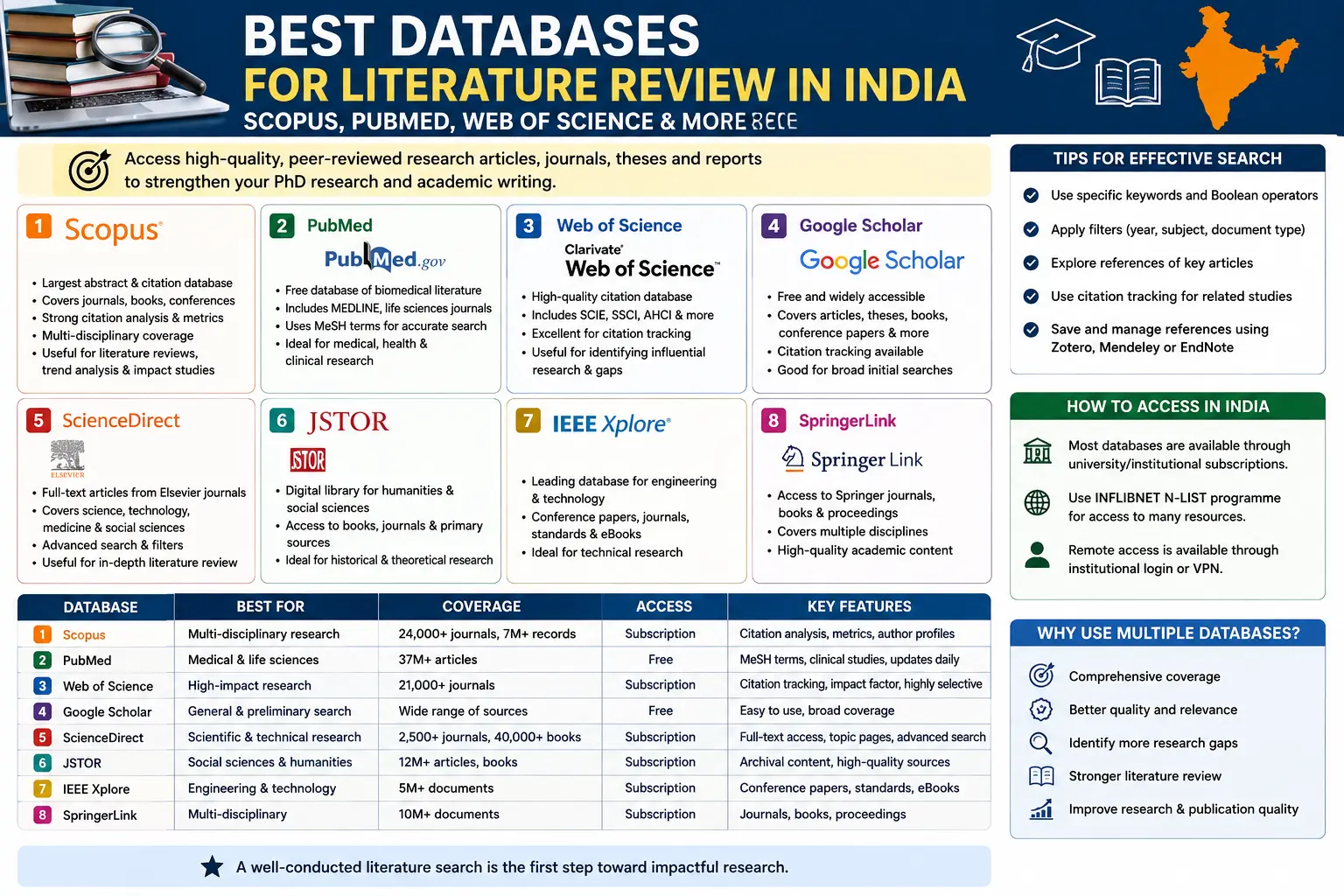
Introduction
A strong literature review is the foundation of every successful research project. Whether you are writing a PhD thesis, dissertation, journal article, conference paper, or research proposal, the quality of your literature review largely depends on the quality of the sources you use.
One of the most common mistakes made by research scholars is relying solely on random Google searches to find academic literature. While search engines can be useful, they often miss high-quality peer-reviewed research that is available through specialized academic databases.
For PhD scholars, faculty members, postgraduate students, and independent researchers in India, understanding how to use academic databases effectively is essential. These databases provide access to scholarly journals, conference proceedings, books, theses, systematic reviews, and citation information that can significantly improve the quality and credibility of research.
In this comprehensive guide, you will learn:
- What academic databases are
- Why databases matter for literature reviews
- The best databases for researchers in India
- Features of Scopus, PubMed, Web of Science, and other databases
- How to choose the right database
- Search strategies for effective literature reviews
- Common mistakes to avoid
- Best practices for PhD scholars
What Is an Academic Database?
An academic database is a digital platform that stores and organizes scholarly publications.
These databases allow researchers to search for:
- Journal articles
- Conference papers
- Books
- Book chapters
- Theses and dissertations
- Government reports
- Systematic reviews
- Research datasets
Unlike general search engines, academic databases focus on credible and scholarly sources.
Why Are Databases Important for Literature Reviews?
A literature review should be based on reliable, peer-reviewed, and relevant research.
Academic databases help researchers:
Access High-Quality Research
Most indexed journals undergo peer review.
Save Time
Advanced search filters improve efficiency.
Identify Research Gaps
Researchers can explore existing evidence systematically.
Track Citations
Citation analysis helps identify influential studies.
Improve Publication Success
Using credible sources strengthens manuscripts and theses.
What Makes a Good Research Database?
Before selecting a database, consider the following factors:
Coverage
Does the database cover your discipline?
Quality of Sources
Are journals peer-reviewed?
Search Features
Does it offer advanced filtering options?
Citation Tracking
Can you track citations and impact?
Accessibility
Can Indian researchers access the content through their institutions?
1. Scopus
Overview
Scopus is one of the world's largest abstract and citation databases for scholarly literature.
It is widely used by universities, researchers, publishers, and ranking agencies.
What Scopus Covers
Scopus indexes:
- Journals
- Conference proceedings
- Books
- Book chapters
- Trade publications
Across disciplines such as:
- Engineering
- Medicine
- Social Sciences
- Business
- Computer Science
- Environmental Science
Advantages of Scopus
Extensive Coverage
Indexes thousands of journals worldwide.
Citation Analysis
Researchers can analyze:
- Citation counts
- h-index
- Author impact
Advanced Search Features
Powerful filters improve search precision.
Research Trends
Useful for identifying emerging research areas.
Best For
- PhD thesis literature reviews
- Citation analysis
- Bibliometric studies
- Research impact assessment
2. PubMed
Overview
PubMed is one of the most trusted databases in health and medical sciences.
Maintained by the U.S. National Library of Medicine, it provides free access to millions of biomedical records.
What PubMed Covers
Areas include:
- Medicine
- Nursing
- Public Health
- Pharmacy
- Dentistry
- Life Sciences
- Healthcare Management
Advantages of PubMed
Free Access
Accessible without subscription.
Evidence-Based Research
Widely used in systematic reviews.
Medical Subject Headings (MeSH)
Improves search accuracy.
Regular Updates
New studies are added frequently.
Best For
- Medical research
- Healthcare studies
- Clinical research
- Public health literature reviews
3. Web of Science (WoS)
Overview
Web of Science is a leading citation database known for indexing high-impact journals.
It is often used alongside Scopus.
What Web of Science Covers
Includes:
- Science Citation Index
- Social Sciences Citation Index
- Arts & Humanities Citation Index
Advantages of Web of Science
High-Quality Journals
Focuses on reputable publications.
Citation Tracking
Excellent citation network analysis.
Research Performance Evaluation
Used in university rankings and assessments.
Historical Coverage
Provides access to older scholarly records.
Best For
- Citation analysis
- High-quality literature reviews
- Research performance studies
4. Google Scholar
Overview
Google Scholar is one of the most widely used academic search engines.
Although not a traditional database, it remains an essential research tool.
What Google Scholar Covers
- Journal articles
- Conference papers
- Books
- Theses
- Reports
- Preprints
Advantages of Google Scholar
Free Access
Anyone can use it.
Broad Coverage
Indexes diverse content types.
Citation Counts
Displays citation information.
Easy to Use
Simple search interface.
Limitations
Not all indexed sources are peer-reviewed.
Researchers should evaluate source quality carefully.
Best For
- Preliminary literature searches
- Citation chasing
- Identifying key studies
5. ScienceDirect
Overview
ScienceDirect is one of the largest full-text scientific databases.
Published by Elsevier, it provides access to thousands of journals and books.
Subject Areas
- Engineering
- Computer Science
- Medicine
- Business
- Social Sciences
- Environmental Studies
Advantages
Full-Text Access
Provides complete articles.
High-Impact Journals
Many Scopus-indexed publications.
Advanced Search Options
Efficient literature retrieval.
Best For
- Full-text article access
- Engineering research
- Scientific literature reviews
6. JSTOR
Overview
JSTOR is particularly valuable for humanities and social sciences researchers.
Subject Coverage
- History
- Sociology
- Political Science
- Literature
- Education
- Economics
Advantages
Archival Content
Access to historical research.
High-Quality Journals
Extensive scholarly collection.
Interdisciplinary Resources
Useful across multiple fields.
Best For
- Humanities research
- Social science literature reviews
7. ERIC
Overview
ERIC (Education Resources Information Center) is one of the leading databases for education research.
Coverage
- Education policy
- Teaching methods
- Curriculum studies
- Educational technology
Best For
- Education PhD scholars
- Teacher training research
- Educational policy studies
8. IEEE Xplore
Overview
IEEE Xplore is the preferred database for engineering and technology researchers.
Coverage
- Electrical Engineering
- Electronics
- Computer Science
- Artificial Intelligence
- Robotics
- Telecommunications
Advantages
Conference Papers
Strong conference coverage.
Technical Standards
Access to IEEE standards.
Emerging Technologies
Latest developments in engineering.
Best For
- Engineering PhD scholars
- Computer science research
- Technology-focused literature reviews
9. SpringerLink
Overview
SpringerLink provides access to a vast collection of journals, books, and conference proceedings.
Subject Coverage
- Engineering
- Business
- Medicine
- Social Sciences
- Mathematics
Best For
- Multidisciplinary research
- Book chapters
- Conference proceedings
10. ProQuest Dissertations & Theses
Overview
This database provides access to theses and dissertations from universities worldwide.
Why It Is Useful
Researchers can:
- Review doctoral studies
- Understand thesis structures
- Identify research gaps
Best For
- PhD proposal development
- Dissertation research
Which Database Should Indian PhD Scholars Use?
The ideal database depends on your field.
Engineering and Computer Science
- Scopus
- IEEE Xplore
- ScienceDirect
Medical and Health Sciences
- PubMed
- Scopus
- Web of Science
Management and Business
- Scopus
- Web of Science
- ScienceDirect
Education
- ERIC
- Scopus
- JSTOR
Social Sciences
- JSTOR
- Scopus
- Web of Science
Humanities
- JSTOR
- Google Scholar
Effective Search Strategies for Literature Reviews
Simply searching keywords is not enough.
Use Boolean Operators
AND
Narrows results.
Example:
Artificial Intelligence AND Marketing
OR
Expands results.
Example:
Consumer Behaviour OR Consumer Behavior
NOT
Excludes terms.
Example:
AI NOT Healthcare
Use Quotation Marks
Search exact phrases.
Example:
"Digital Marketing"
Use Filters
Filter by:
- Year
- Document type
- Subject area
- Language
Common Mistakes Researchers Make
Using Only Google
Relying exclusively on Google can miss important scholarly work.
Ignoring Database Filters
Advanced search options improve relevance.
Using Outdated Sources
Prioritize recent studies while retaining seminal works.
Failing to Track References
Use reference management software such as:
- Mendeley
- Zotero
- EndNote
Not Checking Journal Quality
Ensure sources come from reputable journals.
Best Practices for Conducting a Literature Review
Search Multiple Databases
No single database covers everything.
Document Search Strategies
Maintain transparency.
Use Citation Chaining
Follow references from important studies.
Organize Sources Systematically
Create thematic folders.
Update Searches Regularly
New research is published continuously.
Future of Academic Databases
Research databases are rapidly evolving.
Emerging trends include:
- AI-powered search tools
- Semantic search capabilities
- Automated literature mapping
- Citation network visualization
- Research recommendation systems
These innovations will make literature reviews faster and more efficient in the coming years.
Conclusion
Choosing the right database is one of the most important decisions when conducting a literature review. Databases such as Scopus, PubMed, Web of Science, Google Scholar, ScienceDirect, JSTOR, and IEEE Xplore provide access to high-quality academic literature that can significantly strengthen the quality of research.
For Indian PhD scholars, using multiple databases is often the best strategy because no single platform covers all disciplines and publication types. By combining comprehensive search techniques, citation management tools, and systematic organization methods, researchers can build a robust literature review that supports high-quality academic work and successful publication outcomes.
A strong literature review begins with strong sources—and the right database can make all the difference.
Website: www.thesislikho.com
Call/WhatsApp: +91 96438 02216