
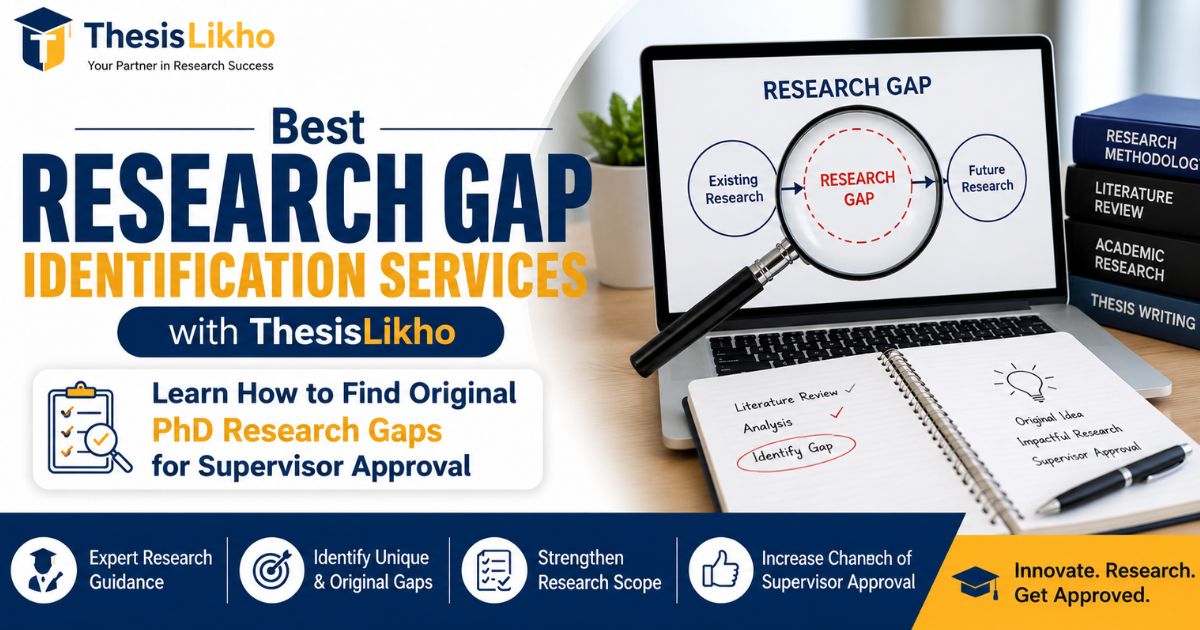
Best Research Gap Identification Services with ThesisLikho. Learn How to Find PhD Research Gaps for Supervisor Approval
Introduction
What Is a Research Gap?
A research gap is a question that has not been answered in studies or an area that has not been explored or a limitation in existing research that needs to be looked into further. Finding a research gap is very important for a successful PhD because universities want doctoral scholars to come up with new knowledge instead of just repeating what is already known.
Many PhD scholars think that choosing a research topic is the part of doing a PhD. But actually the bigger challenge is finding a research gap that is important to academics relevant to real life and can lead to meaningful contributions to the field. This is why supervisors often ask a powerful question when you present your synopsis:
"What is new in your proposed research?"
If you cannot answer this question in a convincing way your proposed title will probably need to be changed a lot.
ThesisLikho uses an approach that helps scholars find real research gaps by doing a systematic literature review, bibliometric analysis, citation mapping, PRISMA-based evidence synthesis and analyzing new research trends. Of just guessing scholars learn how experienced researchers find opportunities that can lead to high-quality PhD research and studies that can be published.
Why Most PhD Research Titles Are Rejected
A lot of research proposals need to be revised because they do not show anything new. Common reasons for this include:
The research problem has already been studied a lot.
The literature review is old.
No real research gap has been found.
The research objectives are not clear.
The study is not relevant to life.
The methodology does not match the research problem.
Recent studies that are indexed in Scopus have not been considered.
The potential for publication has not been evaluated.
ThesisLikho does not treat these issues as problems but instead addresses them through a structured research planning process before the title is finalized.
The ThesisLikho Framework for Identifying High-Impact Research Gaps
of searching randomly for topics ThesisLikho follows a step-by-step approach that is similar to what experienced researchers use.
Step 1: Define the Research Domain
Start with an academic area.
Examples include:
ESG Reporting in Corporate Finance
Explainable Artificial Intelligence
Cyber Law and Digital Privacy
Learning Analytics in Higher Education
Precision Healthcare
Sustainable Supply Chain Management
The goal at this stage is not to find a title but to define the broader research area.
Step 2: Review High-Quality Evidence
The next step is to look at academic literature using reputable databases and peer-reviewed publications.
The review focuses on:
papers that are indexed in Scopus
Publications in the Web of Science
Systematic literature reviews
Meta-analyses
Government reports
International policy papers
Conference proceedings
This helps scholars understand what has already been established and where there are still opportunities for meaningful research.
Step 3: Identify Patterns Using Bibliometric Analysis
analysis provides a scientific way to understand how research has evolved over time.
Scholars look at:
Themes that are studied a lot
Authors who are cited a lot
Networks of researchers who collaborate
keywords
Clusters of citations
Trends in publications
Areas of research that are popular
Instead of choosing topics based on how popular they are scholars find areas that are growing but still not well explored.
Case Example: From a Broad Topic to a Publishable PhD Direction
Broad Topic: Artificial Intelligence in Healthcare
After doing a review and bibliometric analysis several focused research opportunities come up:
Using Explainable AI for clinical decision support in rural hospitals.
Governing AI-based diagnostic systems in a way.
Building trust in AI-assisted consultations.
Using Federated learning to keep healthcare data private.
Identifying barriers to adopting AI among healthcare providers.
Of coming up with one general topic the scholar develops multiple research directions that are focused on publication and have clear originality.
This is the difference between choosing a topic and planning scientific research.
Professors Quick Evaluation Checklist
Before approving a PhD title experienced supervisors often ask:
Does the research address a gap?
Is the literature up to date?
Does the study offer something
Is the conceptual framework clear?
Can the right data be collected?
Does the methodology fit the objectives?
Will the findings contribute to theory and practice?
Can the work support journal publications?
The ThesisLikho process helps scholars answer each of these questions with confidence.
How Does a PRISMA-Based Literature Review Help Identify Research Gaps?
A PRISMA-based literature review is a way to identify, screen, evaluate and synthesize published research. Unlike a literature review, which may rely on selected articles PRISMA encourages transparency and systematic evidence selection. This approach helps scholars understand not what has been studied but also what remains unanswered.
The ThesisLikho framework encourages scholars to review publications from Scopus, Web of Science, Crossref, Google Scholar and other peer-reviewed sources before finalizing a research direction. Of collecting articles randomly researchers evaluate the quality of publications, methodology, findings, limitations and recommendations for future studies.
A systematic review helps scholars:
Find recurring research themes.
Discover findings that contradict each other.
Identify researched populations.
Evaluate limitations in methodology.
Detect technologies.
Understand priorities for research.
Build academic justification.
This process strengthens both the research title and the synopsis by providing evidence for why the proposed study deserves attention.
Conceptual Framework vs. Theoretical Framework: Why Both Matter
One of the common reasons doctoral proposals need to be revised is the lack of a clear research framework.
A theoretical framework explains the established theories that support the research while a conceptual framework illustrates how the studys variables or concepts are expected to interact.
For example:
Management
A scholar studying ESG Reporting and Corporate Performance may use stakeholder theory as the foundation while developing a conceptual framework linking ESG disclosure, investor confidence and financial performance.
Artificial Intelligence
A researcher investigating AI in Healthcare may combine technology acceptance theory with variables such as trust, transparency and diagnostic accuracy.
Education
A study on AI-Powered Adaptive Learning may integrate learning theory with student engagement learning outcomes and digital readiness.
Developing these frameworks during title selection improves research clarity. Demonstrates academic maturity to supervisors.
Qualitative, Quantitative and Mixed Methods: Choosing the Right Research Direction
Many scholars find a topic but overlook the importance of selecting an appropriate research approach.
ThesisLikho helps scholars evaluate whether the research gap is best explored through:
Qualitative Research
Suitable for:
Interviews
Case studies
Policy analysis
Phenomenological research
Grounded theory
Quantitative Research
Suitable for:
Surveys
Hypothesis testing
Structural Equation Modeling
Regression analysis
research
Mixed Methods Research
Suitable when both numerical evidence and participant experiences are required to answer the research problem comprehensively.
Choosing the methodology at the title selection stage reduces future revisions and ensures alignment between research objectives, data collection and analysis.
Research Gap Examples Across Different Disciplines
Management
Broad Topic: Digital Marketing
High-Impact Research Gap:
The impact of AI on customer trust in omnichannel retail is not well understood in emerging markets.
Artificial Intelligence
Broad Topic: Machine Learning
High-Impact Research Gap:
There is research on explainable machine learning models for healthcare decision support in low-resource environments.
Law
Broad Topic: Data Protection
High-Impact Research Gap:
The legal implications of AI-generated evidence, in investigations are not well understood in developing jurisdictions.
Healthcare is a field and Telemedicine is a part of it. There is a problem that needs to be solved. Not many studies have compared how well patients stick to their treatment plans when they use AI-assisted telemedicine versus teleconsultation services.
Education is another field and Online Learning is a part of it. There is a hole in the research when it comes to adaptive learning platforms for postgraduate research education. We do not know much about how these platforms work.
Let us compare two ways of doing things. One way is the approach and the other way is the scientific approach. The generic approach is when you read an articles and pick a topic that is popular. The scientific approach is when you review high-quality articles and find a gap in the research that needs to be filled.
The scientific approach is better because it helps you build a foundation for your research. You can develop a framework and a plan for your research. You can also think about how you will publish your work. This way you will be well prepared when you talk to your supervisor.
Converting a research gap into a PhD research project is not easy. You need to turn the gap into a defined problem set measurable goals develop a good framework and plan your research methodology. This is a challenge but it is also a great opportunity.
The ThesisLikho research planning methodology can help you with this. It combines steps into one process. You can review the literature identify a research gap develop a framework plan your methodology and think about publication.
Of asking if a topic is interesting you should ask more important questions. Does this study solve an academic problem? Can the contribution be measured? Will the findings add to existing theory? Can the study influence professional practice or policy? Does the proposed research have long-term publication potential?
A developed research gap should be matched with a university that supports your research interests. AdmissionsDekho can help you with this. They provide admission guidance, including university selection, PhD admission counselling, eligibility evaluation, documentation support, entrance examination guidance, interview preparation, research proposal preparation and synopsis preparation.
Frequently Asked Questions
1. What is the difference between a research problem and a research gap?
A research gap is what existing literature has not fully addressed whereas a research problem is the issue your doctoral study aims to investigate and resolve.
2. How research papers should you review before selecting a PhD topic?
There is no number but reviewing a substantial body of recent high-quality literature provides a stronger foundation for identifying meaningful research gaps.
3. Can bibliometric analysis improve PhD topic selection?
Yes it can. Bibliometric analysis helps you identify research trends, influential authors, citation networks, emerging keywords and developing research areas.
4. Why is PRISMA useful during PhD research planning?
PRISMA offers an systematic process for identifying, screening and synthesizing research evidence.
Conclusion
In conclusion quality doctoral research starts with asking the right questions. A identified research gap provides the academic justification for the entire PhD. It influences the literature review shapes the methodology strengthens the conceptual framework and ultimately determines the originality and impact of the completed research.
The ThesisLikho approach combines steps into one process. It enables scholars to build research that's academically rigorous, practically relevant and aligned with current international research priorities.
Selecting a research gap is not the first step in a PhD. It is the foundation upon which every successful doctoral project is built. With planning, scientific evaluation and expert academic guidance scholars can begin their research journey, with confidence and create work that contributes lasting value to their discipline.
Start Your PhD with an Evidence-Based Research Gap
Don't spend months revising your research title after supervisor feedback. Build your research on a validated academic foundation from the beginning.
ThesisLikho provides comprehensive support for:
Research Gap Identification
Systematic Literature Review
PRISMA-Based Evidence Review
Bibliometric Analysis
Conceptual Framework Development
Theoretical Framework Selection
PhD Topic Finalization
Synopsis Writing Guidance
Research Proposal Preparation
Publication-Oriented Research Planning
Website: www.thesislikho.com
Call / WhatsApp: +91 96438 02216
Develop a research project that begins with a genuine research gap, satisfies supervisor expectations, supports publication, and creates meaningful academic and professional impact.