
Introduction
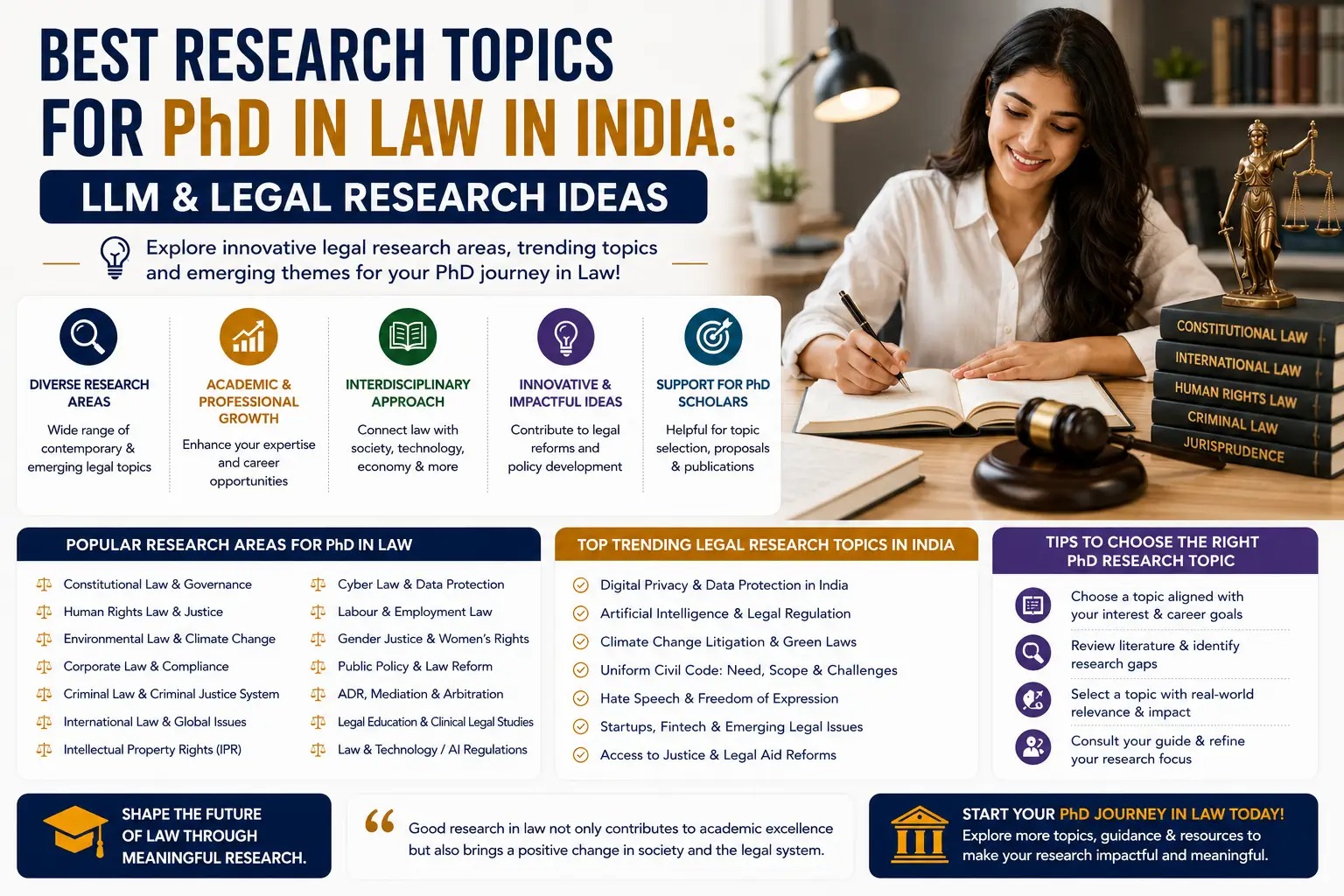
Pursuing a PhD in Law in India is a prestigious academic journey that requires not only deep commitment but also the selection of a research topic that is relevant, impactful, and future‑oriented. For LLM graduates and aspiring legal scholars, choosing the right topic is often the most challenging step. A strong research idea should address pressing legal issues, contribute to policy development, and open pathways for academic and professional growth.
1. Why Topic Selection Matters
- Academic Contribution: A PhD thesis should add new insights to legal scholarship.
- Policy Impact: Research can influence legislation, judicial decisions, and governance.
- Career Opportunities: The right topic enhances prospects in academia, judiciary, corporate law, and international organizations.
- Personal Interest: Passion for the subject sustains motivation during years of research.
2. Factors to Consider Before Choosing a Topic
- Relevance to Indian Legal System: Focus on issues that affect Indian society and governance.
- Availability of Resources: Access to case law, statutes, and academic literature.
- Supervisor Expertise: Choose topics aligned with faculty specialization.
- Scope for Innovation: Avoid overly saturated areas; look for emerging issues.
- Interdisciplinary Potential: Law intersects with economics, technology, sociology, and politics.
3. Broad Areas for PhD Research in Law
a) Constitutional and Administrative Law
- Federalism and Centre‑State relations.
- Judicial activism vs. judicial restraint.
- Fundamental rights and directive principles.
b) Corporate and Commercial Law
- Corporate governance reforms.
- Insolvency and bankruptcy code.
- Competition law and anti‑trust issues.
c) Technology and Cyber Law
- Data protection and privacy.
- Artificial intelligence and liability.
- Blockchain and smart contracts.
d) Human Rights and Social Justice
- Gender justice and equality.
- Rights of marginalized communities.
- Refugee and migration law.
e) Environmental and Climate Law
- Climate change litigation.
- Sustainable development policies.
- Biodiversity and conservation law.
f) Criminal Law and Criminology
- Juvenile justice reforms.
- Cybercrime and digital evidence.
- Restorative justice models.
4. Suggested PhD Topics in Law (India‑Focused)
1. Judicial Review and Constitutional Amendments in India
Exploring the balance between parliamentary sovereignty and judicial oversight.
2. Corporate Governance and Shareholder Rights in India
Analyzing SEBI regulations and global best practices.
3. Data Privacy and Protection under Indian Law
Evaluating the Personal Data Protection Bill and its implications.
4. Artificial Intelligence and Legal Liability
Studying accountability in autonomous systems and AI‑driven decisions.
5. Climate Change Litigation in Indian Courts
Assessing judicial responses to environmental challenges.
6. Gender Justice and Workplace Equality
Examining implementation of POSH Act and labor laws.
7. Criminal Justice Reform in India
Evaluating prison reforms, speedy trials, and victim rights.
8. Comparative Study of Insolvency Laws
Analyzing India’s IBC framework against global standards.
9. Human Rights of Refugees and Migrants in South Asia
Exploring India’s obligations under international law.
10. Digital Evidence and Cybercrime Prosecution
Studying admissibility and reliability of electronic records.
5. Tools and Resources for Legal Research
- Manupatra & SCC Online: Case law databases.
- HeinOnline & JSTOR: International journals.
- Google Scholar: Free access to legal literature.
- Law Commission Reports: Policy recommendations.
- Parliamentary Debates: Legislative intent.
6. Challenges Faced by Indian Legal Scholars
- Access to International Literature: Subscription costs can be high.
- Interdisciplinary Gaps: Limited collaboration with other fields.
- Policy Implementation: Translating research into practice is difficult.
- Time Management: Balancing teaching, practice, and research.
7. Strategies for Successful PhD Research
- Start with a Strong Proposal: Clear objectives, methodology, and scope.
- Engage in Conferences: Present papers at law schools and bar associations.
- Publish Regularly: Aim for Scopus‑indexed journals and law reviews.
- Network with Experts: Collaborate with judges, lawyers, and policymakers.
- Stay Updated: Follow Supreme Court judgments and legislative developments.
8. Career Opportunities After PhD in Law
- Academia: Professorships in law universities.
- Judiciary: Enhanced prospects in judicial services.
- Corporate Sector: Legal advisors in multinational firms.
- Policy Making: Roles in government and think tanks.
- International Organizations: UN, WTO, and human rights bodies.
FAQs: PhD in Law Research Topics
1. What is the most trending topic in law for 2026?
Data protection, AI liability, and climate change litigation are highly trending.
2. Can I pursue interdisciplinary research?
Yes, combining law with economics, sociology, or technology adds value.
3. How important is publishing during PhD?
Very important. Publications strengthen academic credibility and career prospects.
4. Do Indian universities support international collaboration?
Yes, many law schools encourage joint research and exchange programs.
5. Is corporate law a good area for PhD?
Yes, with India’s growing corporate sector, it offers strong career opportunities.
6. Can I focus on regional legal issues?
Absolutely. Research on state‑specific laws adds unique insights.
7. How long does a PhD in Law take in India?
Typically 3–5 years, depending on university regulations.
8. Do I need to publish in international journals?
Not mandatory, but highly recommended for global recognition.
9. Can PhD research lead to policy changes?
Yes, many Law Commission reports are influenced by academic research.
10. What skills are essential for PhD in Law?
Critical thinking, legal writing, research methodology, and interdisciplinary awareness.
Conclusion
Choosing the right PhD thesis topic in Law is a defining step for LLM graduates and legal scholars in India. Whether you focus on constitutional law, corporate governance, technology law, or human rights, your research should aim to bridge gaps in legal scholarship and contribute to society.
With India’s evolving legal landscape—data privacy laws, corporate reforms, climate litigation, and human rights challenges—PhD scholars have immense opportunities to make meaningful contributions. By aligning your topic with current trends, leveraging resources, and staying committed, you can build a strong academic profile and open doors to impactful careers.
ThesisLikho supports scholars throughout the dissertation process helping them turn research ideas into quality academic contributions that meet university and publication standards.
Contact ThesisLikho
Website: www.ThesisLikho.com
Call/WhatsApp: +91 96438 02216