
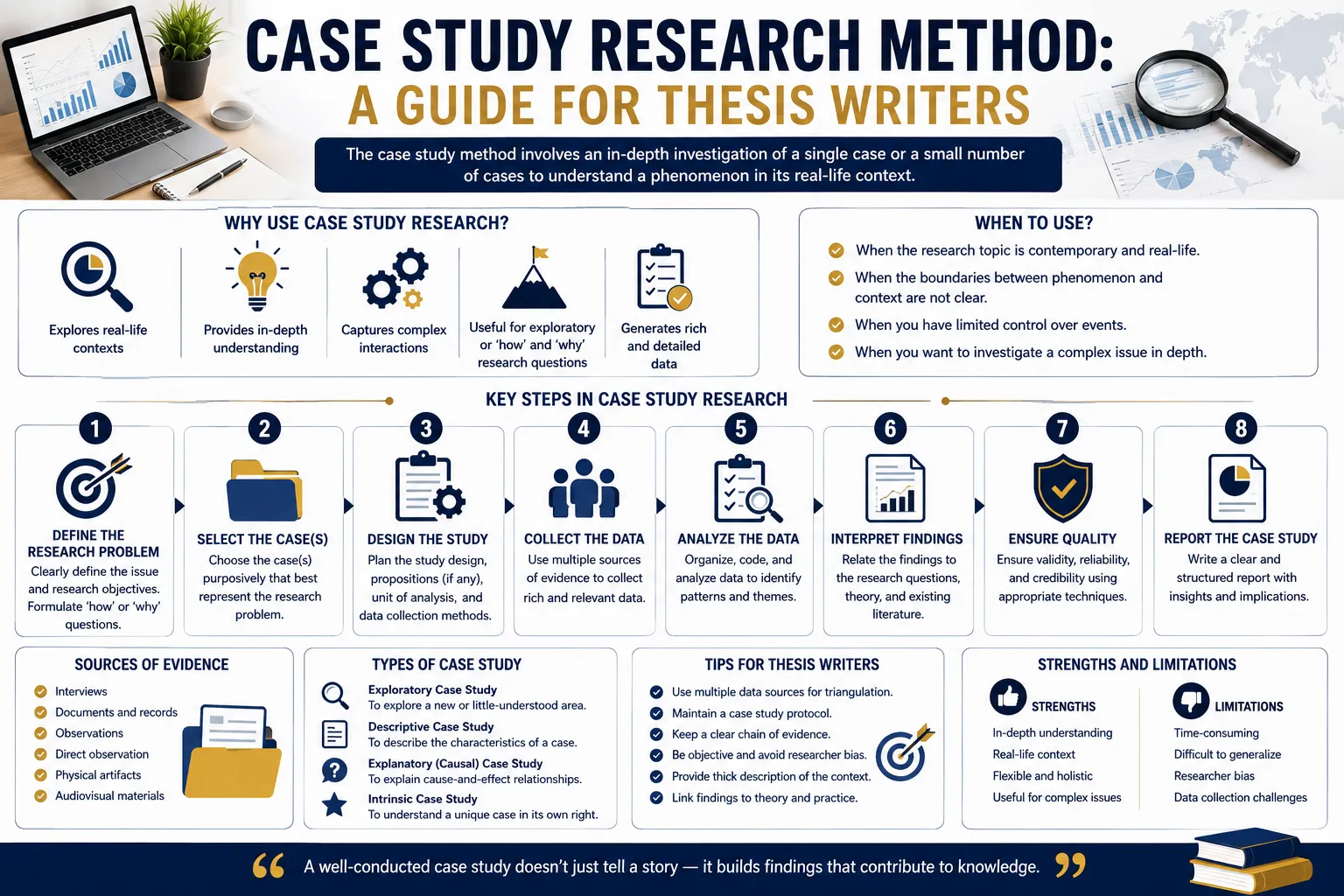
If your research question keeps circling back to "how did this happen" or "why does this work this way" rather than "how much" or "how many," case study research might be the method your thesis actually needs. This guide walks through what the case study method involves, how to choose between single and multiple cases, and how to design a study that holds up to committee scrutiny.
Case study methodology is a qualitative — and sometimes mixed-methods — research strategy involving the in-depth, empirical investigation of a single bounded case: a person, group, organisation, event, programme, or process, studied intensively within its real-world context. It's the method of choice for answering "how" and "why" questions about a contemporary phenomenon, particularly when the boundaries between the phenomenon and its surrounding context aren't clear-cut.
Case study research is one of the most widely used and accepted qualitative methods across disciplines — education, healthcare, social work, sociology, organizational studies, anthropology, medicine, law, and political science all draw on it regularly. It's particularly valuable when you need in-depth appreciation of an issue, event, or phenomenon in its natural, real-life setting.
Two Foundational Perspectives You Should Know
Two authorities dominate case study methodology, and it genuinely helps to understand where each is coming from before designing your own study.
Robert K. Yin takes a structured, post-positivist approach. He stresses a clear research design established in advance, theoretical propositions that guide what data you collect, multiple sources of evidence, a documented chain of evidence, and formal tests of construct validity, internal validity, external validity, and reliability. If your thesis committee expects rigor comparable to quantitative research standards, Yin's framework is usually the safer foundation.
Robert Stake, by contrast, frames the case study less as a methodological choice and more as a choice of what is studied. Stake's approach emphasizes depth and the inherent complexity of the particular case itself, favoring a more interpretive, less formally structured approach than Yin's.
Neither approach is universally "correct" — the right choice depends on your discipline's norms and your specific research question. If you're unsure which fits your study, this is worth discussing directly with your supervisor before finalizing your design.
Single-Case vs. Multiple-Case Design: How to Choose
When a Single-Case Design Makes Sense
Yin identifies specific justifications for choosing to study just one case in depth:
- Critical case — the case tests a well-formulated theory
- Unusual or extreme case — the case is atypical in a way that makes it analytically valuable
- Common case — the case represents an everyday, typical situation
- Revelatory case — the case offers access to something previously inaccessible to researchers
- Longitudinal case — the case is studied at two or more points in time
If your research doesn't clearly fit one of these justifications, a single-case design may be harder to defend to your committee.
When a Multiple-Case Design Makes Sense
A multiple-case design studies several cases to allow cross-case comparison and replication logic. Each case functions like a separate experiment that either predicts similar results (literal replication) or predicts contrasting results for anticipatable reasons (theoretical replication). When your purpose is comparison and replication, multiple-case studies produce more compelling evidence and are generally considered more methodologically robust than single-case studies.
To write a proper multiple-case study, you can't simply present each case side by side. You need to report a summary of each individual case, then draw explicit cross-case conclusions in a dedicated cross-case report — the synthesis across cases is what makes the design valuable, not just the individual case descriptions.
The Real Trade-Off to Consider
A genuine tension exists between the two approaches. Some scholars argue multiple cases enable stronger cross-case analysis and more generalizable findings. Others argue single-case studies produce better, more precise theory — spreading attention across more cases inevitably means fewer in-depth observations per case, which can reduce analytical precision. On top of this, multiple-case studies are considerably more expensive and time-consuming to conduct — a genuine feasibility consideration for a thesis-length project with a fixed timeline and limited resources. Be honest with yourself about what your timeline and resources can actually support before committing to a multiple-case design.
Holistic vs. Embedded Analysis
Beyond the single-vs-multiple decision, you'll also need to decide whether your analysis is holistic (treating each case as a single, undivided unit of analysis) or embedded (examining distinct sub-units within each case). An embedded multiple-case design might, for example, call for conducting a structured survey at each individual case study site, in addition to interviews — giving you both case-level and sub-unit-level data within the same overall design.
Exploratory vs. Descriptive Purpose
Yin also categorizes case studies by their underlying purpose. An exploratory case study is used when the intervention being evaluated has no clear single set of outcomes — it helps define research questions and develop a theoretical framework where one doesn't yet exist. A descriptive case study, by contrast, is used to describe an intervention or phenomenon and the real-life context in which it occurred, without necessarily aiming to generate new theory. Clarifying which purpose your study serves early on will shape both your data collection plan and how you frame your findings later.
Step-by-Step: Designing Your Case Study Research
Step 1: Confirm the Case Study Method Actually Fits Your Question
Ask whether your research question is genuinely a "how" or "why" question about a contemporary phenomenon within its real-world context. If your question is really about measuring the extent or frequency of something, a survey-based or other quantitative design may serve you better.
Step 2: Choose Single vs. Multiple Case Design
Match your choice to Yin's justifications for single-case studies, or to the comparison/replication logic of multiple-case studies — and weigh this decision honestly against your available time and resources.
Step 3: Decide on Holistic or Embedded Analysis
Determine whether you're studying the case as a whole or examining specific sub-units within it, and let this decision shape your data collection instruments.
Step 4: Establish Theoretical Propositions in Advance
Following Yin's approach, define the theoretical propositions that will guide what data you collect — this keeps your case study focused rather than an unstructured, exploratory narrative.
Step 5: Plan Multiple Sources of Evidence
Case study research typically draws on multiple methods of data collection and multiple data sources — interviews, documents, observations, and archival records. Triangulation across these sources is considered critical to obtaining an in-depth, corroborated understanding and adds rigor, breadth, and depth to your study.
Step 6: Maintain a Chain of Evidence
Keep clear documentation linking your research questions, data collection protocols, collected evidence, and eventual conclusions — this chain of evidence is what allows examiners to trace how you arrived at your findings, and it's central to Yin's validity and reliability tests.
Step 7: Conduct Within-Case Analysis First
For multiple-case designs, start by describing themes within each individual case in detail before attempting any comparison — this within-case analysis is the foundation the cross-case analysis builds on.
Step 8: Conduct Cross-Case Analysis
Once each case has been analyzed individually, move to thematic analysis across all cases, identifying patterns, similarities, and differences that reveal how the cases compare along dimensions relevant to your research question.
Practical Checklist: Is Your Case Study Design Ready?
- Research question is genuinely a "how" or "why" question about a contemporary, contextual phenomenon
- Single vs. multiple case design decision is justified against Yin's or the comparison-logic criteria
- Holistic vs. embedded analysis approach is decided and matches the data collection plan
- Theoretical propositions are established in advance to guide data collection
- Multiple sources of evidence are planned to allow triangulation
- A chain of evidence is maintained connecting questions, data, and conclusions
- For multiple cases, within-case analysis is planned before cross-case analysis
- Feasibility (time, access, resources) has been honestly checked against the chosen design's demands
- Exploratory vs. descriptive purpose is clearly stated
Two Practical Scenarios
Scenario 1 — Justifying a Single-Case Design A scholar studying organizational change management wanted to focus on one company undergoing a rare, large-scale digital transformation that few other organizations in the region had attempted. Rather than defaulting to a multiple-case design for perceived rigor, the scholar justified the single-case choice explicitly as a "revelatory case" — access to this specific transformation process was previously inaccessible to researchers, making deep, single-case investigation more valuable than a broader, shallower multiple-case comparison. The committee accepted this justification because it mapped directly onto one of Yin's recognized rationales.
Scenario 2 — Managing the Cost of a Multiple-Case Design A scholar initially proposed a six-case comparative study on SME adoption of digital payment systems, but after mapping out the interview and site-visit time required for each case against their thesis timeline, realized six cases weren't feasible. Reducing the design to three carefully selected cases — chosen specifically to represent contrasting outcomes for theoretically anticipatable reasons — preserved the comparative, replication-based logic of a multiple-case design while keeping the project achievable within the available time.
Common Mistakes Thesis Writers Make With Case Study Research
- Choosing case study method by default for qualitative work, without confirming the research question genuinely calls for it.
- Selecting multiple cases without a clear replication logic, resulting in cases that don't meaningfully compare to each other.
- Skipping within-case analysis and jumping straight to cross-case comparison, weakening the depth of the eventual findings.
- Relying on a single data source instead of triangulating across interviews, documents, and observations.
- Underestimating the time and access required for a multiple-case design relative to the thesis timeline.
Frequently Asked Questions
What is the case study research method, and how does it work for thesis writers?
It's a qualitative (or mixed-methods) research strategy involving in-depth investigation of one or more bounded cases within their real-world context, typically used to answer "how" and "why" questions, and structured around theoretical propositions, multiple sources of evidence, and a documented chain of evidence.
Why does the case study research method matter for a thesis?
It's one of the few methods well-suited to studying complex, contextual phenomena in depth, making it valuable for research questions that quantitative methods alone can't adequately answer — but its rigor depends heavily on careful design choices like single vs. multiple case selection and proper triangulation.
How does the case study method affect a thesis's overall design?
The single-vs-multiple and holistic-vs-embedded decisions shape every subsequent stage — data collection instruments, analysis approach, and how findings are eventually generalized or theorized — making these early design choices particularly consequential.
How long does it take to complete a thesis using this approach?
Single-case designs are generally more feasible within standard thesis timelines, while multiple-case designs require significantly more time for data collection and both within-case and cross-case analysis — factor this into your design choice early.
Is professional help available for case study research method thesis writing?
Yes. ThesisLikho's PhD-qualified experts have guided 10,000+ scholars through case study research design, data collection planning, and complete thesis writing assistance across disciplines.
Get Expert Guidance on Your Case Study Research Design
Choosing between a single-case and multiple-case design, and structuring your data collection for proper triangulation, takes careful early planning matched to your specific research question and resources. If you'd like expert input on designing a defensible case study methodology for your thesis, ThesisLikho's PhD-qualified team offers research design support, data collection guidance, and complete thesis writing assistance. If you need expert guidance with your case study design, sampling plan, or overall research methodology, you can explore our Thesis Writing Assistance service.
Talk to a Thesis Expert → https://thesislikho.com/writing-services/thesis-writing