
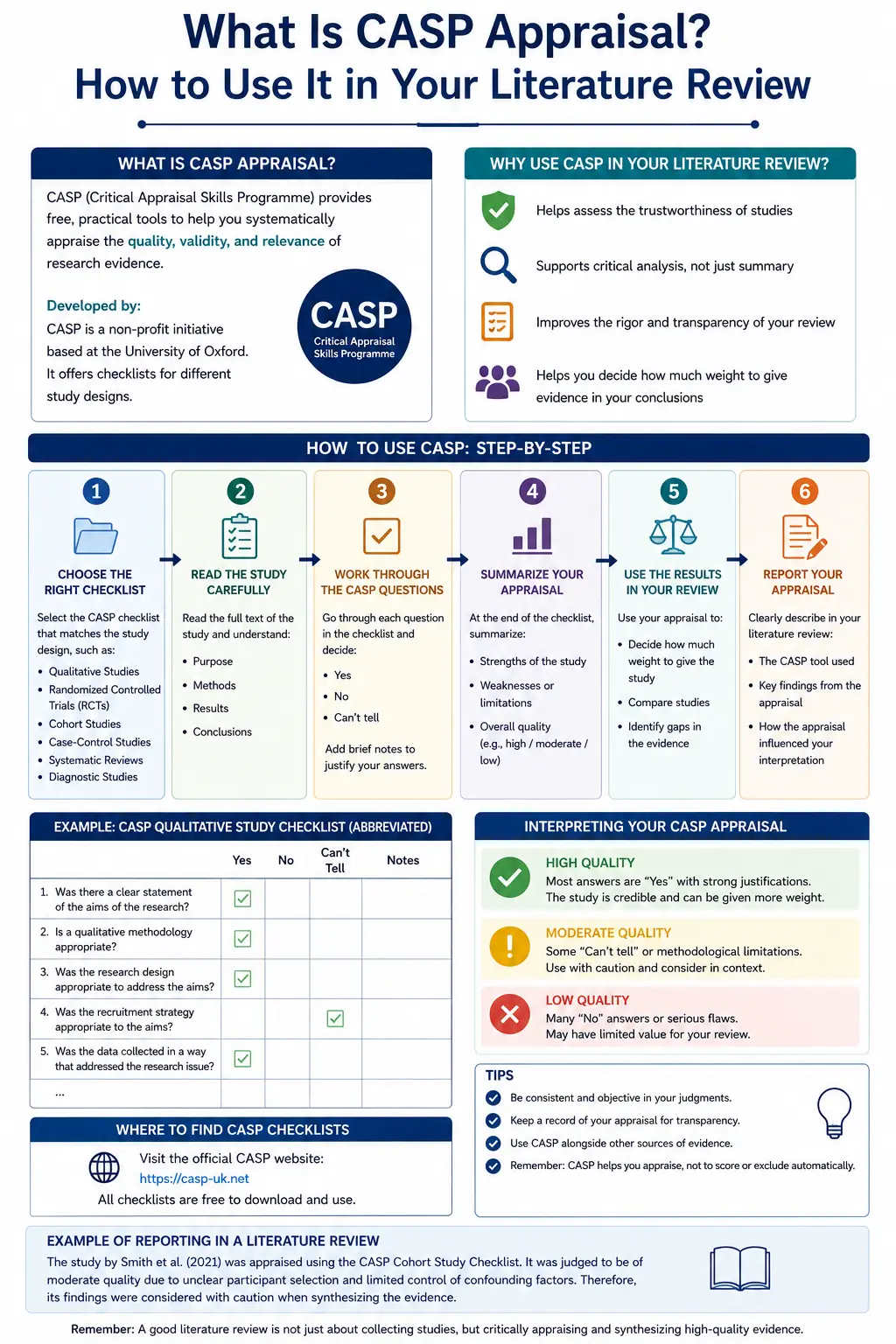
Introduction
Conducting a literature review is one of the most important stages of any research project. Whether you are pursuing a PhD, writing a dissertation, preparing a research paper, or conducting a systematic review, you must evaluate the quality of the studies you include. Simply collecting articles is not enough; researchers must determine whether those studies are reliable, valid, and relevant.
This is where CASP Appraisal becomes valuable.
The Critical Appraisal Skills Programme (CASP) provides a structured framework for assessing the quality and trustworthiness of research studies. It helps researchers critically evaluate evidence before including it in a literature review or systematic review.
For PhD scholars, postgraduate students, and academic researchers, understanding how to use CASP can significantly improve the quality and credibility of research findings.
In this guide, you will learn:
- What CASP appraisal is
- Why critical appraisal matters
- Types of CASP checklists
- How to use CASP in a literature review
- Step-by-step appraisal process
- Advantages and limitations of CASP
- Practical examples for researchers
What Is CASP Appraisal?
CASP (Critical Appraisal Skills Programme) is a set of evidence-based checklists designed to help researchers systematically evaluate research studies.
The programme was originally developed in the United Kingdom to improve the ability of healthcare professionals and researchers to critically assess evidence. Today, CASP is widely used across multiple disciplines including:
- Health sciences
- Nursing
- Medicine
- Psychology
- Social sciences
- Education
- Public policy
- Management research
The primary goal of CASP is to answer three key questions:
- Is the study valid?
- What are the results?
- Are the results useful and applicable?
By answering these questions, researchers can determine whether a study should be included in their literature review.
Why Is Critical Appraisal Important?
Many published studies contain limitations such as:
- Small sample sizes
- Poor research design
- Sampling bias
- Inadequate data analysis
- Weak conclusions
Without critical appraisal, researchers may unknowingly include low-quality evidence in their literature review.
Critical appraisal helps to:
Identify Reliable Studies
Not all published articles are equally trustworthy. CASP helps identify studies with strong methodology.
Improve Research Quality
Using only high-quality evidence strengthens your arguments and findings.
Reduce Bias
Researchers can identify sources of bias that may affect study results.
Support Evidence-Based Research
CASP ensures that conclusions are based on robust evidence rather than assumptions.
Strengthen Systematic Reviews
Most systematic reviews require a formal quality assessment of included studies.
What Are CASP Checklists?
CASP provides specialized checklists for different types of research designs.
Each checklist contains a series of questions that guide researchers through the appraisal process.
Major CASP Checklists Include:
1. CASP Randomized Controlled Trial Checklist
Used to evaluate:
- Clinical trials
- Experimental studies
- Intervention research
2. CASP Cohort Study Checklist
Used for:
- Longitudinal studies
- Prospective studies
- Retrospective cohort research
3. CASP Case-Control Study Checklist
Suitable for studies comparing cases and controls.
4. CASP Qualitative Research Checklist
Used to assess:
- Interviews
- Focus groups
- Ethnographic studies
- Phenomenological research
5. CASP Systematic Review Checklist
Designed for evaluating systematic reviews and meta-analyses.
6. CASP Economic Evaluation Checklist
Used in health economics and policy research.
7. CASP Diagnostic Study Checklist
Evaluates diagnostic accuracy studies.
8. CASP Cross-Sectional and Observational Studies
Useful for survey-based research and observational analyses.
Structure of a CASP Checklist
Most CASP checklists contain around 10–12 questions organized into three sections.
Section 1: Are the Results Valid?
This section examines methodological quality.
Questions may include:
- Did the study address a clearly focused issue?
- Was the methodology appropriate?
- Were participants selected properly?
- Was bias minimized?
Section 2: What Are the Results?
This section evaluates findings.
Questions include:
- What are the key results?
- How precise are the results?
- Are findings statistically significant?
Section 3: Will the Results Help Locally?
This section considers applicability.
Questions include:
- Can results be generalized?
- Are findings relevant to your research context?
- Do benefits outweigh limitations?
How to Use CASP in Your Literature Review
Using CASP in a literature review involves a systematic evaluation process.
Step 1: Identify Relevant Studies
Search academic databases such as:
- Google Scholar
- Scopus
- Web of Science
- PubMed
- JSTOR
- ScienceDirect
Apply inclusion and exclusion criteria.
For example:
Inclusion Criteria
- Published after 2020
- Peer-reviewed articles
- English language studies
Exclusion Criteria
- Conference abstracts
- Editorials
- Non-peer-reviewed source
Step 2: Read the Study Carefully
Before completing the checklist:
- Read the abstract
- Review the methodology
- Examine data collection methods
- Analyze findings
- Evaluate conclusions
Take notes while reading.
Step 3: Answer CASP Questions
Work through each checklist question systematically.
Example from the CASP Qualitative Checklist:
Question: Was the recruitment strategy appropriate?
Consider:
- Who participated?
- How were participants selected?
- Were inclusion criteria justified?
Provide evidence from the article to support your answer.
Step 4: Compare Study Quality
After appraising all studies:
- Identify high-quality studies
- Note methodological strengths
- Highlight weaknesses
- Discuss limitations
This comparison strengthens the critical analysis section of your review.
Step 5: Incorporate Findings into Literature Review
Do not simply report study results.
Instead, critically discuss quality.
Example:
"While Sharma (2024) reported strong evidence regarding employee engagement, CASP appraisal indicated a limited sample size, reducing the generalizability of findings."
This demonstrates critical thinking.
CASP Appraisal for Systematic Reviews
CASP is especially valuable when conducting systematic reviews.
Researchers often evaluate dozens or hundreds of studies.
CASP helps:
- Standardize quality assessment
- Reduce reviewer bias
- Improve transparency
- Support evidence synthesis
Most high-quality systematic reviews include a dedicated section explaining how CASP or similar tools were used.
Advantages of CASP Appraisal
Easy to Use
The checklists are straightforward and beginner-friendly.
Structured Evaluation
Provides a systematic assessment process.
Widely Accepted
Recognized internationally in academic research.
Supports Evidence-Based Decision Making
Improves reliability of conclusions.
Applicable Across Disciplines
Useful beyond healthcare and medical research.
Encourages Critical Thinking
Researchers move beyond simple summaries and engage in analytical evaluation.
Limitations of CASP Appraisal
Despite its benefits, CASP has some limitations.
Subjectivity
Different reviewers may interpret questions differently.
No Universal Scoring System
CASP focuses on judgment rather than numerical scoring.
Time-Consuming
Large literature reviews may require extensive appraisal work.
Requires Methodological Knowledge
Researchers must understand research methods to evaluate studies effectively.
Not Suitable for Every Study Type
Some research designs may require alternative appraisal tools.
Common Mistakes When Using CASP
Using the Wrong Checklist
Always match the checklist to the study design.
Focusing Only on Results
Methodology is equally important.
Ignoring Bias
Every study should be assessed for potential bias.
Treating CASP as a Scoring Tool
CASP emphasizes critical judgment rather than numerical scores.
Not Reporting Appraisal Methods
Explain clearly how CASP was applied in your methodology chapter.
Tips for PhD Scholars Using CASP
To maximize the benefits of CASP:
- Start appraisal early in your literature review process.
- Maintain detailed appraisal notes.
- Use spreadsheets to organize assessments.
- Compare findings across studies.
- Discuss methodological strengths and weaknesses.
- Include appraisal outcomes in your thesis methodology chapter.
These practices improve research rigor and academic credibility.
Conclusion
CASP Appraisal is one of the most effective tools for evaluating research quality in literature reviews and systematic reviews. By providing structured checklists tailored to different study designs, CASP helps researchers determine whether evidence is valid, reliable, and relevant.
For PhD scholars, master's students, and academic researchers, CASP offers a practical framework for identifying high-quality studies, reducing bias, and strengthening research conclusions. Rather than merely summarizing previous studies, researchers can use CASP to critically analyze evidence and produce a more rigorous and impactful literature review.
As academic research becomes increasingly evidence-driven, mastering CASP appraisal is an essential skill for every researcher seeking to produce trustworthy and high-quality scholarly work.
Website: www.thesislikho.com
Call/WhatsApp: +91 96438 02216