
Introduction
Academic writing is one of the most important skills every research student must master. Whether you are preparing a PhD thesis, master's dissertation, research proposal, journal article, conference paper, or literature review, the quality of your writing directly influences how your research is understood and evaluated. Even a well-designed study with strong data and valuable findings can lose credibility if it is presented with unclear language, poor structure, grammatical errors, or unsupported arguments.
Many research students believe that academic writing is simply about using formal language and citing references correctly. In reality, effective academic writing requires much more. It involves presenting ideas logically, supporting arguments with evidence, maintaining an objective tone, organizing information coherently, and communicating complex concepts in a way that readers can easily understand.
The challenge is that many writing mistakes are subtle. Students often repeat words unnecessarily, write overly long sentences, misuse technical terms, rely too heavily on passive voice, or make unsupported claims without realizing how these issues affect the quality of their work. These mistakes can lead to lower grades, extensive revisions, negative reviewer comments, and even rejection from academic journals.
The good news is that most academic writing errors are entirely avoidable. By recognizing common pitfalls and adopting proven writing strategies, you can significantly improve the clarity, professionalism, and impact of your research.
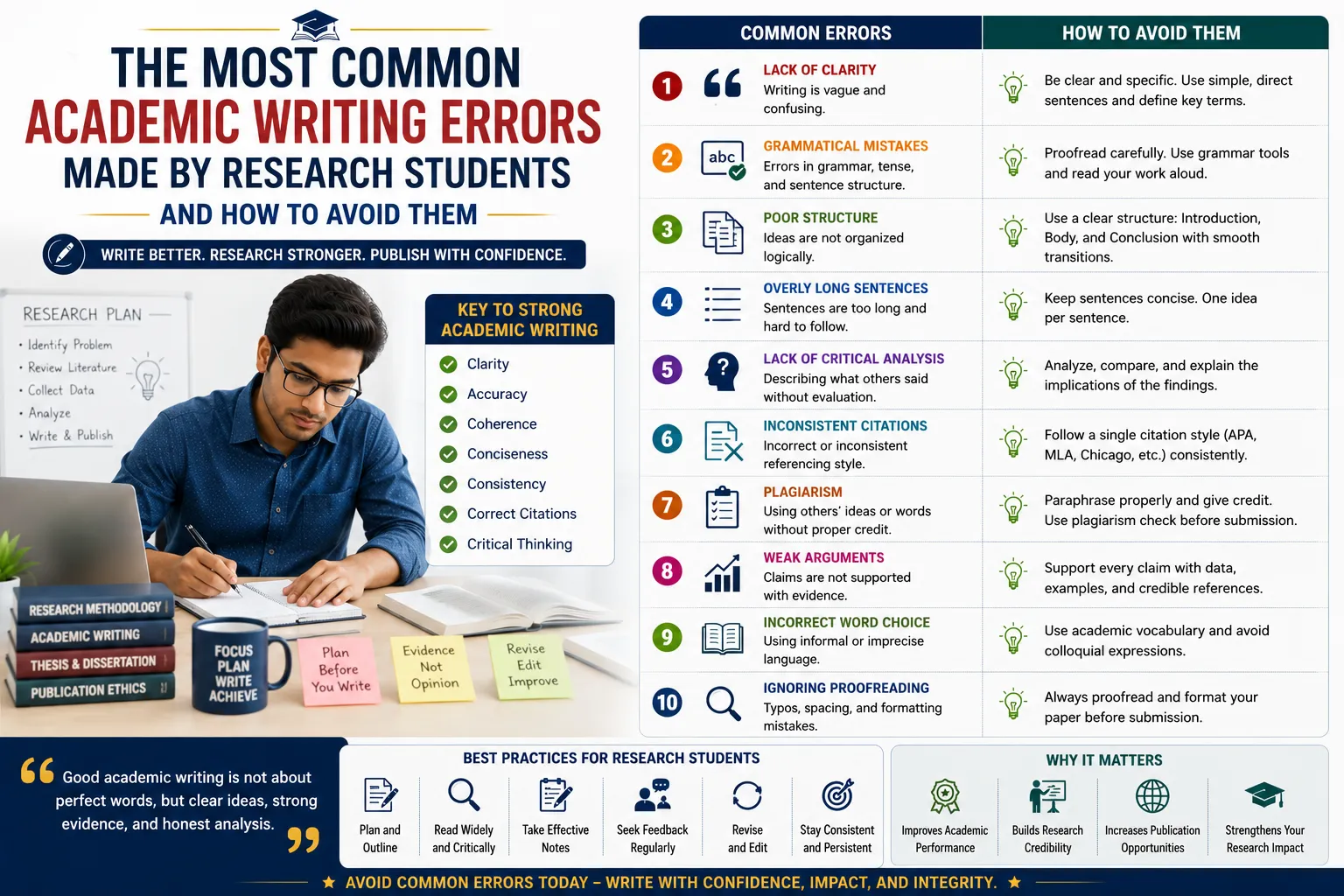
This comprehensive guide explores the most common academic writing errors made by research students and explains how to avoid them while producing high-quality scholarly work.
Why Academic Writing Matters
Academic writing is more than a method of reporting research—it is the primary way researchers communicate ideas, share evidence, and contribute to knowledge.
Good academic writing helps you:
- Present arguments logically.
- Demonstrate critical thinking.
- Explain complex concepts clearly.
- Support claims with credible evidence.
- Build trust with readers.
- Improve thesis quality.
- Increase the chances of journal publication.
Clear writing reflects clear thinking. If readers struggle to understand your writing, they may also question the quality of your research.
Error 1: Writing Long and Complicated Sentences
One of the most common mistakes is believing that long sentences sound more academic.
Example:
"Considering the numerous variables that have been identified throughout the research process and taking into account the diverse perspectives that have emerged from previous literature, it can therefore be concluded that..."
Such sentences are difficult to follow and often contain multiple ideas.
How to Avoid It
Break long sentences into shorter ones.
Instead of writing one 50-word sentence, write two or three concise sentences that each express a single idea.
Shorter sentences improve readability and reduce the likelihood of grammatical errors.
Error 2: Using Unnecessarily Complex Vocabulary
Some students replace simple words with complicated alternatives in an attempt to sound scholarly.
Examples include:
- Utilize instead of use
- Commence instead of begin
- Facilitate instead of help (when appropriate)
- Demonstrate instead of show (where simpler wording is sufficient)
How to Avoid It
Choose the simplest word that accurately communicates your meaning.
Academic writing values precision more than complexity.
Error 3: Overusing Technical Jargon
Technical terminology is necessary in specialized fields, but excessive jargon can make your writing inaccessible.
Readers outside your immediate discipline may struggle to understand unexplained technical language.
How to Avoid It
- Use technical terms only when necessary.
- Define specialized terminology when first introduced.
- Avoid using jargon simply to sound more academic.
Your goal is to communicate knowledge, not create unnecessary barriers for readers.
Error 4: Weak Thesis Statement
Every research paper or thesis chapter should communicate a clear central argument or purpose.
A vague thesis statement leaves readers uncertain about your objectives.
How to Avoid It
Write a thesis statement that clearly explains:
- What you are studying
- Why it matters
- What your research aims to achieve
Revisit your thesis statement during revision to ensure it aligns with the content of the chapter.
Error 5: Poor Paragraph Structure
Many students include multiple unrelated ideas within the same paragraph.
This makes arguments difficult to follow.
How to Avoid It
Use the "one idea per paragraph" principle.
Each paragraph should contain:
- A topic sentence
- Supporting evidence
- Analysis
- A concluding or transition sentence
Logical paragraph structure improves coherence.
Error 6: Lack of Logical Flow
Even well-written paragraphs lose effectiveness if they are disconnected.
Readers should understand how one idea leads naturally to the next.
How to Avoid It
Use transition words such as:
- Furthermore
- However
- Therefore
- Consequently
- In contrast
- Similarly
- For example
Transitions create smoother reading experiences and strengthen your argument.
Error 7: Unsupported Claims
Academic writing requires evidence.
Statements such as:
"Online learning is the best educational method."
are opinions unless supported by research.
How to Avoid It
Support every important claim using:
- Peer-reviewed journal articles
- Academic books
- Government publications
- Official reports
- Credible statistical data
Evidence-based writing is the foundation of scholarly communication.
Error 8: Poor Citation Practices
Improper referencing can lead to plagiarism and reduce academic credibility.
Common mistakes include:
- Missing citations
- Incorrect citation style
- Inconsistent formatting
- Incomplete reference lists
How to Avoid It
Follow your university's required citation style consistently, such as APA, MLA, Chicago, Harvard, or IEEE.
Reference management software like Zotero, Mendeley, or EndNote can help maintain accuracy.
Error 9: Plagiarism
Plagiarism remains one of the most serious academic offenses.
It includes:
- Copying text without citation
- Paraphrasing too closely to the original source
- Reusing your own previous work without acknowledgment (self-plagiarism)
How to Avoid It
- Write in your own words.
- Cite all sources appropriately.
- Use quotation marks for direct quotations.
- Check originality with plagiarism detection tools before submission.
Ethical writing strengthens your academic reputation.
Error 10: Excessive Passive Voice
Passive voice has legitimate uses, but overusing it can make writing indirect and difficult to read.
Example:
"The questionnaire was distributed by the researcher."
Improved Version
"The researcher distributed the questionnaire."
How to Avoid It
Prefer active voice when the subject performing the action is important.
Use passive voice only when emphasizing the process or outcome.
Error 11: Repetition
Repeating the same words, phrases, or ideas weakens academic writing.
Examples include repeatedly using terms such as:
- Important
- Significant
- Research
- Study
- Results
How to Avoid It
Revise your work to remove unnecessary repetition.
Use appropriate synonyms where they preserve the intended meaning, but avoid replacing technical terms with inaccurate alternatives.
Error 12: Writing Without Critical Analysis
Many students summarize previous studies without evaluating them.
A literature review should analyze rather than merely describe research.
How to Avoid It
Discuss:
- Strengths
- Weaknesses
- Similarities
- Differences
- Research gaps
- Methodological limitations
Critical analysis demonstrates higher-order thinking.
Error 13: Inconsistent Terminology
Changing terminology throughout your thesis can confuse readers.
For example:
Using:
- Participants
- Respondents
- Subjects
- Individuals
interchangeably without explanation may reduce clarity.
How to Avoid It
Choose consistent terminology throughout the document unless there is a clear reason to distinguish between terms.
Error 14: Weak Introductions and Conclusions
Some chapters begin abruptly or end without summarizing key points.
How to Avoid It
An effective introduction should:
- Introduce the topic
- Provide context
- Explain significance
- State objectives
An effective conclusion should:
- Summarize key findings
- Reinforce the main argument
- Highlight implications
- Suggest future research where appropriate
Error 15: Ignoring Grammar and Punctuation
Even excellent research can appear unprofessional if filled with language errors.
Common issues include:
- Subject-verb disagreement
- Incorrect tense
- Misplaced commas
- Run-on sentences
- Sentence fragments
- Apostrophe errors
How to Avoid It
Proofread carefully and use grammar-checking tools as a first step, followed by manual review.
Reading aloud often reveals awkward constructions.
Error 16: Writing Without Revision
First drafts rarely represent your best work.
Submitting them without revision often leaves avoidable errors.
How to Avoid It
Revise in stages:
- Structure
- Content
- Clarity
- Grammar
- References
- Formatting
Taking a short break before revising helps you identify mistakes more easily.
Error 17: Failing to Follow University Guidelines
Every institution has formatting requirements.
Commonly overlooked elements include:
- Margins
- Font size
- Line spacing
- Citation style
- Heading hierarchy
- Table formatting
How to Avoid It
Download your university's thesis manual before writing and review it regularly throughout the writing process.
Error 18: Overloading Sentences With Multiple Ideas
Attempting to explain several concepts in one sentence often creates confusion.
How to Avoid It
Each sentence should communicate one primary idea.
Complex arguments should be developed gradually over several sentences or paragraphs.
Error 19: Poor Time Management
Many students postpone writing until data collection is complete.
This creates unnecessary pressure.
How to Avoid It
Write continuously throughout your research journey.
Complete sections such as:
- Introduction
- Literature review
- Methodology
before finishing data collection whenever possible.
Regular writing reduces stress and improves quality.
Error 20: Neglecting the Reader
Some students write only for themselves rather than considering the reader's perspective.
Readers should never have to guess:
- What a paragraph means
- Why evidence is presented
- How ideas connect
How to Avoid It
Ask yourself:
"If someone unfamiliar with my research reads this paragraph, will they understand it?"
Writing with the reader in mind improves clarity and engagement.
Best Practices for Strong Academic Writing
To produce high-quality academic work:
- Plan your writing before you begin.
- Create a clear outline.
- Use simple and precise language.
- Keep paragraphs focused.
- Support arguments with evidence.
- Maintain an objective tone.
- Use logical transitions.
- Cite sources consistently.
- Revise multiple times.
- Seek feedback from supervisors and peers.
These habits lead to stronger, more persuasive writing.
Academic Writing Checklist
Before submitting your thesis or research paper, confirm the following:
- Is my purpose clear?
- Does each paragraph focus on one idea?
- Have I supported every major claim with evidence?
- Have I avoided unnecessary jargon?
- Are grammar and punctuation correct?
- Have I followed the required citation style?
- Is terminology consistent throughout the document?
- Have I revised for clarity and readability?
- Are all references complete and accurate?
- Does the conclusion effectively summarize the chapter?
Using a checklist helps catch small issues before they become larger problems.
Conclusion
Academic writing is a skill that improves with deliberate practice, careful revision, and attention to detail. While research students commonly make mistakes such as writing overly long sentences, using unnecessary jargon, presenting unsupported claims, or neglecting proper structure, these errors are not permanent obstacles. They can be corrected by adopting clear writing habits, organizing ideas logically, and focusing on communicating knowledge rather than impressing readers with complexity.
The most effective academic writing is not the most complicated—it is the writing that explains ideas accurately, supports arguments with credible evidence, and guides readers smoothly from one point to the next. By avoiding the common errors discussed in this guide and consistently applying best practices, you can significantly improve the quality of your thesis, dissertation, or research paper.
Remember that excellent research deserves excellent presentation. Clear, concise, and well-structured academic writing allows your ideas to stand out, strengthens your credibility as a researcher, and increases the impact of your work within the academic community. Investing time in improving your writing skills today will benefit every future research project, publication, and professional opportunity throughout your academic career.
Call / WhatsApp: +91 96438 02216
Website:www.ThesisLikho.com