
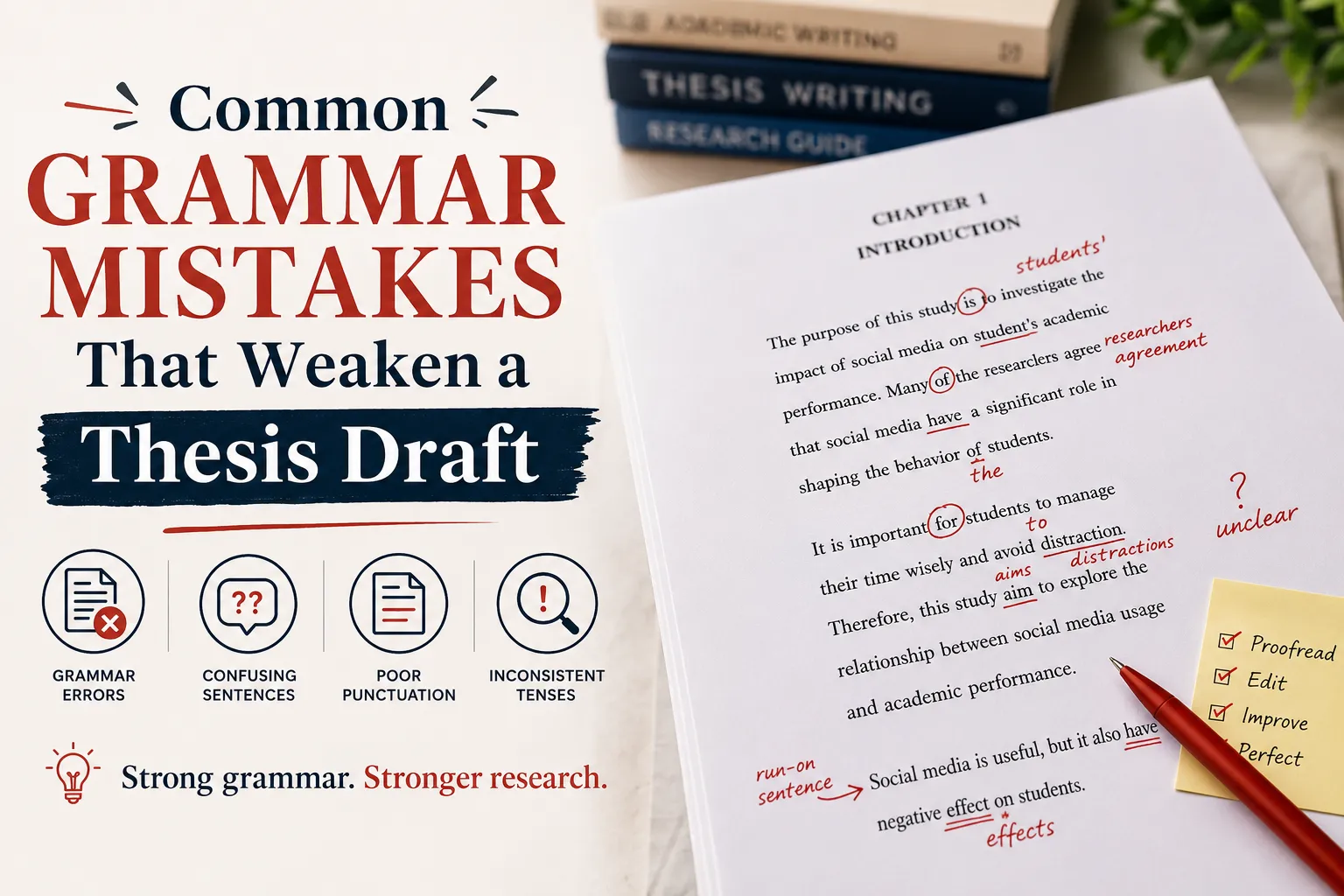
A thesis can represent years of genuinely rigorous research and still read as less credible than it deserves, simply because of grammar patterns that quietly undermine a reader's confidence sentence by sentence. Common grammar mistakes that weaken a thesis draft aren't usually the dramatic, obvious kind — they're the small, recurring patterns (a subject and verb that don't quite agree across a long sentence, a paragraph that drifts between past and present tense, a "which" where a "that" belongs) that accumulate across two hundred pages into a draft that reads as less polished and less trustworthy than the underlying research actually is.
This guide walks through the specific grammar patterns that show up most often in thesis writing, why each one matters more in academic writing than it might in casual prose, and practical ways to catch and fix them during revision. We've grounded this in current academic writing research and the patterns we see across scholars ThesisLikho supports through the editing and revision stage.
Why Grammar Matters More in a Thesis Than It Might Seem
Academic writing is unusually unforgiving of grammar errors compared to everyday writing, for a specific reason: a thesis is read by people whose job is to evaluate precision and rigor, and grammar errors are often the first, most visible signal a reader encounters before they've even engaged with your argument. A reviewer or examiner who spots recurring subject-verb agreement errors or inconsistent tense in your first few pages doesn't necessarily conclude your research is weak, but they do start reading more skeptically — grammar precision functions, fairly or not, as an early proxy for the precision of your thinking more broadly.
This matters practically at every stage: your supervisor's confidence in a draft, a Research Advisory Committee's impression during synopsis or thesis review, and a journal reviewer's willingness to engage generously with a submitted manuscript. Clean grammar doesn't make a weak argument strong, but consistently imprecise grammar can make a strong argument read as less credible than it actually is.
Subject-Verb Agreement in Long Academic Sentences
Subject-verb agreement is one of the most fundamental rules in English grammar and, in academic writing specifically, one of the most frequently violated — not because writers don't know the basic rule, but because long, clause-heavy academic sentences create genuine distance between the subject and its verb, making the true subject easy to lose track of.
Three specific patterns cause most of the trouble. First, phrases like "along with," "in addition to," and "accompanied by" do not change a subject's number, even though they sit right next to the verb: "The manager, along with her assistants, is attending the meeting" stays singular because "the manager" is the true subject, not "her assistants." Second, subjects joined by "or" or "nor" agree with the noun closest to the verb: "Neither the supervisor nor the committee members were available" takes a plural verb because "committee members" is closest, while "Neither the committee members nor the supervisor was available" takes a singular verb. Third, and most common in thesis writing specifically, long intervening clauses between subject and verb can obscure the true subject entirely — in a sentence like "The findings of this study, which draw on survey data collected across three organizational contexts and interviews conducted over a six-month period, suggest...", it's easy to mistakenly match the verb to the nearest noun ("period") rather than the actual subject ("the findings"). Reading a long sentence aloud, or mentally stripping out everything between the subject and verb, is a reliable way to catch this pattern.
Verb Tense Consistency Across Sections
Tense inconsistency is documented as one of the most frequent grammar errors in academic manuscripts, and it's a particular risk within methods and results sections specifically, where the shift from describing what you did (past tense) to describing what your instrument or model does generally (present tense) can happen inconsistently within the same paragraph. The standard convention: use past tense for your completed methods and specific results ("we collected 250 responses," "the regression showed a significant relationship"), and present tense for established facts, general truths, and your conclusions ("prior research suggests," "these findings indicate that..."). The literature review typically uses present tense when discussing findings still considered current and accepted ("Smith (2023) argues"), though past tense is also acceptable when specifically describing what a study did methodologically.
The specific danger is drifting mid-paragraph without a clear reason — a jarring shift from "the data was collected" (past) to "the data is processed" (present) within the same descriptive passage confuses a reader about whether you're describing a completed action or an ongoing, general process. Keeping tense consistent within each section, and being deliberate about the few places where a shift is genuinely appropriate, avoids this confusion.
The Which Versus That Distinction
Misusing "which" and "that" is a small error with outsized consequences for precision, since the distinction genuinely changes meaning rather than being a purely stylistic preference. Use "that" for restrictive (essential) clauses — information necessary to identify exactly what you're referring to, with no comma before it: "The samples that were contaminated were discarded" specifies that only the contaminated samples were discarded, implying others existed and weren't. Use "which" for non-restrictive (non-essential) clauses — additional, incidental information that could be removed without changing the sentence's core meaning, always preceded by a comma: "The samples, which were contaminated, were discarded" implies all the samples were contaminated and discarded, with the contamination mentioned as extra context rather than a distinguishing detail.
This distinction matters more in a thesis than almost anywhere else, since methods and results sections frequently describe specific subsets of data, participants, or conditions — getting "which" and "that" wrong can genuinely leave a reader uncertain whether you're describing all of something or only part of it.
Comma Splices and Run-On Sentences
A comma splice joins two independent clauses (each capable of standing as its own complete sentence) with only a comma and no connecting word: "The results were significant, this supports the initial hypothesis" is a comma splice, since both halves could stand alone as complete sentences. A run-on sentence joins independent clauses with no punctuation at all. Both errors are common in thesis writing specifically because scholars often try to connect two closely related ideas quickly, without pausing to choose the right connector.
Fixes are straightforward once identified: split the two clauses into separate sentences, join them with a semicolon if they're closely related, or add an appropriate coordinating conjunction ("and," "but," "so") after the comma. A related error, the sentence fragment — a group of words lacking a subject, verb, or complete thought, punctuated as if it were a full sentence — is generally best avoided entirely in formal academic writing, even though it's sometimes used stylistically in other forms of writing.
Article Errors: A, An, and The
Article usage is consistently identified as one of the most common error categories for non-native English writers specifically, and it's genuinely one of the more difficult areas of English grammar to master, since the underlying rules don't map cleanly onto many other languages' article systems. The basic rule: use "a" or "an" for a general or first-mentioned countable noun ("we used a questionnaire to measure attitudes"), and use "the" for a specific noun already known to the reader or previously mentioned ("the questionnaire was distributed to 200 respondents," referring back to the one just introduced). A quick practical check: if a noun is countable, singular, and new to the reader in that specific mention, it almost always needs "a" or "an"; if you and the reader already share a specific understanding of exactly which one you mean, use "the."
Common thesis-specific article errors include dropping the article entirely before a countable singular noun ("participants completed task" instead of "participants completed the task" or "a task") and inconsistent article use when referring back to something introduced earlier in a paragraph. This is an area where a dedicated proofreading pass, ideally by someone else or with careful, deliberate attention, catches errors a writer's own eye tends to skip past.
Collective and Technical Noun Agreement
Several nouns common in academic and research writing carry singular/plural distinctions that trip up even experienced writers. "Data" is formally the plural of "datum" and, in traditionally formal academic writing, takes a plural verb ("the data show a significant trend" rather than "the data shows"), though singular usage has become increasingly accepted in less formal contexts — check your specific university or target journal's style convention rather than assuming either is universally correct. "Criteria" is plural, "criterion" is singular; "phenomena" is plural, "phenomenon" is singular — using the plural form when describing a single instance ("this phenomena suggests") is a common, easily avoidable error.
Being consistent with whichever convention you adopt — and checking your specific institution's or journal's style guide where one exists — matters more than which specific convention you choose, since inconsistency within the same document (treating "data" as plural in one chapter and singular in another) reads as carelessness regardless of which individual usage is defensible on its own.
Pronoun-Antecedent Agreement
Pronouns must agree with their antecedents (the noun they refer back to) in number: a singular antecedent needs a singular pronoun, a plural antecedent needs a plural pronoun. This becomes genuinely tricky with indefinite pronouns like "each," "everyone," or "one of," which grammatically take singular verbs and singular pronoun references even when they refer to a group — "each participant completed their own survey" is increasingly accepted informally, though more traditionally formal academic style would use "each participant completed his or her own survey" or restructure the sentence entirely to avoid the issue ("participants completed their own surveys").
The singular "they" as a gender-neutral pronoun is increasingly accepted in formal academic writing, including by several major style guides, though conventions vary by institution and discipline — worth checking your specific university's or target journal's current guidance rather than assuming either the traditional or the newer convention is universally expected.
Dangling and Misplaced Modifiers
A dangling modifier is a descriptive phrase that doesn't clearly and logically connect to the subject it's meant to modify, often because the actual subject has been left out of the sentence: "After analyzing the data, the results were surprising" dangles, since "the results" didn't do the analyzing — the researcher did. A clearer version: "After analyzing the data, we found the results surprising," or "After we analyzed the data, the results were surprising." This error appears frequently in methods and results sections specifically, where scholars often open a sentence with a participial phrase describing an action they performed, but then follow it with a passive subject that didn't actually perform that action.
A misplaced modifier, related but distinct, is positioned too far from the word it's meant to describe, creating ambiguity about what's actually being modified — checking that descriptive phrases sit as close as possible to the specific word or idea they're meant to clarify is a reliable way to catch this pattern during revision.
Parallel Structure in Lists and Objectives
Parallel structure means using the same grammatical form consistently across items in a list, a series, or a set of comparable elements — a rule that matters particularly for research objectives, hypotheses, and any bulleted or numbered list in a thesis. A list of objectives that begins "To assess...", "To examine...", then shifts to "Understanding how..." breaks parallel structure, and while each individual item may be grammatically correct on its own, the inconsistency across the set reads as careless and makes the list harder to scan quickly.
The fix is straightforward once you're actively checking for it: after drafting a list or series, read through just the opening words or grammatical structure of each item in isolation, confirming they follow the same pattern throughout.
Passive Voice: When It Helps and When It Hides Meaning
Passive voice ("the survey was distributed to participants") isn't inherently wrong in academic writing — it's often appropriate specifically because the action itself matters more than who performed it, which is common in methods sections. The genuine problem arises when passive voice obscures who or what is actually responsible for an action in a way that weakens clarity or, in results and discussion sections particularly, makes it unclear whether a claim is your own interpretation or an established fact: "It is believed that the relationship is significant" leaves entirely unclear who believes this, whereas "This study's findings suggest the relationship is significant" attributes the claim clearly.
A reasonable working rule: use passive voice deliberately, when the action or result matters more than the actor, particularly in methods; default to active voice, especially in your discussion and conclusion, whenever clarity about who is making a claim or interpretation matters — which, in a thesis specifically, is often exactly where your own original contribution needs to be visible.
Preposition Errors
Prepositions ("in," "on," "at," "by," "with," "for") are consistently among the trickiest elements of English for non-native writers specifically, since their usage often doesn't follow logical, learnable rules the way subject-verb agreement does — many correct preposition choices are essentially fixed idiomatic patterns that need to be learned individually rather than derived from a general principle. Common thesis-specific errors include incorrect prepositions after certain verbs ("consists in" instead of "consists of," "based in" instead of "based on") and inconsistent preposition use when referring to statistical relationships ("correlated with" versus "correlated to," where usage conventions vary and consistency within your own document matters more than which specific form you choose).
Because preposition errors are less rule-governed than most other grammar categories on this list, a dedicated proofreading pass — ideally by a fluent English speaker, a writing center, or a careful automated grammar tool — tends to catch these more reliably than self-editing alone, since these specific errors are genuinely difficult to hear as wrong when you're the one who wrote them.
A Practical Revision Process for Catching These Errors
Trying to catch every error type in a single read-through is inefficient and unreliable — a more effective approach is running separate, focused revision passes, each looking for one specific error category at a time: one pass checking only subject-verb agreement, particularly in your longest, most clause-heavy sentences; one pass checking tense consistency, paragraph by paragraph; one pass checking every "which" and "that" specifically; and so on through the categories most relevant to your own writing patterns. This is slower than a single general read-through, but it catches considerably more, since your attention is genuinely focused on one specific pattern rather than trying to notice everything simultaneously.
Reading your draft aloud is a reliably effective technique across nearly every category on this list — awkward subject-verb agreement, dangling modifiers, and broken parallel structure are often immediately audible even when they're easy to miss visually. And having someone else read your draft, even briefly, catches errors your own eye has become genuinely blind to after extended, close engagement with the same text.
Real Before-and-After Examples
Subject-verb agreement: "The impact of the findings, along with their implications for policy and practice, remain significant." → "The impact of the findings, along with their implications for policy and practice, remains significant." (The true subject is "the impact," singular, not "implications.")
Tense consistency: "We collected data from 250 participants. The survey is administered online over a two-week period." → "We collected data from 250 participants. The survey was administered online over a two-week period." (Both describe completed past actions.)
Which versus that: "The firms which adopted digital tools reported higher efficiency." → "The firms that adopted digital tools reported higher efficiency." (Restrictive clause identifying specifically which firms, no comma needed.)
Dangling modifier: "After analyzing the interview transcripts, three key themes emerged." → "After analyzing the interview transcripts, we identified three key themes." (The researcher, not the themes, performed the analysis.)
Common Mistakes Beyond Individual Grammar Rules
- Relying entirely on automated grammar checkers without understanding the underlying rule, which can miss context-dependent errors (like "which" versus "that") that require genuine comprehension of meaning, not just pattern matching.
- Editing for grammar and content simultaneously in a single pass, rather than separating structural revision from line-level grammar editing, which tends to miss errors in both categories.
- Inconsistent conventions across the document — treating "data" as plural in one chapter and singular in another, or mixing serial comma usage inconsistently — even when either individual convention would be acceptable on its own.
- Not checking institution- or journal-specific style guidance before assuming a "standard" grammar rule applies universally, when style conventions genuinely vary across academic contexts.
- Skipping a dedicated proofreading pass entirely, treating grammar as something to fix only if time permits after content revision is complete.
- Not reading the draft aloud, missing an easy and reliable technique for catching several of the error categories covered here.
Grammar Revision Checklist
Before finalizing your thesis draft, confirm you have:
- Checked subject-verb agreement specifically in your longest, most clause-heavy sentences
- Confirmed tense consistency within each section, using past tense for completed methods/results and present tense for established facts and conclusions
- Reviewed every "which" and "that" for correct restrictive/non-restrictive usage
- Checked for comma splices and run-on sentences, particularly where two closely related ideas are joined
- Confirmed correct and consistent article usage ("a," "an," "the") throughout
- Applied a consistent convention for collective/technical nouns like "data," "criteria," and "phenomena"
- Checked pronoun-antecedent agreement, particularly with indefinite pronouns
- Reviewed sentences for dangling or misplaced modifiers, especially in methods and results sections
- Confirmed parallel structure across all lists, objectives, and hypotheses
- Reviewed passive voice usage, ensuring clarity about who is making claims in your discussion and conclusion
- Run at least one dedicated, focused proofreading pass separate from content revision
- Read the full draft aloud at least once, or had someone else review it
For guidance on a closely related area of academic writing precision, see our related guide, [how to write clear research objectives and hypotheses]. And if English isn't your first language, our dedicated guide, [how to write a thesis when English is not your first language], covers additional strategies specific to that challenge.
How Long Does It Take to Complete a Thesis Using This Approach?
A dedicated grammar revision pass across a full thesis draft typically takes one to three weeks, depending on the draft's length and how many separate error-category passes you run. This is best planned as a distinct stage after your content and structural revisions are largely settled, rather than attempted simultaneously with substantive rewriting, since grammar-level editing works best on text that's close to its final structural form.
Is Professional Help Available for Common Grammar Mistakes That Weaken a Thesis Draft?
Yes — many scholars work with academic mentors, professional editors, or research consultancies specifically to catch and correct grammar patterns that are difficult to see in your own writing, particularly for scholars writing in a second language or working under tight submission deadlines. ThesisLikho's PhD-qualified research experts have supported thesis writers through exactly this stage, helping ensure every draft reads with the precision and polish its underlying research deserves — all while keeping the ideas, arguments, and findings entirely your own. Explore ThesisLikho's thesis writing services for one-on-one guidance.
FAQs
What is common grammar mistakes that weaken a thesis draft?
These are recurring grammar patterns — subject-verb agreement errors in long sentences, inconsistent tense, misused "which" and "that," comma splices, article errors, and dangling modifiers among others — that individually seem minor but collectively make an otherwise strong thesis read as less precise and credible.
How long does it take to complete a thesis using this approach?
A dedicated grammar revision pass typically takes one to three weeks, best scheduled as a distinct stage after content and structural revisions are largely finalized.
Is professional help available for common grammar mistakes that weaken a thesis draft?
Yes. Academic mentors, professional editors, and research consultancies, including ThesisLikho's PhD-qualified experts, help scholars catch and correct grammar patterns that are difficult to see in their own writing, while preserving full ownership of the underlying ideas and argument.
Why does common grammar mistakes that weaken a thesis draft matter?
Because grammar precision functions as an early credibility signal to supervisors, committees, and journal reviewers — recurring errors can make a reader engage more skeptically with an argument before they've fully evaluated its substance, even when the underlying research is genuinely strong.
How does common grammar mistakes that weaken a thesis draft affect a thesis?
Persistent grammar errors can slow committee approval, invite additional rounds of revision, and weaken a reader's confidence in your precision as a researcher — clean, consistent grammar doesn't strengthen a weak argument, but it ensures a strong one is read with the credibility it deserves.
Ready to polish your thesis draft into a precise, credible final version?
Talk to a Thesis Expert → https://thesislikho.com/writing-services/thesis-writing