
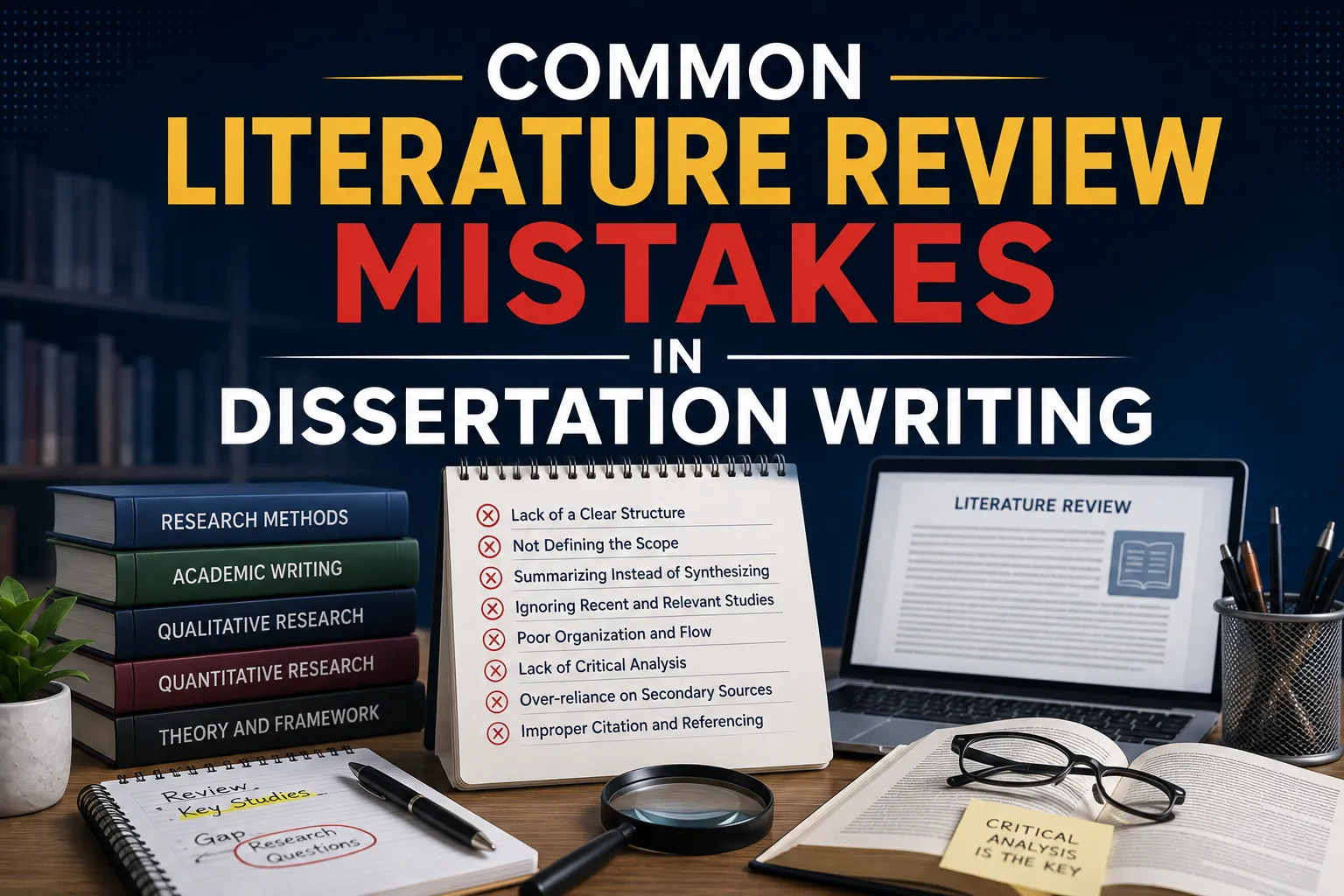
Ask any dissertation supervisor which chapter gets sent back for revision most often, and the literature review usually tops the list — not because students haven't read enough, but because the same handful of avoidable mistakes show up again and again, chapter after chapter, cohort after cohort.
This guide walks through the most common literature review mistakes in dissertation writing — what they actually look like on the page, why they happen, and exactly how to fix or avoid them. We've written it the way an experienced dissertation mentor would talk you through your own draft, because that's genuinely the kind of guidance ThesisLikho's PhD-qualified team provides to the thousands of scholars we've supported through exactly this chapter.
Why the Same Mistakes Keep Recurring
Nearly every one of the mistakes covered in this guide comes from the same root cause: treating the literature review as a reading-comprehension exercise rather than an argument-building one. Students are taught throughout their education to read a source and accurately report what it said — and that instinct, while useful, isn't actually what a literature review chapter needs. A literature review needs you to read many sources and then say something new about how they relate to each other and to your own research question.
Understanding this underlying pattern makes the specific mistakes below easier to recognize in your own writing, since most of them are really just different symptoms of the same root issue: reporting instead of arguing.
Mistake 1: Summarizing Instead of Synthesizing
This is, by a wide margin, the most frequently cited literature review mistake across academic writing guides, and it's worth understanding exactly what it looks like. A summarized review reads like a roll call: "Smith (2019) found that remote work increases efficiency. Jones (2020) discovered that remote work makes people lonely. Brown (2021) noted that it depends on the job role." Each sentence is accurate, properly cited, and completely disconnected from the ones around it — the reader is handed individual puzzle pieces but never sees you assemble them.
A synthesized version connects these same findings into an actual argument: "While early studies suggested remote work reliably increases efficiency (Smith, 2019), more recent research complicates this picture, pointing to loneliness as a significant offsetting cost (Jones, 2020) — a tension that appears to depend heavily on job role and the degree of required collaboration (Brown, 2021)." The underlying sources are identical; what changed is that the second version makes a claim about the relationship between findings, not just a list of what each one said in isolation.
Mistake 2: Undefined or Drifting Scope
A literature review without a clearly defined scope tends to sprawl — pulling in tangentially related studies simply because they mention a shared keyword, without a clear rationale for inclusion. This mistake typically stems from skipping an explicit scoping step before searching: deciding your time frame, geographical focus, and specific sub-topics upfront, rather than discovering your actual boundaries only after you've already read (and now feel obligated to include) forty loosely related papers.
The fix is straightforward but requires discipline: write your scope statement — topic, time window, geographic or population focus, discipline lens — before you run your first search, and revisit it explicitly if you notice yourself including sources that don't clearly serve your stated boundaries.
Mistake 3: Over-Reliance on Secondary Sources
Citing a summary of a study, rather than the original study itself, is a subtle but real credibility issue examiners are trained to notice. Over-relying on secondary sources — textbook summaries, review articles citing the original finding rather than the finding itself — suggests a lack of genuine engagement with primary literature, and can occasionally propagate errors: a widely repeated "fact" traced back to a single misinterpreted or miscalculated original study is a known risk in academic citation chains.
The practical fix: when you come across a compelling finding cited secondhand, track down the original source and read it yourself, even if only the abstract, methods, and conclusion. Secondary sources have a legitimate, limited role — providing general background definitions, typically in an introduction section — but shouldn't form the backbone of your literature review's core argument.
Mistake 4: Starting Before the Research Question Is Settled
A less obvious but genuinely damaging sequencing mistake: diving into extensive literature review writing before your research question is specific enough to guide it. Some methodology guidance actually recommends drafting your methodology section's core logic before your full literature review, precisely because a clear research question focuses your reading and prevents you from researching and reporting on tangents that never end up relevant to your final argument.
If you notice your literature review keeps expanding without ever feeling "done," this is often the underlying cause — the review has no fixed target to build toward, because the research question it's meant to support hasn't been pinned down yet.
Mistake 5: One-Sided Source Selection
A literature review that only engages with research supporting the student's existing viewpoint produces a one-sided, unbalanced chapter — and examiners are quick to spot this pattern, since it usually shows up as an absence of any genuine counterargument or complicating evidence. A robust literature review isn't built on quantity of sources alone; it depends on genuine diversity of perspective, including studies that complicate, contradict, or add nuance to your expected argument.
If your literature review currently reads as entirely one-directional — every source confirming the same conclusion — it's worth actively searching for studies that challenge or complicate that narrative before finalizing the chapter, since including and honestly engaging with contrary evidence generally strengthens, rather than weakens, your eventual argument.
Mistake 6: Subjective Language and Unearned Opinions
Literature reviews exist to present the current state of research on a topic, not to advocate a personal position — which means emotionally loaded language ("shockingly," "unfortunately," "clearly the best approach") and unsupported personal opinions have no real place in this chapter. This mistake is often unintentional; students slip into subjective phrasing simply because it feels more natural to write than neutral, evidence-based prose.
A simple self-check: if a sentence expresses how you feel about a finding rather than what the finding actually shows or how it relates to other research, it likely needs rewording. Your own critical perspective absolutely belongs in a literature review — but it should take the form of identifying gaps, tensions, or unanswered questions in the existing research, not personal reactions to it.
Mistake 7: Unjustified or Unsupported Claims
A specific and easily overlooked mistake: making a factual claim in your literature review without a clear citation trail supporting it. This often happens gradually — a student paraphrases a general "fact" they've absorbed from multiple readings without tracing it to any single specific source, and the resulting sentence ends up floating without support. A useful test for every factual claim in your literature review: could you point to the exact source and passage that supports this specific statement? If not, either find that support or rephrase the claim as more clearly tentative and attributed.
Mistake 8: Poor Organization and Structure
Poor organization is repeatedly named as one of the most damaging literature review mistakes, precisely because it's expensive to fix — a badly structured review usually requires substantial rewriting and restructuring, not light editing, once the problem is identified. This mistake often stems from writing sources in the order they were read, rather than deliberately organizing them by theme before drafting begins.
Common organizational structures worth choosing deliberately, rather than defaulting into by accident, include thematic organization (grouping sources by sub-topic or debate), chronological organization (tracing how understanding of a topic developed over time), and methodological organization (grouping sources by research approach). Choosing one of these explicitly, and sticking to it consistently, prevents the disjointed, hard-to-follow structure that so often triggers a "needs restructuring" comment from a supervisor.
Mistake 9: Over-Quoting Instead of Paraphrasing
APA Style's own guidance is explicit that published authors paraphrase far more often than they quote directly, and student writers should follow the same convention. A literature review stitched together from a series of direct quotations — even properly cited ones — reads as fragmented and under-analyzed, since it leans on other people's exact wording rather than demonstrating your own understanding and synthesis of the material.
Reserve direct quotation for genuinely rare cases where the exact original wording carries specific significance — a precise legal or technical definition, for instance — and paraphrase everything else in your own analytical voice. This isn't just a stylistic preference; it's also one of the more effective ways to avoid inflated similarity scores during plagiarism checks, since heavily quoted text registers as direct textual overlap regardless of correct citation.
Mistake 10: Missing the Forward-Looking Argument
A literature review's job doesn't end at describing what's already been studied — according to guidance drawn from Nature's editor and researcher interviews on review writing, a strong literature review does two things simultaneously: it provides historical context for how a field developed, and it offers a perspective on where that field is heading next. A review that stops at description, without ever pointing toward an unresolved question or emerging direction, misses this second, equally important function.
This mistake often shows up as a literature review chapter that simply ends — no clear closing argument, no explicit statement of what remains unanswered. The fix is to treat your final paragraph as mandatory, not optional: a literature review chapter should always close by explicitly naming the gap your own research is positioned to address.
A Newer Mistake Worth Naming: Unverified AI-Assisted Drafting
A more recent addition to this list, specific to the current academic environment: using AI writing tools to draft literature review content without independently verifying every citation and claim they produce. AI language models can generate plausible-sounding summaries of research that don't accurately reflect what a cited study actually found, or in some cases reference sources that don't exist at all — a risk distinct from, but related to, the over-reliance on secondary sources covered earlier.
If you use AI tools anywhere in your drafting process, treat every factual claim and citation they produce as unverified until you've personally confirmed it against the original source — the same standard covered under Mistake 7's unjustified-claims problem applies here with extra force, since AI-generated inaccuracies can look just as confidently written as accurate ones, with no visible signal to distinguish them. Many Indian universities are now also screening submissions for AI-generated writing patterns as a separate check alongside traditional plagiarism review, which makes independently verifying and substantially rewriting any AI-assisted content in your own analytical voice a matter of academic integrity, not just accuracy.
A Realistic Example Walkthrough
Scenario — Ishaan, a first-time dissertation writer in a business analytics program
Ishaan's first literature review draft ran into several of these mistakes at once, without him initially realizing it. His chapter moved through sources roughly in the order he'd read them, summarizing each one in its own paragraph. He'd relied heavily on a few well-written review articles rather than tracking down the original studies they referenced. And his final paragraph simply stopped, without any explicit statement of what his own research was contributing.
His supervisor's feedback named all three issues directly. Rather than starting over, Ishaan reorganized his existing notes into four clear themes, tracked down and read the three most-cited original studies his secondary sources had been summarizing, and added a closing paragraph explicitly stating the specific gap his research addressed. The underlying reading he'd already done didn't need to be redone — what changed was the structure and the argument built on top of it, which took roughly a third of the time his original drafting had taken, since the hardest thinking (understanding the material) was already complete.
This is a pattern we see constantly in mentoring work: literature review problems are rarely reading problems. They're almost always structural and argumentative problems, and they're considerably faster to fix once named specifically, rather than left as a vague sense that "something isn't working" in the chapter.
Scenario — Meenal, a PhD scholar in an organizational behavior program
Meenal's literature review draft had a different combination of issues. Her chapter engaged almost exclusively with studies supporting her hypothesis that flexible work arrangements improve employee retention, without meaningfully addressing the sizable body of research suggesting mixed or even negative effects in certain organizational contexts. Her committee flagged this directly during her synopsis review, noting that the one-sided treatment made her literature review read more like advocacy than scholarship. In her revision, Meenal deliberately searched for and incorporated three studies presenting contrary or complicating findings, engaging with them honestly rather than dismissing them — and found, somewhat to her surprise, that acknowledging this tension actually strengthened her eventual argument, since it let her position her own research as addressing exactly the kind of contextual variation the contradictory findings pointed toward.
If you'd like a second opinion on your own literature review before it goes to your supervisor, our Dissertation Writing Service offers exactly this kind of structural review from PhD-qualified mentors.
How These Mistakes Show Up Differently Across Disciplines
While the ten mistakes above apply broadly, they tend to surface in slightly different forms depending on your field, and recognizing your discipline's specific pattern can help you spot the issue faster in your own writing.
In management and business dissertations, the summarizing-instead-of-synthesizing mistake often shows up as a series of case-study or company-example paragraphs with no comparative analysis connecting them — describing what happened at three different organizations without ever drawing out what their differences or similarities actually reveal. In technical and engineering dissertations, the over-reliance on secondary sources mistake frequently appears as citing a survey paper's summary of a technique rather than the original paper that introduced it, which can misrepresent technical details that got simplified or altered in the secondary summary. In social science and humanities dissertations, the subjective-language mistake tends to surface more subtly, since interpretive disciplines legitimately involve more evaluative language than quantitative fields — the line between appropriate critical analysis and unsupported personal opinion is worth discussing explicitly with your supervisor, since it's genuinely more field-dependent here than in more purely empirical disciplines.
Knowing which version of these mistakes is most likely to appear in your specific field means you can watch for it proactively, rather than only recognizing the problem after a supervisor has already flagged it.
A few habits catch most of these mistakes before submission, without needing to wait for external feedback. Reading your own literature review aloud, paragraph by paragraph, quickly reveals summarized "roll call" sections, since disconnected source-by-source writing sounds noticeably choppy when read out loud. Checking your reference list against your actual citations reveals over-reliance on a narrow set of secondary sources, since a heavily repeated small handful of citations relative to your total source count is a visible pattern once you look for it. And explicitly re-reading your final paragraph with the question "does this clearly state what's still unanswered" catches the missing forward-looking argument before a supervisor has to point it out.
Pre-Submission Checklist
Before finalizing your literature review chapter, confirm that sources are synthesized into a connected argument rather than summarized one at a time, your scope (time frame, geography, sub-topics) is clearly and explicitly defined, primary sources form the backbone of your review rather than secondary summaries, your research question was reasonably settled before the bulk of the chapter was drafted, your source selection includes genuine diversity of perspective rather than only confirming evidence, your language stays neutral and evidence-based rather than subjective or emotionally loaded, every factual claim traces to a specific, identifiable source, your chapter follows one deliberate organizational structure throughout, paraphrasing (not direct quotation) carries the bulk of your analysis, and your final paragraph explicitly states the specific gap your research addresses.
Getting Expert Support
Even experienced researchers benefit from a second, structural read on a literature review draft before it goes to their supervisor — these ten mistakes are common precisely because they're easy to miss in your own writing, even when you'd catch them instantly in someone else's.
ThesisLikho's mentoring team — PhD-qualified experts who've guided over 10,000 scholars through this exact chapter — offers structured literature review review as part of our Dissertation Writing Service, helping you catch and fix these patterns before submission.
Frequently Asked Questions
What are the common literature review mistakes in dissertation writing? The most frequent mistakes include summarizing sources instead of synthesizing them into a connected argument, undefined or drifting scope, over-reliance on secondary sources, one-sided source selection, poor organization, over-quoting instead of paraphrasing, and ending the chapter without a clear statement of the research gap.
How long does it take to complete a dissertation using this approach?
Avoiding these mistakes from the start, rather than discovering and fixing them after a full draft, typically saves several weeks of restructuring time — a poorly organized literature review often requires substantial rewriting once identified, while a well-structured one built around a clear synthesis approach from the beginning moves through revision far more quickly.
Is professional help available for literature review mistakes in dissertation writing?
Yes — structured mentoring on literature review structure, synthesis technique, and source evaluation is a standard, legitimate form of academic support. ThesisLikho's PhD-qualified mentors offer this kind of guided review for dissertation scholars.
Why do literature review mistakes in dissertation writing matter?
These mistakes directly affect how credible and persuasive your entire dissertation appears to examiners, since the literature review is where you demonstrate command of your field and build the case for your own research's contribution — a weak version of this chapter undermines confidence in everything that follows.
How do literature review mistakes affect a dissertation overall?
A flawed literature review chapter typically requires substantial rework, delays your methodology and results chapters (which depend on a clearly established gap), and can lead directly to a "revise and resubmit" outcome at proposal or synopsis stage if left uncorrected.
Get Dissertation Help Now
If you'd like a mentor to review your literature review chapter for these exact mistakes before you submit it, ThesisLikho's team is ready to help.