
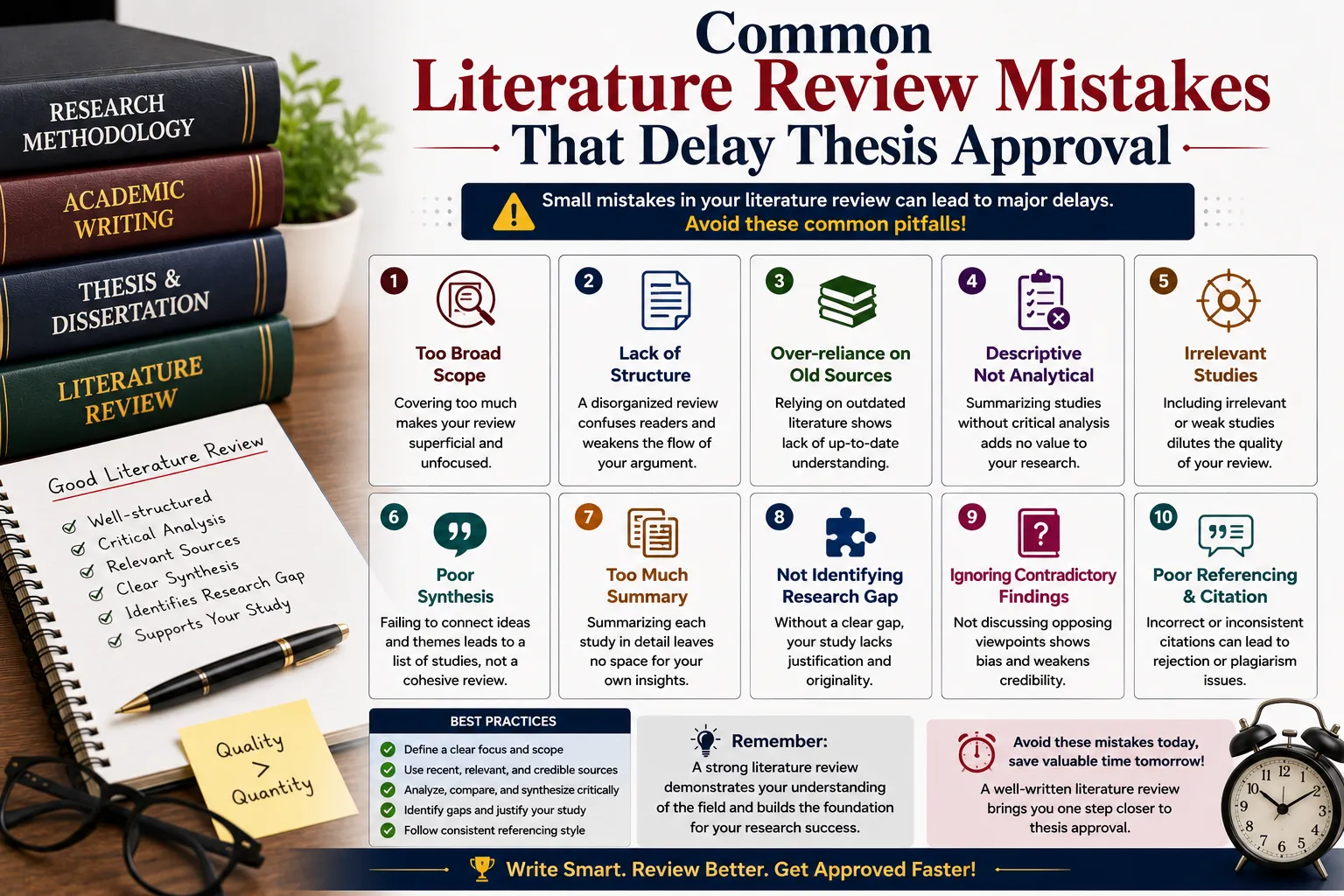
If your literature review chapter has come back from your supervisor marked "needs revision" more than once, you're not alone — and you're probably not dealing with a writing problem. You're dealing with one of a handful of common literature review mistakes that delay thesis approval, almost all of which are structural, not stylistic. The good news is that once you can name the mistake, it's usually fixable in days, not weeks.
This guide walks through the mistakes that most often send a literature review back for revision — from confusing it with a systematic review, to building an annotated bibliography instead of an argument, to citation inconsistencies that quietly erode your credibility with examiners. Along the way, you'll find the fixes research scholars actually use to get their chapter approved on the first or second pass.
Why the Literature Review Is Where Approvals Stall
Of all the thesis chapters, the literature review is the one most likely to bounce back from committee review — not because it's the hardest to write, but because it's the easiest to write incorrectly while still feeling finished. A chapter can be long, well-referenced, and confidently written, and still fail to do the one thing a literature review actually has to do: build an argument about what's known, what's contested, and what's missing.
Supervisors and examiners are trained to spot this quickly. A literature review that lists sources instead of synthesizing them, or that borrows systematic-review language without following systematic methods, reads as underdeveloped even when the underlying research behind it is solid. That mismatch — real effort, wrong structure — is the single biggest reason literature review chapters get sent back for revision rather than approved.
Understanding the specific mistakes below won't just help you avoid a rejected chapter. It will make your literature review genuinely stronger, because most of these mistakes are also what separate a review that merely reports the field from one that positions your thesis within it.
Mistake 1: Confusing a Literature Review With a Systematic Review
This is one of the fastest ways to lose credibility with a committee. A traditional literature review — the kind most thesis chapters require — is a narrative synthesis of existing research, organized thematically around your research questions. A systematic review is a different, standalone research method entirely: it follows a pre-registered protocol with explicit inclusion and exclusion criteria, a fully documented search strategy across specific databases, and a formal quality assessment of every included study, typically reported using PRISMA guidelines.
The mistake happens in both directions. Some scholars call their narrative review "systematic" without actually following a systematic protocol — a red flag supervisors notice immediately. Others attempt genuine systematic methods without realizing how much documentation PRISMA requires: PRISMA exists specifically because incomplete reporting makes a systematic review impossible to properly evaluate — a reader can't judge whether your conclusions are trustworthy without knowing exactly how comprehensive your search was, how many studies you excluded and why, and how you assessed bias across included studies.
The fix: Before you write a single paragraph, confirm with your supervisor which type of review your chapter actually requires. If it's a narrative review (true for most thesis literature review chapters), don't borrow systematic-review terminology like "screening" or "eligibility criteria" unless you're genuinely following that protocol. If your discipline or topic does call for a systematic review — common in health sciences, education interventions, and some social science meta-questions — build your search strategy and documentation around the PRISMA four-phase process (identification, screening, eligibility, inclusion) from day one, not retroactively after your committee asks for it.
What This Looks Like in Practice
If your review genuinely follows a systematic protocol, you'll typically need to document: the databases you searched (and when), your exact search string or keyword combination, how many records were initially identified, how many were removed as duplicates, how many were screened by title and abstract, how many were assessed for full-text eligibility, and how many were ultimately included — often visualized as a PRISMA flow diagram. This level of documentation is precisely what allows a reader to appraise whether your review's conclusions are trustworthy, rather than taking your synthesis on faith.
If that level of documentation sounds disproportionate to what your chapter actually needs, that's often a useful signal in itself: most thesis literature review chapters don't require it, because they're narrative reviews built to establish context and identify a gap, not standalone systematic studies. Committing to the wrong format — either accidentally under-documenting a systematic review or over-engineering a narrative one — wastes weeks either way.
Mistake 2: Writing an Annotated Bibliography Instead of a Synthesis
This is arguably the most common structural mistake in first-draft literature reviews, and it's an easy one to fall into because an annotated bibliography genuinely is a useful step in the process — it just isn't the final product.
The telltale pattern looks like this: "Smith (2020) found that remote work increased productivity. Jones (2021) argued that hybrid models were more effective. Patel (2022) studied employee satisfaction in tech firms." Each sentence is accurate, properly cited, and individually well-written — and the whole passage still fails, because it's a list of what other people said, not an argument about what the field collectively knows, disagrees on, or hasn't yet answered.
A literature review should synthesize research rather than just summarize it — which in practice often means weaving multiple authors into a single paragraph, organized around a theme or claim rather than around individual sources. Building an annotated bibliography as you research is genuinely useful groundwork: writing an annotation for each source forces closer, more critical reading than simply collecting citations, and it helps you see where your own research fits into the larger scholarly conversation. The mistake isn't in creating that bibliography — it's in submitting it, lightly reworded, as your literature review chapter.
The fix: Once your annotated bibliography is built, don't write your review source by source. Group your sources by theme, method, finding, or debate, and organize your chapter around those groupings instead. Use transitional language that signals relationships between sources — "in contrast," "building on this work," "a significant limitation of this approach, however" — because that's the language of synthesis, not summary.
To see the difference concretely: a summary-style passage reads, "Kumar (2023) found that flexible work arrangements improved retention in Indian IT firms. Sharma (2024) reported similar findings in the manufacturing sector." A synthesized version of the same material reads, "The link between flexible work arrangements and retention appears consistent across sectors — Kumar (2023) documented this in IT firms, and Sharma (2024) found comparable effects in manufacturing, suggesting the relationship may hold independent of industry type. What remains unclear across both studies, however, is whether this effect persists for hourly or contract-based employees, a gap this thesis addresses directly." The second version does everything the first does, plus it compares, connects, and points toward the gap — which is the actual job of a literature review paragraph.
Mistake 3: An Undefined or Overly Broad Search Scope
The most common mistake researchers make at the search stage is casting too wide a net and then drowning in loosely relevant material. A well-scoped literature review answers one focused question, or a small set of tightly related questions — not an entire field. Scholars who skip this scoping step often end up with a review that reads as unfocused, because it technically covers "the topic" without making clear which specific slice of the topic the thesis is actually engaging with.
This mistake compounds badly. A broad, undefined scope makes it harder to identify a genuine research gap later (you're competing with too much unrelated literature to see the pattern), and it often results in a chapter that's simultaneously too long and too thin — long in word count, thin in argument.
The fix: Before searching, write down your review's boundaries explicitly: which population, time period, methodology, geography, or sub-question you're covering, and — just as importantly — what you're deliberately excluding and why. This single paragraph, drafted before your search begins, will save you from having to retroactively narrow a sprawling first draft.
Mistake 4: Skipping a Theoretical Framework
In many disciplines — especially social sciences, education, and management — the literature review is expected to do double duty: it should map existing research and establish or justify the theoretical framework your thesis will use. Skipping this is a common oversight, particularly among first-time scholars who treat the literature review purely as a summary chapter.
A literature review can argue for the relevance of a specific theoretical approach, or combine multiple theoretical concepts into a framework built specifically for your research question. Left out entirely, this absence tends to surface later as a bigger problem — usually when a scholar reaches the methodology chapter and realizes there's no clearly justified lens connecting their literature review to their analysis.
The fix: As you group your sources thematically, ask which theory, model, or conceptual lens keeps reappearing across the studies most relevant to your question. That recurring framework — whether it's a single established theory or a combination you're building a case for — belongs explicitly in your literature review, not bolted on later.
Mistake 5: Inconsistent or Incorrect Citation Management
Citation errors rarely sink a chapter on their own, but accumulated inconsistency signals carelessness to an examiner in a way that's disproportionate to the actual error. APA 7th edition, published in 2020, remains the current standard across most social science, education, and management theses, and it comes with specific, checkable rules: author-date in-text citations, a hanging-indent reference list, and — a rule scholars frequently get wrong — using the first author followed by "et al." for any work with three or more authors from the very first citation, not just subsequent ones. DOIs should be included whenever available, formatted as full hyperlinks rather than plain text.
Mixing citation styles within a single chapter, inconsistent formatting between in-text citations and the reference list, or citing sources you never actually discuss in the body of the review are all patterns examiners flag quickly, because they suggest the reference list was assembled separately from the writing rather than built alongside it.
The fix: Use a reference manager — Zotero and Mendeley are the two most widely used free options among thesis scholars — from your very first source, not retroactively before submission. Both tools let you save sources as you find them and auto-generate APA-formatted citations and bibliographies, which eliminates the majority of formatting inconsistencies that come from manually tracking dozens or hundreds of sources across a long chapter.
Mistake 6: Relying on Outdated Sources
A literature review anchored heavily in sources from a decade ago — even foundational, well-respected ones — risks reading as disconnected from the current state of the field. Failing to include the most recent research results in a review that doesn't reflect where the conversation actually stands today, which is exactly the kind of gap an alert examiner will notice, particularly in fast-moving fields like technology, management, or public health.
This doesn't mean discarding foundational or classic studies — those often belong in your review precisely because they establish the theoretical grounding everything since has built on. The mistake is when recent literature is thin or absent entirely, leaving your review looking like it stopped tracking the field two or three years before you started writing.
The fix: Once your core thematic structure is in place, run a final targeted search filtered to the last 12–18 months specifically. This catches recent studies that may shift, support, or complicate your existing narrative — and demonstrates to your committee that your gap is still current, not one that's already been closed by someone faster.
Mistake 7: No Clear Research Gap at the End
A literature review that ends without explicitly naming what's missing leaves the reader — and the committee — to guess why the thesis needed to be written at all. This is often the final, quiet failure point even in reviews that are otherwise well-organized and well-cited: everything gets summarized and synthesized, but the chapter never delivers its "so what" moment.
The research gap should be the explicit, stated conclusion your literature review is building toward — not an implicit takeaway the reader is expected to infer. It's the direct bridge between your literature review chapter and your problem statement or research objectives. For a deeper walkthrough of identifying and validating that gap before you even begin drafting your chapters, see our earlier guide.
The fix: End your literature review with a dedicated closing section — not just a summary paragraph — that states plainly what the existing research has and hasn't addressed, and how your thesis fills that specific space. If you can't write that closing section in two or three clear sentences, it usually means your synthesis needs another pass before the gap becomes visible.
What Supervisor Feedback Usually Signals
If you've received vague-sounding feedback on a literature review draft, it often maps directly onto one of the mistakes above, even when the wording doesn't say so explicitly:
- "This reads like a list" or "this feels disjointed" almost always points back to Mistake 2 — an annotated-bibliography structure rather than a thematic synthesis.
- "I'm not sure what gap you're addressing" points to Mistake 7 — the review never arrives at an explicit, stated gap.
- "This is too broad" or "narrow your focus" points to Mistake 3 — an undefined search scope that's trying to cover too much ground.
- "What theoretical lens are you using?" points to Mistake 4 — a missing or unstated theoretical framework.
- "Your references aren't consistent" or specific formatting corrections point to Mistake 5 — citation management that wasn't handled systematically from the start.
- "This literature feels dated" points to Mistake 6 — insufficient coverage of the last 12–18 months of published research.
Recognizing which underlying mistake a piece of vague feedback is actually pointing to saves a round of guesswork — and often a round of resubmission — because you can address the structural cause directly instead of making surface-level edits that don't fix the real issue.
Two Real Scenarios: A Chapter Sent Back, and One Approved First Time
Scenario 1 — The chapter that came back for revision. A first-time master's scholar submitted a 40-page literature review chapter organized almost entirely source by source: one paragraph per study, each summarizing a different paper's findings on digital banking adoption. The chapter was thorough and accurately cited, but the supervisor sent it back with a single core comment — "this is a bibliography, not a review." The scholar had to regroup the same sources into four thematic clusters (technology trust, generational adoption patterns, regulatory barriers, and rural access), rewrite the transitions to compare and contrast findings across studies, and add an explicit gap statement at the end. The underlying research didn't change — the structure did, and the second draft was approved without further revision.
Scenario 2 — The chapter approved on the first pass. A different scholar, working on a similar topic, started by drafting a one-paragraph scope statement before searching: which population, time frame, and specific sub-question the review would cover, and what it would deliberately leave out. Sources were logged in Zotero from the first day of research, tagged by theme as they were read. The final chapter was organized around four thematic arguments rather than individual studies, closed with an explicit gap statement, and used consistent APA 7th-edition formatting throughout. The Research Advisory Committee approved the chapter with only minor language suggestions — no structural rework required.
The difference in both cases wasn't research quality. It was whether the chapter was built as an argument from the start, or assembled as a list and hoped into shape afterward.
A Quick Self-Check Before You Submit Your Chapter
Before you send your literature review chapter to your supervisor or committee, run through these checks honestly:
- Is your chapter organized by theme, not by source? If you can point to a paragraph that's really just "Author A said X, Author B said Y," that section likely needs restructuring.
- Have you clearly stated your review's scope and boundaries, including what you deliberately excluded?
- Does your citation style stay consistent throughout, with every in-text citation matching an entry in your reference list?
- Have you included literature from the last 12–18 months, not just foundational or older sources?
- Does your chapter end with an explicit, clearly stated research gap — not an implied one the reader has to infer?
- If you used systematic-review language, have you actually followed a systematic protocol, or should you reframe it as a narrative review?
If you answer "not quite" to more than one of these, it's worth a structural revision pass before submission — this is far faster than a full rewrite after committee feedback.
If you'd like an experienced second opinion on your literature review structure, citation consistency, or gap statement before you submit it, you can check out our Thesis Writing Service — our PhD-qualified mentors regularly help scholars restructure literature review chapters at exactly this stage.
How Long Should a Literature Review Take to Get Right?
There's no single official timeline, but most scholars need several weeks of focused reading, thematic organization, and drafting to move from a raw pile of sources to a properly synthesized chapter — and that estimate assumes the scope was defined clearly at the outset. What usually extends this timeline isn't the reading itself; it's the rework that follows a committee sending back a chapter built around the wrong structure. Avoiding the mistakes above doesn't just speed up your first draft — it protects you from the multi-week revision cycles that come from submitting a chapter that looks finished but isn't structurally sound.
FAQs
What is a literature review mistake that delays thesis approval?
The most common ones are structural: writing an annotated bibliography instead of a thematic synthesis, confusing a narrative literature review with a systematic review, using an undefined or overly broad search scope, inconsistent citation formatting, relying on outdated sources, and ending the chapter without a clearly stated research gap.
Why does avoiding literature review mistakes matter for thesis approval?
Because committees and supervisors are trained to spot structural weaknesses quickly, even when the underlying research is solid. A chapter that reads as a list of summaries rather than a synthesized argument typically gets sent back for revision — costing weeks of rework that a properly structured first draft avoids.
How does a literature review mistake affect a thesis beyond just that chapter?
A weak literature review usually creates downstream problems — an unclear theoretical framework, a vague or missing research gap, and a methodology chapter that doesn't connect cleanly back to the literature. Fixing the review chapter early tends to strengthen every chapter that follows it.
How long does it take to complete a thesis using this approach?
Structuring your literature review correctly from the start doesn't add time to your overall thesis — it removes it, by avoiding the revision cycles that come from committee rejection of a poorly organized chapter.
Is professional help available for literature review mistakes that delay thesis approval?
Yes. Academic mentoring services can review your chapter's structure, citation consistency, and gap statement before you submit it to your committee — supporting your own writing and research rather than replacing it.
A literature review chapter that's built as an argument from the start — scoped clearly, organized thematically, cited consistently, and closed with an explicit gap — tends to move through committee review far faster than one that simply demonstrates how much you've read. If you'd like a second, experienced eye on your literature review before you submit it, our team at ThesisLikho — PhD-qualified mentors who've guided thousands of scholars through this exact chapter — is here to help. Talk to a Thesis Expert.