
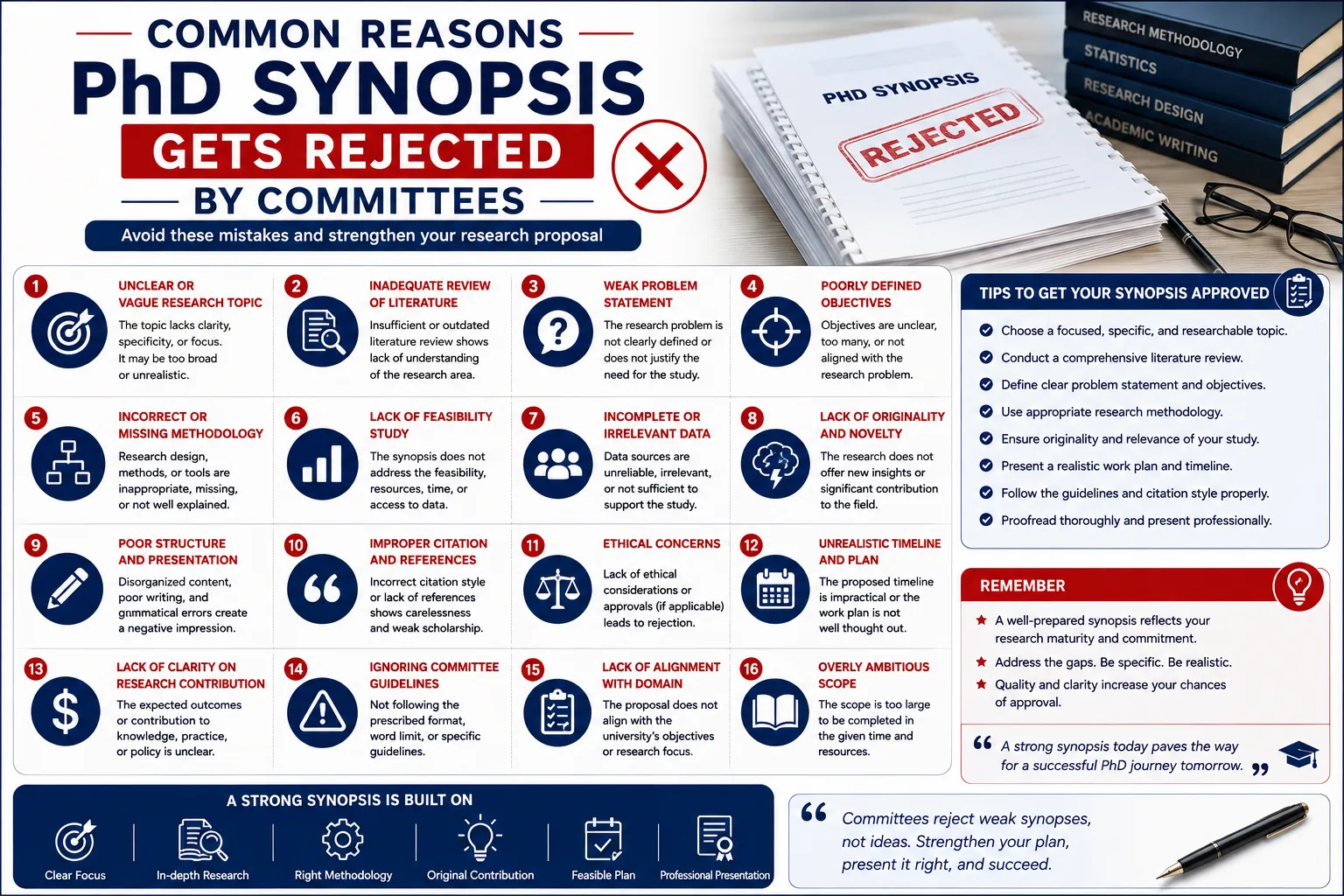
Getting a synopsis sent back isn't rare, and it isn't a verdict on your ability to do doctoral research — it's usually a craft problem, not a capability problem. First submissions get flagged for revision far more often than most scholars expect, and the good news is that the actual reasons a Research Committee sends a synopsis back cluster around a fairly small, predictable, and fixable set of issues.
This guide walks through the common reasons PhD synopsis gets rejected by committees the way an experienced research supervisor would — plainly, with the specific fix for each one. If you're a first-time PhD thesis writer without a strong research background, this is written specifically for you, whether you're preparing your first submission or figuring out what actually went wrong with one that already came back.
At ThesisLikho, our PhD-qualified mentors have guided more than 10,000 scholars through synopsis writing and Doctoral Research Committee presentations across disciplines. What follows draws on that mentoring experience, checked against established guidance on common research proposal and synopsis rejection patterns.
1. Why Synopsis Rejection Is Common and Rarely Fatal
Before working through the specific reasons, it's worth normalizing this experience: a substantial majority of first synopsis submissions receive at least one request for revision from the committee — this is close to the norm, not the exception, and it typically takes a first-time researcher only a few weeks to revise and resubmit successfully once the specific issues are identified.
A rejection or revision request almost always means the committee couldn't yet see a feasible, well-scoped, defensible project — not that the underlying research idea lacks merit or that you lack the ability to complete a PhD. That distinction matters practically: the fix is usually sharpening the craft of the proposal itself, not abandoning the research direction or losing confidence in your capability to do the work.
Understanding this distinction upfront changes how you approach the revision process. Scholars who treat a rejection as a verdict on their intelligence or research ability tend to spiral, second-guessing their entire topic and sometimes abandoning genuinely promising research directions unnecessarily. Scholars who treat it as a specific, diagnosable craft problem — this section was too vague, that gap wasn't clearly stated, this timeline wasn't realistic — tend to fix the actual issue efficiently and move forward. The ten reasons below are meant to help you do the second thing.
2. Reason 1: The Research Topic Is Too Broad or Poorly Articulated
This is consistently identified as one of the most common reasons a synopsis gets sent back. A topic like "the impact of digital transformation on business" or "mental health among college students" sounds substantive, but it's actually unmanageable — there's no way to design a feasible methodology, timeline, or scope around a topic this large, and committees know this immediately.
The fix is specificity: your topic needs to clearly address the who, what, where, and when of your proposed research, narrowing it into something genuinely manageable within a PhD timeline. A well-articulated version of a broad idea like "organisational trust" might become something closer to "the factors that cultivate organisational trust between customers and companies within the Indian life insurance industry" — specific enough that a committee can immediately picture what data you'd collect and how you'd analyze it, rather than needing to guess at the actual scope you have in mind.
3. Reason 2: No Clear Research Gap Despite an Extensive Literature Review
A synopsis can include dozens of citations and still fail on this point, because listing relevant studies isn't the same as demonstrating a gap. Failing to properly synthesize the literature — rather than simply listing what's been done — is repeatedly flagged as one of the most damaging, common weaknesses in rejected synopses.
The fix requires more than reading widely; it requires synthesis. Your literature review needs to integrate existing research into a coherent summary, explicitly identify weaknesses or limitations in that existing work, and clearly connect those limitations to the specific gap your proposed research will fill. A literature review that reads as a list of individually summarized papers, without ever stepping back to say "here's what's missing across all of this work," has done the reading but not the synthesis — and committees can tell the difference immediately.
One practical habit that helps considerably: after summarizing each cluster of related studies, write a single explicit linking sentence stating what those studies collectively establish and what they collectively fail to address. Do this consistently throughout the chapter, and your stated research gap at the end will read as the natural, inevitable conclusion of everything preceding it — rather than an assertion that appears somewhat disconnected from the review that came before it.
4. Reason 3: Objectives, Research Questions, and Aims Don't Align
A surprisingly common, purely structural problem: a synopsis's stated goals, its specific objectives, and its research questions don't actually match each other. Your aim might promise to "explore," while your objectives describe something closer to "measure," while your research questions ask something different again — and this kind of misalignment, even when each individual piece looks reasonable in isolation, creates exactly the disparity that triggers rejection.
The fix is a deliberate consistency check: write your central aim, your specific objectives, and your research questions, then explicitly trace each objective back to the aim and each research question back to a specific objective. If any of the three doesn't map cleanly onto the others, that's the mismatch to resolve before submission — not something to hope a committee won't notice.
5. Reason 4: Insufficient Justification of Methodology
Naming a methodology isn't the same as justifying it, and this distinction trips up first-time writers constantly. It's not enough to state that you'll use interviews, or a survey, or a specific analytical technique — you need to explain why that specific method is the right fit for your specific research problem and questions, since committees need to see that you've genuinely figured out how you'll actually conduct the research, not just that you've picked a method that sounds appropriate.
The fix connects directly back to your research questions: for each major methodological choice, state explicitly why it suits your specific question, and where relevant, briefly note why you didn't choose a plausible alternative instead. A poor or thin research design is repeatedly identified as one of the single most common reasons for outright rejection, which makes this section worth genuinely over-preparing rather than treating as a formality.
A useful test: read your methodology section and ask whether it answers "how, specifically" for every major step, or whether it settles for "what" alone. "Semi-structured interviews will be conducted" answers what. "Semi-structured interviews will be conducted with fifteen purposively selected mid-level managers, because the research question requires understanding individual decision-making processes that a structured survey couldn't capture in sufficient depth" answers how and why. Committees are reading for the second version throughout, not just the first.
6. Reason 5: A Weak or Superficial Theoretical Foundation
Committees include subject-matter experts specifically capable of spotting a thin theoretical foundation immediately, and a few specific warning signs recur constantly: heavy reliance on personal opinion or anecdote rather than academic literature, missing the landmark or foundational studies in the specific research area, and leaning on low-quality or outdated sources rather than current, authoritative ones.
The fix requires genuinely demonstrating command of your field, not just gesturing toward it — your theoretical review needs to show you've engaged with the actual foundational and current literature that defines your specific research area, not just literature that happened to be convenient to find. If you're uncertain whether your reading has covered the genuinely important work in your area, ask your supervisor directly for the two or three papers or books they'd consider essential reading — a gap here is exactly the kind of thing an expert committee member notices within the first few minutes of reading your review.
7. Reason 6: An Infeasible or Unrealistic Timeline
A proposal that's scientifically sound on paper can still be rejected because the committee can't see how the described scope of work fits within your programme's actual timeframe. This is a distinct problem from methodology weakness — the methods themselves might be entirely appropriate, but the amount of work described (multiple large data collection phases, extensive fieldwork across several locations, an unrealistically ambitious sample size) simply doesn't fit inside a standard PhD tenure.
The fix is honest scoping: build a realistic timeline — a Gantt chart or a clear written breakdown — that a committee can check against your programme's actual duration and any fixed milestone dates it enforces. If your proposed scope doesn't comfortably fit, the more strategic move is narrowing the research itself before submission, rather than submitting an overambitious plan and hoping the mismatch goes unnoticed.
Reason 7: Poor Writing, Formatting, or Presentation
Even a technically sound synopsis can lose real credibility through poor language and sloppy presentation — this is repeatedly named as a factor that reduces a proposal's impact even when every other element meets the bar. This isn't about needing literary flair; it's about clarity, consistency, and the basic professionalism a formal academic document is expected to demonstrate.
The fix is straightforward but easy to skip under deadline pressure: proofread carefully, maintain consistent formatting and heading styles throughout, and, ideally, have someone else — a supervisor, a peer, or a professional editor — read the document before submission. A synopsis riddled with typos or inconsistent formatting signals rushed, careless work, even when the underlying research thinking is genuinely strong.
Reason 8: Not Following Your University's Specific Requirements
A technically excellent synopsis can still be rejected purely on procedural grounds if it doesn't comply with your specific institution's format requirements — margins, section ordering, word or page limits, required components. This is one of the most frustrating rejection reasons precisely because it has nothing to do with the quality of your actual research thinking.
The fix is simple but non-negotiable: read your department's specific synopsis format guidelines directly, in full, before finalizing your document, rather than relying on generic online templates or a friend's synopsis from a different department or university. Where guidelines are ambiguous, ask your supervisor or department office directly rather than guessing.
Reason 9: Inconsistent Tense and Confused Research Stage Signaling
A subtler, easily overlooked issue: inconsistent verb tense throughout a synopsis can genuinely signal confusion about what stage your research is actually at. A synopsis proposing research that hasn't yet been conducted should generally use future tense consistently ("this study will examine…"), while a completed thesis or dissertation typically shifts to past or present tense. Mixing these inconsistently — describing your proposed methodology in past tense as though it's already been executed, for instance — creates a confusing, unprofessional impression even when the underlying content is sound.
The fix is a dedicated tense-consistency pass during your final proofread, checking specifically that your synopsis reads throughout as a proposal for work not yet done, not a report of work already completed.
Reason 10: Plagiarism or Insufficiently Original Framing
Plagiarism concerns — whether from improperly cited sources or content that too closely mirrors existing published work — are a serious, occasionally career-affecting reason for synopsis rejection, and one that requires zero tolerance in how you handle it. Beyond outright plagiarism, a synopsis can also be rejected for insufficient originality more broadly: proposing research that's essentially a repeat of existing, already well-covered work without a genuinely novel angle, population, context, or method.
The fix starts with rigorous citation discipline throughout your drafting process, not just a final plagiarism-checker pass — cite as you write, not retroactively. On originality specifically, your literature review's gap-identification work (covered in Reason 2) is your best defense here: a clearly and specifically stated gap is itself the evidence that your proposed research isn't simply repeating what's already been done.
12. How to Diagnose Which Reason Applies to Your Synopsis
If your synopsis has already been sent back, the committee's specific feedback is your most direct diagnostic tool — read it carefully and map each comment to one of the reasons above rather than treating the feedback as a vague, generalized rejection. If you're preparing a first submission and want to pressure-test it before sending, work through each reason above as a checklist: is your topic specific enough to state in one sentence with clear scope; does your literature review synthesize rather than list; do your aim, objectives, and questions align; is every methodological choice explicitly justified; does your theoretical foundation draw on current, authoritative, field-defining sources; is your timeline realistic against your programme's actual duration; is your formatting clean and your university's specific requirements met; is your tense usage consistent throughout; and is your citation practice rigorous.
Running through this list honestly, ideally with a supervisor's input, before submission catches the large majority of what would otherwise come back as a revision request.
It's worth being honest with yourself during this exercise rather than reading generously through your own draft. It's genuinely difficult to spot vagueness or misalignment in your own writing, precisely because you already know what you mean — a reader encountering the document for the first time doesn't have that advantage. This is exactly why a fresh pair of eyes, whether a supervisor, a peer in a different specialization, or a professional reviewer, tends to catch issues a self-review misses; if you can, build at least one round of genuinely external feedback into your timeline before formal submission, rather than relying solely on your own read-through.
13. What to Do After a Rejection or Revision Request
Whatever you do, don't simply make superficial edits and resubmit an essentially unchanged document — committees notice this, and resubmitting the same proposal with only minor edits is specifically flagged as a critical error that undermines your credibility further. Instead, treat the revision process as genuine, substantive work: address the specific feedback directly and visibly, and where the feedback points to a deeper issue (a genuinely unclear gap, an infeasible scope), take the time to actually resolve it rather than patching around it.
It's also worth knowing that revision cycles are a normal, expected part of the process — most first-time researchers take only a few weeks to revise and resubmit successfully once they understand the specific issues, and a synopsis that required one or two rounds of revision is not unusual or a mark against you once it's ultimately approved.
If you'd like a second set of eyes on your synopsis before submission — checking it against exactly these common rejection patterns — our Synopsis Writing service works through this stage with scholars directly.
14. Two Realistic Case Studies
Case Study 1 — Fixing a Topic That Was Too Broad
A scholar's first synopsis submission proposed research on "employee engagement in Indian organizations" and was returned with a note that the scope was unmanageable. Rather than resubmitting with only cosmetic changes, the scholar narrowed the topic to "the relationship between flexible work arrangements and employee engagement among mid-level managers in Indian IT services firms" — specifying the who, what, and context the original version lacked. The narrowed version was approved on the next submission, with the committee specifically noting that the scope now matched a genuinely completable PhD project.
Case Study 2 — Resolving an Aims-Objectives-Questions Mismatch
A first-time scholar's synopsis was sent back with feedback that the research questions didn't clearly follow from the stated objectives, even though each section individually looked reasonable. On review, the scholar discovered the aim promised to "explore attitudes," the objectives described measuring specific attitude scores, and the research questions asked about causal relationships — three subtly different framings that had drifted apart during multiple rounds of independent editing. Rewriting all three sections together, in a single sitting, to explicitly trace back to the same underlying research focus resolved the mismatch, and the revised synopsis was approved without further comment on this point.
FAQs
What is the most common reason a PhD synopsis gets rejected by committees?
A topic that's too broad or poorly articulated, and a literature review that lists existing research without synthesizing it into a clearly identified gap, are consistently the two most frequently cited reasons — both are fixable through deliberate narrowing and synthesis rather than requiring an entirely new research direction.
Why does understanding these rejection reasons matter?
Because a rejection or revision request almost always reflects a fixable craft issue in how the proposal is presented, not a judgment on your capability to complete doctoral research — knowing the specific, common patterns lets you diagnose and fix your own synopsis proactively, rather than guessing at what went wrong.
How does this affect a PhD synopsis in practice?
Scholars who check their synopsis against these common rejection patterns before submission typically face fewer revision cycles, and those who do receive a revision request can address it more precisely and efficiently once they understand which specific issue applies.
How long does it take to complete a synopsis using this approach?
Most first-time researchers take only two to three weeks to revise and resubmit a synopsis successfully once specific committee feedback is available — building a synopsis carefully against these common pitfalls before first submission typically avoids this revision cycle altogether.
Is professional help available for reasons a PhD synopsis gets rejected by committees?
Yes — support with reviewing your synopsis against common rejection patterns, strengthening your research gap, and ensuring methodology and formatting are properly justified is available through services such as Synopsis Writing.
Ready to get your synopsis approved on the first submission? Get Synopsis Help Now from ThesisLikho's PhD-qualified mentors.