
SEO Meta Title
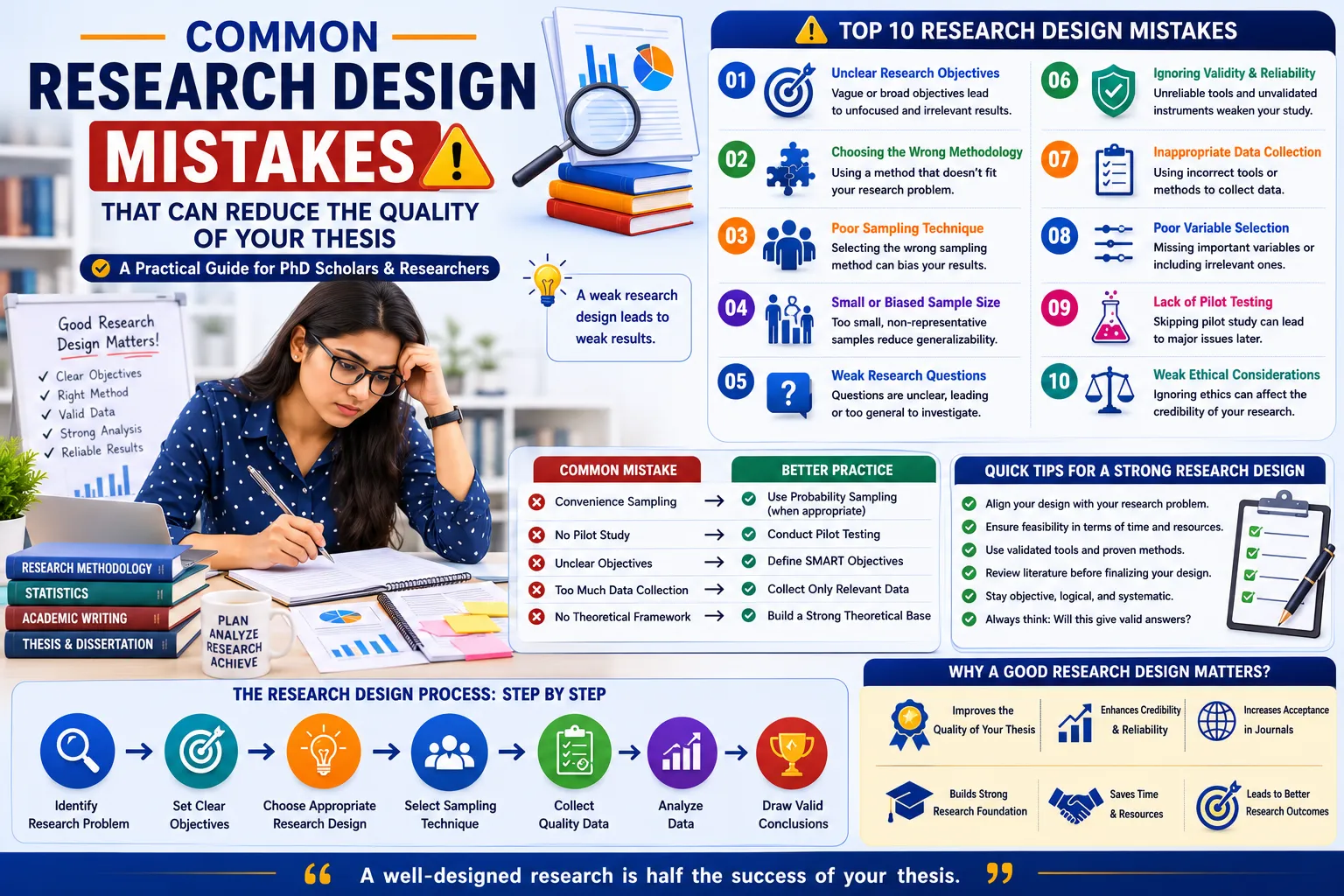
Common Research Design Mistakes That Can Reduce the Quality of Your Thesis (2026 Guide)
Meta Description
Discover the most common research design mistakes that weaken thesis quality and learn practical strategies to avoid them. Improve your research methodology, data collection, and academic credibility with this comprehensive guide.
SEO Slug
common-research-design-mistakes-that-can-reduce-thesis-quality
Common Research Design Mistakes That Can Reduce the Quality of Your Thesis
Introduction
A well-designed research study is the foundation of every successful thesis. Whether you are pursuing a PhD, Master's, MPhil, or undergraduate degree, your research design determines how effectively you answer your research questions and achieve your study objectives. Even the most interesting research topic can produce weak or unreliable findings if the research design is poorly planned.
Unfortunately, research design is one of the most misunderstood aspects of academic research. Many students spend weeks selecting a research topic and reviewing literature but devote very little time to planning how the research will actually be conducted. As a result, they encounter problems such as inappropriate sampling, poorly designed questionnaires, unclear variables, inconsistent data collection, weak statistical analysis, and conclusions that are difficult to justify.
Research design is much more than selecting a qualitative or quantitative approach. It involves creating a logical framework that connects your research problem, objectives, hypotheses, methodology, sampling strategy, data collection methods, analysis techniques, and interpretation of findings. Every component must work together to produce valid, reliable, and meaningful results.
The encouraging news is that most research design mistakes are entirely preventable. By understanding the common pitfalls and following best practices, you can improve the quality of your thesis, satisfy your supervisor's expectations, and increase the chances of publishing your research in reputable academic journals.
This comprehensive guide explores the most common research design mistakes that reduce thesis quality and provides practical solutions to avoid them.
What Is Research Design?
Research design is the overall plan or blueprint that guides your entire research project. It explains how data will be collected, measured, analyzed, and interpreted to answer your research questions.
A strong research design helps you:
- Address your research objectives effectively.
- Collect relevant and reliable data.
- Minimize bias and errors.
- Use appropriate analytical methods.
- Produce credible and reproducible findings.
Without a well-structured research design, even high-quality data may fail to answer the intended research questions.
Why Research Design Matters
A carefully planned research design influences every stage of your thesis.
It helps you:
- Select appropriate participants.
- Choose suitable research methods.
- Develop effective research instruments.
- Improve reliability and validity.
- Reduce unnecessary costs and delays.
- Strengthen academic credibility.
- Produce meaningful conclusions.
Simply put, a good research design provides the roadmap that keeps your study focused and organized.
Mistake 1: Choosing a Research Topic That Is Too Broad
One of the most common mistakes is selecting an overly broad topic.
For example:
Poor Topic
"Digital Marketing in India."
This topic is far too broad to investigate effectively.
A better version would be:
"The Impact of Social Media Marketing on Customer Purchase Intentions Among Small Retail Businesses in Delhi."
A focused topic makes it easier to define objectives, select participants, and collect relevant data.
Mistake 2: Unclear Research Objectives
Research objectives guide every methodological decision.
Weak objectives often lead to:
- Irrelevant data collection
- Poor questionnaire design
- Inappropriate statistical analysis
- Confusing conclusions
Effective objectives should be:
- Specific
- Measurable
- Achievable
- Relevant
- Time-bound (where appropriate)
Each objective should contribute directly to answering your main research question.
Mistake 3: Weak Research Questions
Research questions should clearly identify the relationship or phenomenon being investigated.
Poor example:
"What do people think about education?"
Improved version:
"How does online learning affect student academic performance in higher education institutions?"
Focused research questions improve study design and simplify data analysis.
Mistake 4: Selecting the Wrong Research Design
Many students choose a research design simply because it is familiar rather than because it fits the research problem.
Examples include:
- Using quantitative methods to explore deeply personal experiences.
- Choosing qualitative interviews when numerical comparisons are required.
- Selecting experimental designs when manipulation is impossible.
Choose your research design based on your objectives—not personal preference.
Common research designs include:
- Descriptive
- Exploratory
- Experimental
- Correlational
- Case Study
- Cross-sectional
- Longitudinal
- Mixed Methods
Each serves different research purposes.
Mistake 5: Ignoring Existing Literature
Some researchers rush into data collection without thoroughly reviewing previous studies.
A literature review helps you:
- Identify research gaps.
- Avoid duplication.
- Understand theoretical frameworks.
- Select validated research instruments.
- Improve methodology.
A weak literature review often results in poorly justified research decisions.
Mistake 6: Poor Variable Definition
Every variable should have a clear conceptual and operational definition.
For example:
Conceptual definition:
"Customer satisfaction refers to a customer's overall evaluation of a product or service."
Operational definition:
"Customer satisfaction will be measured using a five-point Likert scale consisting of ten validated questionnaire items."
Clearly defining variables improves measurement accuracy and consistency.
Mistake 7: Using an Inappropriate Sampling Method
Sampling directly affects the quality of your findings.
Common sampling mistakes include:
- Using convenience sampling when random sampling is required
- Selecting participants who do not represent the target population
- Ignoring inclusion and exclusion criteria
- Failing to justify sample size
A representative sample increases the credibility and generalizability of your research.
Mistake 8: Choosing an Insufficient Sample Size
A sample that is too small may not provide enough statistical power to detect meaningful relationships.
Conversely, collecting far more data than necessary wastes time and resources.
Determine sample size using:
- Statistical formulas
- Power analysis
- Established research guidelines
- Previous studies in your field
Always justify your sample size in your methodology chapter.
Mistake 9: Designing Poor Research Instruments
Your questionnaire, interview guide, or observation checklist determines the quality of your data.
Common problems include:
- Leading questions
- Ambiguous wording
- Double-barreled questions
- Technical jargon
- Irrelevant items
- Excessively long questionnaires
A well-designed instrument should be simple, focused, and directly aligned with your objectives.
Mistake 10: Skipping Pilot Testing
Many researchers begin full-scale data collection without testing their research instrument.
A pilot study helps identify:
- Confusing questions
- Technical problems
- Missing response options
- Time required for completion
- Reliability issues
Pilot testing improves both validity and reliability while reducing errors during the main study.
Mistake 11: Ignoring Reliability and Validity
Collecting data without evaluating reliability and validity weakens research credibility.
Reliability ensures consistency, while validity ensures that your instrument measures what it is intended to measure.
Strengthen your study by:
- Using validated instruments
- Conducting expert reviews
- Testing internal consistency
- Assessing construct and content validity
Evidence of reliability and validity is essential for high-quality academic research.
Mistake 12: Collecting Data Inconsistently
Even well-designed instruments can produce unreliable results if data collection procedures vary.
Examples include:
- Different instructions for different participants
- Changing interview questions
- Inconsistent observation methods
- Recording responses differently across researchers
Standardized procedures improve reliability and reduce bias.
Mistake 13: Overlooking Ethical Considerations
Ethics is a critical component of research design.
Common ethical mistakes include:
- Failing to obtain informed consent
- Violating participant confidentiality
- Collecting data without institutional approval
- Coercing participation
- Mishandling sensitive information
Ethical research protects participants and strengthens the integrity of your study.
Mistake 14: Collecting Unnecessary Data
Some students believe that more data automatically leads to better research.
In reality, collecting information unrelated to your objectives:
- Increases respondent fatigue
- Complicates analysis
- Wastes time
- Reduces response quality
Collect only the data needed to answer your research questions.
Mistake 15: Choosing Inappropriate Data Analysis Techniques
Statistical methods should match your research objectives and data type.
Examples:
- Descriptive statistics for summarizing data
- Correlation analysis for relationships
- Regression analysis for prediction
- ANOVA for group comparisons
- Thematic analysis for qualitative interviews
Using inappropriate analytical techniques can produce misleading conclusions.
Mistake 16: Ignoring Assumptions of Statistical Tests
Many statistical techniques have assumptions that must be checked.
Examples include:
- Normality
- Homogeneity of variance
- Independence of observations
- Linearity
- Absence of multicollinearity
Ignoring these assumptions may invalidate your results.
Mistake 17: Confirmation Bias
Researchers sometimes interpret findings in ways that support their expectations.
Confirmation bias may influence:
- Participant selection
- Interview questioning
- Data interpretation
- Reporting results
Maintain objectivity by allowing the evidence—not personal beliefs—to guide your conclusions.
Mistake 18: Weak Documentation
Poor documentation creates confusion during thesis writing.
Maintain detailed records of:
- Sampling procedures
- Questionnaire versions
- Data collection dates
- Consent forms
- Coding systems
- Data cleaning decisions
Comprehensive documentation improves transparency and reproducibility.
Mistake 19: Poor Time Management
Research projects often experience delays because students underestimate the time required for:
- Literature review
- Ethical approval
- Pilot testing
- Participant recruitment
- Data collection
- Data analysis
- Thesis writing
Develop a realistic timeline with contingency periods for unexpected challenges.
Mistake 20: Drawing Conclusions Beyond the Data
Researchers sometimes make claims that their evidence cannot support.
For example, a correlational study cannot establish cause-and-effect relationships.
Your conclusions should:
- Be supported by your findings
- Acknowledge limitations
- Avoid overgeneralization
- Suggest realistic implications
Responsible interpretation enhances academic credibility.
Best Practices for Designing a High-Quality Thesis
To avoid common research design mistakes, follow these best practices:
- Define a focused research problem.
- Develop clear objectives and research questions.
- Conduct a thorough literature review.
- Select the most appropriate research design.
- Clearly define variables.
- Choose representative participants.
- Justify your sample size.
- Develop reliable and valid research instruments.
- Conduct a pilot study.
- Standardize data collection procedures.
- Obtain ethical approval.
- Use suitable analytical methods.
- Document every stage of the research process.
- Interpret findings objectively.
- Discuss limitations honestly.
These practices help ensure your study is methodologically sound and academically rigorous.
A Research Design Checklist
Before beginning your thesis, confirm that you can answer "yes" to the following questions:
- Is my research problem clearly defined?
- Are my objectives specific and achievable?
- Do my research questions align with the objectives?
- Have I selected the appropriate research design?
- Is my sampling strategy justified?
- Have I determined an appropriate sample size?
- Are my research instruments reliable and valid?
- Have I planned a pilot study?
- Have I obtained ethical approval?
- Are my data analysis methods suitable?
- Have I prepared a realistic research timeline?
Using this checklist can help identify potential weaknesses before they affect your study.
Conclusion
A strong research design is the backbone of a successful thesis. It provides the structure that connects your research problem, objectives, methodology, data collection, analysis, and conclusions into a coherent and scientifically sound study. Unfortunately, many students unintentionally reduce the quality of their research by making avoidable mistakes such as choosing broad topics, using inappropriate sampling methods, neglecting pilot testing, designing weak research instruments, or applying unsuitable analytical techniques.
The good news is that these mistakes can be prevented through careful planning, critical thinking, and adherence to established research principles. By defining clear objectives, conducting a comprehensive literature review, selecting the right methodology, ensuring reliability and validity, maintaining ethical standards, and documenting each stage of the process, you can significantly improve the quality and credibility of your thesis.
Remember that an outstanding thesis is not defined by complexity but by clarity, consistency, and methodological rigor. A thoughtfully designed study produces reliable evidence, answers meaningful research questions, and contributes valuable knowledge to your academic discipline. Investing time in designing your research properly at the beginning of your project will save you countless hours later and provide a solid foundation for successful thesis completion and future publication.
Call / WhatsApp: +91 96438 02216
Website:www.ThesisLikho.com