
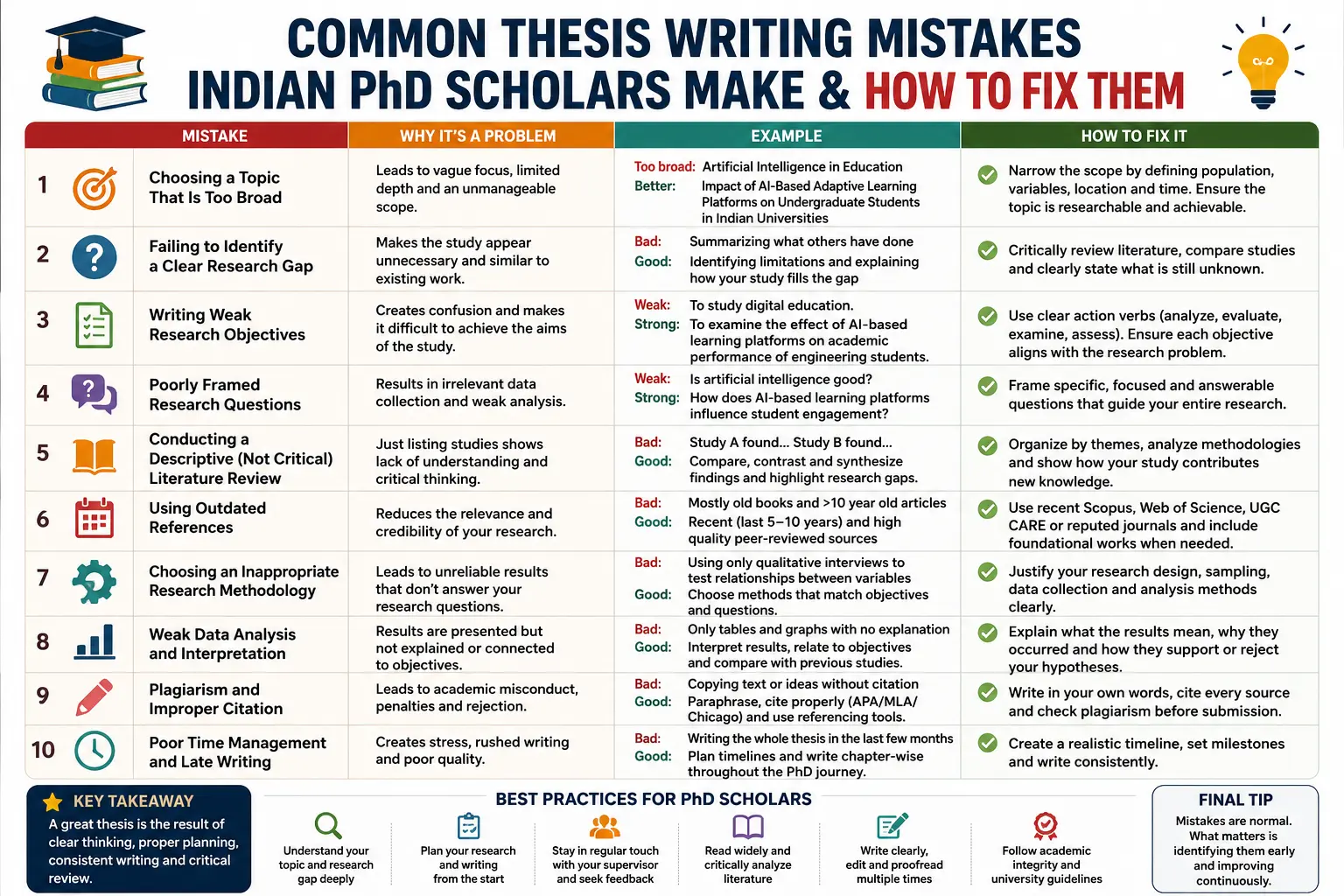
Writing a PhD thesis is one of the most demanding academic tasks a research scholar will undertake. It requires not only subject expertise but also strong research methodology, critical thinking, academic writing skills, and attention to detail. In India, thousands of scholars begin their doctoral journey every year, but many face significant challenges when it comes to thesis writing. While some struggle with research design, others find it difficult to organize their chapters, interpret data, or maintain academic integrity.
The good news is that most thesis writing problems are avoidable. By understanding the common mistakes made by PhD scholars and learning how to correct them, you can improve the quality of your research, reduce revisions, and increase your chances of successful thesis submission and viva voce examination.
This comprehensive guide discusses the most common thesis writing mistakes Indian PhD scholars make, explains why they occur, and provides practical solutions to help you write a clear, well-structured, and academically rigorous thesis.
Why Do PhD Scholars Make Thesis Writing Mistakes?
A PhD thesis is often the first large-scale research project many scholars undertake independently. Common reasons for mistakes include:
- Limited experience with academic research.
- Poor planning and time management.
- Inadequate understanding of research methodology.
- Weak academic writing skills.
- Lack of familiarity with university guidelines.
- Insufficient supervisor interaction.
- Pressure to publish and meet submission deadlines.
Recognizing these challenges early allows scholars to avoid unnecessary setbacks.
Mistake 1: Choosing a Research Topic That Is Too Broad
One of the earliest and most significant mistakes is selecting a topic that is too broad to investigate effectively.
Example
Weak Topic
Artificial Intelligence in Education
This topic covers numerous technologies, educational levels, and outcomes, making it difficult to study comprehensively.
Improved Topic
Impact of AI-Based Adaptive Learning Platforms on Academic Performance of Undergraduate Engineering Students in Indian Universities
The revised topic is focused, researchable, and manageable.
How to Fix It
- Narrow the scope by defining the population, location, variables, and time frame.
- Discuss potential topics with your supervisor before finalizing your proposal.
- Conduct a preliminary literature review to assess feasibility.
Mistake 2: Failing to Identify a Clear Research Gap
Many theses summarize previous studies without explaining why new research is necessary.
A literature review should answer:
- What has already been studied?
- What remains unexplored?
- Why is your research needed?
How to Fix It
Instead of merely reviewing articles, compare findings, identify contradictions, highlight limitations, and explain how your study addresses a specific gap.
Mistake 3: Writing Weak Research Objectives
Objectives that are vague or unrelated to the research problem create confusion throughout the thesis.
Weak Objective
To study digital education.
Improved Objective
To examine the effect of AI-powered learning platforms on academic performance among undergraduate students in Indian universities.
How to Fix It
Use action verbs such as:
- Analyze
- Examine
- Evaluate
- Compare
- Assess
- Determine
- Investigate
Ensure every objective aligns with the research problem and methodology.
Mistake 4: Poorly Designed Research Questions
Research questions should be clear, focused, and answerable.
Weak Question
Is artificial intelligence good?
Better Question
How does the use of AI-based learning platforms influence student engagement and academic performance?
How to Fix It
Each research question should directly correspond to one or more research objectives and guide your data collection and analysis.
Mistake 5: Conducting a Descriptive Instead of Critical Literature Review
A common mistake is listing one study after another without analysis.
Instead of writing:
Author A found...
Author B found...
Author C found...
Group studies by themes, compare methodologies, evaluate strengths and limitations, and explain how your research builds on previous work.
How to Fix It
Organize the review under thematic headings, synthesize evidence, and conclude each section by identifying what is still unknown.
Mistake 6: Using Outdated References
Relying heavily on old books or articles can weaken the relevance of your research.
How to Fix It
- Prioritize recent peer-reviewed journal articles, especially from the last five to ten years.
- Include foundational studies where necessary but balance them with current research.
- Use databases such as Google Scholar, Scopus, Web of Science, IEEE Xplore, PubMed, or discipline-specific repositories.
Mistake 7: Choosing an Inappropriate Research Methodology
Your methodology should match your research objectives and questions.
For example, if your objective is to measure relationships between variables, a qualitative interview design alone may not be sufficient.
How to Fix It
Clearly justify:
- Research design
- Research approach
- Sampling method
- Sample size
- Data collection techniques
- Data analysis methods
Explain why each choice is suitable for your study.
Mistake 8: Poor Questionnaire or Interview Design
Many scholars create questionnaires that are confusing, biased, or unrelated to the research objectives.
Common Problems
- Leading questions
- Double-barreled questions
- Ambiguous wording
- Excessive questionnaire length
How to Fix It
- Keep questions simple and focused.
- Pilot-test your questionnaire.
- Use validated measurement scales where possible.
- Revise based on participant feedback.
Mistake 9: Inadequate Sample Size
A small or poorly selected sample may reduce the reliability of your findings.
How to Fix It
Choose an appropriate sampling technique and justify the sample size using accepted statistical or methodological principles.
Discuss the rationale in your methodology chapter.
Mistake 10: Weak Data Analysis
Presenting tables and graphs without interpretation is a common error.
Data analysis should explain:
- What the results show.
- Why the findings occurred.
- Whether they support your objectives or hypotheses.
- How they compare with previous studies.
How to Fix It
Interpret every table, figure, or statistical output and relate it to your research questions.
Mistake 11: Misinterpreting Statistical Results
Many researchers incorrectly interpret p-values, correlation coefficients, regression results, or reliability statistics.
How to Fix It
- Learn the statistical techniques before conducting analysis.
- Consult a statistician if necessary.
- Report effect sizes and confidence intervals where appropriate.
- Avoid making causal claims unless your study design supports them.
Mistake 12: Ignoring the Theoretical Framework
Some scholars include a theory in Chapter 2 but never refer to it again.
A theoretical framework should guide:
- Research objectives
- Hypotheses
- Methodology
- Interpretation of findings
How to Fix It
Clearly explain how the selected theory supports your variables and revisit it when discussing your results.
Mistake 13: Weak Chapter Organization
A thesis should follow a logical flow.
Common problems include:
- Repetition across chapters.
- Missing transitions.
- Poor paragraph structure.
- Unclear headings.
How to Fix It
Maintain a consistent structure:
- Introduction
- Literature Review
- Methodology
- Results
- Discussion
- Conclusion
Each chapter should build naturally on the previous one.
Mistake 14: Plagiarism and Improper Citation
Plagiarism remains one of the most serious academic issues.
Examples include:
- Copying text without citation.
- Improper paraphrasing.
- Missing references.
- Self-plagiarism.
How to Fix It
- Write in your own words.
- Cite every borrowed idea, figure, or table.
- Use reference management software such as Zotero, Mendeley, or EndNote.
- Check similarity reports before submission.
Mistake 15: Poor Academic Writing
Academic writing should be clear, objective, and concise.
Avoid:
- Long, confusing sentences.
- Informal language.
- Personal opinions without evidence.
- Grammatical errors.
How to Fix It
- Use simple and precise language.
- Prefer active voice where appropriate.
- Proofread carefully.
- Seek professional editing if needed.
Mistake 16: Weak Discussion Chapter
Many scholars simply repeat the results instead of discussing their meaning.
A strong discussion should:
- Interpret findings.
- Compare results with previous studies.
- Explain unexpected outcomes.
- Highlight theoretical and practical implications.
How to Fix It
Focus on answering the question:
"What do these findings mean, and why are they important?"
Mistake 17: Writing a Poor Conclusion
A conclusion should summarize the study without introducing new information.
Common Problems
- Repeating entire chapters.
- Introducing new findings.
- Omitting practical implications.
How to Fix It
Include:
- Summary of findings.
- Contributions of the study.
- Practical recommendations.
- Study limitations.
- Suggestions for future research.
Mistake 18: Ignoring University Formatting Guidelines
Formatting mistakes can delay thesis approval.
Common issues include:
- Incorrect font size.
- Inconsistent headings.
- Improper page numbering.
- Incorrect citation style.
How to Fix It
Download and follow your university's official thesis template from the beginning instead of formatting everything at the end.
Mistake 19: Delaying Thesis Writing Until Research Is Complete
Many scholars wait until all experiments or data collection are finished before writing.
This often leads to stress, rushed work, and inconsistent chapters.
How to Fix It
Write continuously throughout your research.
For example:
- Literature Review during the first semester.
- Methodology after research design.
- Results during data analysis.
- Discussion after interpreting findings.
Writing in stages reduces workload and improves quality.
Mistake 20: Poor Time Management
Many PhD scholars underestimate the time required for literature review, data collection, analysis, revisions, and publication.
How to Fix It
Develop a realistic research timeline with milestones for:
- Proposal preparation
- Literature review
- Data collection
- Data analysis
- Thesis writing
- Revision
- Final submission
Review your progress regularly and adjust the schedule if necessary.
Best Practices for Writing a High-Quality Thesis
To avoid the mistakes discussed above, adopt these best practices:
- Choose a focused and researchable topic.
- Conduct a comprehensive and critical literature review.
- Define clear objectives and research questions.
- Use an appropriate theoretical framework.
- Select a methodology aligned with your research aims.
- Collect reliable and ethical data.
- Interpret results thoughtfully rather than simply reporting them.
- Maintain consistency in formatting and referencing.
- Proofread every chapter multiple times.
- Seek regular feedback from your supervisor.
Consistent effort throughout your PhD is far more effective than rushing near the submission deadline.
Practical Tips for Indian PhD Scholars
If you are pursuing a PhD in India, these recommendations can strengthen your thesis:
- Familiarize yourself with your university's doctoral regulations, formatting requirements, and plagiarism policy from the beginning.
- Use recent research from Scopus, Web of Science, and UGC CARE-listed journals to ensure your literature review reflects current developments.
- Maintain detailed research records, including raw data, analysis outputs, ethics approvals, and laboratory notes where applicable.
- Present your work at seminars and conferences to receive constructive feedback before thesis submission.
- Develop a regular writing habit instead of waiting for "free time."
- Keep your supervisor informed about progress and discuss challenges early rather than after they become major problems.
- Back up all thesis files in multiple secure locations to avoid accidental data loss.
Thesis Writing Checklist Before Submission
Before submitting your thesis, ask yourself the following questions:
- Is the research problem clearly defined?
- Have I identified a genuine research gap?
- Are my objectives and research questions aligned?
- Does the methodology match my research design?
- Have I interpreted my findings instead of simply reporting them?
- Are all references complete and correctly formatted?
- Have I checked grammar, spelling, and formatting?
- Does my thesis comply with university plagiarism limits?
- Have I incorporated feedback from my supervisor?
- Is the overall flow logical and coherent?
A final review using this checklist can help identify weaknesses before submission.
Final Thoughts
Writing a PhD thesis is a complex but rewarding process that requires careful planning, disciplined execution, and continuous refinement. While mistakes are common, they do not have to define the quality of your research. Most thesis writing problems—whether related to topic selection, literature review, methodology, data analysis, academic writing, or formatting—can be avoided through early preparation and consistent guidance.
For Indian PhD scholars, success depends not only on technical knowledge but also on developing strong research habits, maintaining academic integrity, and communicating ideas clearly. By identifying and correcting the common mistakes discussed in this guide, you can produce a thesis that is well organized, academically rigorous, and capable of making a meaningful contribution to your field.
Remember that a high-quality thesis is not written in a few weeks. It is built step by step through thoughtful research, regular writing, critical revision, and constructive feedback. Invest time in every stage of the process, remain open to learning, and treat every revision as an opportunity to improve. With persistence and a systematic approach, you can complete a thesis that meets academic standards, impresses examiners, and becomes a valuable foundation for your future career in research, academia, or industry.
Website: www.thesislikho.com
Call / WhatsApp: +91-96438 02216