
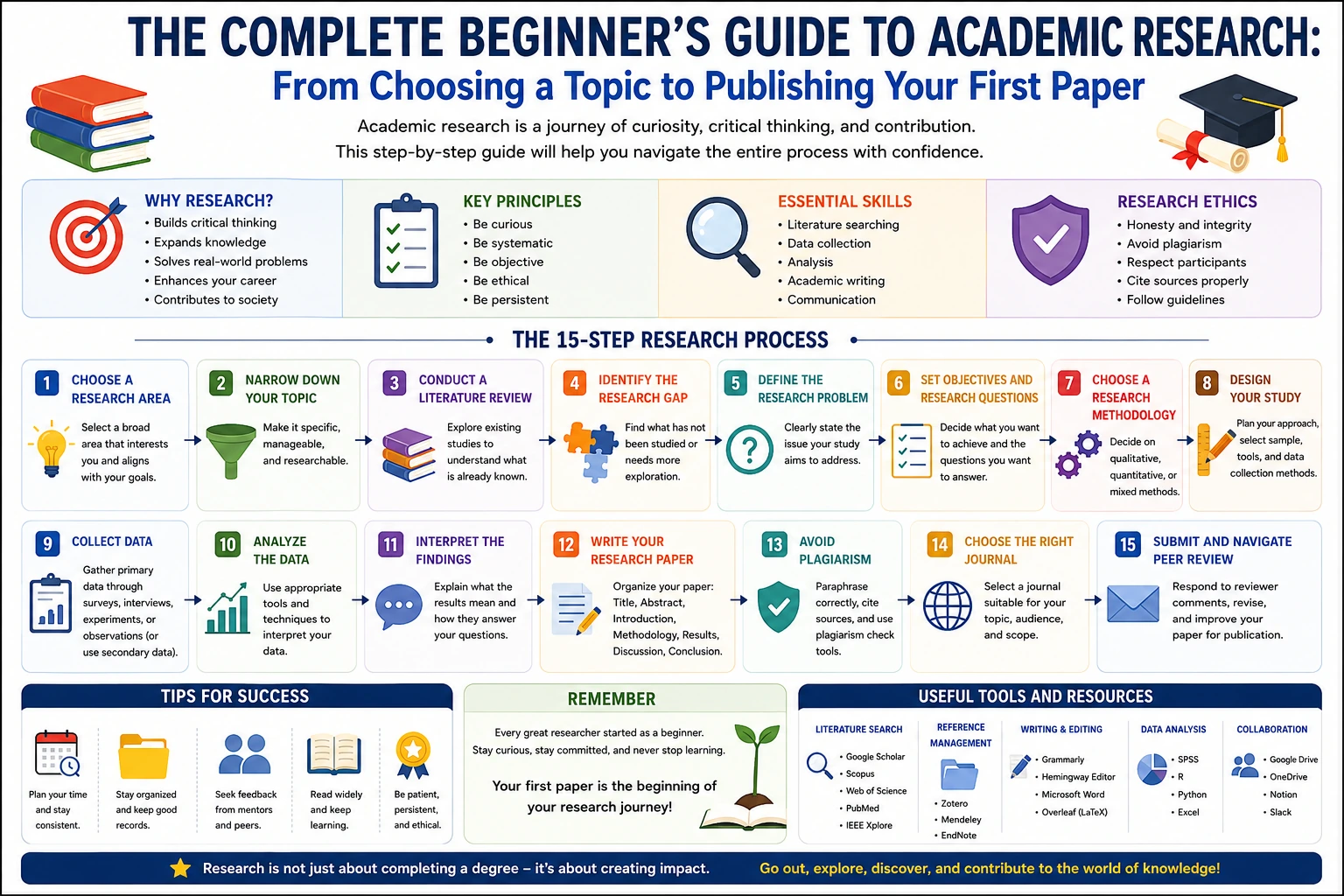
Academic research is the cornerstone of innovation, discovery, and knowledge creation. Whether you are an undergraduate student working on your first project, a Master's student preparing a dissertation, or a PhD scholar embarking on years of independent research, understanding the research process is essential for academic success.
For beginners, however, academic research can feel overwhelming. Questions like How do I choose a research topic? Where do I find credible sources? How do I write a literature review? Which research methods should I use? How can I publish my first paper? are common among new researchers.
The good news is that academic research follows a structured process. Once you understand each stage, research becomes less intimidating and more manageable. From identifying a research problem to publishing your findings in a peer-reviewed journal, every step builds on the previous one.
This comprehensive guide walks you through the complete research journey—from selecting your topic to seeing your work published. Whether you're studying in India or abroad, these principles apply across most disciplines and academic institutions.
What Is Academic Research?
Academic research is a systematic process of investigating questions, testing ideas, and generating new knowledge using scientific and scholarly methods. Unlike casual internet searches or opinion-based writing, academic research is evidence-based, objective, and follows established ethical and methodological standards.
The purpose of academic research is to:
- Solve real-world problems.
- Expand existing knowledge.
- Test theories and hypotheses.
- Develop innovative solutions.
- Inform public policy and professional practice.
- Contribute to scholarly literature.
Research can be conducted in fields such as science, engineering, medicine, management, education, humanities, law, and social sciences.
Why Academic Research Matters
Research plays a vital role in personal, academic, and professional development.
It helps students:
- Develop critical thinking skills.
- Improve analytical and problem-solving abilities.
- Strengthen academic writing.
- Build expertise in a chosen field.
- Increase employability.
- Prepare for higher education and doctoral studies.
- Contribute meaningful solutions to society.
For PhD scholars, research is not only a degree requirement but also the foundation of an academic career.
Step 1: Choose a Research Area That Interests You
Every successful research project begins with curiosity.
Start by identifying a broad area that aligns with your academic background, career goals, and personal interests.
Examples include:
- Artificial Intelligence
- Healthcare Management
- Digital Marketing
- Climate Change
- Education Technology
- Cybersecurity
- Human Resource Management
- Consumer Behaviour
- Renewable Energy
- Entrepreneurship
Choosing a topic that genuinely interests you will make months—or even years—of research more enjoyable and sustainable.
Step 2: Narrow Your Research Topic
Many beginners make the mistake of selecting topics that are too broad.
For example:
Too Broad
Artificial Intelligence in Education
Focused
The Impact of AI Chatbots on Learning Satisfaction Among MBA Students in Indian Universities
Narrow your topic by considering:
- Population
- Geographic location
- Industry
- Time period
- Variables
- Specific research problem
A focused topic makes your research manageable and more likely to contribute new knowledge.
Step 3: Conduct a Literature Review
Before collecting data, understand what researchers have already discovered.
A literature review involves identifying, evaluating, and synthesising existing research related to your topic.
Reliable academic databases include:
- Google Scholar
- Scopus
- Web of Science
- JSTOR
- ScienceDirect
- PubMed
- IEEE Xplore
- ERIC
When reviewing literature, look for:
- Key theories.
- Major findings.
- Research methods.
- Contradictory evidence.
- Research gaps.
- Future recommendations.
Organise your notes using reference management software such as Zotero or Mendeley.
Step 4: Identify the Research Gap
A research gap is an unanswered question or an area that requires further investigation.
Common types of research gaps include:
- Knowledge gaps.
- Population gaps.
- Geographic gaps.
- Methodological gaps.
- Theoretical gaps.
- Practical gaps.
For example, numerous studies may examine online learning in urban universities, while very little research explores its impact in rural colleges.
Your research should aim to fill one meaningful gap.
Step 5: Define Your Research Problem
The research problem clearly states the issue your study intends to address.
A strong problem statement should answer:
- What is the problem?
- Why is it important?
- Who is affected?
- What evidence supports the problem?
- Why has it not been adequately addressed?
A well-defined problem guides the entire research process.
Step 6: Develop Research Objectives and Questions
Research objectives describe what you want to achieve, while research questions specify what you intend to investigate.
Example Objectives
- To analyse the relationship between AI usage and student performance.
- To examine the factors influencing AI adoption in higher education.
Example Research Questions
- Does AI improve academic performance?
- What factors influence student acceptance of AI tools?
Ensure your objectives, questions, and methodology align logically.
Step 7: Choose the Right Research Methodology
Selecting the appropriate methodology is crucial for obtaining reliable results.
Quantitative Research
Uses numerical data and statistical analysis.
Examples:
- Surveys
- Experiments
- Structured questionnaires
Qualitative Research
Explores experiences, opinions, and behaviours.
Examples:
- Interviews
- Focus groups
- Observations
Mixed Methods Research
Combines quantitative and qualitative approaches to provide a comprehensive understanding.
Choose the methodology that best answers your research questions.
Step 8: Design Your Research
Your research design outlines how the study will be conducted.
Key decisions include:
- Target population
- Sampling technique
- Sample size
- Data collection methods
- Research instruments
- Ethical considerations
A well-planned design improves the validity and reliability of your findings.
Step 9: Collect Data
Data collection should follow ethical guidelines and established procedures.
Common methods include:
- Online surveys
- Face-to-face questionnaires
- Interviews
- Focus group discussions
- Observations
- Secondary datasets
- Government databases
Ensure participants provide informed consent and understand how their data will be used.
Step 10: Analyse the Data
The analysis stage transforms raw data into meaningful insights.
Quantitative Analysis Tools
- SPSS
- R
- Python
- Excel
- AMOS
- SmartPLS
Common statistical techniques include:
- Descriptive statistics
- Correlation analysis
- Regression analysis
- ANOVA
- Structural Equation Modelling (SEM)
Qualitative Analysis Tools
- NVivo
- MAXQDA
- ATLAS.ti
Qualitative methods often involve thematic, narrative, or content analysis.
Choose analytical techniques that align with your research objectives.
Step 11: Interpret Your Findings
After analysing the data, explain what the results mean.
Discuss:
- Whether your findings support existing theories.
- How they compare with previous studies.
- Their practical implications.
- Unexpected outcomes.
- Limitations of the study.
Interpretation requires critical thinking rather than simply presenting statistics.
Step 12: Write Your Research Paper
A typical academic paper includes the following sections:
Title
Clear, concise, and informative.
Abstract
A brief summary of the study, including objectives, methods, findings, and conclusions.
Introduction
Provides background information and presents the research problem.
Literature Review
Summarises previous studies and identifies the research gap.
Methodology
Explains how the study was conducted.
Results
Presents findings objectively using tables, charts, and figures where appropriate.
Discussion
Interprets the findings and explains their significance.
Conclusion
Summarises the study, highlights contributions, acknowledges limitations, and suggests future research.
References
Lists all sources using the required citation style.
Step 13: Avoid Plagiarism
Academic integrity is fundamental to research.
Avoid plagiarism by:
- Citing all sources properly.
- Paraphrasing effectively.
- Using quotation marks for direct quotations.
- Maintaining accurate reference lists.
- Using plagiarism detection software before submission.
Originality strengthens your credibility as a researcher.
Step 14: Select the Right Journal
Publishing begins with choosing an appropriate journal.
Consider:
- Scope and subject relevance.
- Peer-review process.
- Indexing (Scopus, Web of Science, UGC CARE where applicable).
- Acceptance rate.
- Publication timeline.
- Open-access policies.
- Journal reputation.
Never submit to predatory journals that promise guaranteed publication without proper peer review.
Step 15: Prepare Your Manuscript
Before submission:
- Follow the journal's author guidelines.
- Use the required formatting style.
- Prepare high-quality tables and figures.
- Check grammar and spelling.
- Verify references.
- Write a compelling cover letter.
Attention to detail increases the likelihood of acceptance.
Step 16: Navigate the Peer Review Process
Most academic journals use peer review to evaluate manuscripts.
Possible editorial decisions include:
- Accepted
- Minor revisions
- Major revisions
- Rejected
Receiving revision requests is normal and should be viewed as an opportunity to improve your work.
Respond professionally to reviewers by addressing each comment carefully and explaining any disagreements respectfully.
Step 17: Celebrate Your First Publication
Publishing your first paper is a significant academic milestone.
Once published, promote your research responsibly by:
- Sharing it with colleagues.
- Presenting at conferences.
- Including it in your academic portfolio.
- Updating professional profiles.
- Exploring future research opportunities based on your findings.
Publishing is not the end of the journey—it is the beginning of your research career.
Essential Skills Every Beginner Researcher Should Develop
Academic success depends on more than technical knowledge.
Develop these skills throughout your research journey:
- Critical thinking
- Academic writing
- Literature searching
- Data analysis
- Time management
- Communication
- Problem-solving
- Ethical decision-making
- Project planning
- Collaboration
These skills will benefit you throughout your academic and professional life.
Useful Tools for Academic Research
Modern researchers have access to powerful digital tools that improve productivity.
Literature Search
- Google Scholar
- Scopus
- Web of Science
Reference Management
- Zotero
- Mendeley
- EndNote
Writing
- Microsoft Word
- Google Docs
- Grammarly
Data Analysis
- SPSS
- R
- Python
- NVivo
- MAXQDA
Collaboration
- Google Drive
- Microsoft OneDrive
- Notion
- Trello
Using these tools efficiently can save time and improve the quality of your research.
Common Mistakes Beginners Should Avoid
New researchers often encounter similar challenges.
Avoid these common mistakes:
- Choosing an overly broad topic.
- Skipping the literature review.
- Ignoring the research gap.
- Using unreliable sources.
- Collecting insufficient data.
- Selecting an inappropriate methodology.
- Poor citation practices.
- Weak time management.
- Failing to seek supervisor feedback.
- Submitting to predatory journals.
Learning from these mistakes early will improve your research experience.
Tips for Indian Students and Early-Career Researchers
If you're pursuing research in India, consider these practical recommendations:
- Familiarise yourself with your university's research guidelines and thesis format.
- Use journals indexed in Scopus, Web of Science, or UGC CARE (where applicable).
- Focus on research topics relevant to India's social, economic, technological, or environmental challenges.
- Attend research methodology workshops, conferences, and webinars to strengthen your skills.
- Build a professional academic network by collaborating with faculty members and fellow researchers.
Developing strong research habits early can significantly enhance your academic career.
Frequently Asked Questions (FAQs)
What is academic research?
Academic research is the systematic investigation of a question or problem using scientific methods to generate new knowledge or validate existing theories.
How do I choose a research topic?
Choose a topic that aligns with your interests, has sufficient academic literature, addresses a genuine research gap, and is feasible within your available time and resources.
How long does it take to complete a research paper?
The timeline varies depending on the scope of the study. A small research project may take several weeks, while a PhD research paper may require months or even years of work.
Can beginners publish research papers?
Yes. Many undergraduate, Master's, and PhD students successfully publish research papers by conducting high-quality research and selecting appropriate journals.
Which software is best for beginners?
Google Scholar, Zotero, Microsoft Word, SPSS (for quantitative research), and NVivo (for qualitative research) are widely used and beginner-friendly.
Conclusion
Academic research may seem complex at first, but it becomes much more manageable when approached as a structured, step-by-step process. From selecting a meaningful research topic and conducting a comprehensive literature review to identifying a research gap, choosing the right methodology, analysing data, and publishing your first paper, each stage builds the foundation for the next.
The key to becoming a successful researcher is not mastering everything at once—it is consistently developing your knowledge, skills, and confidence throughout the journey. Stay curious, ask meaningful questions, read extensively, write regularly, and embrace feedback as an opportunity to improve.
Remember that every accomplished researcher started as a beginner. Your first project may feel challenging, but it also marks the beginning of a rewarding academic journey filled with discovery, learning, and the opportunity to contribute valuable knowledge to your field.
Whether your goal is to complete a thesis, earn a postgraduate degree, or publish in an international journal, following the structured approach outlined in this guide will help you navigate the research process with confidence and set the stage for long-term academic success.
Contact ThesisLikho
Call / WhatsApp: +91 96438 02216
Website:www.ThesisLikho.com