
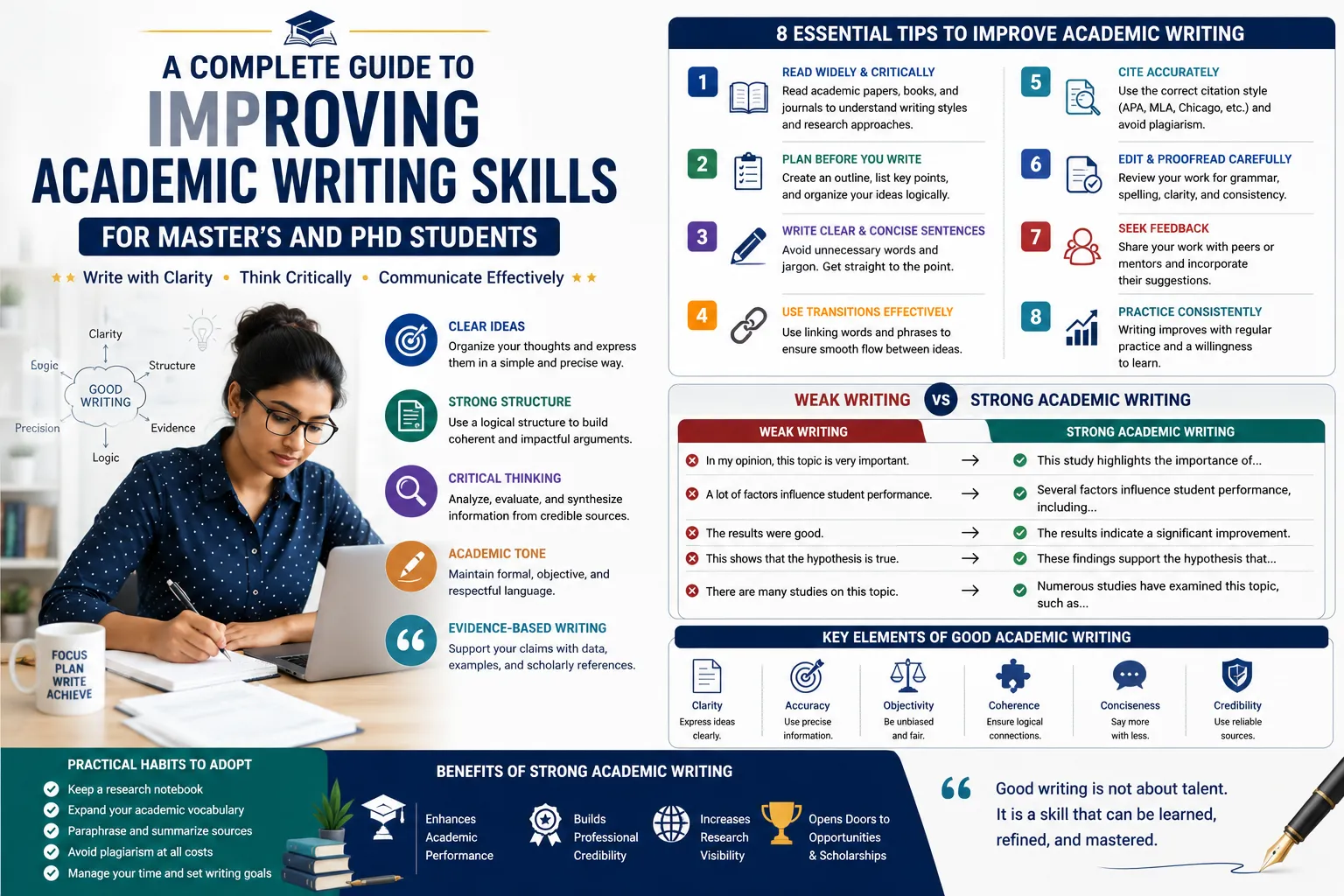
Introduction
Academic writing is one of the most valuable skills every postgraduate student can develop. Whether you are pursuing a Master's degree or a PhD, your ability to communicate research clearly, logically, and professionally plays a significant role in your academic success. From writing research proposals and literature reviews to preparing dissertations, theses, conference papers, and journal articles, academic writing forms the foundation of scholarly communication.
However, many students find academic writing intimidating. They often struggle with organizing ideas, maintaining a formal tone, citing sources correctly, presenting arguments logically, or explaining complex concepts in simple language. Others believe that academic writing requires using complicated vocabulary and long sentences to sound "scholarly." In reality, effective academic writing is not about sounding sophisticated—it is about expressing ideas clearly, accurately, and persuasively while supporting every claim with credible evidence.
Developing strong academic writing skills is a gradual process that requires consistent practice, constructive feedback, and a willingness to revise. The encouraging news is that these skills can be learned by anyone, regardless of their academic discipline. With the right strategies, even students who initially lack confidence can become capable academic writers.
This comprehensive guide provides practical techniques to help Master's and PhD students improve every aspect of their academic writing—from planning and structuring assignments to writing clearly, avoiding common mistakes, and preparing work that meets university and journal standards.
Why Academic Writing Skills Matter
Academic writing is more than a university requirement. It is the primary method researchers use to communicate ideas, share discoveries, and contribute to knowledge.
Strong academic writing helps you:
- Present research findings clearly.
- Demonstrate critical thinking.
- Build persuasive arguments.
- Improve thesis quality.
- Increase publication opportunities.
- Gain positive feedback from supervisors.
- Enhance professional credibility.
Regardless of your discipline, excellent writing enables your research to have greater impact.
Characteristics of Effective Academic Writing
Successful academic writing shares several important characteristics.
It is:
- Clear
- Logical
- Concise
- Objective
- Evidence-based
- Well-organized
- Grammatically accurate
- Properly referenced
- Consistent in style and terminology
These qualities help readers understand and evaluate your research with confidence.
1. Understand the Purpose of Academic Writing
Before writing, ask yourself:
- What am I trying to communicate?
- Who is my audience?
- What evidence supports my argument?
- What conclusions should readers reach?
Every section of your thesis or paper should contribute directly to answering these questions.
Academic writing aims to inform, analyze, evaluate, and contribute to scholarly discussions rather than entertain or persuade emotionally.
2. Read High-Quality Academic Literature Regularly
One of the fastest ways to improve your writing is by reading well-written research papers and theses.
While reading, pay attention to:
- Sentence structure
- Paragraph organization
- Argument development
- Use of evidence
- Transition words
- Academic vocabulary
- Citation style
Reading exposes you to effective writing techniques that you can adapt to your own work.
3. Plan Before You Start Writing
Many students begin writing immediately without organizing their thoughts.
Instead, prepare an outline that includes:
- Main headings
- Subheadings
- Key arguments
- Supporting evidence
- References
- Conclusions
Planning saves time during revision and improves logical flow.
4. Develop Clear Research Questions
Your research questions guide your writing.
Every chapter should contribute to answering them.
Weak research questions often produce:
- Unfocused discussions
- Irrelevant literature reviews
- Confusing conclusions
Clearly defined questions help maintain direction throughout your thesis.
5. Build Strong Paragraphs
Each paragraph should focus on one main idea.
A useful structure includes:
Topic Sentence
Introduces the main point.
Supporting Evidence
Provides research findings, data, or references.
Analysis
Explains why the evidence matters.
Transition
Connects the paragraph to the next idea.
Well-structured paragraphs improve readability and coherence.
6. Use Simple and Precise Language
Academic writing should communicate ideas—not impress readers with difficult vocabulary.
For example:
Instead of:
"Utilize"
Write:
"Use."
Instead of:
"Commence"
Write:
"Begin."
Instead of:
"Due to the fact that"
Write:
"Because."
Simple language often communicates ideas more effectively.
7. Avoid Unnecessary Jargon
Technical terminology is sometimes essential, especially in specialized fields. However, excessive jargon can make your work difficult to understand.
When using specialized terms:
- Define them when first introduced.
- Use them consistently.
- Avoid unnecessary complexity.
Your objective is clarity rather than complexity.
8. Improve Your Academic Vocabulary
Academic vocabulary differs from everyday language.
Useful academic expressions include:
- The findings indicate…
- Previous studies suggest…
- This research demonstrates…
- The evidence supports…
- In contrast…
- Furthermore…
- Consequently…
Building a strong academic vocabulary helps you write more confidently while maintaining a professional tone.
9. Support Every Claim with Evidence
Academic writing depends on evidence, not opinion.
Whenever making an important statement, support it with credible sources such as:
- Peer-reviewed journal articles
- Academic books
- Government reports
- Official statistics
- Reputable institutional publications
Evidence strengthens credibility and persuades readers.
10. Develop Critical Thinking Skills
Good academic writing goes beyond summarizing previous research.
Instead of simply describing studies, ask questions such as:
- What are the strengths of this study?
- What are its limitations?
- How does it compare with other research?
- What research gaps remain?
- How does it support or challenge my research?
Critical evaluation demonstrates deeper scholarly understanding.
11. Maintain an Objective Tone
Academic writing should remain balanced and impartial.
Avoid emotional or exaggerated language such as:
- Amazing
- Terrible
- Obviously
- Everyone knows
- Clearly (without evidence)
Instead, use objective phrases like:
- The findings suggest…
- The results indicate…
- Previous research reports…
- Evidence demonstrates…
Objectivity enhances professionalism.
12. Use Active Voice Appropriately
Many students believe passive voice is mandatory in academic writing.
While passive voice is useful in some contexts, active voice is often clearer.
Example:
Passive:
"The survey was conducted by the researcher."
Active:
"The researcher conducted the survey."
Use whichever form communicates your ideas most effectively.
13. Improve Cohesion and Flow
Readers should move smoothly from one paragraph to the next.
Transition words improve logical flow.
Examples include:
For addition:
- Furthermore
- Moreover
- In addition
For contrast:
- However
- Nevertheless
For cause and effect:
- Therefore
- Consequently
For examples:
- For instance
- Specifically
Effective transitions strengthen coherence.
14. Learn Proper Referencing
Accurate referencing is essential for academic integrity.
Common citation styles include:
- APA
- MLA
- Harvard
- Chicago
- IEEE
Reference management software such as Zotero, Mendeley, or EndNote can simplify citation and bibliography creation while reducing formatting errors.
15. Avoid Plagiarism
Plagiarism includes:
- Copying text without citation
- Inadequate paraphrasing
- Using another author's ideas without acknowledgment
- Self-plagiarism
Avoid plagiarism by:
- Writing in your own words
- Citing all sources
- Using quotation marks for direct quotes
- Checking originality before submission
Ethical writing protects your academic reputation.
16. Revise and Edit Thoroughly
Excellent writing emerges through revision.
Review your work for:
- Structure
- Clarity
- Grammar
- Punctuation
- Consistency
- References
- Formatting
Editing should occur in multiple stages rather than all at once.
17. Seek Constructive Feedback
Supervisors and peers can identify weaknesses you may overlook.
Ask them to evaluate:
- Clarity
- Organization
- Argument strength
- Grammar
- Evidence
- Overall readability
Treat feedback as an opportunity to improve rather than criticism.
18. Develop a Daily Writing Habit
Writing improves through consistent practice.
Consider:
- Writing 300–500 words daily.
- Maintaining a research journal.
- Summarizing journal articles.
- Revising previous chapters.
- Practicing paraphrasing.
Regular writing builds confidence and fluency over time.
19. Use Writing and Editing Tools Wisely
Technology can support—but not replace—careful writing.
Helpful tools include:
- Grammar checkers
- Spell-check software
- Reference managers
- Readability analyzers
- Plagiarism detection tools
Always review suggestions manually, as automated tools may not understand academic context.
20. Manage Your Writing Time Effectively
Avoid leaving writing until the final weeks before submission.
Create a realistic schedule for:
- Literature review
- Methodology
- Data analysis
- Results
- Discussion
- Editing
- Proofreading
Breaking large tasks into smaller milestones reduces stress and improves quality.
Common Academic Writing Mistakes to Avoid
Many Master's and PhD students make similar writing mistakes.
Common errors include:
- Writing long, confusing sentences.
- Using unnecessary jargon.
- Weak paragraph organization.
- Repetition.
- Unsupported claims.
- Inconsistent terminology.
- Poor referencing.
- Lack of critical analysis.
- Grammatical mistakes.
- Failure to revise thoroughly.
Recognizing these issues early can significantly improve your work.
Practical Exercises to Improve Academic Writing
Improvement comes with deliberate practice. Try incorporating these exercises into your weekly routine:
Summarize Research Articles
Read one journal article and summarize its objectives, methods, findings, and conclusions in your own words.
Practice Paraphrasing
Rewrite academic paragraphs without changing their meaning while ensuring proper citation.
Expand Academic Vocabulary
Maintain a notebook of useful academic phrases and transition words.
Analyze Well-Written Papers
Examine how experienced researchers organize arguments, integrate evidence, and conclude sections.
Edit Your Previous Work
Return to older assignments and identify areas for improvement in clarity, grammar, and organization.
These activities help strengthen both writing and critical thinking skills.
Academic Writing Checklist
Before submitting any thesis chapter or research paper, review the following:
- Have I answered my research question?
- Is my writing clear and concise?
- Does each paragraph contain one main idea?
- Are all claims supported with evidence?
- Have I used an objective academic tone?
- Are transitions smooth and logical?
- Have I cited all sources correctly?
- Have I checked grammar and spelling?
- Is terminology consistent throughout?
- Have I revised and proofread carefully?
Using a checklist helps maintain high writing standards.
Conclusion
Academic writing is a skill that every Master's and PhD student can develop through consistent practice, thoughtful planning, and regular revision. While the process may initially seem challenging, improving your writing does not require complicated vocabulary or overly complex sentence structures. Instead, it requires clear thinking, logical organization, strong evidence, and a commitment to communicating ideas effectively.
By reading high-quality research, planning before writing, organizing paragraphs logically, supporting arguments with credible sources, maintaining an objective tone, and revising your work carefully, you can produce writing that meets the expectations of supervisors, examiners, and journal reviewers. Equally important is developing habits such as writing regularly, seeking constructive feedback, and continuously refining your skills through practice.
Remember that academic writing is not simply about completing a thesis or publishing a paper—it is about contributing meaningful knowledge to your field in a way that others can understand, evaluate, and build upon. The stronger your writing skills become, the more effectively your research will reach and influence the academic community. By applying the strategies outlined in this guide, you will not only improve your current assignments but also build a lifelong skill that supports your future academic and professional success.
Call / WhatsApp: +91 96438 02216
Website:www.ThesisLikho.com