
Introduction
Ask most Indian PhD scholars to explain their conceptual framework and you will witness one of two responses. The first is a long, uncomfortable pause followed by a vague reference to the theories mentioned in their literature review. The second is a confident recitation of their theoretical framework — which is not the same thing at all.
The conceptual framework is one of the most misunderstood and most important components of a doctoral thesis. It is misunderstood because most PhD guides treat it briefly, most supervisors assume students will figure it out, and most students confuse it with the theoretical framework, the research methodology, or the literature review itself.
It is important because the conceptual framework is the lens through which your entire study operates. It maps the key concepts of your research, shows how they relate to each other, and connects your specific study to the broader body of theory and knowledge in your field. Without a well-developed conceptual framework, even a technically competent PhD study lacks intellectual coherence.
This guide is written specifically for Indian PhD scholars navigating research in Indian universities, under the UGC framework, across disciplines ranging from education and social work to management, sociology, and the natural sciences. By the end, you will know exactly what a conceptual framework is, how it differs from a theoretical framework, and how to build one systematically for your own thesis.
What Is a Conceptual Framework?
A conceptual framework is a structured visual or written representation of the key concepts in your research study and the proposed relationships between them. It is the researcher's own map of the territory — shaped by existing theory and literature but tailored specifically to the research question at hand.
Think of it this way. Theory is a pre-existing map of a large region, drawn by scholars who came before you. A conceptual framework is the custom map you draw for your specific journey through a specific part of that region, informed by the existing map but specific to your own route.
A conceptual framework typically:
- Identifies the main variables, constructs, or phenomena in your study
- Proposes the relationships between these concepts (causal, correlational, bidirectional, mediating, moderating)
- Grounds these relationships in existing theory and empirical evidence from your literature review
- Visually represents these elements in a diagram, often with arrows or connectors indicating direction of influence
The conceptual framework is usually presented in the early chapters of a PhD thesis — most commonly at the end of the literature review chapter or at the beginning of the methodology chapter — as the bridge between what is already known and what your study will investigate.
Conceptual Framework vs Theoretical Framework: The Distinction Indian Scholars Must Understand
This is the point where most Indian PhD students and even some supervisors lose clarity. The terms are sometimes used interchangeably in the literature, which adds to the confusion. But they are distinct in important ways.
Theoretical Framework
A theoretical framework is the existing theory or theories from the established literature that you adopt as the foundation for your study. It is something you choose from the existing body of knowledge — you adopt it, you do not create it.
Examples of theoretical frameworks used in Indian PhD research:
- Vygotsky's Zone of Proximal Development (in education research)
- Maslow's Hierarchy of Needs (in organizational behavior or management studies)
- Amartya Sen's Capability Approach (in development economics or welfare research)
- Bandura's Social Learning Theory (in psychology or education)
- Habermas's Theory of Communicative Action (in sociology or media studies)
Your theoretical framework tells your reader: "These are the established theories I am working within. These are the intellectual shoulders I am standing on."
Conceptual Framework
A conceptual framework, by contrast, is something you construct. It emerges from your engagement with the literature — including but not limited to your theoretical framework — and it maps the specific concepts and proposed relationships that are central to your particular study.
Your conceptual framework tells your reader: "Given the existing theories and evidence, here is how I conceptualize the specific phenomenon I am studying. Here are the key concepts, here is how I think they relate to each other, and here is what I am going to investigate."
A useful way to remember the distinction: the theoretical framework is borrowed; the conceptual framework is built. Both are grounded in the literature, but the conceptual framework is your original intellectual contribution to organizing and framing your specific research problem.
Can They Overlap?
Yes. In many PhD theses, the conceptual framework incorporates and extends the theoretical framework. A scholar studying teacher motivation in Indian government schools might adopt Self-Determination Theory as the theoretical framework but build a conceptual framework that adds contextual variables specific to Indian public education — institutional culture, resource availability, community expectations — that the original theory does not address.
This layering is precisely what makes a conceptual framework valuable: it adapts existing theory to your specific research context.
Why Indian PhD Scholars Struggle with Conceptual Frameworks
Several factors specific to the Indian academic context make the conceptual framework particularly challenging for doctoral scholars:
Supervisory variation. Some supervisors require a formal conceptual framework chapter or section; others never mention it. Without consistent guidance, scholars either ignore it or treat it as an afterthought.
Over-reliance on Western frameworks. Many Indian disciplines import theoretical frameworks wholesale from Western academic traditions without interrogating their applicability to Indian social, cultural, or institutional contexts. A conceptual framework built this way lacks the contextual sensitivity that a PhD examiner will probe.
Confusion with the literature review. Indian PhD students sometimes produce what amounts to a very long literature review and call it a conceptual framework. A literature review surveys what others have found; a conceptual framework synthesizes those findings into a structured map of your own research territory.
Pressure to replicate existing work. The culture in some Indian departments — particularly where PhD guides have a preferred methodological template — can pressure scholars to replicate the supervisor's own framework rather than develop an original one.
Lack of explicit training. Unlike in some Western doctoral programmes where framework development is a structured part of the coursework, Indian PhD programmes under the UGC format often leave this entirely to the scholar-supervisor relationship.
Understanding these challenges is the first step toward overcoming them.
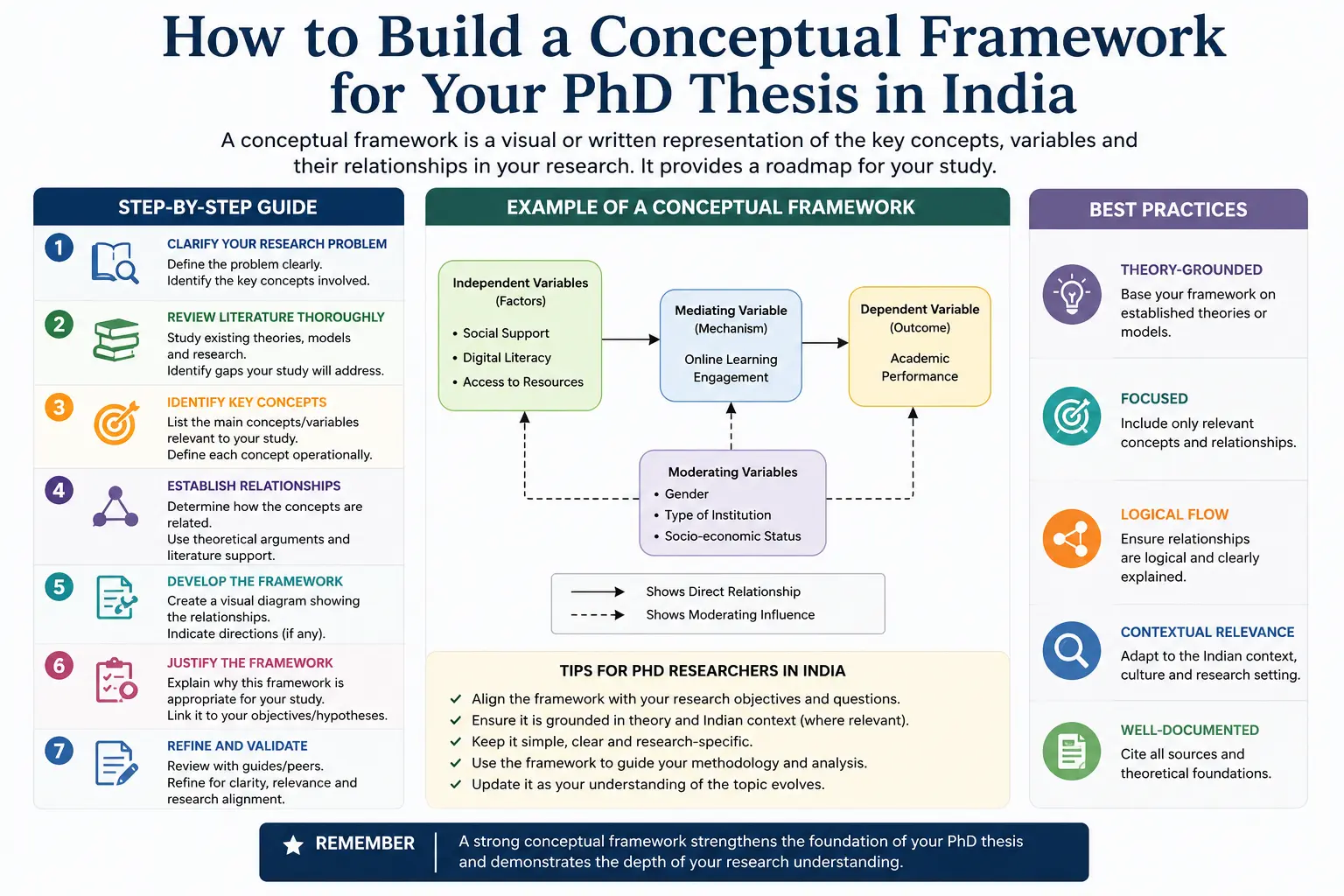
Step-by-Step Guide to Building a Conceptual Framework for Your PhD Thesis
Step 1: Clearly Articulate Your Research Problem and Research Questions
You cannot build a conceptual framework before you know what you are researching. Begin with a clear, specific statement of your research problem and derive your research questions from it.
Your conceptual framework will ultimately map the concepts that appear in your research questions. If your research question is vague or sprawling, your conceptual framework will be too.
Example research problem: Female secondary school teachers in rural Rajasthan demonstrate lower retention rates than their urban counterparts despite similar qualification levels.
Derived research questions:
- What factors influence the job satisfaction of female teachers in rural Rajasthan government schools?
- How do institutional support, community attitudes, and professional development opportunities relate to teacher retention in rural settings?
- What role does self-efficacy play in the relationship between institutional support and teacher retention?
These questions already reveal the key concepts: job satisfaction, institutional support, community attitudes, professional development, self-efficacy, teacher retention. These become the building blocks of your conceptual framework.
Step 2: Conduct and Synthesize Your Literature Review
Your conceptual framework is built from your literature review, not before it. You must engage deeply with the existing scholarship before you can map the conceptual terrain.
As you review the literature, do the following:
Identify recurring concepts. Which variables or constructs appear repeatedly across studies related to your topic? These are the core concepts that belong in your framework.
Note proposed relationships. How do scholars in your field theorize the relationships between these concepts? Which variables are treated as independent, which as dependent, which as mediating or moderating?
Identify gaps and contradictions. Where does the existing literature leave questions unanswered, or where do findings conflict? Your conceptual framework should be oriented toward these gaps — your study fills them.
Note the theoretical bases. Which theories have scholars drawn on to explain the concepts and relationships in your area? These inform your theoretical framework and, by extension, your conceptual framework.
Step 3: Identify Your Key Concepts and Variables
From your literature synthesis, list all the major concepts relevant to your research. Then categorize them:
Independent variables (IV): Concepts that influence or predict outcomes (e.g., institutional support, community attitudes, professional development opportunities)
Dependent variable (DV): The outcome your study seeks to explain or predict (e.g., teacher retention)
Mediating variables: Concepts that explain the mechanism through which an IV affects the DV (e.g., self-efficacy — institutional support may increase self-efficacy, which in turn increases retention)
Moderating variables: Concepts that affect the strength or direction of the IV-DV relationship (e.g., years of service, school location)
Contextual factors: Background conditions that shape the entire system without being directly measured as variables (e.g., rural-urban divide in India, state education policy)
Not every study will have all these elements. Simple studies may have only IVs and a DV. Complex interdisciplinary studies may involve multiple mediators, moderators, and contextual layers.
Step 4: Propose the Relationships Between Concepts
This is the intellectually demanding step — and the one that distinguishes a genuine conceptual framework from a simple list of variables.
Based on your literature review, propose how each concept relates to the others:
- Does institutional support directly affect teacher retention?
- Does self-efficacy mediate the relationship between institutional support and retention?
- Does community attitude moderate the effect of professional development on self-efficacy?
Each proposed relationship should be supported by evidence from the literature or logically derived from existing theory. This is not speculation — it is informed theorizing based on what the literature suggests and what your research context implies.
Write a brief narrative justification for each proposed relationship. This narrative, alongside the visual diagram, constitutes your conceptual framework.
Step 5: Draw the Conceptual Framework Diagram
The visual representation is important. It allows your reader — and your examiner — to grasp at a glance the structure of your study. A good conceptual framework diagram:
- Presents all key concepts as labeled boxes or circles
- Uses arrows to indicate direction of proposed relationships
- Distinguishes between direct effects, mediating pathways, and moderating effects (often shown with different arrow styles)
- Is clean, uncluttered, and easy to read
- Is accompanied by a legend or explanatory notes if needed
Use simple tools: Microsoft Word's SmartArt, PowerPoint, Canva, or draw.io for a clean digital diagram. Avoid overly complex diagrams with dozens of variables — if your framework looks like a circuit board, it needs to be simplified.
Common diagram structures for Indian PhD research:
The most common is the input-process-output (IPO) model — particularly used in management, education, and social sciences — where independent variables feed into a central process and produce outcomes.
The mediational model is used when the researcher is interested in the mechanism through which one variable affects another.
The ecological or contextual model situates the key variables within layers of context — individual, institutional, community, policy — often drawing on Bronfenbrenner's ecological systems theory.
Step 6: Write the Narrative Explanation
The diagram alone is not enough. Write a structured narrative that:
- Introduces each concept and briefly defines it as you are using it in your study
- Explains each proposed relationship and cites the literature supporting it
- Acknowledges any assumptions embedded in the framework
- Explains any adaptations you have made to existing frameworks or theories to fit the Indian context
- States what the framework implies for your research methodology (what you will measure or explore, and how)
The narrative should be a coherent argument, not a list of definitions. It should read as your intellectual justification for why your study is designed the way it is.
Step 7: Revisit and Refine After Data Collection
The conceptual framework you build before data collection is a proposed framework. After you collect and analyze your data, you may find that some proposed relationships were not supported, that additional concepts emerged as important, or that the direction of relationships was different from what you theorized.
A PhD thesis should acknowledge this evolution. In your discussion chapter, revisit your conceptual framework in light of your findings. Where your data confirmed the framework, say so. Where it challenged or complicated the framework, discuss what this means. This reflexive engagement with your own framework is a mark of intellectual maturity that examiners value highly.
Contextualizing Your Conceptual Framework for India
Indian PhD scholars have a responsibility — and an opportunity — that their counterparts in Western institutions sometimes do not. India's social, cultural, institutional, and policy contexts are distinct in ways that affect virtually every research domain.
A conceptual framework developed for teacher motivation in Finland may not travel intact to rural Chhattisgarh. A framework for organizational commitment built on data from American corporations may not capture the dynamics of family-owned enterprises in Gujarat or public sector organizations in West Bengal.
When building your conceptual framework, ask explicitly: what aspects of the Indian context are relevant to my research problem? These contextual factors — caste dynamics, language diversity, federalism in education and health policy, urban-rural disparities, gender norms, the role of family structures — should be named in your framework, even if they are treated as background conditions rather than measured variables.
Scholars like Amartya Sen, Partha Chatterjee, André Béteille, Krishna Kumar, and Shiv Visvanathan have developed theoretical and conceptual tools specifically grounded in Indian social reality. Drawing on this tradition not only strengthens your conceptual framework — it contributes to the Indianization of academic knowledge, which the National Education Policy 2020 explicitly encourages.
Common Mistakes to Avoid
Drawing the diagram before reading the literature. The framework must emerge from the literature, not precede it. Drawing a diagram before you have done the reading produces a framework that is speculative rather than grounded.
Including too many concepts. A conceptual framework with fifteen variables and twenty-five arrows is not comprehensive — it is confused. Focus on the core concepts most relevant to your research questions.
Copying a framework from a published paper without adaptation. It is legitimate to draw on and adapt existing frameworks — in fact, this is encouraged. But presenting someone else's framework as your own without adaptation or acknowledgment is academically problematic.
Ignoring the Indian context. Adopting a Western framework wholesale and applying it to Indian data without interrogating its cross-cultural validity is a common weakness in Indian PhD theses.
Treating the framework as a one-time task. Your framework should be a living document that is revisited, refined, and discussed throughout your thesis — not a box ticked in Chapter 2 and never mentioned again.
Final Thoughts
A well-built conceptual framework is one of the clearest signs of a mature doctoral researcher. It demonstrates that you have not just read the literature but have synthesized it. It shows that you understand how your specific research question sits within a broader intellectual landscape. It gives your methodology coherence and your discussion a foundation.
For Indian PhD scholars working under the UGC framework, across diverse disciplines and institutional contexts, the conceptual framework is also an opportunity to think critically about how existing theory applies — or does not apply — to Indian realities. That critical thinking, grounded in the literature and honestly articulated, is precisely what doctoral research is for.
Take the time to build your framework carefully. It will repay that investment across every chapter of your thesis.
Contact ThesisLikho Today
Call / WhatsApp: +91 96438 02216
Visit: ThesisLikho.com