
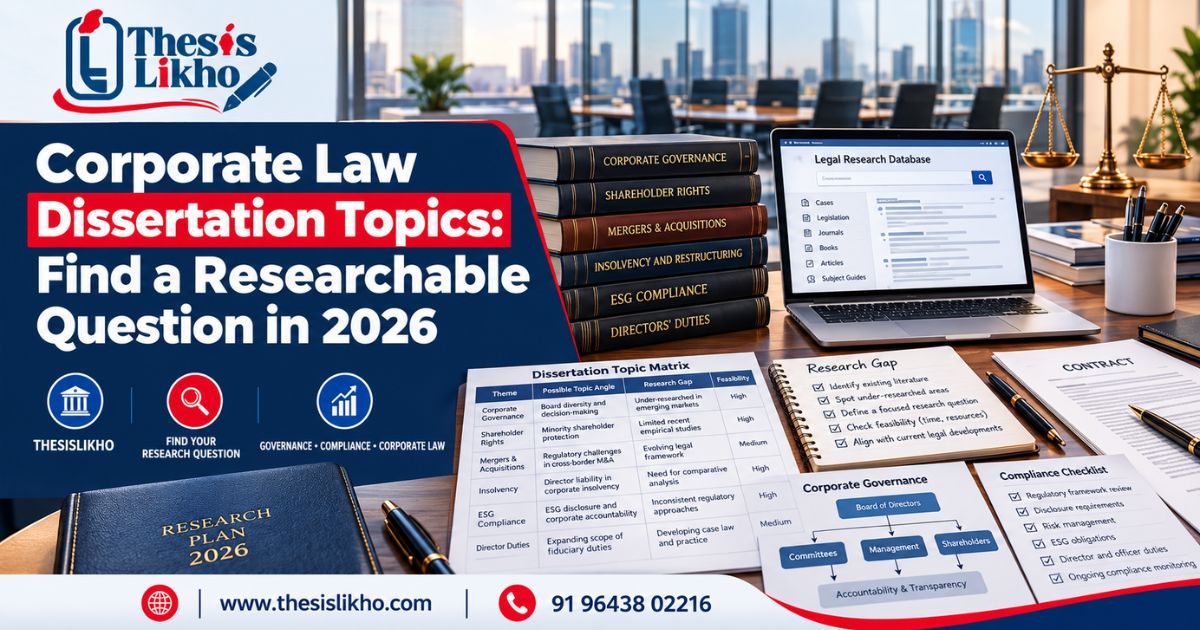
Choosing among corporate law dissertation topics is harder than choosing an area that sounds current. “Corporate governance in India” may interest you, but it does not yet tell your supervisor what legal problem you will investigate, which companies or transactions matter, or what evidence you can analyse. The same difficulty appears when students search for LLM dissertation topics or research topics for a PhD in law: a promising theme can become an unmanageable dissertation once its scope and sources are tested.
This guide helps you turn a broad corporate law interest into a precise question. You will see worked topic ideas, a practical way to test each one, and the checks to complete before submitting a proposal. Use the ideas as starting points; your university’s requirements and supervisor’s feedback determine the final topic.
Quick answer: The strongest corporate law dissertation topics identify one legal problem, define the Indian law or regulatory framework, and specify evidence that can answer the question. Shortlist three questions, check current primary sources and existing research, then discuss the most feasible one with your supervisor. A topic list alone does not establish originality or secure approval.
Contents: What makes a topic researchable · Why topic choices fail · Corporate law topic ideas · How to select a topic · From proposal to submission · Sources and documents · Mistakes to avoid · Final checklist · When review helps · FAQs
Main problemA broad subject produces a descriptive dissertation.Recommended approachFrame one question around a legal duty, dispute, gap or regulatory outcome.Information neededUniversity guidelines, current law, relevant decisions, scholarship and available data.Major riskChoosing a question that cannot be answered with accessible evidence.Final actionSend a short proposal with the question, scope, sources and method for supervisor review.
What makes a topic researchable?
A subject names a field: corporate governance, insolvency or shareholder rights. A dissertation topic narrows that field to a problem. A research question states what you will investigate.
For example, “corporate disclosure” is a subject. “How do disclosure requirements address a defined class of related-party transactions in listed Indian companies?” is a question that can guide source selection and analysis.
For an LLM, the question should fit the dissertation’s available time, word limit and approved method. Research topics for a PhD in law usually need a more substantial, defensible contribution and a longer research plan. Neither degree level makes a topic original simply because it mentions AI, ESG or a recent amendment.
Why topic choices fail
Scholars commonly struggle because they:
- Start with a fashionable label. “AI and corporate law” names too many distinct legal problems.
- Skip the source check. They discover late that decisions, filings or reliable data needed for the proposed analysis are unavailable.
- Mix several regulators and legal regimes. The question grows beyond the dissertation’s limits.
- Confuse a legal change with a research gap. A new rule gives a reason to investigate; it does not, by itself, prove that prior research is missing.
- Choose a method before the question. Interviews or surveys add little unless respondents can supply evidence relevant to the legal issue.
- Ignore university requirements. Proposal formats, ethics review, citation style and supervisor approval may shape what is feasible.
For doctoral work, check the current university rules as well as applicable UGC regulations. UGC’s PhD framework includes a Research Advisory Committee role in reviewing the proposal and finalising the research topic.
Corporate law topic ideas
These corporate law dissertation topics are framed as questions so you can see the proposed boundary and evidence. They are ideas to investigate, not claims that a legal gap has already been established.
Related-party transactions: How clearly do listed-company disclosures allow shareholders to assess a specified type of related-party transaction?
SEBI rules, selected disclosures, decisions and commentaryPick one transaction type and a defined period.Independent directors: What limits arise when independent directors oversee conflicts of interest in a particular class of listed companies?
Statutory duties, SEBI requirements, decisions and company disclosuresDefine the duty and company class.Minority shareholder remedies: How accessible is a selected legal remedy in disputes involving closely held companies?
Statutes, tribunal decisions and procedural rulesStudy one remedy and one dispute pattern.Corporate insolvency: How has a specific procedural issue affected stakeholder treatment in corporate insolvency cases?
Current IBBI framework and a defined set of decisionsAvoid covering the entire insolvency process.Board oversight of cyber risk: What duties and disclosure questions arise when a listed company faces a material cyber incident?
Applicable company and securities law, disclosures and decisionsSeparate governance duties from technical security controls.ESG disclosures: Can investors meaningfully compare one selected disclosure measure across a defined group of listed companies?
Current SEBI requirements and company reportsChoose one measure and test data availability first.
Check the current regulatory text before fixing a title. SEBI publishes its regulations and amendments, while IBBI maintains its insolvency legal framework; an older secondary article may describe a superseded version.
LLM versus PhD example: An LLM student might analyse how a defined set of decisions interprets one minority shareholder remedy. A PhD scholar could investigate a broader unresolved question about the remedy’s design, application and effects, provided the proposed contribution and evidence support that scope. If you searched for PhD topics for law, use this distinction to test depth rather than merely lengthening an LLM title.
How to select a topic
- Choose one corporate law problem. Write a sentence beginning, “The uncertainty I want to examine is…” If it contains three separate disputes, narrow it.
- Define the boundary. Specify the jurisdiction, relevant companies or transactions, legal provisions and time period. Verify that each boundary serves the question.
- Read primary law first. Locate the applicable statute, regulations and leading decisions. Record the version or decision date so an amendment does not undermine your proposal.
- Check what scholars have already argued. Compare several relevant studies and theses. Note disagreements or unanswered questions; avoid calling every underexplored angle a proven “research gap.”
- Test the evidence. Can you obtain enough decisions, filings, disclosures or permitted interview responses? If not, revise the question before committing.
- Match the method to the question. Doctrinal analysis may suit interpretation of duties; a defined comparison may suit disclosure practices. Explain why any empirical element is needed.
- Draft a short proposal. Include the question, significance, scope, provisional sources, method and likely limitations. Ask your supervisor to challenge its feasibility.
For broader comparisons with other fields, link to ThesisLikho’s LLM dissertation topic guide. Keep this page focused on selecting a corporate law question.
From proposal to submission
Proposal: State the precise question and why its answer matters. Describe the contribution you intend to test, without promising a finding.
Literature review: Organise sources by arguments and disagreements. A sequence of article summaries will not show how your question fits existing work.
Methodology: Explain which statutes, rules, decisions or documents you will analyse and how you selected them. If you plan interviews, confirm access and any ethics requirements first.
Analysis and discussion: Apply the method consistently. Distinguish what the law says, what the evidence shows and what you infer from it. Address evidence that challenges your argument.
Citations and submission: Trace every legal proposition to an appropriate source, match citations to the reference list, and follow your university’s formatting and approval process.
A separate law research project guide can support the writing stage once the topic is approved.
Sources and documents
Prepare this small research file before settling on a title:
- University dissertation or PhD guidelines: For the permitted scope, proposal format, ethics rules and submission requirements.
- One-page question brief: For the problem, boundary, proposed method and expected sources.
- Current primary-law list: For the provisions and decisions you must interpret.
- Literature matrix: For each relevant work’s question, method, conclusion and limitation.
- Evidence inventory: For the filings, decisions or other material you can actually access.
- Supervisor feedback record: For decisions about revisions and approval.
Use official SEBI regulations, the IBBI legal framework and UGC regulations where relevant to your question. These are starting points; cite the precise applicable document in the dissertation.
Mistakes to avoid
Using “A study of corporate law in India” as the titleNo clear questionName one duty, conflict or remedy.Claiming a gap without reviewing prior workWeak originality claimBuild a literature matrix first.Treating every company as comparableMisleading analysisDefine the company sample and why it fits.Relying on an outdated rule summaryIncorrect legal frameworkCheck the regulator’s current publication.Promising interviews without accessUnworkable methodConfirm access and approvals or use a suitable document-based method.Treating a suggested topic as a ready-made thesisGeneric proposalDevelop your own question and argument.Combining governance, tax, insolvency and cyber lawScope becomes unmanageableKeep only issues necessary to answer one question.
Final checklist
Before submitting the proposal or dissertation, verify:
- The title matches one answerable research question.
- The question, scope, method and evidence agree.
- Legal provisions and decisions are current and accurately described.
- Each quotation and legal claim has a checked citation.
- The reference list matches the sources cited.
- Formatting and required files follow official university guidelines.
- Your supervisor has reviewed the version you intend to submit.
When review helps
Independent academic review can help when your question remains too broad, your literature review does not establish the proposed contribution, or your method cannot answer what the title promises. Ask a reviewer to identify specific weaknesses and explain possible revisions. You remain responsible for your research decisions, analysis and final submission.
FAQs
Which corporate law dissertation topic is best for an LLM student?
The best choice is a question you can answer within your university’s word limit and timeline using accessible, authoritative sources. Start with an area you understand, then test one specific problem against current law, prior research and available evidence. A narrow question with a defensible method is more useful than a fashionable title covering several areas.
Can I use an LLM dissertation topic for a PhD proposal?
You can use the same broad area, but the proposed doctoral question needs its own justified contribution, scope and research plan. Review existing theses and scholarship before claiming originality. Discuss whether the question meets your department’s expectations with a potential supervisor; changing “LLM” to “PhD” in a title does not complete that work.
How do I find research topics for a PhD in law without repeating an existing thesis?
Begin with a defined legal problem, then map leading scholarship and relevant theses. Record what each source asks, which method it uses and where authors disagree. A different jurisdiction, decision set or time period may offer an angle, but you must show why that difference matters to the legal question.
Do corporate law dissertation topics require surveys or interviews?
No. The method depends on the question. Analysis of statutes, regulations and decisions may be appropriate for a question about legal interpretation. Interviews can be useful for a practice question, if you can reach suitable participants and meet applicable ethics requirements. Do not add a survey simply to make a topic appear advanced.
Where should I check whether a corporate law rule is current?
Use the relevant regulator’s official legal or regulatory pages and check amendments, commencement and the version applicable to your study period. For listed-company issues, start with SEBI; for insolvency issues, check IBBI. Then verify relevant statutes and decisions. Record the date you checked each source so your final draft can be reviewed again.
How many LLM dissertation topics should I take to my supervisor?
Take two or three developed options, rather than a long list of titles. For each, provide a question, its legal scope, initial sources, possible method and one practical limitation. This gives your supervisor enough detail to judge feasibility and helps you revise an option without restarting the search.
Conclusion
Use corporate law dissertation topics as prompts for investigation, then select one question that has a clear scope, current legal sources and an achievable method. Whether you are comparing LLM dissertation topics or considering research topics for a PhD in law, verify your university’s rules and seek supervisor approval before committing to the title.
Need feedback on your proposed question or research plan? Send ThesisLikho your topic, degree level and university requirements through the enquiry option on its website. Ask for a review of the scope and method; keep authorship and final academic decisions your own.