
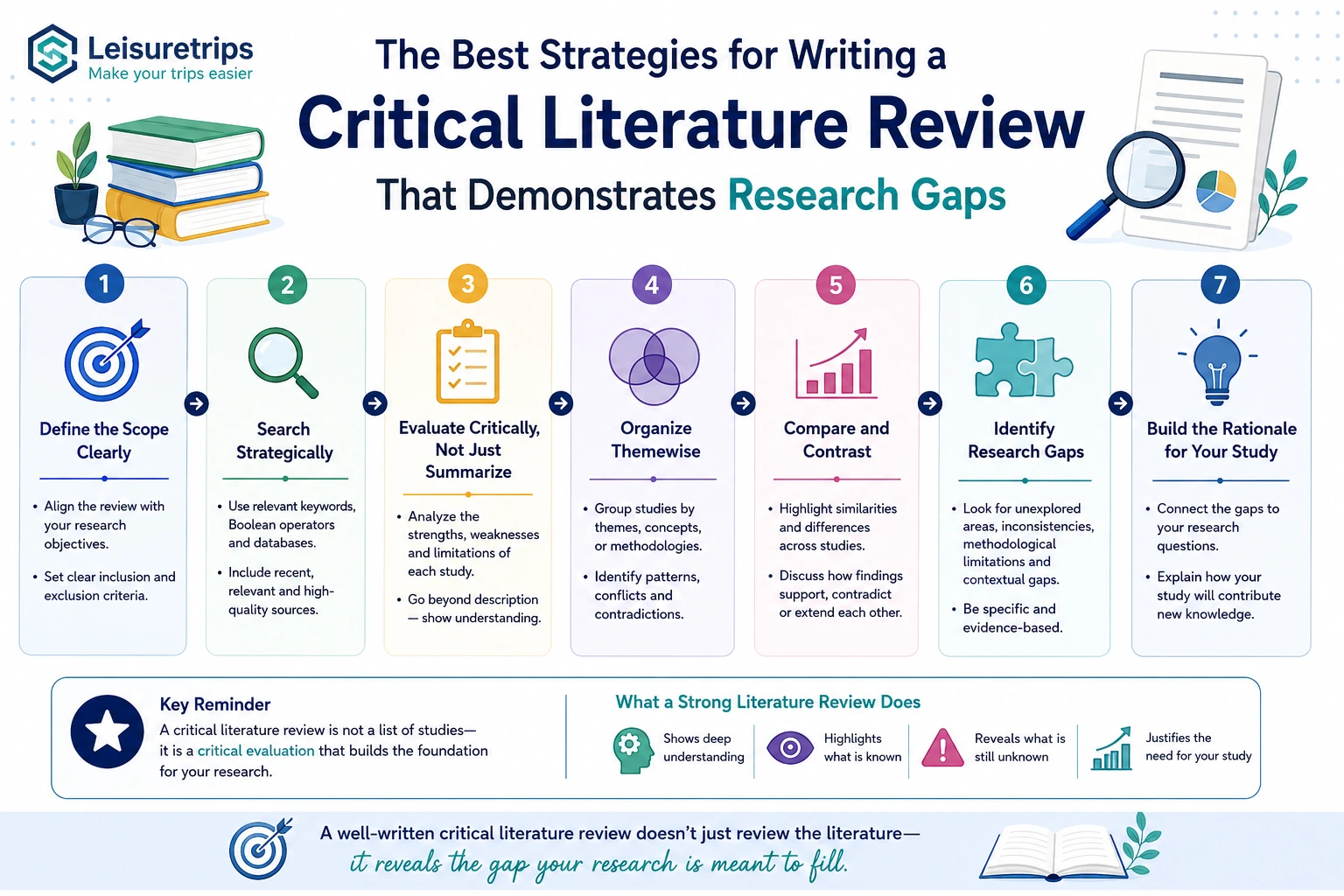
A literature review is one of the most important chapters of a PhD thesis, yet it is also one of the most misunderstood. Many research scholars believe that a literature review simply requires summarizing journal articles one after another. While this approach may show that you have read previous studies, it does little to demonstrate your ability to think critically or establish the originality of your research.
In reality, a critical literature review is much more than a collection of summaries. It evaluates, compares, synthesizes, and critiques existing research while identifying clear research gaps that justify the need for your study. A well-written literature review demonstrates your understanding of the field, highlights unresolved questions, and lays the foundation for your research objectives and methodology.
For PhD scholars in India, writing a strong literature review is especially important because universities and examiners expect evidence of critical thinking, scholarly analysis, and originality. A weak literature review can undermine an otherwise well-designed study, while a strong one strengthens the credibility and significance of your entire thesis.
This comprehensive guide explains the best strategies for writing a critical literature review that clearly demonstrates research gaps and supports a high-quality doctoral thesis.
What Is a Critical Literature Review?
A critical literature review is a systematic analysis of existing research that goes beyond describing previous studies. Instead of simply explaining what researchers have done, it evaluates the quality of their work, compares findings, identifies contradictions, highlights limitations, and explains how your research addresses unanswered questions.
A critical literature review helps answer questions such as:
- What is already known about the topic?
- Which theories dominate the field?
- What methodologies have been used?
- Where do researchers disagree?
- What limitations exist?
- Which research gaps remain?
- How will your study contribute to the field?
Rather than presenting isolated summaries, it builds a logical argument that leads naturally to your research problem.
Why Is a Critical Literature Review Important?
A well-developed literature review is the backbone of a successful thesis.
It helps you:
- Demonstrate knowledge of your research field.
- Identify theoretical and methodological gaps.
- Avoid duplicating existing research.
- Justify your research objectives.
- Build a conceptual or theoretical framework.
- Support your research methodology.
- Establish the originality of your study.
- Improve the credibility of your thesis.
Without a critical review, it becomes difficult to convince examiners that your research makes a meaningful contribution.
What Are Research Gaps?
A research gap is an area where existing knowledge is incomplete, inconsistent, outdated, or insufficient.
Research gaps can arise because:
- Certain populations have not been studied.
- Previous studies used limited methodologies.
- Findings are contradictory.
- Emerging technologies create new research questions.
- Existing theories fail to explain new phenomena.
- Geographic regions remain underrepresented.
Identifying these gaps provides the rationale for your own research.
Types of Research Gaps
Understanding different types of research gaps makes them easier to identify.
1. Knowledge Gap
Certain topics remain unexplored.
Example:
Limited research on AI adoption among rural small businesses in India.
2. Methodological Gap
Previous studies relied on methods with limitations.
Example:
Most studies used cross-sectional surveys, while longitudinal research is lacking.
3. Theoretical Gap
Existing theories fail to explain new developments.
Example:
Traditional technology adoption models may not fully explain generative AI adoption.
4. Population Gap
Some groups have received little attention.
Example:
Most studies examine urban consumers but ignore rural populations.
5. Geographic Gap
Research concentrates on particular countries or regions.
Example:
Digital banking studies primarily focus on developed economies rather than India.
6. Practical Gap
Existing research offers limited practical recommendations for policymakers or practitioners.
Step 1: Define Your Research Scope
Before reviewing the literature, clearly define:
- Research topic
- Research problem
- Objectives
- Research questions
- Keywords
- Inclusion and exclusion criteria
A focused scope prevents unnecessary reading and helps maintain relevance.
Step 2: Search High-Quality Literature
Use reputable academic sources, such as:
- Google Scholar
- Scopus
- Web of Science
- ScienceDirect
- SpringerLink
- JSTOR
- IEEE Xplore
- PubMed
- Wiley Online Library
- Taylor & Francis Online
- Shodhganga
Prioritize peer-reviewed journal articles while also including foundational books and landmark studies.
Step 3: Read Critically, Not Passively
As you read each paper, ask:
- What problem does the study address?
- Why is it important?
- Which theory is used?
- Is the methodology appropriate?
- Are the findings convincing?
- What limitations exist?
- How does it relate to other studies?
Critical questions encourage analysis rather than simple note-taking.
Step 4: Organize the Literature by Themes
Avoid discussing papers one by one.
Instead, group them into themes.
Example:
Theme 1: Technology Adoption
- Technology Acceptance Model
- Innovation Diffusion
- User Behavior
Theme 2: Organizational Factors
- Leadership
- Culture
- Digital Readiness
Theme 3: Performance Outcomes
- Productivity
- Innovation
- Customer Satisfaction
A thematic structure improves coherence and makes it easier to identify trends and gaps.
Step 5: Compare Studies
A critical review compares rather than merely reports.
For each theme, examine:
- Similar findings.
- Contradictory evidence.
- Different methodologies.
- Diverse theoretical perspectives.
- Contextual differences.
Example:
While several studies report that organizational support increases AI adoption, others suggest that employee digital literacy plays a more influential role. These contrasting findings indicate that the relationship may depend on organizational context.
Step 6: Evaluate Research Methodologies
Methodological analysis is essential.
Compare:
- Quantitative vs. qualitative approaches.
- Cross-sectional vs. longitudinal designs.
- Survey vs. interview methods.
- Small vs. large sample sizes.
- Convenience vs. probability sampling.
Example:
Many studies rely on cross-sectional surveys, limiting the ability to examine changes over time. Longitudinal studies could provide deeper insights into technology adoption processes.
Step 7: Examine Theoretical Foundations
Analyze whether previous studies have used appropriate theories.
Questions include:
- Is the selected theory suitable?
- Have researchers relied too heavily on one theoretical perspective?
- Could alternative theories explain the phenomenon better?
A discussion of theoretical strengths and limitations strengthens your review.
Step 8: Identify Patterns and Trends
Look across the literature for recurring observations.
For example:
- Increasing use of artificial intelligence in healthcare.
- Growing emphasis on sustainability.
- Shift from traditional banking to digital platforms.
- Rising adoption of mixed-methods research.
Recognizing patterns helps explain how the field has evolved.
Step 9: Identify Contradictions
Conflicting findings often reveal valuable research opportunities.
Example:
Study A concludes that remote work improves productivity.
Study B reports no significant effect.
Rather than choosing one study, explore possible reasons for the difference:
- Different industries.
- Different countries.
- Different sample sizes.
- Different measurement tools.
Step 10: Demonstrate Research Gaps Clearly
After analyzing the literature, explain what remains unknown.
Instead of writing:
"There is a research gap."
Write:
Although previous studies have examined AI adoption in large organizations, limited research has investigated the adoption challenges faced by Indian micro and small enterprises. Furthermore, most existing studies use cross-sectional designs, leaving long-term adoption patterns largely unexplored.
Specificity makes your research gap more convincing.
Build a Logical Argument
A strong literature review should guide readers toward your research problem.
A common structure is:
- Introduce the topic.
- Discuss foundational theories.
- Review major themes.
- Compare findings.
- Evaluate methodologies.
- Highlight contradictions.
- Identify research gaps.
- Justify your study.
Each section should naturally lead to the next.
Integrate Sources Instead of Listing Them
Weak writing:
Sharma (2023) found X. Gupta (2024) found Y. Singh (2025) found Z.
Strong writing:
Several studies identify trust as a key predictor of technology adoption (Sharma, 2023; Gupta, 2024). However, researchers differ regarding the influence of organizational culture, suggesting that contextual factors may shape adoption outcomes.
Integration creates a more analytical discussion.
Common Mistakes to Avoid
Avoid these frequent errors:
- Summarizing every paper separately.
- Ignoring contradictory evidence.
- Overlooking methodological limitations.
- Failing to identify research gaps.
- Relying on outdated sources.
- Using too many direct quotations.
- Writing without a clear structure.
- Connecting literature weakly to your own research.
Best Tools for Writing a Critical Literature Review
Several tools can improve your workflow.
Zotero
Organizes references, annotations, and citations.
Mendeley
Supports PDF highlighting and collaborative research.
EndNote
Ideal for large reference collections.
Notion
Useful for thematic organization and literature matrices.
Microsoft Excel
Helpful for comparing studies and tracking research gaps.
VOSviewer
Visualizes research themes and keyword relationships.
ResearchRabbit
Helps discover related papers and citation networks.
ChatGPT
Can assist with explaining theories, generating comparison tables, suggesting thematic structures, and refining academic writing. However, all critical analysis and conclusions should be based on your own evaluation of the original literature.
Practical Tips for Indian PhD Scholars
To strengthen your literature review:
- Combine international and Indian research to provide balanced coverage.
- Include recent peer-reviewed studies while also discussing foundational theories.
- Explore Shodhganga to identify completed doctoral research and avoid duplication.
- Discuss your literature review regularly with your supervisor to refine themes and research gaps.
- Revise your literature review periodically as new publications emerge during your PhD.
Frequently Asked Questions (FAQs)
What is a critical literature review?
A critical literature review evaluates and synthesizes existing research rather than simply summarizing it. It compares studies, examines strengths and weaknesses, identifies research gaps, and explains how your study contributes to the field.
How do I identify a research gap?
Research gaps can be identified by examining contradictions in findings, methodological limitations, under-researched populations, emerging topics, theoretical weaknesses, and areas where evidence remains limited or outdated.
Should I include both Indian and international studies?
Yes. Including both provides a broader perspective and helps demonstrate how your research fits within the global literature while addressing local or regional contexts.
How many studies should I include in a literature review?
There is no fixed number. Include enough high-quality, relevant studies to comprehensively cover your topic, justify your research gap, and support your theoretical and methodological choices.
Can I use AI tools when writing a literature review?
AI tools can assist with organizing information, explaining concepts, and improving writing clarity. However, you should always read the original sources, perform your own critical analysis, and verify all information before including it in your thesis.
Conclusion
A critical literature review is far more than a summary of previous research—it is a scholarly analysis that demonstrates your understanding of the field, identifies meaningful research gaps, and provides a compelling justification for your study. By organizing literature thematically, comparing findings, evaluating methodologies, examining theoretical perspectives, and synthesizing evidence across multiple studies, you can develop a literature review that is analytical, coherent, and academically rigorous.
For Indian PhD scholars, mastering the art of critical literature review writing is essential for producing a high-quality thesis that meets university standards and contributes original knowledge to the discipline. By adopting the strategies outlined in this guide, using reliable academic databases, maintaining a structured literature matrix, and continuously refining your analysis, you can transform your literature review into one of the strongest chapters of your thesis.
Call / WhatsApp: +91 96438 02216
Website:www.ThesisLikho.com