
A successful thesis begins long before data collection, statistical analysis, or writing the first chapter. It starts with identifying a strong research problem—a clear, relevant, and researchable issue that forms the foundation of your entire study. Whether you are pursuing a PhD, Master's dissertation, MPhil, or undergraduate research project, the quality of your research problem often determines the quality of your thesis.
Many students make the mistake of selecting a topic based on personal interest alone without clearly defining the problem they want to investigate. As a result, they struggle to write research objectives, formulate research questions, choose an appropriate methodology, and produce meaningful findings. A vague or poorly defined research problem can lead to months of confusion, repeated revisions, and delays in thesis completion.
A strong research problem, on the other hand, provides direction for every stage of the research process. It explains what issue exists, why it matters, who is affected, and why the problem deserves further investigation. It also helps supervisors, review committees, and journal reviewers understand the significance and originality of your research.
In this comprehensive guide, you'll learn what a research problem is, why it is essential, how to identify and refine one, common mistakes to avoid, and practical examples that will help you develop a research problem capable of supporting a high-quality thesis.
What Is a Research Problem?
A research problem is a specific issue, challenge, or gap in existing knowledge that a researcher intends to investigate. It is not simply a broad topic or an area of interest. Instead, it is a well-defined problem that requires systematic investigation to generate new knowledge or provide practical solutions.
For example:
Broad Topic
Artificial Intelligence in Education
Research Problem
Although artificial intelligence tools are increasingly used in higher education, limited research has examined how AI-assisted learning influences academic performance and student engagement among postgraduate students in Indian universities.
The second statement identifies a clear issue, establishes context, and explains why further research is needed.
Why Is a Strong Research Problem Important?
A well-developed research problem serves as the backbone of your thesis. It influences every subsequent stage of the research process, including the literature review, research objectives, methodology, data collection, analysis, and conclusions.
A strong research problem helps you:
- Focus your research on a specific issue.
- Demonstrate the originality of your study.
- Identify a genuine research gap.
- Develop clear research objectives and questions.
- Select appropriate research methods.
- Justify the significance of your research.
- Produce meaningful findings that contribute to your field.
Without a clearly defined problem, even a well-written thesis may lack direction and academic value.
Characteristics of a Strong Research Problem
Not every issue qualifies as a good research problem. An effective research problem should possess several important characteristics.
Specific
Your problem should focus on a clearly defined issue rather than a broad subject area.
Weak Example
Technology in Education
Strong Example
Factors Affecting the Adoption of AI-Based Learning Tools Among MBA Students in Private Universities in India
Researchable
You should be able to investigate the problem using appropriate research methods and available data.
Avoid questions that rely solely on opinion or speculation.
Significant
A strong research problem should address an issue that has academic, professional, or societal importance.
Ask yourself:
- Does solving this problem contribute new knowledge?
- Will the findings help practitioners or policymakers?
- Does the issue affect a meaningful group of people?
Feasible
The research should be achievable within your available time, budget, resources, and academic requirements.
Consider whether you have access to participants, datasets, software, and ethical approvals.
Original
Originality does not necessarily mean studying a completely new topic. It often involves exploring an existing issue from a new perspective, population, geographic area, or methodological approach.
Where Do Research Problems Come From?
Strong research problems can emerge from many sources.
Existing Literature
Reading journal articles often reveals unanswered questions, conflicting findings, or methodological limitations.
Professional Experience
Challenges encountered in workplaces or industries frequently inspire meaningful research problems.
Social Issues
Current societal challenges such as climate change, digital transformation, healthcare access, or education inequality provide valuable research opportunities.
Technological Advancements
Emerging technologies like artificial intelligence, blockchain, or the Internet of Things create new research questions as industries adapt to change.
Government Policies
New regulations and policy initiatives often generate opportunities to evaluate their effectiveness and impact.
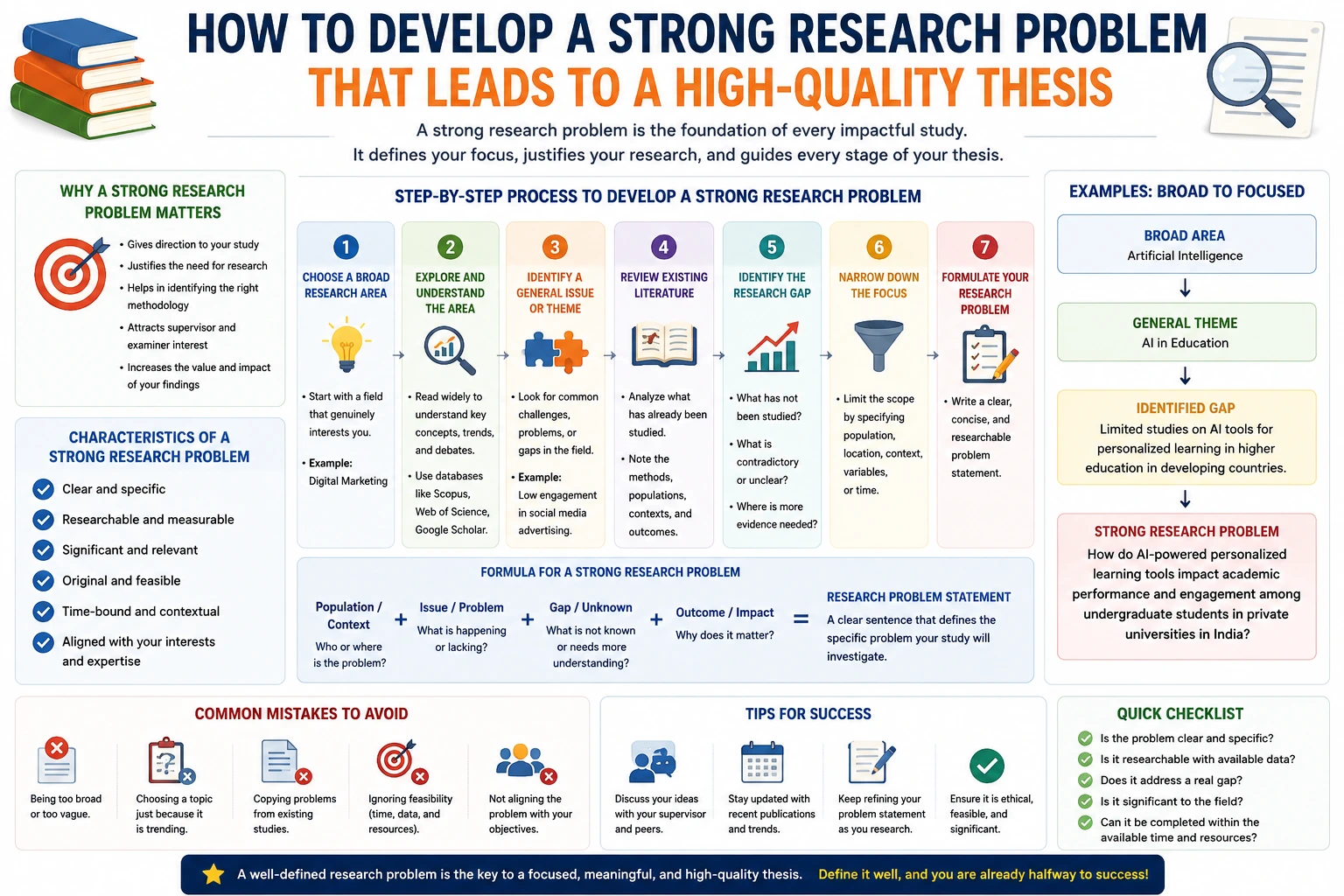
Step-by-Step Guide to Developing a Strong Research Problem
Step 1: Choose a Broad Area of Interest
Start with a field that genuinely interests you.
Examples include:
- Artificial Intelligence
- Human Resource Management
- Consumer Behaviour
- Healthcare
- Finance
- Education
- Environmental Sustainability
- Entrepreneurship
At this stage, your goal is simply to identify a broad domain.
Step 2: Conduct a Comprehensive Literature Review
Review recent academic studies to understand:
- Current knowledge.
- Existing theories.
- Research methods.
- Key findings.
- Limitations.
- Future research recommendations.
Reliable databases include:
- Google Scholar
- Scopus
- Web of Science
- ScienceDirect
- JSTOR
- IEEE Xplore
- PubMed
Pay particular attention to systematic literature reviews, which summarise existing evidence and identify unresolved issues.
Step 3: Identify a Research Gap
A research gap is the foundation of a strong research problem.
Look for:
- Understudied populations.
- New technologies.
- Contradictory findings.
- Geographic limitations.
- Methodological weaknesses.
- Practical challenges.
For example, many studies may explore AI adoption in developed countries, but few investigate its use among postgraduate students in Indian universities.
This gap becomes the basis of your research problem.
Step 4: Define the Context
Every research problem should clearly define its context.
Specify:
- Target population.
- Geographic location.
- Industry.
- Time period.
- Variables involved.
For example:
Instead of:
Employee Satisfaction
Use:
Factors Influencing Employee Satisfaction Among Software Engineers Working in Startups in Bengaluru
Context transforms a broad topic into a focused research problem.
Step 5: Explain Why the Problem Matters
A compelling research problem explains the consequences of leaving the issue unresolved.
Consider questions such as:
- Who is affected?
- What are the practical implications?
- Why should researchers investigate this issue?
- How does solving the problem contribute to knowledge or practice?
Clearly articulating significance strengthens your proposal and thesis.
Step 6: Formulate the Problem Statement
A research problem statement usually consists of three elements:
Background
Introduce the topic and current situation.
Gap
Explain what existing research has overlooked.
Need
Describe why further investigation is necessary.
Example
Artificial intelligence has become increasingly integrated into higher education. While numerous studies have examined AI adoption in developed countries, limited evidence exists regarding its impact on postgraduate students in Indian universities. Understanding this relationship is essential for educational institutions seeking to improve learning outcomes and digital transformation strategies.
Questions to Ask Before Finalising Your Research Problem
Before moving forward, ask yourself:
- Is the problem specific?
- Can it be researched objectively?
- Is sufficient literature available?
- Does it address a genuine research gap?
- Is the study feasible?
- Will the findings contribute new knowledge?
- Does the problem align with my academic goals?
If you can confidently answer "yes" to these questions, your research problem is likely well developed.
Examples of Strong Research Problems
Example 1: Marketing
Topic
Digital Marketing
Research Problem
Despite increasing investment in influencer marketing, limited evidence exists regarding how influencer authenticity affects purchase intentions among Gen Z consumers in Tier-2 Indian cities.
Example 2: Human Resource Management
Topic
Employee Retention
Research Problem
Indian IT companies continue to experience high employee turnover, yet limited research has examined how flexible work arrangements influence retention among early-career software professionals.
Example 3: Healthcare
Topic
Telemedicine
Research Problem
Although telemedicine services expanded rapidly after the COVID-19 pandemic, little research has explored factors affecting adoption among elderly patients in rural India.
Example 4: Education
Topic
Online Learning
Research Problem
While online learning platforms are widely adopted, limited evidence exists regarding their impact on student engagement among postgraduate management students in private universities.
Common Mistakes Students Make
Developing a research problem requires careful thought. Avoid these common pitfalls.
Choosing a Topic Instead of a Problem
Many students stop after selecting a general subject without identifying a specific issue.
Being Too Broad
Problems such as "Climate Change" or "Artificial Intelligence" are too extensive for a single thesis.
Ignoring Existing Research
Always conduct a literature review before defining your problem.
Selecting an Unresearchable Problem
Questions that cannot be investigated using empirical methods are unsuitable for academic research.
Focusing on Personal Opinions
A research problem should be based on evidence and scholarly literature rather than assumptions or personal beliefs.
Tips for Writing a Strong Problem Statement
Follow these best practices:
- Begin with the broader context.
- Use recent statistics or literature where appropriate.
- Clearly identify the research gap.
- Explain why the issue matters.
- Avoid unnecessary jargon.
- Keep the statement concise and focused.
- Ensure alignment with your research objectives.
A well-written problem statement should naturally lead readers toward your research questions.
Best Tools for Developing a Research Problem
Several digital tools can support your research journey.
Literature Search
- Google Scholar
- Scopus
- Web of Science
Citation Management
- Zotero
- Mendeley
- EndNote
Research Discovery
- Connected Papers
- ResearchRabbit
- Litmaps
Academic Writing
- Microsoft Word
- Google Docs
- Grammarly
These tools help organise literature, identify research gaps, and streamline academic writing.
Tips for PhD and Master's Students in India
Indian universities increasingly emphasise originality, practical relevance, and methodological rigour in research proposals.
When developing your research problem:
- Review your university's research guidelines before finalising your topic.
- Focus on issues relevant to Indian industries, education, healthcare, or public policy.
- Use recent articles from reputable journals indexed in Scopus or Web of Science.
- Ensure your study has practical implications in addition to academic significance.
- Discuss your proposed research problem with your supervisor early in the process to refine its scope and feasibility.
A contextually relevant and well-justified research problem not only strengthens your thesis but also increases the likelihood of publication in high-quality journals.
Frequently Asked Questions (FAQs)
What is the difference between a research topic and a research problem?
A research topic is a broad subject area, while a research problem is a specific issue within that topic that requires investigation.
How do I identify a research problem?
Conduct a comprehensive literature review, identify research gaps, analyse limitations in previous studies, and explore emerging trends in your field.
Can I change my research problem later?
Many universities allow revisions during the proposal stage. However, changing your research problem after data collection begins may require formal approval and could delay your research.
How long should a research problem statement be?
A research problem statement is typically one to three paragraphs, depending on your university's requirements. It should be concise while clearly explaining the context, gap, and significance.
Why is a research problem important?
The research problem provides the foundation for your entire study. It guides your objectives, research questions, methodology, analysis, and conclusions while demonstrating the originality and relevance of your research.
Conclusion
Developing a strong research problem is one of the most critical steps in producing a high-quality thesis. Rather than beginning with a broad topic, successful researchers focus on identifying a specific issue that is significant, researchable, and grounded in a genuine gap within the existing literature.
By conducting a thorough literature review, analysing previous studies, defining the context of your research, and clearly explaining why the problem matters, you create a strong foundation for every stage of your academic project. A well-crafted research problem not only guides your objectives and methodology but also demonstrates the originality and value of your work to supervisors, reviewers, and future readers.
Remember that a great thesis does not start with data collection—it starts with asking the right question. Investing time in refining your research problem will make the rest of your research journey more focused, efficient, and impactful. Whether you are preparing a Master's dissertation, a PhD thesis, or your first independent research project, mastering this skill will significantly improve the quality of your research and your chances of academic success.
Contact ThesisLikho
Call / WhatsApp: +91 96438 02216
Website:www.ThesisLikho.com