
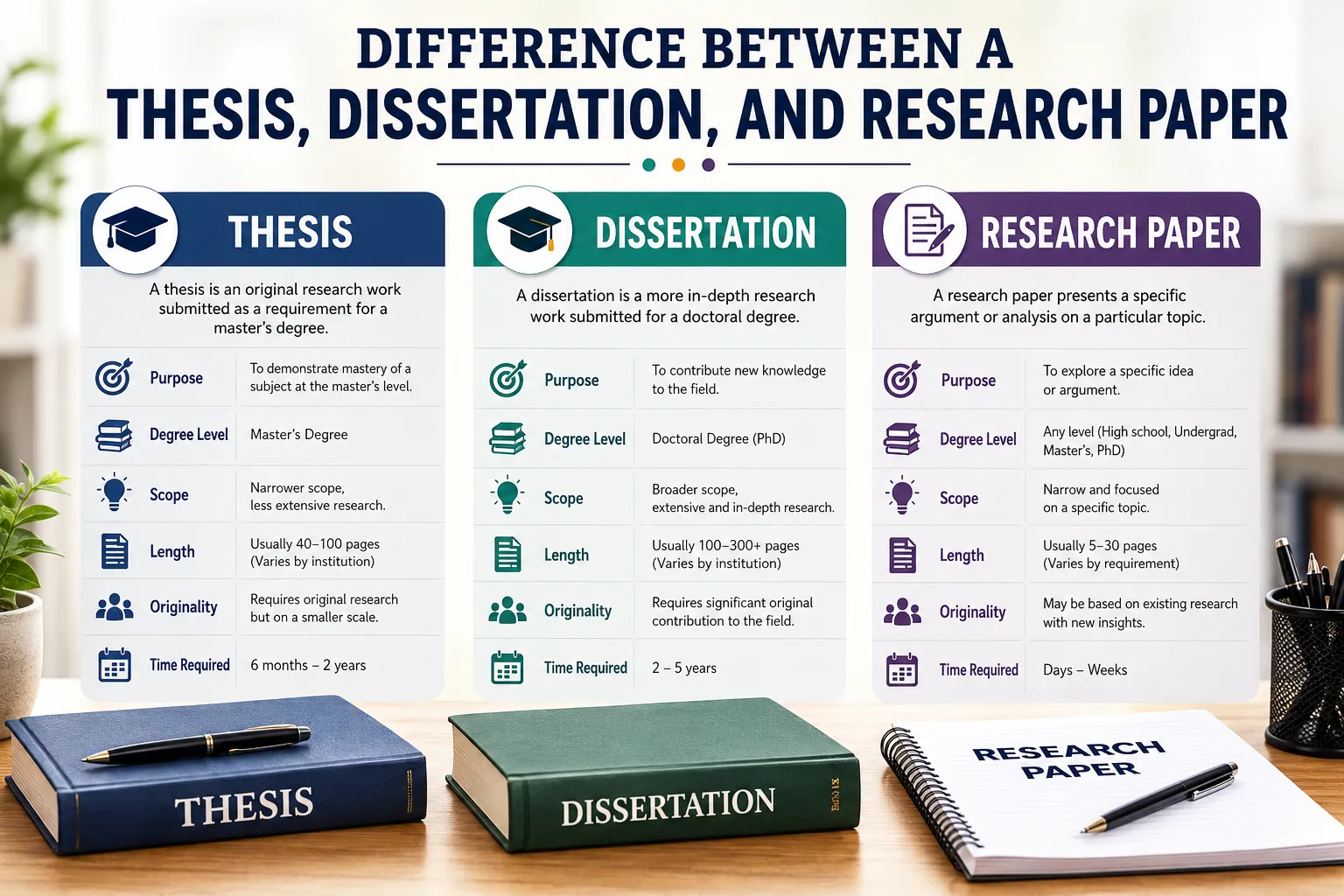
If you've searched this exact question, you've probably already noticed the problem: half the sources online contradict each other. That's not because the internet is wrong — it's because these terms genuinely mean different things depending on which country's academic system you're in. This guide untangles the difference between a thesis, dissertation, and research paper clearly, including exactly what applies if you're studying in India.
The Confusing Part First: It Depends Entirely on Your Country
In the USA, a thesis is typically written for a master's degree, and a dissertation is written for a PhD. In the UK and many Commonwealth systems — and this includes India — the terminology is essentially reversed: "thesis" usually refers to PhD-level work, while "dissertation" is used for undergraduate or master's-level projects.
India specifically follows the UK convention. In the Indian academic framework, a dissertation is submitted as part of a postgraduate master's program — M.A., M.Sc., M.Com., and similar degrees — while a thesis is required for a PhD and represents the culmination of original, extensive research. This distinction is recognized by UGC India and is standard across Indian universities.
So if you're an Indian student and someone from a US-based source tells you "a thesis is for master's students," they're describing the American convention, not the one that applies to your own degree. Always confirm the specific terminology and requirements directly with your own university and department, rather than assuming a general definition from an international source applies to your specific program.
The Distinction That Actually Matters More Than the Label
Here's the genuinely important insight buried underneath all this confusing terminology: the single most important distinction isn't length, it's the type of research expected. The master's-level document (whatever it's called in your country) typically synthesizes and applies what's already known in the field. The doctoral-level document (again, whatever it's called where you are) is expected to add something genuinely new — an original contribution to knowledge that didn't exist before your research.
Despite the confusing labels, in every country's tradition, the doctoral-level document is always the more demanding one — larger in scope, requiring genuine original contribution, and typically taking 3–4 years to complete, regardless of whether it's called a "dissertation" (US) or a "thesis" (UK, India).
Where a Research Paper Fits In — A Genuinely Different Category
A research paper is a fundamentally different kind of document from either a thesis or dissertation, not just a shorter version of the same thing.
Length: A research paper is typically 5–20 pages, or 3,000–6,000 words for a journal article specifically — compared to a thesis running 50–100+ pages, or a dissertation running 100–200+ pages (roughly 20,000–40,000+ words).
Purpose: A thesis or dissertation's purpose is to obtain a degree or professional qualification while demonstrating the candidate's command of their field. A research paper's purpose is different: to establish credibility and contribute new knowledge through peer review and publication, independent of any specific degree requirement. You can write and publish research papers throughout your academic career, long after your thesis or dissertation is complete.
Methodology and scope: A research paper typically involves analysis and synthesis of existing sources, or a single narrowly scoped study. A thesis or dissertation involves collecting primary data, extensive investigation, and much deeper analysis across an entire multi-chapter research project — not a single focused study, but a sustained body of work.
Formatting: A thesis or dissertation follows university-specific, often quite rigid formatting guidelines set by your specific institution. A research paper submitted to a journal instead follows that journal's specific author guidelines, typically adhering to a consistent IMRAD (Introduction, Methods, Results, Discussion) format throughout.
Abstract length: This difference in scope shows up even at the abstract stage — a journal article or research paper abstract is typically 150–250 words, while a dissertation abstract is typically around 350 words, reflecting the proportionally larger underlying document.
If You're Turning Your Thesis Into a Research Paper
Many scholars eventually convert part of their thesis or dissertation into a journal article for publication — a genuinely valuable step for career and academic visibility. But this requires substantial restructuring, not simple excerpting. Your dissertation's extensive literature review, built to demonstrate comprehensive command of your field, needs to be condensed into a much more explicit, narrow literature review that only covers what's needed to understand the specific research gap your article addresses. Copying and pasting a chapter directly into a journal submission almost never works — the content needs to be genuinely rewritten for the tighter, more focused conventions of journal publication.
A Quick Reference for Confirming Your Own Situation
Rather than relying on a general international definition, work through these questions specific to your own program:
- What country and university are you studying in, and which convention (US-style or UK/India-style) does your institution follow?
- Is your document for a master's degree or a PhD — since this, not the label itself, determines whether original contribution is expected?
- Does your program have its own specific formatting guidelines you should follow, rather than a generic template?
- If you're aiming to publish part of your work as a research paper, have you checked your target journal's specific author guidelines and IMRAD structure requirements?
Step-by-Step: Clarifying Which Document You're Actually Writing
- Identify your country and specific institution's naming convention (US-style thesis/dissertation, or UK/India-style thesis/dissertation)
- Confirm your degree level (master's or PhD) to understand whether original contribution or synthesis of existing knowledge is expected
- Check your department's specific formatting handbook rather than relying on general online guidance
- If your goal includes eventual journal publication, separately review your target journal's specific author guidelines and format expectations
- If converting thesis content into a research paper later, plan to substantially rewrite (not excerpt) sections like your literature review for the tighter journal format
Practical Checklist: Do You Know What You're Actually Writing?
- Confirmed which country's terminology convention applies to your specific institution
- Confirmed your degree level and whether original contribution or synthesis is the expected standard
- Checked your department's specific formatting and structural requirements directly
- Understand that a research paper is a genuinely different document type, not just a shorter thesis
- If aiming for journal publication, reviewed the specific target journal's author guidelines separately
- Understand the abstract length expectation appropriate to your specific document type
Two Practical Scenarios
Scenario 1 — An Indian Student Confused by US-Based Guidance
A master's student in India read several US-based online guides stating "a thesis is for master's students, a dissertation is for PhD students," and assumed this applied to their own program. After checking their university's specific student handbook, they discovered their institution — following the standard Indian/UGC convention — actually referred to their master's-level document as a "dissertation," with "thesis" reserved specifically for PhD candidates. This clarified which formatting template and requirements document actually applied to their work.
Scenario 2 — Converting a Thesis Chapter Into a Journal Article
A recently graduated master's student wanted to publish their thesis's literature review chapter as a standalone journal article. Initially attempting to simply trim the original chapter down to fit the journal's word limit, they found reviewers flagged the submission as reading like an excerpt rather than a focused article. Following guidance on proper conversion, they substantially rewrote the literature review specifically to cover only what was needed to establish the article's narrower research gap, rather than the comprehensive field overview appropriate to a full thesis chapter — resulting in a tighter, more publishable piece.
Common Mistakes Students Make With This Terminology
- Assuming a single international definition applies everywhere, without checking their own country's and institution's specific convention.
- Confusing the label with the actual expectation, when what matters more is whether original contribution or synthesis is required at their specific degree level.
- Treating a research paper as simply "a short thesis," missing that it's a genuinely different document type with a different purpose and format.
- Copying and pasting thesis content directly into a journal submission, rather than substantially rewriting it for the tighter, more focused conventions of journal publication.
- Not checking their own department's specific formatting handbook, relying instead on generic guidance that may not match their institution's actual requirements.
Frequently Asked Questions
What is the difference between a thesis, a dissertation, and a research paper?
In the US, a thesis is for master's degrees and a dissertation is for PhDs; in the UK and India, this is reversed, with "thesis" referring to PhD-level work and "dissertation" to master's-level work. A research paper is a genuinely different, shorter document — typically 5–20 pages — written to contribute new knowledge through peer review and publication, independent of any specific degree requirement.
Why does the difference between these terms matter for students?
Confusing which convention applies to your own institution can lead to using the wrong formatting template, wrong length expectations, or wrong understanding of whether original contribution is required — all of which can cause real confusion when planning your work.
How does understanding this difference affect a thesis or dissertation's success?
Confirming the specific requirements that apply to your degree level and institution, rather than assuming a general definition, ensures your document meets your actual program's expectations from the start, avoiding wasted effort restructuring later.
When should you confirm which term applies to your own work?
As early as possible — ideally before you begin drafting — by checking your specific department's handbook or asking your supervisor directly, rather than relying on general online guidance that may reflect a different country's convention.
Is professional help available for understanding the difference between a thesis, dissertation, and research paper?
Yes. ThesisLikho's PhD-qualified mentors have guided 10,000+ scholars through thesis and dissertation writing, research paper conversion, and complete academic writing assistance tailored to Indian university requirements.
Get Expert Guidance on Your Thesis, Dissertation, or Research Paper
Understanding exactly which document you're writing — and what your specific institution expects — is the first step toward a smooth writing process. If you'd like expert input on your thesis, dissertation, or converting your research into a publishable paper, ThesisLikho's PhD-qualified team offers structure guidance, formatting support, and complete academic writing assistance tailored to Indian university requirements. If you need expert guidance with your thesis, dissertation, or research paper, you can explore our Thesis Writing Assistance service.
Talk to a Thesis Expert → https://thesislikho.com/writing-services/thesis-writing