
Two sections of a research synopsis cause more confusion than almost anything else in the document: the aim and the objectives. Scholars often write them as near-duplicates of each other, or accidentally swap their roles entirely — and a Doctoral Research Committee reviewing the synopsis will usually notice within the first read.
This guide untangles the research aim and research objectives in a synopsis — what each one is actually for, how they relate to each other, and how to write both so your committee sees a coherent, well-structured research plan rather than two overlapping paragraphs saying roughly the same thing. We've written it the way an experienced synopsis mentor would talk you through your own draft, because that's genuinely the kind of guidance ThesisLikho's PhD-qualified team provides to the thousands of scholars we've supported through exactly this stage.
Why This Distinction Trips Up First-Time Scholars
Most first-time scholars have an intuitive sense that a synopsis needs "something about what I'm trying to do" and "something about how I'll do it." The trouble starts when that intuition doesn't map cleanly onto the aim-objectives structure a committee expects — scholars either write an aim that's already objective-level specific, or write objectives that are just restated versions of the aim with different wording.
Getting this right matters more than it might seem, because your aim and objectives aren't just descriptive prose — they're the scaffolding your entire methodology, chapter structure, and eventual results chapters are built on. A vague or duplicated aim-objectives section tends to produce a vague, hard-to-defend methodology section right after it.
What a Research Aim Actually Is
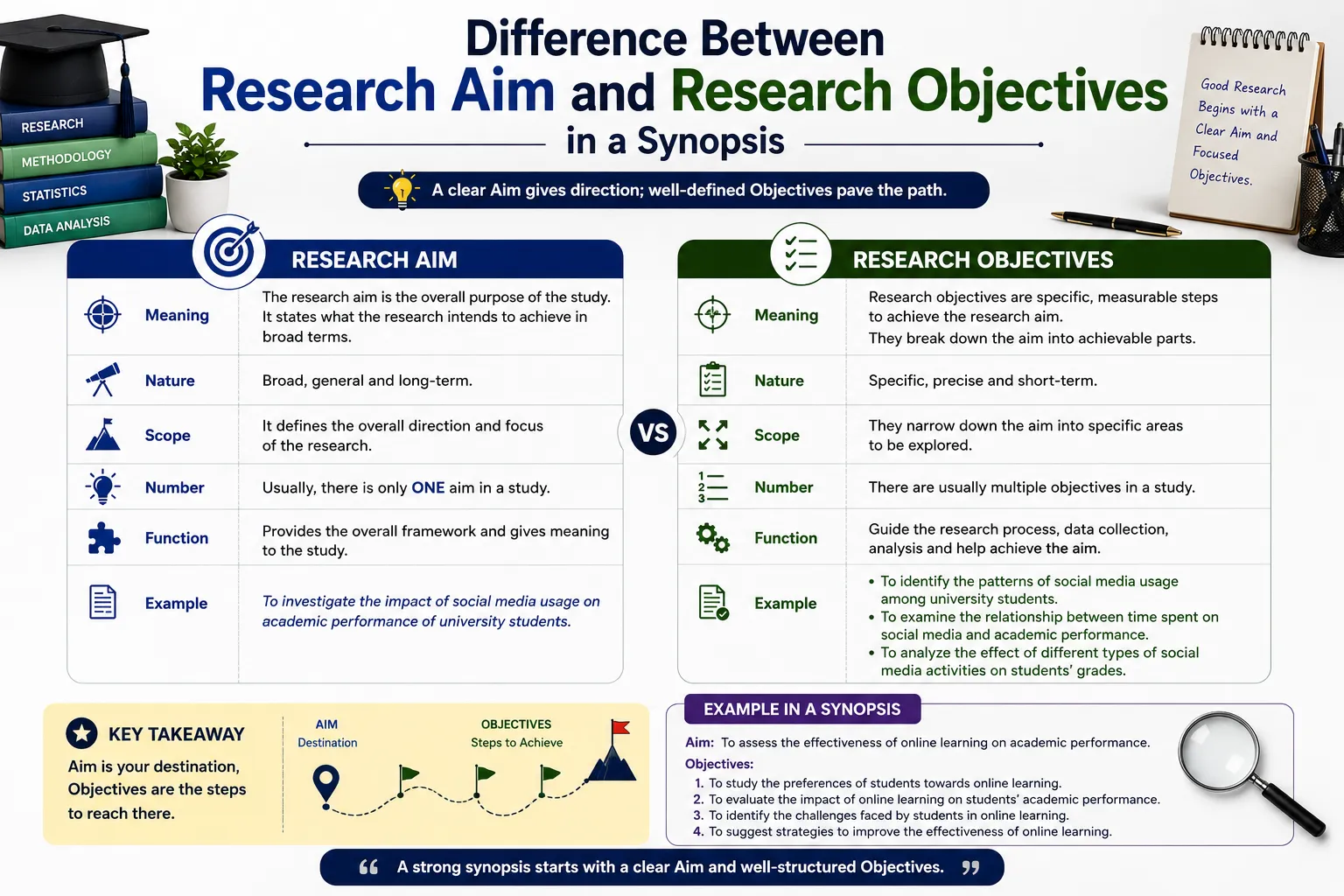
A research aim is a single, broad statement describing the overall purpose of your study — what you intend to achieve, at the highest level. It should be concise (typically one sentence), directly connected to your research problem or gap, and general enough to capture the full scope of your intended contribution without listing out every specific step you'll take to get there.
Example aim: "This study aims to examine the effect of influencer credibility on purchase intention among Gen Z consumers in urban India."
Notice this doesn't specify your sample size, your data collection method, or your specific analytical technique — that level of detail belongs elsewhere. The aim exists purely to state, clearly and broadly, what the research is fundamentally about.
What Research Objectives Actually Are
Research objectives break your aim down into the specific, measurable steps you'll take to achieve it. Where the aim answers "what," objectives answer "how" — and they should be written as concrete, actionable statements, typically using clear action verbs like analyze, assess, evaluate, investigate, or examine.
Example objectives, building from the aim above:
- To identify the specific dimensions of influencer credibility most relevant to Gen Z consumers.
- To measure the relationship between influencer credibility and purchase intention.
- To assess whether brand trust mediates this relationship.
Each objective here does something the aim alone doesn't: it names a specific, testable piece of the puzzle, which is exactly what makes it possible to design a methodology around it later.
The Core Difference, Spelled Out
Laid out plainly, the two sit at opposite ends of the same statement. Scope-wise, the aim is broad and overarching, while objectives are narrow and specific. The aim answers "what is this research about," while objectives answer "how will this research actually be carried out." In terms of length, an aim is typically a single sentence, while objectives form a numbered list of usually three to six items. The aim stays at the level of general direction, while objectives spell out actionable, measurable steps. Even the verbs differ in character — aims tend to use broader verbs like "to examine," "to explore," or "to understand," while objectives lean on action-specific verbs like "to identify," "to assess," "to evaluate," or "to compare." And critically, the aim connects to your methodology only indirectly, setting the overall direction, while each objective should connect to it directly — mapping to a specific method or analysis you'll actually carry out.
A useful mental test: if you can't picture a specific method or data source tied to a statement, it's probably functioning as your aim, not an objective. If a statement is specific enough that a reader could picture exactly what you'd measure or analyze, it belongs in your objectives list.
How Aim, Objectives, and Research Questions Relate
A third element often enters this conversation and adds to the confusion: the research question. Here's how the three fit together. Your research question is closely tied to your aim — it's essentially the aim phrased as a question rather than a statement. Your objectives are the specific, actionable steps taken to actually answer that question.
Using the earlier example: the research question might be "Does influencer credibility have a significant effect on purchase intention among Gen Z consumers, and is this relationship mediated by brand trust?" — this maps directly onto the aim, just phrased interrogatively. The three objectives listed earlier are what you'll actually do to answer it. Some university synopsis templates ask for all three elements explicitly (aim, objectives, and research question/hypothesis); others expect just aim and objectives, treating the research question as implicit within them. Check your specific department's template rather than assuming one format is universal.
How Many Objectives Should You Have?
There's no single fixed number, but a widely used convention across academic guidance suggests one research aim paired with three to six research objectives. Fewer than three often means your objectives aren't specific enough — they're likely still operating at aim-level generality. More than six or seven often signals your scope has become too broad for a single thesis, or that some "objectives" are actually sub-steps of a larger objective and should be consolidated.
As a rule, each objective should map to a distinct, substantial piece of your research — often corresponding to a specific results chapter or a specific analytical step, rather than a minor task within a larger piece of work.
Writing Objectives That Actually Guide Your Methodology
The single most common flaw in synopsis objectives isn't vagueness — it's a disconnect between the objectives and the proposed methodology that follows them. If your objective states you'll "assess consumer perception," but your methodology section proposes only a quantitative Likert-scale survey with no qualitative component, a committee will likely flag the mismatch, since "perception" as a concept is often better captured through open-ended or interview-based methods.
A reliable check: for each objective, ask yourself what specific method, tool, or data source would actually let you achieve it. If you can't answer that concretely, either the objective needs to be reworded to be more specific, or your methodology section needs revising to genuinely match what the objective is asking for. This consistency — between objective, method, and analysis — is exactly the kind of alignment a DRC or RAC is checking for when they review this section.
Common Mistakes in Synopsis Aim/Objective Sections
- Writing an aim that's already objective-level specific — cramming multiple steps into a single "aim" sentence, leaving nothing distinct for the objectives to add
- Restating the aim as objectives with different wording, rather than genuinely breaking it into distinct, actionable components
- Too few or too many objectives — under three often signals insufficient specificity; more than six or seven often signals scope creep
- Using vague verbs ("to study," "to look at") instead of specific, action-oriented ones ("to assess," "to compare," "to evaluate")
- Objectives that don't map to the proposed methodology — a mismatch that's one of the most commonly cited reasons for synopsis revision requests
- Treating the research question as identical to the aim without recognizing their subtly different function (declarative vs. interrogative framing)
Applying SMART Criteria to Your Objectives
Beyond simply using action verbs, many supervisors and thesis-writing guides recommend checking each objective against SMART criteria — a simple filter that catches vague or unrealistic objectives before they reach committee review:
- Specific — names a precise variable, relationship, or population, not a general area of interest
- Measurable — describes something you can actually assess, quantify, or evaluate with data
- Achievable — realistic given your timeline, access to data, and available resources
- Relevant — clearly contributes to your overall research aim, not a tangential side-interest
- Time-bound — implicitly or explicitly achievable within your program's research period
Running each draft objective through this checklist takes only a few minutes but reliably catches two of the most common problems covered earlier: objectives that are too vague to guide a methodology (failing "specific" and "measurable"), and objectives that sound impressive but aren't realistically achievable within a single thesis (failing "achievable" and "time-bound").
How Aim and Objectives Differ Across Disciplines
While the underlying aim-objectives structure stays consistent, the style and emphasis shift somewhat depending on your field. In management and business research, aims typically examine a relationship between variables (something like "to examine the effect of X on Y"), and objectives often include measurement, mediation or moderation testing, and comparative sub-questions. In engineering and computer science, aims tend to state a system, model, or technical improvement to be developed or evaluated, with objectives frequently phrased as "to design," "to implement," or "to evaluate the performance of" something specific. In life sciences and medicine, aims state a clinical or biological outcome to be investigated, and objectives often specify a population, intervention, and measurable clinical outcome, closely mirroring a PICO-style structure. In humanities and social sciences, aims tend to state a phenomenon, text, or social process to be interpreted or understood, with objectives using verbs like "to interpret," "to critically examine," or "to trace the development of," reflecting a more interpretive approach than the measurement-driven objectives common in other fields.
If you're working across an interdisciplinary topic, it's worth explicitly deciding which disciplinary convention your aim and objectives should follow, since a mismatch (using engineering-style implementation objectives for a fundamentally interpretive humanities topic, for example) can itself become a point of committee confusion.
A Worked Example, Start to Finish
Research Problem: Limited empirical research exists on how influencer credibility specifically affects purchase intention among Gen Z consumers in the Indian D2C market.
Research Aim: To examine the effect of influencer credibility on purchase intention among Gen Z consumers of Indian direct-to-consumer (D2C) brands.
Research Objectives:
- To identify the key dimensions of influencer credibility relevant to Gen Z consumers of D2C brands.
- To measure the relationship between influencer credibility and purchase intention using a structured survey instrument.
- To assess whether brand trust mediates the relationship between influencer credibility and purchase intention.
- To compare this relationship across different D2C product categories (fashion, beauty, and food/beverage).
Research Question: Does influencer credibility have a significant effect on purchase intention among Gen Z D2C consumers, and is this relationship mediated by brand trust?
Notice how each objective is distinct, measurable, and clearly maps to a specific analytical step — objective 2 points toward a quantitative survey and correlation/regression analysis, objective 3 points toward mediation analysis (likely via SmartPLS or a similar SEM tool), and objective 4 points toward a comparative, subgroup-level analysis. A committee reading this can immediately picture the shape of the eventual methodology chapter.
Two Realistic Scenarios
Scenario 1 — Priyanka, a first-time master's-level synopsis writer Priyanka's initial draft stated her aim as: "To study social media marketing, influencer credibility, brand trust, and their combined effect on purchase intention among various consumer segments." Her objectives section then largely repeated the same list of concepts, just broken into separate bullet points. Her supervisor pointed out that this wasn't really an aim-and-objectives structure at all — it was one long aim, split awkwardly. Her revision narrowed the aim to a single clear sentence about influencer credibility and purchase intention specifically, then built four distinct, actionable objectives underneath it — each one mapping to a specific step her methodology would need to address.
Scenario 2 — Rakesh, a PhD scholar revising after DRC feedback Rakesh's synopsis was sent back specifically because his fourth objective — "to explore the broader implications of digital transformation for Indian retail" — didn't connect to any part of his proposed survey-based methodology. His committee correctly identified this as a mismatch: the objective was written at a scope far broader than anything his data collection plan could actually support. He revised the objective to something his methodology could genuinely deliver on — assessing implications specifically within his surveyed retail segment — and the revised synopsis was approved without further changes to this section.
Revising Your Aim and Objectives After Committee Feedback
If your synopsis comes back with feedback specifically targeting this section, a few practical habits make the revision process faster and more likely to succeed on resubmission.
Address the root cause, not just the wording. If a committee flags an objective as "too broad," simply rephrasing it with different words while keeping the same underlying scope rarely satisfies the concern — the actual fix usually requires narrowing what the objective is asking you to do, not just how it's worded.
Re-check alignment across the whole section, not just the flagged line. Since objectives, methodology, and chapter scheme are all interconnected, revising one objective in isolation can accidentally create a new mismatch elsewhere — for instance, narrowing an objective's scope might mean your previously planned sample size or analysis technique no longer quite fits either, and now needs a corresponding adjustment.
Keep a brief revision log. Many DRCs and RACs expect a short summary of what changed and why alongside a resubmitted synopsis. Noting exactly how each objective was revised, and why, makes the second review noticeably faster, since committee members don't have to reconstruct what changed by comparing drafts line by line themselves.
Loop in your supervisor before resubmitting. A quick informal check with your supervisor after revising this section — rather than waiting for the next formal committee meeting — often catches a lingering issue before it costs you another full review cycle.
Most synopses that receive feedback specifically on aim and objectives are approved on the next submission, provided the revision genuinely resolves the scope or alignment concern raised rather than simply presenting the same idea in different language.
How This Section Ripples Through the Rest of Your Synopsis
It's worth understanding just how much downstream work your aim and objectives section quietly sets up, since this explains why committees give it such close attention relative to its short length.
Your chapter scheme typically mirrors your objectives fairly closely — in many theses, each objective corresponds to a distinct results or analysis chapter, meaning a poorly scoped objective can leave you with either an underweight chapter with too little to say, or an overloaded one trying to cover ground that should have been split into two separate objectives from the start.
Your hypotheses (for quantitative or causal research) are typically derived directly from your objectives — an objective like "to assess whether brand trust mediates the relationship between influencer credibility and purchase intention" translates almost directly into a testable mediation hypothesis, which then dictates a specific statistical approach (such as bootstrapped mediation analysis in SmartPLS or AMOS).
Your expected outcomes/significance section should also trace back to your objectives — if you can't articulate why achieving each objective matters, either to theory, practice, or both, it's worth revisiting whether that objective belongs in your synopsis at all, or whether it needs sharper framing to justify its inclusion.
Seen this way, a synopsis's aim and objectives function less like an introductory formality and more like a table of contents for the reasoning behind every other section that follows — which is exactly why getting this part right early tends to make every later section of the synopsis, and eventually the thesis itself, considerably easier to write.
Why Committees Scrutinize This Section So Closely
Your aim and objectives aren't just introductory framing — they function as a contract for the rest of your research. A DRC or RAC reviewing your synopsis uses this section to judge whether your entire research plan is internally consistent: does the methodology that follows actually deliver on what the objectives promise? Does the scope implied by your objectives match what's realistically achievable within your program's timeline?
This is really why understanding the research aim and research objectives distinction matters so much for synopsis approval — get this section right, and your methodology section becomes far easier to write convincingly, because you already know exactly what each part of your research needs to accomplish.
Pre-Submission Checklist
- Your aim is a single, concise sentence stating the overall purpose of your research
- Your objectives are written as a numbered list of 3–6 specific, actionable items
- Each objective uses a clear action verb (analyze, assess, evaluate, compare) rather than vague language
- Each objective maps to a specific, identifiable method or analytical step in your methodology section
- Your research question (if required separately) reflects your aim phrased interrogatively, not a restatement of your objectives
- No objective duplicates another, and none is simply a reworded version of your aim
- The overall scope implied by your objectives is realistically achievable within your program's timeline
Getting Expert Support
Even experienced researchers benefit from a second, structured read on their aim and objectives before submitting a synopsis — a subtle mismatch between an objective and the proposed methodology is far easier to catch and fix on paper than after a DRC sends the document back for revision.
ThesisLikho's mentoring team — PhD-qualified experts who've guided over 10,000 scholars through this exact stage — offers structured synopsis review as part of our Synopsis Writing Service, helping you tighten your aim, objectives, and methodology alignment before it reaches your committee.
Frequently Asked Questions
What is the difference between a research aim and research objectives in a synopsis?
A research aim is a single, broad statement describing the overall purpose of your study, while research objectives are the specific, measurable, actionable steps you'll take to achieve that aim — typically presented as a numbered list of three to six items.
How long does it take to complete a synopsis using this approach?
Drafting a clear, well-aligned aim-and-objectives section typically takes a few focused writing sessions once your research problem is settled, though it's common to need one or two revision rounds after supervisor or committee feedback.
Is professional help available for research aim and research objectives in a synopsis?
Yes — structured mentoring on formulating aims and objectives that align cleanly with your proposed methodology is a standard, legitimate form of academic support. ThesisLikho's PhD-qualified mentors offer this kind of guided review for synopsis writers.
Why does the distinction between research aim and objectives matter in a synopsis?
Confusing the two often produces a synopsis where the methodology section can't clearly deliver on what's promised — a mismatch that's one of the most commonly cited reasons for a DRC or RAC to send a synopsis back for revision.
How does getting research aim and objectives right affect a synopsis overall?
A clear, well-structured aim and objectives section makes your entire synopsis easier to defend, since your methodology, chapter scheme, and expected outcomes can all be built logically from a clearly stated research direction rather than reverse-engineered from a vague starting point.
Get Synopsis Help Now
If you'd like a mentor to review your aim and objectives before you submit your synopsis, ThesisLikho's team is ready to help.