
Introduction
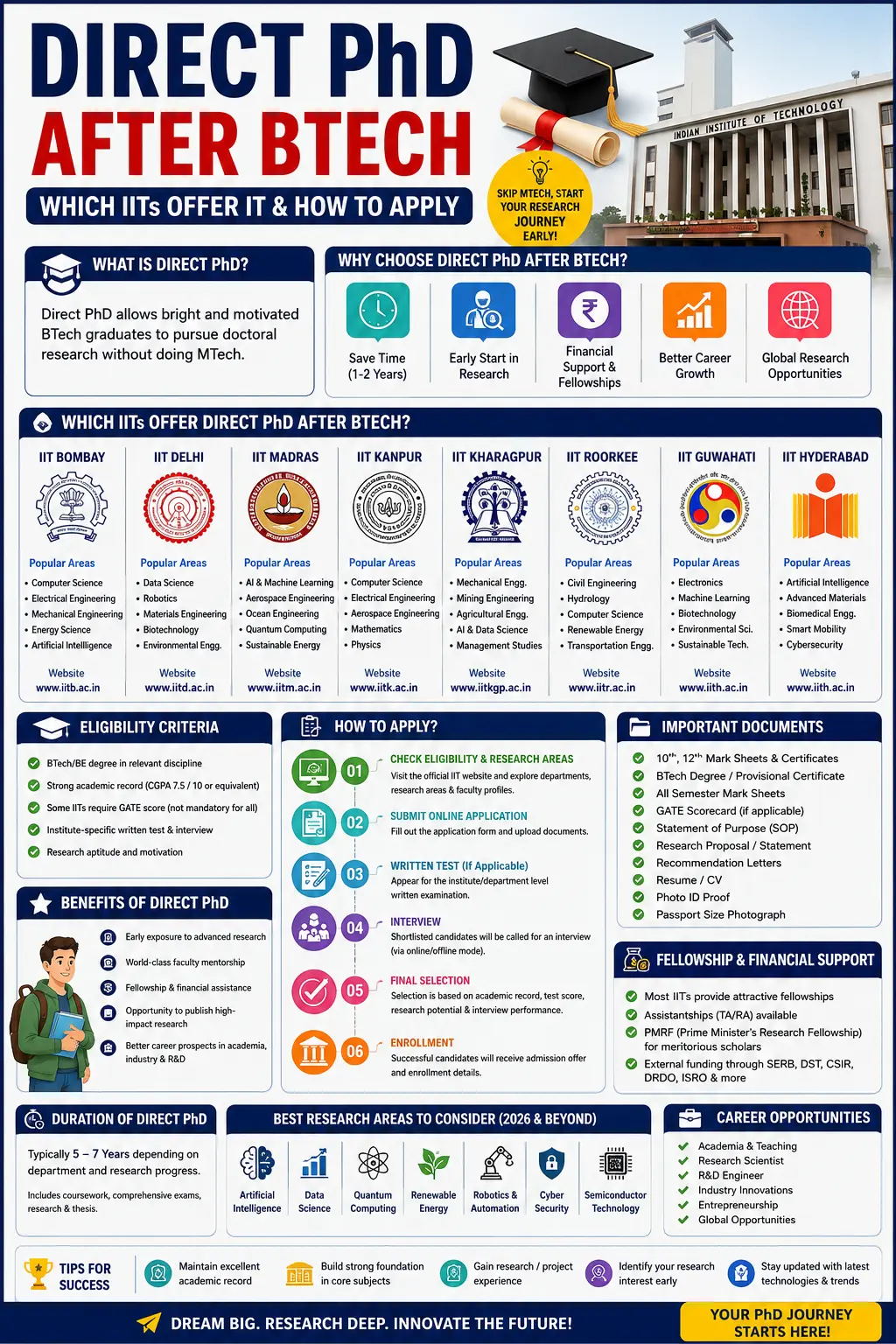
For many engineering graduates in India, the traditional academic pathway involves completing a BTech degree, pursuing an MTech, and then enrolling in a PhD program. However, with the increasing emphasis on research and innovation, several prestigious institutions now offer an alternative route: Direct PhD after BTech.
The Direct PhD program allows exceptional BTech graduates to enter doctoral research without completing a separate master's degree. This pathway is especially attractive for students who are passionate about research, academic careers, advanced technology development, and innovation-driven industries.
India's premier institutions, particularly the Indian Institutes of Technology (IITs), have introduced Direct PhD programs to attract talented students into research at an early stage. These programs combine advanced coursework with doctoral research, enabling students to complete their PhD more efficiently while receiving financial support through fellowships and assistantships.
In this guide, we explore everything you need to know about Direct PhD after BTech in India, including eligibility criteria, IITs that offer the program, admission processes, scholarships, career opportunities, and tips for successful applications.
What Is a Direct PhD Program?
A Direct PhD program allows students with a bachelor's degree, typically BTech or BE, to directly enroll in a doctoral program without first earning an MTech or MS degree.
The structure generally includes:
- Advanced postgraduate-level coursework
- Research methodology training
- Qualifying examinations
- Doctoral research work
- Thesis submission and defense
In many cases, students complete coursework equivalent to an MTech during the initial phase of the PhD program.
Why Choose Direct PhD After BTech?
The Direct PhD route offers several advantages for academically strong students.
Save Time
Students can move directly into doctoral research, reducing the overall duration of higher education.
Early Research Exposure
Scholars begin working on advanced research projects sooner than traditional PhD candidates.
Financial Support
Most IITs provide fellowships, teaching assistantships, or research assistantships.
Strong Academic Career Path
Direct PhD programs are ideal for students planning careers in:
- Academia
- Research laboratories
- Government research organizations
- Industrial R&D centers
- Technology startups
International Opportunities
A strong PhD profile can improve chances of international collaborations and postdoctoral research.
Eligibility for Direct PhD After BTech
Eligibility requirements vary across institutions, but common criteria include:
Academic Qualifications
Candidates should possess:
- BTech or BE degree in a relevant discipline
- Strong academic record throughout their studies
Many IITs require:
- Minimum CGPA of 7.5 to 8.0 on a 10-point scale
- First-class academic performance
Entrance Examination Requirements
Depending on the institution, candidates may need:
- GATE score
- UGC-NET qualification (for certain interdisciplinary areas)
- Institute-specific entrance examination
- Written test and interview
Some IITs may waive GATE requirements for students with exceptional academic performance.
IITs That Offer Direct PhD After BTech
Several IITs offer Direct PhD admission pathways.
IIT Bombay
IIT Bombay offers Direct PhD admissions across various engineering and science departments.
Popular Research Areas
- Computer Science and Engineering
- Electrical Engineering
- Mechanical Engineering
- Civil Engineering
- Energy Science
- Artificial Intelligence
Eligibility
- Excellent academic record
- BTech degree in a relevant field
- Written test and interview
IIT Delhi
IIT Delhi provides Direct PhD opportunities for highly qualified BTech graduates.
Research Specializations
- Data Science
- Robotics
- Materials Engineering
- Biotechnology
- Environmental Engineering
Admission Process
- Online application
- Departmental screening
- Interview evaluation
IIT Madras
IIT Madras is one of India's leading research institutions.
Major Research Areas
- Artificial Intelligence
- Quantum Computing
- Aerospace Engineering
- Ocean Engineering
- Sustainable Energy
The institute encourages research-oriented students to apply directly after graduation.
IIT Kanpur
IIT Kanpur has a strong reputation for scientific and engineering research.
Popular Departments
- Computer Science
- Electrical Engineering
- Aerospace Engineering
- Physics
- Mathematics
The admission process includes detailed academic evaluation and interviews.
IIT Kharagpur
IIT Kharagpur offers Direct PhD programs across multiple disciplines.
Research Areas
- Mechanical Engineering
- Mining Engineering
- Agricultural Engineering
- Artificial Intelligence
- Management Studies
The institute supports interdisciplinary doctoral research.
IIT Roorkee
IIT Roorkee offers research opportunities in engineering, sciences, and management.
Key Areas
- Structural Engineering
- Hydrology
- Computer Science
- Renewable Energy
- Transportation Systems
IIT Guwahati
IIT Guwahati has become a prominent research destination.
Research Focus Areas
- Electronics
- Machine Learning
- Sustainable Technologies
- Biotechnology
- Environmental Science
IIT Hyderabad
IIT Hyderabad is known for cutting-edge research and innovation.
Popular Fields
- Artificial Intelligence
- Advanced Manufacturing
- Biomedical Engineering
- Smart Mobility
- Cybersecurity
Direct PhD Admission Process at IITs
Although specific procedures differ among institutions, the admission process generally follows similar steps.
Step 1: Identify Research Interests
Before applying, students should identify:
- Preferred research area
- Department of interest
- Potential faculty supervisors
Having a clear research direction strengthens applications.
Step 2: Check Eligibility Requirements
Review:
- Minimum CGPA requirements
- Entrance exam criteria
- Department-specific conditions
Each IIT publishes detailed admission guidelines on its website.
Step 3: Submit Online Application
Applicants typically submit:
- Academic transcripts
- Resume or CV
- Statement of Purpose (SOP)
- Research interests
- Recommendation letters
Step 4: Written Test
Some departments conduct:
- Subject-specific written examinations
- Research aptitude assessments
Not all departments require a written test.
Step 5: Interview
The interview is often the most important stage.
Faculty members evaluate:
- Subject knowledge
- Research aptitude
- Problem-solving ability
- Motivation for doctoral research
Step 6: Final Selection
Selection is based on:
- Academic performance
- Entrance scores
- Research potential
- Interview performance
Fellowships and Financial Support
One of the biggest advantages of Direct PhD programs is financial assistance.
Institute Fellowships
Most IITs provide monthly fellowships.
Teaching Assistantships (TA)
Students assist faculty in:
- Laboratory sessions
- Tutorials
- Grading assignments
Research Assistantships (RA)
Students work on sponsored research projects.
PMRF (Prime Minister's Research Fellowship)
Outstanding scholars may qualify for the Prime Minister's Research Fellowship, which offers attractive financial benefits.
External Funding Agencies
Support is also available through:
- CSIR
- DST
- DRDO
- ISRO
- SERB
These fellowships help students focus entirely on research.
How Long Does a Direct PhD Take?
The duration varies depending on discipline and research progress.
Typical duration:
- 5 to 7 years
Initial years focus on:
- Coursework
- Comprehensive examinations
- Research proposal development
Later years are dedicated to:
- Research execution
- Publications
- Thesis writing
Best Research Areas for Direct PhD Students in 2026
Several research domains are expected to grow significantly in the coming years.
Artificial Intelligence and Machine Learning
Applications include:
- Healthcare
- Finance
- Smart Cities
- Robotics
Cybersecurity
Growing digitalization is increasing demand for cybersecurity researchers.
Quantum Computing
An emerging area with significant long-term potential.
Renewable Energy
India's clean energy transition is generating major research opportunities.
Data Science
Organizations increasingly rely on data-driven decision-making.
Robotics and Automation
Industry 4.0 is creating demand for intelligent automation systems.
Semiconductor Technologies
India's semiconductor initiatives are expanding research opportunities.
Career Opportunities After Direct PhD
Graduates enjoy diverse career opportunities.
Academia
- Assistant Professor
- Research Faculty
- Academic Administrator
Research Organizations
- DRDO
- ISRO
- CSIR Laboratories
- BARC
Industry Research
- Technology Companies
- R&D Centers
- Semiconductor Firms
- AI Companies
International Research Careers
Many graduates pursue:
- Postdoctoral research
- International faculty positions
- Global research collaborations
The demand for highly trained researchers continues to rise worldwide.
Tips for Getting Selected in a Direct PhD Program
Maintain a Strong Academic Record
High CGPA significantly improves admission chances.
Build Research Experience
Participate in:
- Internships
- Research projects
- Publications
- Technical competitions
Prepare a Strong SOP
Clearly explain:
- Research interests
- Career goals
- Motivation for pursuing a PhD
Contact Potential Supervisors
Faculty interaction can help align research interests.
Prepare Thoroughly for Interviews
Review core subjects and recent developments in your chosen field.
Future Scope of Direct PhD Programs in India
India is investing heavily in research and innovation through initiatives such as:
- National Research Foundation
- Digital India
- Semiconductor Mission
- Startup India
- National Education Policy
As research funding increases, Direct PhD programs are expected to become even more popular among talented engineering graduates.
Institutions are increasingly encouraging students to pursue research careers earlier, making Direct PhD programs an attractive option for ambitious scholars.
Conclusion
Direct PhD after BTech is an excellent pathway for students who are passionate about research and wish to accelerate their academic journey. Leading IITs including IIT Bombay, IIT Delhi, IIT Madras, IIT Kanpur, IIT Kharagpur, IIT Roorkee, IIT Guwahati, and IIT Hyderabad offer well-structured Direct PhD programs across various disciplines.
These programs provide early exposure to advanced research, generous fellowships, world-class mentorship, and strong career opportunities in academia, industry, and government research organizations. While the admission process is competitive, students with strong academic records, research aptitude, and clear goals can significantly improve their chances of selection.
For engineering graduates aiming to contribute to innovation, technology development, and scientific advancement, a Direct PhD from an IIT can be a transformative step toward a successful research career.