
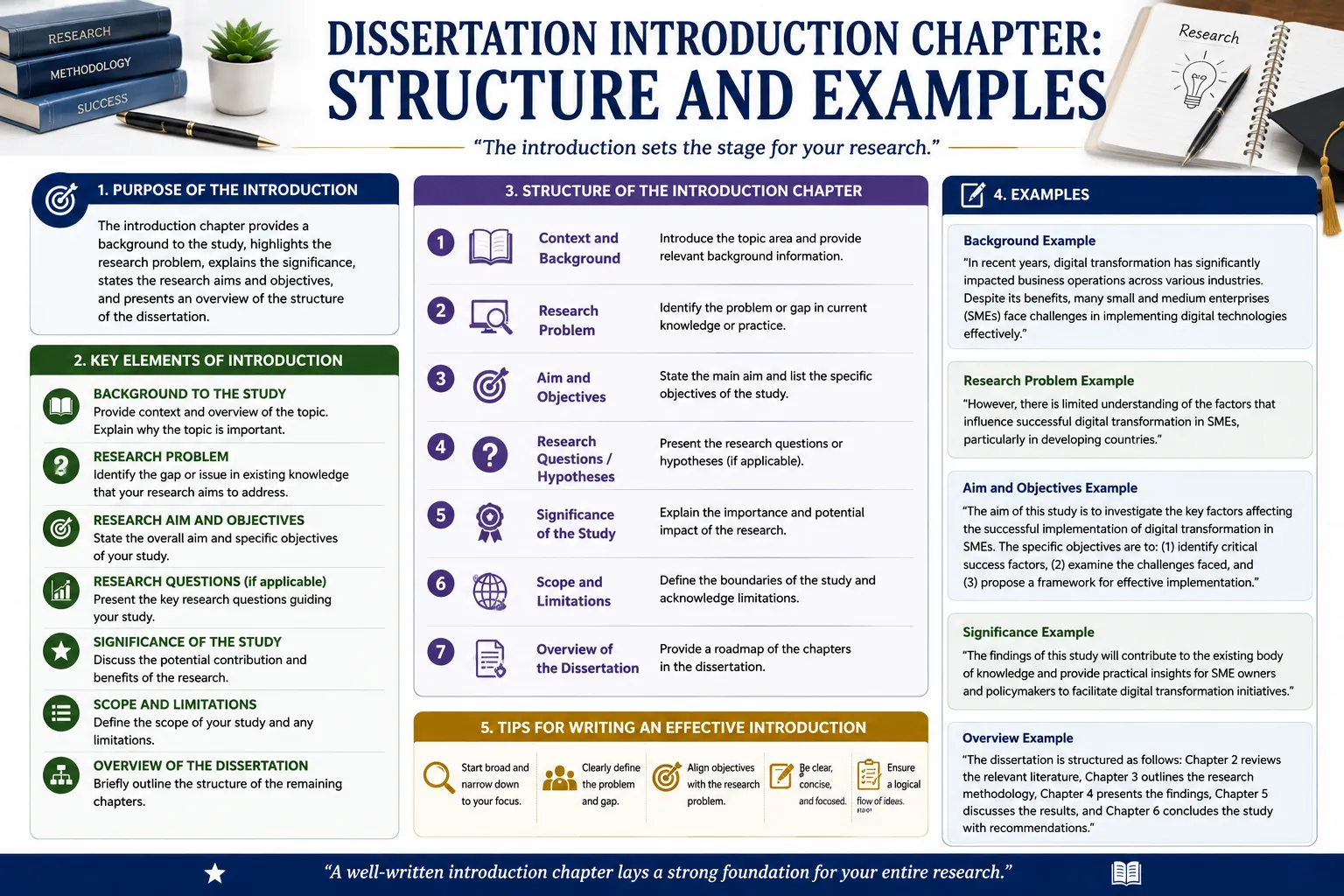
Your dissertation's introduction gets read closely by every single examiner — and, on average, they'll spend about 12 minutes forming their first impression of your entire project from it. That's a lot of weight for a chapter that typically makes up only around 10% of your total word count. This guide walks through the dissertation introduction chapter's structure with concrete examples, so those first pages do genuine justice to the work behind them.
The Ten Components of a Complete Introduction
The essential components of a dissertation introduction are: background and context, problem statement, purpose statement, research questions and hypotheses, significance of the study, scope and delimitations, limitations, theoretical or conceptual framework, definition of terms, and a chapter overview. Each of these components requires a genuinely different rhetorical approach — background context reads differently from a problem statement, which reads differently again from a chapter overview. Not every dissertation needs all ten in full detail (definitions of terms, for instance, are only necessary if you're using field-specific or ambiguous terminology), but each should at least be considered deliberately, not skipped by default.
The Hourglass Structure
The hourglass model, widely endorsed across disciplines, describes the logical movement of a well-structured introduction. The chapter opens broadly, narrows progressively to the specific problem and research questions, then widens again as it gestures toward the study's significance and contribution to knowledge. Picture the shape literally: wide at the top (broad context), narrow in the middle (your specific problem and questions), wide again at the bottom (why this matters more broadly).
Every section needs to connect logically to the next one — a reader should never need to pause and ask "how did we get here?" If your literature context jumps straight to your research questions without a clear bridge explaining the gap between them, that's a sign the hourglass isn't narrowing smoothly.
Writing a Strong Opening — With a Worked Example
A strong opening highlights real-world relevance using evidence-based context, not a generic statement. Consider this representative example: "Global investment in sustainable fashion increased from £3.4 billion in 2019 to £8.7 billion in 2024, yet conversion rates remain low despite high consumer awareness…" This opening immediately grounds the topic in specific, credible, quantified evidence — a reader knows within one sentence that this is a real, measurable phenomenon worth investigating, not a vague area of general interest.
Specific Openings to Avoid
Two specific patterns are consistently flagged as weak: generic statements like "In today's modern world…" and dictionary definitions of key terms. Both signal an underdeveloped opening — they establish nothing specific about your particular study and could introduce almost any topic in almost any field.
Writing Your Problem Statement and Research Questions — With a Worked Example
Once your opening has established genuine, evidenced context, narrow toward your specific problem and research question. A representative example of a properly narrowed research question: "How does influencer authenticity affect sustainability-based purchase intention among Gen Z consumers?" Notice how specific this is compared to a broader phrasing like "How does social media affect consumer behavior?" — the narrowed version names the specific mechanism (influencer authenticity), the specific outcome (sustainability-based purchase intention), and the specific population (Gen Z consumers).
Don't Let Your Introduction Become a Mini Literature Review
A common and specifically flagged mistake: turning the introduction into a condensed literature review. Your introduction should be brief, focused, and forward-looking — leading the reader toward your research questions, not attempting to impress them with exhaustive detail. That level of comprehensive engagement with prior scholarship belongs in your literature review chapter proper. If you notice your background section running several pages deep into detailed discussion of individual studies, that content likely belongs elsewhere.
Closing With a Chapter Roadmap
End your introduction with a brief chapter-by-chapter overview, using just one to two sentences per chapter. This tells your examiner exactly how your dissertation is structured before they read any further — functioning as a roadmap, not a content preview. A roadmap sentence should show connection, not just list topics: "Chapter 3 details the mixed-methods design used to test the hypotheses introduced in Chapter 2" does more work than "Chapter 3 covers the methodology."
How Long Should Your Introduction Be?
Word count benchmarks converge around a consistent range of roughly 5–10% of your total dissertation word count, though specific figures vary somewhat by source and institution. Representative benchmarks include:
- 10,000-word dissertation → roughly 800–1,000 words
- 12,000-word dissertation → roughly 1,200 words
- 15,000-word dissertation → roughly 1,500 words
- 80,000-word PhD dissertation → roughly 3,000–5,000 words (4–6%)
These are guidelines, not fixed rules — always confirm your specific institution's expectations, since different universities and departments genuinely vary in what they expect from this chapter.
You Don't Have to Write It First
You do not have to write your introduction first, despite it appearing first in your final document. Because each chapter is meant to be reasonably self-contained with its own clear purpose, many writers start with whichever chapter is easiest to write and return to the introduction later. Most students write a rough introduction draft early simply to give themselves direction, then substantially revise — or effectively rewrite — it once the rest of the dissertation is complete. This is the correct process, not a mistake, since your dissertation's argument, findings, and framing will likely shift and tighten considerably as your writing progresses.
Step-by-Step: Structuring Your Dissertation Introduction
- Draft a strong, evidence-based opening establishing real-world relevance, avoiding generic statements and dictionary definitions
- Provide selective background context, narrowing progressively toward your specific problem
- State your problem statement clearly and specifically
- Present your research questions or hypotheses, ensuring they're precisely narrowed, not broad enough to fit any related study
- State the significance of your study, widening back out toward its broader contribution
- Address scope, delimitations, and limitations concisely
- Define any field-specific or ambiguous terms your reader will need
- Close with a brief, one-to-two-sentence-per-chapter roadmap
- Check your total length against your institution's expected percentage of total word count
- Revisit and substantially revise this chapter once the rest of your dissertation is complete
Practical Checklist: Is Your Dissertation Introduction Ready?
- Opens with specific, evidence-based context, not a generic statement or dictionary definition
- Follows the hourglass structure — broad, narrowing to specific, widening again toward significance
- Includes all relevant components: background, problem statement, research questions, significance, scope/limitations
- Research question is narrowed precisely, not broad enough to fit multiple different studies
- Background section stays selective, avoiding becoming a mini literature review
- Ends with a brief chapter-by-chapter roadmap (one to two sentences per chapter)
- Falls within the roughly 5–10% word count benchmark for your total dissertation length
- Has been (or will be) substantially revised after the rest of the dissertation is complete
Two Practical Scenarios
Scenario 1 — Replacing a Generic Opening With Evidence
A scholar's first draft opened with "In today's modern world, sustainability has become increasingly important to consumers." After reviewing guidance on avoiding generic openings, the scholar replaced it with a specific, evidenced statement: "UK investment in sustainable fashion grew from £3.4 billion in 2019 to £8.7 billion in 2024, yet conversion rates remain low despite high consumer awareness." The revised opening immediately signaled a genuine, measurable phenomenon worth investigating, rather than a vague area of general interest.
Scenario 2 — Narrowing an Overly Broad Research Question
A scholar's initial research question read: "How does social media influence consumer behavior?" — broad enough to fit dozens of different studies. Applying the narrowing principle, the scholar revised it to: "How does influencer authenticity affect sustainability-based purchase intention among Gen Z consumers?" — specifying the mechanism, the outcome, and the population, giving the introduction's hourglass structure a genuinely precise point to narrow toward.
Common Mistakes Writers Make With the Dissertation Introduction
- Opening generically ("In today's world…") or with a dictionary definition, rather than specific, evidence-based context.
- Turning the introduction into a mini literature review, duplicating content that belongs in the literature review chapter.
- Stating an overly broad research question that doesn't reflect the hourglass structure's narrowing.
- Skipping the closing chapter roadmap, leaving the examiner without a clear preview of the dissertation's structure.
- Finalizing the introduction too early, before the rest of the dissertation's actual content and argument is known.
Frequently Asked Questions
What is the structure of a dissertation introduction chapter?
It follows an hourglass structure — opening broadly with evidence-based context, narrowing to a specific problem statement and research questions, then widening again toward the study's significance — and includes components such as background, problem statement, research questions, significance, scope, limitations, and a closing chapter roadmap.
Why does the dissertation introduction chapter's structure matter?
Examiners typically spend around 12 minutes on their first read of this chapter, forming an early impression of the entire dissertation — a clearly structured, evidence-grounded introduction signals scholarly capability from the very first page.
How does the introduction chapter affect a dissertation's overall impression?
A well-structured introduction with a specific, narrowed research question and a clear roadmap makes the rest of the dissertation easier to follow, while a generic or overly broad introduction can create doubt before the examiner even reaches the literature review.
How long should a dissertation introduction chapter be?
Generally around 5–10% of your total dissertation word count, though the exact figure varies by institution and degree level — always confirm your specific department's expectations rather than assuming a universal benchmark.
Is professional help available for structuring a dissertation introduction chapter?
Yes. ThesisLikho's PhD-qualified mentors have guided 10,000+ scholars through introduction chapter structuring, problem statement framing, and complete dissertation writing assistance tailored to individual disciplines.
Get Expert Guidance on Your Dissertation Introduction Chapter
Structuring an introduction that genuinely follows the hourglass model — with a specific, evidence-grounded opening and a precisely narrowed research question — takes careful, deliberate drafting. If you'd like expert input on structuring or sharpening your dissertation introduction, ThesisLikho's PhD-qualified team offers introduction chapter support, problem statement guidance, and complete dissertation writing assistance. If you need expert guidance with your introduction, chapter structure, or overall dissertation writing, you can explore our Dissertation Writing Assistance service.
Get Dissertation Help Now → https://thesislikho.com/writing-services/dissertation-writing