
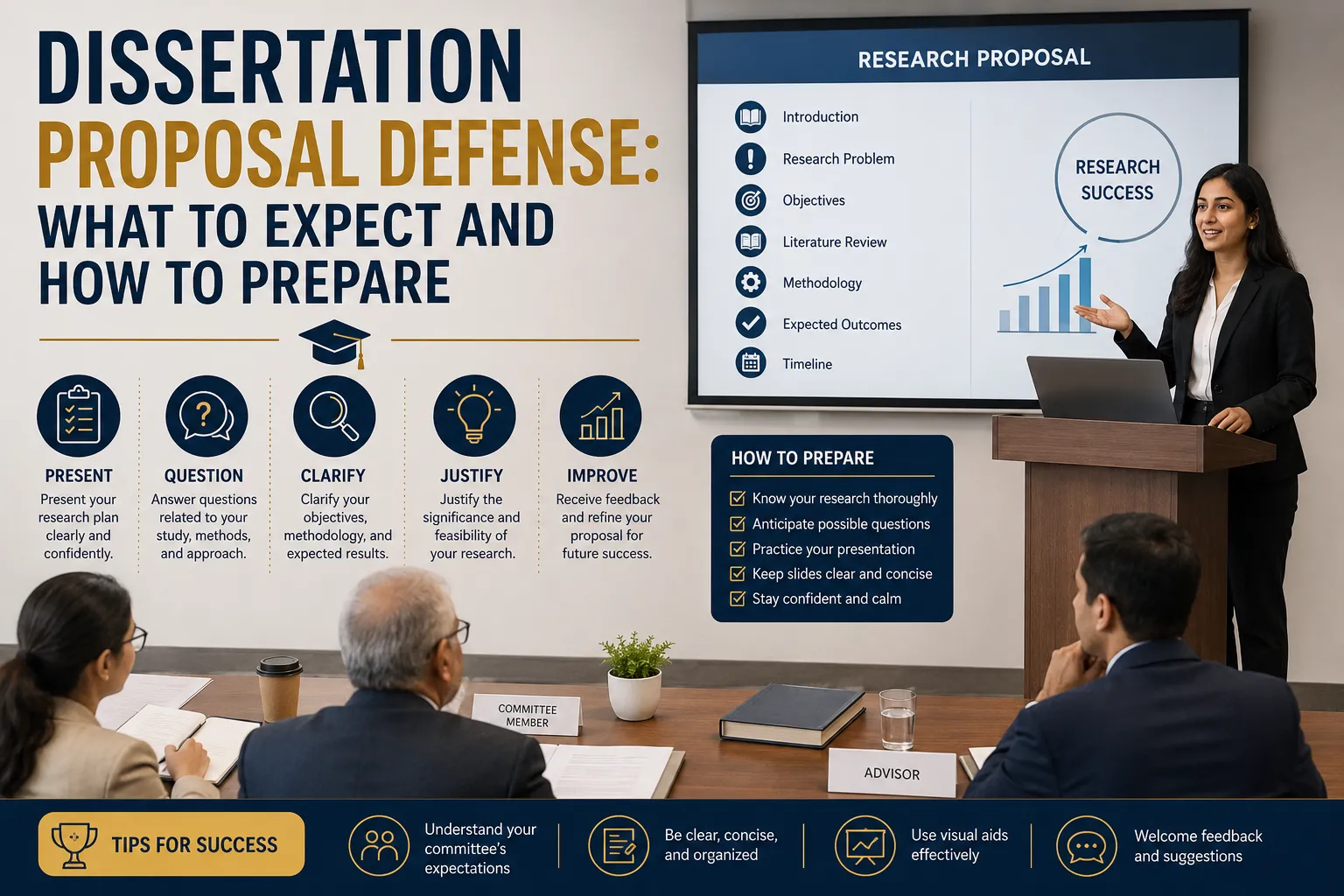
If your proposal defense is coming up and you're not entirely sure what actually happens in that room, you're not alone — most first-time scholars have a vague sense that they'll "present their plan and answer questions," but very little idea of what committees are genuinely evaluating or how to prepare for it beyond rereading their own proposal one more time. This guide walks through exactly what a dissertation proposal defense involves, what your committee is actually looking for underneath the surface-level questions, and a practical, step-by-step way to prepare so you walk in with real confidence rather than just hope.
What a Proposal Defense Actually Is (and Isn't)
A proposal defense is an oral evaluation of your research plan — not your findings, since you haven't collected data yet, and not your final dissertation, which comes later. Its entire purpose is to confirm that your research question is significant, your methodology is sound, your plan is feasible within your actual timeline and resources, and you personally understand your own plan deeply enough to carry it out independently. It's easy to conflate this with a final dissertation defense, but the two serve genuinely different functions: a proposal defense checks whether your plan is worth pursuing, while a final defense checks whether you executed and interpreted it well.
Understood this way, a proposal defense is actually good news dressed up as a stressful event: it's the checkpoint specifically designed to catch a flawed research design, an unrealistic timeline, or an under-scoped methodology while those problems are still cheap to fix — before you've spent months or years building on a shaky foundation.
How the Format Works, Including India-Specific Structures
While specifics vary by university, a proposal defense typically follows a consistent shape: a candidate presentation (often 20–25 minutes, though this varies by institution), followed by a structured question-and-answer session with the committee, after which committee members deliberate privately — sometimes asking the candidate to step out of the room — and reach a decision: approve, approve with minor revisions, require major revisions and a resubmission, or in rarer cases, decline the proposal as presented.
In Indian universities specifically, this process for research-degree (PhD) scholars generally runs through a Doctoral Research Committee (DRC) and Research Advisory Committee (RAC), commonly involving a synopsis of roughly 2,000 to 5,000 words presented at an open seminar. The RAC then recommends the topic for formal registration, sometimes conditional on specific revisions. Master's-level dissertations usually follow a lighter version of the same underlying logic — a proposal presented to your guide or a smaller department committee for sign-off before you're cleared to begin data collection, without the full multi-committee structure PhD scholars go through.
If you're specifically preparing for the Indian synopsis-defense format, our companion guides, [Link: How to Present a Synopsis Before a Doctoral Committee] and [Link: How to Build Presentation Slides for a Synopsis Defense], go deeper into that specific process.
What Your Committee Is Really Evaluating
It helps enormously to understand what's actually being assessed underneath the surface of individual questions, because it changes how you prepare. Committees are generally weighing:
- Significance and contribution — does your research question matter, and does it add something genuinely new (theoretically, methodologically, or empirically) rather than repeating settled ground?
- Soundness of your research design — are there structural flaws in your methodology that would undermine your findings regardless of how well you execute it?
- Grounding in existing literature — is your proposal consistent with, and clearly positioned against, the relevant theoretical and empirical work already published in your area?
- Feasibility — realistic timelines with built-in buffer, genuine evidence that access problems (data, respondents, sites, instruments) have already been addressed rather than optimistically assumed, and honest acknowledgment of where things could go wrong.
- Your demonstrated readiness for independent research — this runs underneath every other category. Committees are ultimately asking whether you understand your plan deeply enough to execute it and adapt it without constant hand-holding, not just whether the document reads well.
Understanding this list matters because it reframes what "passing" actually requires: it's not about defending every sentence of your document without concession, but demonstrating that you understand your research deeply enough to reason through its weak points honestly and competently.
Step 1: Rewrite Your Proposal Into a Presentation, Not a Reading
Your written proposal and your oral presentation are not the same document, and treating them as interchangeable is one of the most common early mistakes. A presentation needs to compress dozens of pages into a tight, spoken narrative that a committee can absorb in real time — which means cutting far more than feels comfortable. Identify the three or four things your committee absolutely needs to walk away understanding (your research question, why it matters, your core methodological approach, and your realistic plan for executing it), and build your presentation around those, treating everything else as backup material you can pull up if asked rather than content you need to actively present.
Step 2: Build Your Presentation as a Story, Not a Data Dump
Presentation-skills training aimed at researchers consistently emphasizes building talks around a clear narrative arc — moving from the problem, to why it matters, to your specific approach — rather than a flat, sequential walk through your document's structure. A strong opening matters more than most candidates realize: starting with a genuinely compelling question or framing engages a committee far more effectively than opening with a restated title slide and a table of contents. Spend real rehearsal time specifically on your first two minutes, since that's what sets the tone for how receptively the rest of your presentation gets received.
Step 3: Pre-Answer the Questions You Expect
One of the most consistently recommended preparation techniques is deceptively simple: build your presentation to explicitly answer every question you expect your committee to ask, so you control which material surfaces first rather than being caught addressing a weakness only when someone raises it. If you know a particular aspect of your methodology is contestable, or your timeline is tight, or your literature review has a gap you haven't fully closed — address it directly and confidently in your presentation rather than hoping nobody notices. Committees consistently respond better to a candidate who raises their own weak points with a clear mitigation plan than to one who appears to be avoiding them.
Step 4: Run a Mock Defense
Reading your presentation aloud alone is not the same as defending it under real, unscripted questioning. Ask your supervisor, a senior scholar, or two or three peers to run a genuine mock defense — including some deliberately challenging questions, not just supportive ones. This surfaces gaps in your reasoning far faster than any amount of solo rehearsal, simply because you're forced to respond in real time rather than composing a polished answer at your own pace. If your department doesn't organize this formally, it's worth asking for informally; even a single hour of unscripted questioning is disproportionately valuable preparation time.
Designing Slides That Support Rather Than Distract
Slides for a proposal defense have a narrow, specific job: they should anchor your spoken narrative and give the committee a visual reference point, not carry the full weight of your explanation. A useful rule of thumb is to treat each slide as a prompt for what you're about to say, rather than a summary of everything you could say. For your literature review section specifically, resist the urge to include a dense list of every source you've read — a small number of well-chosen studies that clearly frame your gap will land far better than an exhaustive bibliography squeezed onto one slide. For your methodology section, a simple visual flow (your research question leading into your data source, your analysis approach, and your expected output) tends to communicate your plan faster than a paragraph of text ever could. Save your most detailed material — full variable lists, complete instrument details, extended timelines — for appendix slides you can pull up only if a specific question calls for them, rather than presenting them as part of your main flow.
It's also worth rehearsing your transitions between slides out loud, not just the content of each one individually. A presentation that flows smoothly from section to section reads as more confident and more rehearsed than one where each slide feels like a separate, disconnected block — even if the underlying content is identical.
Logistics Worth Sorting Out Before the Day
A surprising share of proposal-defense stress comes from logistics rather than content, and most of it is entirely preventable with a little advance planning. If your defense is in person, confirm the room, check what presentation equipment is available, and do a dry run with your actual laptop and adapter rather than assuming compatibility. If it's virtual — increasingly common for at least part of a committee — test your screen-sharing setup, your internet connection, and your backup plan (a phone hotspot, a second device) well before the scheduled time, since a technical delay at the start of a defense tends to unsettle a candidate's composure more than any actual question does.
Bring a printed or annotated digital copy of your full proposal into the room, tabbed or bookmarked at key sections, so you can quickly reference specific details if a committee member asks about something not covered in your slides. Confirm in advance how much time you'll actually have, since a presentation built for 25 minutes that gets cut short by scheduling pressure can throw off your pacing if you haven't planned for a shorter version. Finally, get a full night's sleep and eat properly beforehand — this sounds obvious, but nervous candidates skip both far more often than they'd admit, and both meaningfully affect how clearly you think under real-time questioning.
Common Questions to Prepare For
Across the categories your committee is evaluating, a few question types come up consistently enough to be worth rehearsing specific, spoken answers for: "Why does this research question matter, and to whom?"; "What specifically is missing from the existing literature that your study addresses?"; "Why this methodology over the available alternatives?"; "What happens to your study if your primary data-access assumption doesn't hold?"; "What is the single most original contribution of this proposed research?"; and "What's the biggest risk to your timeline, and how are you managing it?" Rehearsing spoken, not just written, answers to these — ideally out loud to another person — is one of the highest-value uses of your final preparation time.
It's worth noting what distinguishes a strong answer from a weak one across all of these: strong answers are specific and grounded in something concrete you've already done — a source you've read, a conversation you've already had with a potential data provider, a comparison you've already worked through — rather than a confident-sounding but generic restatement of your proposal's language. If a committee member asks "why this methodology," a weak answer restates that it's "commonly used in this field"; a strong answer explains specifically what your research question needs that this methodology provides, and what you considered and ruled out instead. The difference is almost always about specificity, not confidence of delivery — a calm, specific answer will consistently land better than an enthusiastic, vague one.
A related category worth preparing for is the "devil's advocate" question, where a committee member deliberately pushes back on an assumption in your proposal to see how you respond under genuine pressure, not because they necessarily disagree with your approach. The right response here isn't to abandon your position at the first sign of pushback, nor to become defensive — it's to acknowledge the validity of the concern, explain your reasoning for the choice you made, and be honest about where you'd adjust if the concern turned out to be a real problem. Committees consistently report that this kind of measured, reasoned response is what actually signals research maturity, far more than simply having a ready answer for every possible question.
What Happens After the Defense
After the question-and-answer session, most committees deliberate privately, and candidates are typically asked to step out of the room during this discussion. The outcome generally falls into a small number of categories: approval to proceed as planned, approval with minor revisions (a common, unremarkable outcome that simply means refining specific points before formal registration), a request for major revisions and resubmission, or — rarely — a decision that the proposal isn't yet ready to proceed. It's worth normalizing this range of outcomes ahead of time: being asked to revise is a routine part of the process for a large share of candidates, not a sign that something has gone fundamentally wrong.
In the Indian RAC/DRC structure specifically, this typically translates into the committee recommending your synopsis for formal registration outright, recommending it conditional on specific, stated revisions being incorporated before registration proceeds, or asking for a revised synopsis to be resubmitted and presented again at a future seminar. Whichever outcome you receive, it's worth asking your committee or supervisor for specific, written feedback on exactly what needs to change, rather than leaving the meeting with only a general impression — this turns a vague sense of "it didn't go perfectly" into a concrete action list you can work through methodically before your next attempt.
A Real Example: When One Unaddressed Weakness Dominates the Room
A candidate's proposal treated a genuine data-access risk — whether a specific partner organization would actually grant survey access to its employees — as a brief footnote, mentioned once and then set aside. During the defense, nearly every committee member's question circled back to this same unresolved point, since it was the one place where the proposal's confidence didn't match its actual level of certainty. What should have been a fifteen-minute defense turned into an hour of repeated variations on the same concern. On revision, the candidate secured a written confirmation of access before resubmitting, and directly addressed the risk and its mitigation plan in the very next presentation — which passed with only minor additional comments. The lesson generalizes well: an unaddressed weak point doesn't just risk one bad question, it tends to become the entire session's focus, because committees will keep returning to whatever feels least resolved.
Common Mistakes That Undermine an Otherwise Strong Proposal
- Reading slides verbatim instead of presenting. A committee wants to see that you understand your own research well enough to speak about it naturally, not that you can read text off a screen.
- Overloading slides with dense text or excessive data. Your presentation should support your narrative, not replace it — save detailed tables and full literature summaries for the written document.
- Being defensive rather than reflective when challenged. Committees are testing your reasoning, not trying to catch you out; acknowledging a genuine limitation with a clear plan to address it reads as far stronger than insisting nothing could be improved.
- Treating feasibility as a formality. Vague optimism about access, timeline, or resources tends to invite more scrutiny than an honestly flagged risk paired with a concrete mitigation plan.
- Skipping rehearsal under real questioning. Solo practice catches weak phrasing; a mock defense with genuinely challenging questions catches weak reasoning — and only the second kind of gap is likely to show up in the actual room.
- Memorizing a script word-for-word. A fully memorized presentation tends to fall apart the moment a committee member interrupts with a question, since the candidate loses their place in a rehearsed sequence rather than being able to pick the conversation back up naturally. Knowing your material well enough to speak from a rough outline is more resilient than memorizing exact phrasing.
- Assuming the committee has read every page as closely as you have. A committee member's question sometimes reflects a genuine gap in how clearly your proposal communicated something, not a flaw in the underlying idea itself — treat these moments as a chance to clarify rather than a sign your reasoning was wrong.
FAQs
What is a dissertation proposal defense? It's an oral evaluation of your research plan — not your findings or final dissertation — where a committee assesses your research question's significance, your methodology's soundness, your plan's feasibility, and your demonstrated readiness to carry out independent research.
Why does a dissertation proposal defense matter?
Because it's the checkpoint specifically designed to catch flawed methodology, unrealistic timelines, or scope problems while they're still inexpensive to fix — before you've invested months or years building on an unresolved weakness.
How does a dissertation proposal defense affect a dissertation?
A proposal returned for revision delays your start on data collection but is a routine, common outcome; a smoothly approved proposal lets you proceed with committee-backed confidence in your plan, which tends to reduce friction at later stages, including your final defense.
How long does it take to complete a dissertation using this approach?
This varies significantly by degree level and institution, but a clearly scoped, well-defended proposal is one of the more reliable ways to keep your overall dissertation timeline on track, since it reduces the chance of a major methodological pivot partway through your research.
Is professional help available for dissertation proposal defense preparation?
Yes. Experienced mentors routinely help candidates rewrite a written proposal into an effective oral presentation, anticipate likely committee questions, and run structured mock defenses — this is a core part of what services like ThesisLikho's dissertation writing support provide.
Walking into your defense with a plan you've genuinely rehearsed — not just written — is what turns a stressful checkpoint into a confident conversation. If you'd like support preparing your proposal or your defense presentation, Get Dissertation Help Now →