
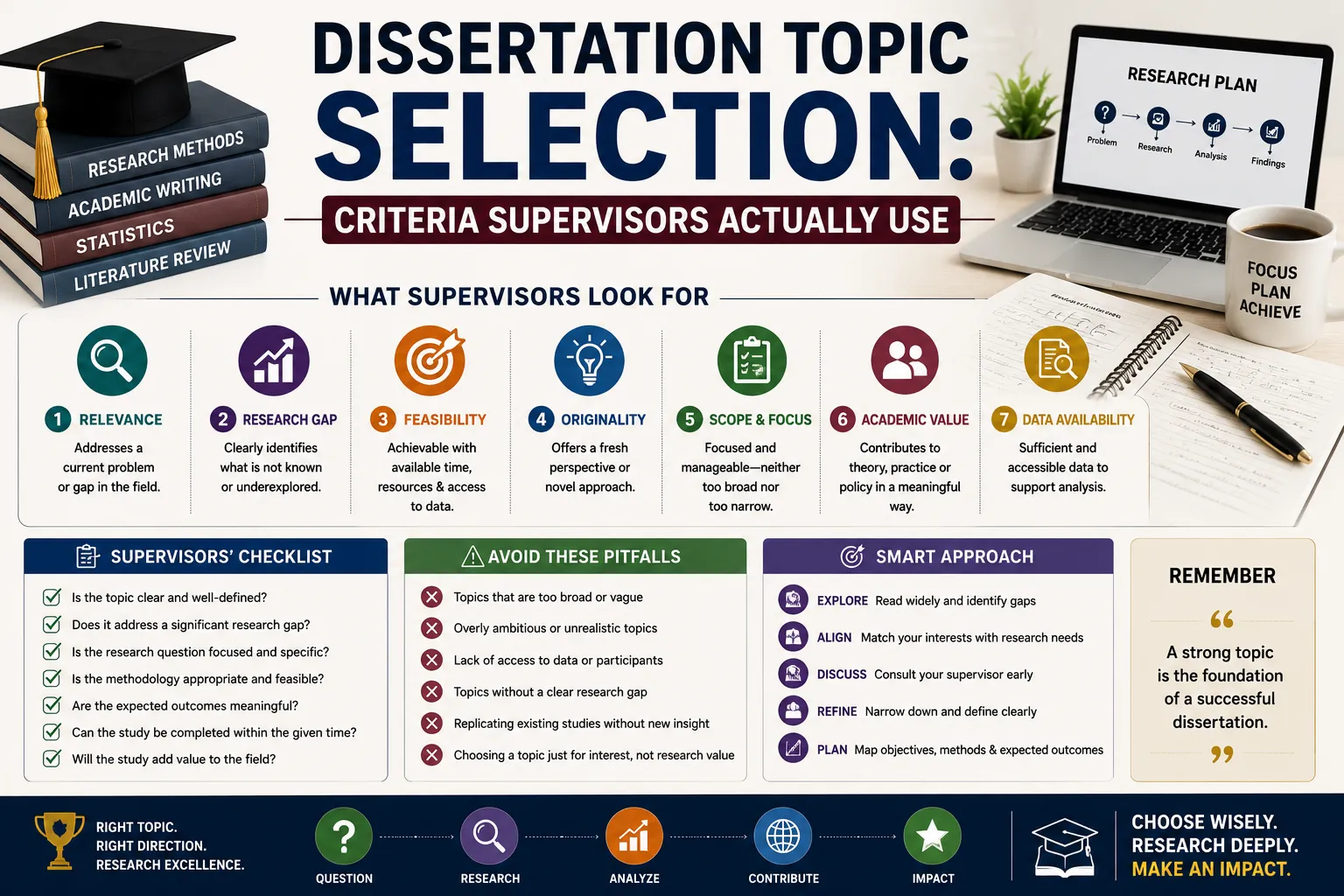
You've probably heard "choose something you're passionate about" more times than you can count. It's not wrong, but it's incomplete — and it doesn't explain why some genuinely interesting topics get sent back for revision while others sail through approval. This guide breaks down dissertation topic selection: the criteria supervisors actually use, beyond passion, to evaluate whether a topic is worth approving.
A good dissertation topic is consistently defined across academic guidance as original, specific, feasible within your timelines and resources, and clearly connected to an identifiable gap or debate in existing scholarship. These four qualities apply regardless of field, though they show up differently depending on discipline. Understanding exactly what each criterion means — and how supervisors actually test for it — is what separates a smooth approval from months of back-and-forth revision.
The Four Criteria Framework Supervisors Actually Apply
A concise framework captures what most supervisors are really checking for, whether or not they state it explicitly:
- Original — the exact study hasn't been done before
- Problem-driven — it addresses a real problem that practitioners or the field genuinely need solved
- Feasible — it can actually be completed within your timeframe and resources
- Professor-approved — your specific committee will genuinely support it, not just tolerate it.
Every topic-selection decision ultimately gets tested against these four lenses. Below, we unpack each one with the specific checks supervisors apply.
Criterion 1: Originality — What It Actually Means
Originality doesn't mean inventing an entirely new field. A topic is considered original if no previous study has examined the exact combination of your research context, population, methodology, and timeframe — or if you're applying an established theory to a new geographic, cultural, or sectoral context. This is why a well-studied theory applied to an under-researched population or region can be genuinely original, even if the underlying theory itself is decades old.
Supervisor test: Can you clearly state what specific combination of factors makes your study different from the closest existing published work?
Criterion 2: Specificity and Scope — The Broad-vs-Narrow Balance
A topic is too broad if it cannot be addressed with data you can realistically collect, requires expertise across multiple disciplines simultaneously, would need decades to answer adequately, or encompasses too many sub-questions at once (Source: Thesis Ace Writers). At the same time, an overly narrow topic can limit available data or academic relevance. Effective topics strike a balance — specific enough to be manageable, yet broad enough to allow meaningful investigation.
Supervisor test: Could this topic be answered in a single dissertation timeframe, or does it read more like a five-year research program?
Criterion 3: Feasibility — The Criterion Most Topics Fail On
Supervisors often evaluate proposals specifically on feasibility, and a topic that's too broad, too narrow, or lacking academic relevance struggles to gain approval regardless of how interesting it sounds (Source: ExamProg, "Choosing a Strong Dissertation Topic and Research Question"). Feasibility isn't just about time — it's about whether your chosen research method genuinely matches your available resources. A frequently cited example of misalignment: proposing an experimental neuroscience topic without lab access, versus a feasible alternative like survey-based analysis using online questionnaires.
Supervisor test: Given your actual data access, equipment, timeline, and skill set, can you realistically execute this specific method?
Criterion 4: Genuine Committee Support — Not Just Sign-Off
A topic can technically satisfy originality, scope, and feasibility, and still fail to gain traction if it doesn't align with your specific supervisor's expertise or your department's resources. Supervisor fit matters as much as topic quality — research on doctoral supervision outcomes found that a supervisor's subject-matter expertise and successful supervision track record are the strongest factors associated with reducing future difficulties and increasing a student's confidence in successfully defending their dissertation. A brilliant topic paired with a mismatched supervisor creates friction that a strong topic alone can't overcome.
Supervisor test: Does this topic sit within an area your supervisor can genuinely guide you through, not just approve on paper?
What Each Topic Selection Criterion Actually Checks
When evaluating a research topic, supervisors and review committees assess several key criteria to determine whether the study is suitable and achievable.
Originality: This criterion checks whether the research offers a new contribution through a unique context, population, methodology, or time period. A common mistake is selecting a topic that closely duplicates a supervisor's or another researcher's work.
Specificity and Scope: This evaluates whether the topic is focused enough to be completed within a single dissertation. Many proposals fail because the research question is too broad or spans multiple disciplines beyond the available time.
Feasibility: This criterion assesses whether the research methodology can be carried out with the available time, resources, equipment, and data. A common failure is choosing methods that require facilities or datasets that are not accessible.
Committee Support: This examines whether the supervisor and committee have the expertise to guide the research effectively. A proposal may struggle if approval is granted but there is insufficient subject expertise or ongoing academic support.
Step-by-Step: How to Select a Topic That Passes All Four Criteria
Step 1: Start With a Genuine Interest, Not Just a Trend
Begin with the subfield, theory, population, or phenomenon that genuinely interests you, since you'll be living with this topic for a long time.
Step 2: Read Recent Literature and Note Unanswered Questions
Read journal articles from the last 3–5 years in your field and note what questions remain unanswered. Review "future research" sections of published papers specifically — these are explicit invitations to explore specific gaps.
Step 3: Talk to Your Supervisor Early About Fit
Discuss current trends and departmental needs directly with your supervisor before finalizing a direction. This surfaces both originality opportunities and feasibility concerns early, when adjustments are still cheap.
Step 4: Run the Feasibility Check Explicitly
Ask directly: can you realistically collect the data this topic requires within your timeframe? If your ideal method needs resources you don't have, look for a feasible alternative method that still answers a meaningful version of the same question.
Step 5: Verify the Combination Is Genuinely Original
Confirm that your specific combination of context, population, methodology, and timeframe hasn't already been studied — not just that the general topic area is unexplored.
Step 6: Draft a Specific, Not Generic, Working Title
A strong working title signals clarity to your supervisor from the first read. Titles can evolve, but starting with a precise, well-scoped title saves revision time later.
Step 7: Confirm Supervisor Expertise Genuinely Covers the Area
Before committing, confirm your prospective supervisor has genuine expertise or supervision history in your specific chosen area — not just general availability.
Practical Checklist: Does Your Topic Pass the Four-Criteria Test?
- The specific combination of context, population, method, and timeframe hasn't been studied before
- The topic is answerable within a single dissertation timeframe
- The topic doesn't require expertise across multiple unrelated disciplines simultaneously
- Your chosen research method matches your actual data access, equipment, and skills
- You've reviewed recent literature and "future research" sections for explicit gap signals
- Your prospective supervisor has genuine expertise in this specific area
- Your working title is specific, not generic
- You've discussed the topic directly with your supervisor before finalizing it
Two Practical Scenarios
Scenario 1 — A Topic That Failed the Feasibility Test
A student proposed an experimental study requiring access to a neuroimaging lab their university didn't have. After the topic was returned for revision, they retained the same underlying research question but shifted to a survey-based methodology examining self-reported cognitive outcomes instead — preserving the original research interest while matching a method their department could actually support. The revised proposal was approved within one review cycle.
Scenario 2 — A Topic That Passed Originality by Reframing Context
A student wanted to study a well-established organizational behavior theory that had already been extensively tested in Western corporate settings. Rather than abandoning the theory as "already done," they reframed the study to apply it within a specific under-researched sector — mid-sized manufacturing firms in a particular Indian state — satisfying the originality criterion through a genuinely novel context and population combination, even though the underlying theory itself wasn't new.
Common Mistakes Students Make in Topic Selection
- Confusing "interesting to me" with "approvable by my committee" — passion alone doesn't satisfy feasibility or originality.
- Copying a supervisor's or colleague's research direction too closely, raising originality concerns later at the defense stage.
- Skipping the preliminary literature search, only to discover a near-identical published study months into the work.
- Choosing a method before checking resource access, rather than the reverse.
- Treating the topic statement and the research question as identical, producing a proposal that sounds interesting but isn't actually answerable.
Frequently Asked Questions
What is dissertation topic selection: criteria supervisors actually use?
It refers to the specific standards — originality, appropriate scope, feasibility given available resources, and genuine alignment with supervisor expertise — that supervisors apply when evaluating whether a proposed dissertation topic is approvable, beyond simply whether the topic sounds interesting.
Why does dissertation topic selection criteria matter?
A topic that fails feasibility or originality checks is one of the most common reasons dissertation proposals are returned for revision, regardless of how compelling the underlying research idea is.
How does dissertation topic selection affect the overall dissertation process?
The chosen topic shapes every subsequent chapter — literature review, methodology, and analysis all grow directly from it — so a topic that passes all four criteria early tends to produce a smoother, more coherent dissertation overall.
How long does it take to complete a dissertation using this approach?
Timelines vary, but scholars who apply feasibility and originality checks before finalizing a topic typically avoid the delays caused by later topic revision or committee pushback.
Is professional help available for dissertation topic selection criteria supervisors actually use?
Yes. ThesisLikho's PhD-qualified mentors have guided 10,000+ scholars through topic selection, feasibility assessment, and complete dissertation writing assistance tailored to individual university requirements.
Get Expert Guidance on Your Dissertation Topic Selection
Choosing a topic that satisfies originality, scope, feasibility, and genuine supervisor fit takes more than enthusiasm — it takes a structured evaluation before you commit. If you'd like expert input on whether your dissertation topic will hold up against these criteria, ThesisLikho's PhD-qualified team offers topic selection support, feasibility assessment, and complete dissertation writing assistance. If you need expert guidance with your topic selection, research methodology, or thesis writing, you can explore our PhD Thesis Assistance service.
Get Dissertation Help Now → https://thesislikho.com/writing-services/dissertation-writing