
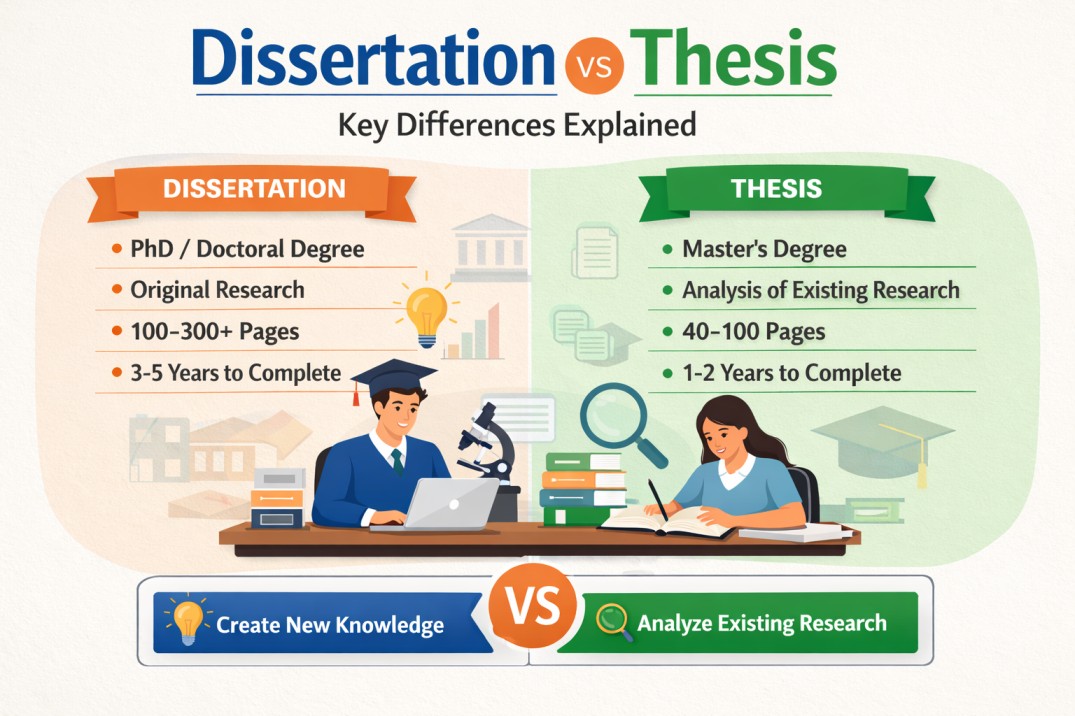
Many students pursuing higher education often feel confused about the terms dissertation and thesis. These two academic documents are essential research projects, but they are not the same. Understanding the difference between dissertation and thesis helps students prepare better for their academic journey and research work.
In simple words, both a thesis and a dissertation involve extensive research and academic writing, but they differ in purpose, level of study, research depth, and originality.
This blog will explain dissertation vs thesis, their definitions, major differences, similarities, and which one you might need depending on your degree program.
What is a Thesis?
A thesis is a research-based academic document usually required for completing a master’s degree. The primary purpose of a thesis is to demonstrate a student’s understanding of a specific subject and their ability to analyze existing research.
In a thesis, students typically:
- Review existing studies and literature
- Analyze previously published data
- Present their interpretation or argument
- Provide conclusions based on existing knowledge
A thesis does not always require completely original research, although some programs may include small experiments or surveys.
Key Features of a Thesis
- Usually required for master’s degree programs
- Focuses mainly on analysis of existing research
- Shorter than a dissertation
- Demonstrates subject knowledge and critical thinking
- Typically ranges from 40–100 pages depending on the university
Purpose of a Thesis
The main goal of a thesis is to show that a student understands the research topic and can evaluate academic literature effectively. It helps develop important skills such as:
- Research methodology
- Academic writing
- Data analysis
- Critical thinking
For many students, writing a thesis is also preparation for future doctoral research.
What is a Dissertation?
A dissertation is a more advanced academic research project usually required for doctoral (PhD) programs. Unlike a thesis, a dissertation focuses on creating new knowledge or contributing new findings to a particular academic field.
In a dissertation, students must:
- Identify a research gap
- Conduct original research
- Collect and analyze data
- Present new theories or conclusions
A dissertation represents the highest level of academic research, often taking several years to complete.
Key Features of a Dissertation
- Required for PhD or doctoral degrees
- Involves original research
- Much longer and more detailed
- Requires extensive literature review
- Often ranges from 100 to 300+ pages
Purpose of a Dissertation
The primary goal of a dissertation is to add new knowledge to the academic field. Students must prove that their research is unique and contributes something meaningful to existing studies.
Completing a dissertation also demonstrates that the researcher is capable of conducting independent research and academic analysis.
Dissertation vs Thesis: Major Differences
Understanding the differences between a dissertation and a thesis helps students know what to expect in different academic programs.
Feature

A thesis focuses on interpreting and analyzing existing information, whereas a dissertation requires creating new research findings.
Key Differences Explained
1. Level of Study
The biggest difference between a thesis and a dissertation is the academic level.
- Thesis – Master’s degree
- Dissertation – Doctoral or PhD degree
A thesis proves that the student understands their field, while a dissertation proves that the student can contribute new knowledge.
2. Research Depth
Thesis research typically involves reviewing existing studies and forming conclusions from them. Dissertation research goes further by conducting experiments, surveys, or theoretical studies to generate new data.
Because of this, dissertations are much more complex and require advanced research methods.
3. Length of Document
A dissertation is significantly longer than a thesis.
Typical word counts include:
- Thesis: 10,000 – 25,000 words
- Dissertation: 40,000 – 90,000 words or more
The longer length reflects the deeper research and analysis required.
4. Time Required
A thesis usually takes one to two years to complete, depending on the program.
A dissertation, however, can take three to five years, as it involves designing research, collecting data, analyzing results, and writing extensive chapters.
5. Research Contribution
The thesis demonstrates a student’s understanding of existing knowledge. In contrast, a dissertation must add something new to the field.
This is why doctoral students must defend their dissertation before an academic committee.
Similarities Between Dissertation and Thesis
Although they differ in several ways, theses and dissertations also share some similarities.
1. Both Are Research Projects
Both require systematic research, literature review, and academic writing.
2. Both Require Academic Structure
Typical sections include:
- Introduction
- Literature Review
- Methodology
- Results
- Discussion
- Conclusion
3. Both Require Supervisor Guidance
Students usually work under the supervision of a professor or research advisor.
4. Both Require Defense
Many universities require students to present and defend their research before a committee.
Dissertation vs Thesis in Different Countries
Another reason for confusion is that the terminology varies by country.
United States
- Thesis – Master’s degree
- Dissertation – PhD degree
United Kingdom and Europe
The terms may sometimes be reversed depending on the university.
India
In most Indian universities:
- Master’s programs require a thesis
- PhD programs require a dissertation
Students should always follow the guidelines of their specific university.
Structure of a Thesis or Dissertation
Both documents follow a structured format.
Typical chapters include:
- Introduction
- Literature Review
- Research Methodology
- Data Analysis
- Discussion
- Conclusion
- References
A dissertation may also include additional chapters such as theoretical frameworks and extended analysis.
Tips for Writing a High-Quality Thesis or Dissertation
Students often struggle with research writing. Here are some helpful tips:
Choose the Right Topic
Select a topic that is interesting, researchable, and relevant to your academic field.
Conduct Strong Literature Review
A good literature review helps identify research gaps and supports your arguments.
Follow Proper Research Methods
Choose suitable research methods such as:
- Surveys
- Interviews
- Experiments
- Case studies
Maintain Academic Writing Style
Use formal language, proper citations, and avoid plagiarism.
Seek Guidance from Experts
Working with experienced mentors or professional research support services can make the writing process easier.
Conclusion
Both a thesis and a dissertation are important academic research projects, but they serve different purposes in higher education.
A thesis focuses on analyzing existing research and is usually required for a master’s degree. A dissertation, on the other hand, involves original research and is required for doctoral programs.
Understanding the difference between dissertation vs thesis helps students prepare better for their academic journey, manage their research effectively, and meet university expectations.
If you are planning to write a thesis or dissertation, proper research planning, structured writing, and expert guidance can make a significant difference in the quality of your work.
FAQs
What is the main difference between a dissertation and a thesis?
The main difference is that a thesis analyzes existing research for a master’s degree, while a dissertation involves original research for a doctoral degree.
Which is longer, thesis or dissertation?
A dissertation is usually longer and more detailed than a thesis because it involves original research.
Is dissertation required for PhD?
Yes, most doctoral programs require students to submit a dissertation to earn their PhD.
Can a thesis become a dissertation?
Sometimes, a master’s thesis can serve as the foundation for doctoral research, which later develops into a dissertation.