
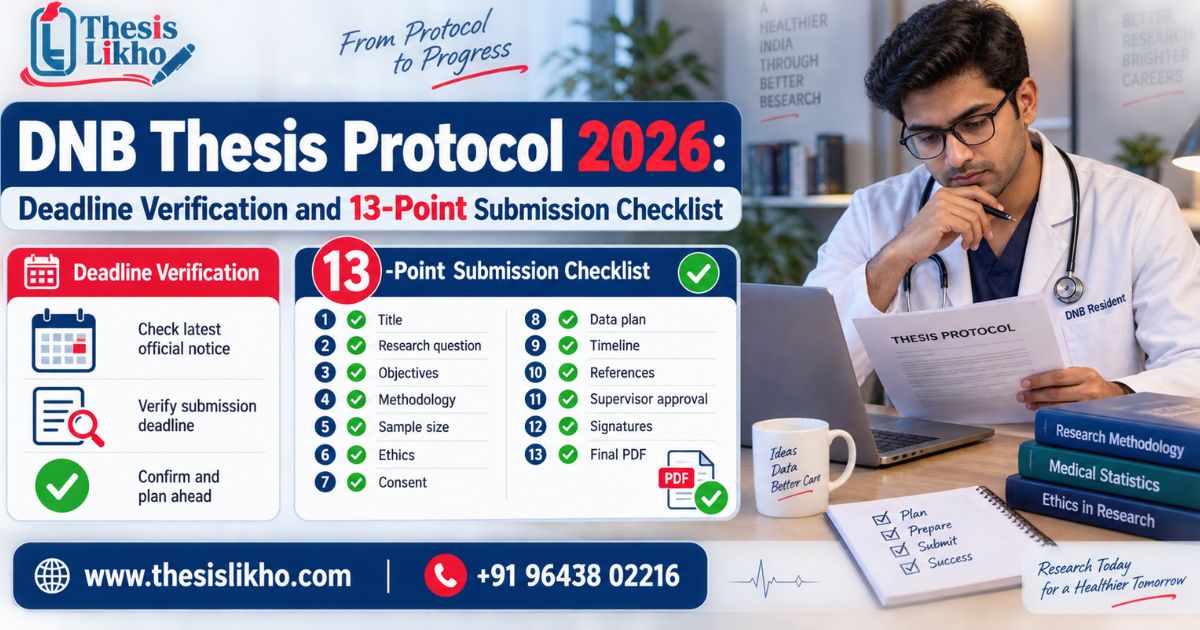
A DNB thesis protocol is the approved research blueprint that connects a clinical problem with measurable objectives, an ethical study design, a feasible sample and a defensible analysis plan. It is not the completed thesis. In 2026, trainees must also separate the protocol timeline from the DNB thesis submission last date, because the applicable requirement may depend on the programme, admission batch and final-examination session. This practical guide explains how to verify the controlling NBEMS notice, prepare the protocol, document approvals and complete a 13-point pre-submission check. Always treat the current NBEMS portal and session-specific notice—not an old blog, screenshot or forwarded message—as authoritative.
Quick answer: Prepare the DNB thesis protocol before data collection by defining the research question, objectives, design, population, sample-size basis, analysis plan and ethics process. For the final thesis deadline, identify your exact DNB examination session and check the latest NBEMS notice. Do not apply one date to every trainee or confuse protocol upload with final thesis submission.
Official information notice: ThesisLikho is independent of NBEMS. Dates, eligibility, and portal instructions must be confirmed on the official NBEMS website and Digital Thesis Processing Portal.
Quick Highlights
Item Practical guidance
Main document Approved research plan prepared before the final thesis
Deadline rule Verify by programme, admission batch and examination session
Critical alignment Objective → variable → data source → analysis → result
Key approvals Institutional/scientific and ethics approvals, as applicable
Strongest evidence Current NBEMS notice, portal status and saved acknowledgement
Main risk Treating upload, payment or a draft as a confirmed submission
Table of Contents
- Protocol and final thesis are different
- DNB thesis submission last date 2026
- The Protocol-to-Submission Clock
- What a strong DNB thesis protocol contains
- Step-by-step protocol preparation
- Documents and approvals
- Common protocol problems and corrections
- Final readiness checklist
- 13-point pre-submission check
- Frequently asked questions
Protocol and Final Thesis Are Different {#protocol-and-final-thesis-are-different}
The protocol describes what the trainee intends to study and how the work will be conducted. The final thesis reports what was actually done, the data obtained, the analysis performed and the conclusions supported by those results.
Element DNB thesis protocol Final DNB thesis
Purpose Obtain approval for a feasible research plan Present completed research for assessment.
Research stage Before or at the beginning of the approved study After data collection and analysis
Data Proposed variables and collection plan Actual collected data and results
Analysis Planned statistical or qualitative methods Completed analysis with interpretation.
Ethics Participant-protection plan and required approvals Evidence that approved procedures were followed.
Main output Approved study blueprint Complete research document
Deadline basis Programme, admission and current protocol rules Applicable final-exam/session timeline and notices
Confusing these stages creates practical errors. A protocol should not contain invented results, and a completed thesis should not quietly replace the approved population, objectives or method without following the authorised change process.
Why the protocol matters after approval
The protocol remains the reference point for the final thesis. During analysis and writing, compare the approved title, objectives, outcomes, population, variables and analysis plan with the work actually completed. Where a justified change occurred, retain the formal approval or guidance associated with that change.
DNB Thesis Submission Last Date 2026 {#dnb-thesis-submission-last-date-2026}
There is no safe one-line deadline for every DNB or DrNB trainee. NBEMS publishes guidance and session-specific notices, and extensions may apply only to a named examination or candidate group.
Candidates should use the current notice displayed by NBEMS and read it together with any later notice applicable to their programme, admission batch or examination session. Because notices can be revised or extended for a limited group, this article intentionally does not present one date as universally applicable.
Historical planning pattern—verify before relying on it
Published NBEMS thesis guidance has used the following final-thesis cut-offs:
Intended final theory examination Historical guideline cut-off2026 planning interpretation
December final examination 30 June of the same year A December 2026 candidate should verify whether 30 June 2026 governed their session
June final examination 31 December of the preceding year A June 2027 candidate should verify whether 31 December 2026 governs their session
This table is a planning aid, not a substitute for the latest notice. A new NBEMS timeline notice, relaxation or extension can change how the rule applies to a particular session.
How to verify your actual deadline
Use this five-point check:
- Identify whether you are enrolled in DNB, Post Diploma DNB or DrNB.
- Confirm your admission session and intended final theory examination.
- Open the official NBEMS Digital Thesis Processing Portal.
- Read the latest timeline notice and any later notice naming your session or candidate category.
- Save a copy of the controlling notice and record the deadline in your project calendar.
Do not confuse an extension with a universal new date.
If NBEMS publishes an extension for a specified DNB/DrNB examination session, it does not automatically change the deadline for every trainee. Check the notice title, programme, examination session and candidate category before relying on it.
What if the displayed deadline has passed?
Do not rely on an unofficial promise that the portal will reopen. Check the official notice board, trainee portal and authorised institutional/NBEMS communication route. Preserve proof of any prior technical problem, payment or submission attempt. ThesisLikho cannot extend a deadline or alter eligibility.
The Protocol-to-Submission Clock {#the-protocol-to-submission-clock}
Instead of treating the deadline as one final date, use a Protocol-to-Submission Clock with five controlled stages.
StageKey decisionEvidence to retain Risk if delayed
1. Research definition Is the question specific, relevant and feasible? Topic note and guide feedback Broad project cannot be completed
2. Scientific design Can the method answer each objective? Protocol version and review comments Objectives and analysis do not align
3. Ethics and approval Are approvals complete before regulated activities begin? IEC/institutional records Data may be unusable or non-compliant
4. Study execution Is work following the approved protocol? Data log, deviations and authorised changes Final thesis conflicts with approval
5. Final submission Are the thesis, documents and portal steps complete? Application, payment and acknowledgement Draft/upload mistaken for submission
Build backwards from the official cut-off.
Once the correct final-thesis deadline is verified, reserve time for:
- Completion and cleaning of data
- Statistical or qualitative analysis
- Results tables and figures
- Discussion linked to current evidence
- Guide/supervisor review
- Citation and reference checks
- Formatting and PDF validation
- Required certificates and declarations
- Portal upload, payment and acknowledgement
The official cut-off is not the appropriate internal completion date. A final file should be ready early enough to resolve academic or portal defects.
What a Strong DNB Thesis Protocol Contains {#what-a-strong-dnb-thesis-protocol-contains}
Always use the current NBEMS and institutional format. The following components explain the research logic that normally needs to be clear.
Title
The title should identify the central variables or phenomenon, relevant population and study context without unnecessary words. Avoid claiming “effect” or “efficacy” when the design can establish only association or description.
Background and rationale
The introduction should move from the clinical context to the specific unresolved problem. It should explain what is already known, what remains uncertain and why the proposed study is useful in the chosen setting.
Research question
The question should be answerable with the proposed population, data and method. Frameworks such as PICO may help for appropriate clinical questions, but not every study should be forced into one template.
Aim and objectives
Use one clear overall aim and specific objectives that can be measured or answered. Each objective should later connect with a data field, analysis method and final result.
Study design and setting
Name the design accurately and justify why it fits the question. Describe the clinical department, institution or data source relevant to the study.
Study population and eligibility criteria
Define who can enter the study, who is excluded and why. Criteria should protect validity and participant safety without excluding people merely to make data convenient.
Sample-size basis
State the parameter, expected value/effect, precision or power, significance level and source of assumptions as applicable. A final sample number without the underlying basis is difficult to assess or reproduce.
Variables and operational definitions
Define exposures, outcomes, predictors, confounders and clinically important categories. The same term should not change meaning between protocol, data sheet and thesis.
Data-collection procedure
Explain who collects which information, when, using what instrument, and how accuracy and confidentiality will be maintained. Attach or reference the case-record form, questionnaire or extraction sheet where required.
Statistical analysis plan
Map each objective to variables, summary measures and a suitable analysis. Do not list many tests without explaining when each will be used. Address missing data, assumptions and confounding where relevant.
Ethics and participant protection
Cover consent, privacy, risk, benefit, vulnerable participants, data access and required review. Data collection and protocol changes must follow the applicable institutional ethics and NBEMS process.
References and annexures
Use verified, relevant sources and a consistent citation style. Required annexures may include data-collection instruments, consent documents and approval-related formats, subject to current requirements.
Step-by-Step Protocol Preparation {#step-by-step-protocol-preparation}
Step 1: Convert the clinical interest into one answerable question
Begin with the decision, uncertainty or outcome that matters. Define the patient group, clinical setting, variables and feasible observation period. A narrowly defined study completed correctly is stronger than an ambitious project that cannot recruit or measure reliably.
Step 2: Search evidence before fixing the method
Review current guidelines, systematic reviews, major studies and relevant Indian/local evidence. Record search terms and databases. The search should show whether the question is genuinely unresolved and provide realistic assumptions for design and sample-size planning.
Step 3: Create an Objective–Data–Analysis Map
Use this table before writing the full protocol:
ObjectiveRequired variable/dataCollection sourcePlanned analysisExpected output
Primary objective Define the exact outcome Form, record or test Suitable method Primary estimate/table.
Secondary objective 1 Define the variable Confirmed source Suitable method Relevant output.
Secondary objective 2 Define the variable Confirmed source Suitable method Relevant output.
If a row cannot be completed, the objective may be vague, the necessary data unavailable, or the analysis plan incomplete.
Step 4: Test feasibility
Estimate eligible cases, recruitment rate, follow-up, test availability, cost, data quality and time. Check whether the sample can realistically be completed before the thesis timeline.
Step 5: Draft the method and analysis together
Do not write methodology and statistics as separate afterthoughts. Each design choice determines the kind of data and inference available. Statistical consultation is most valuable before collection, when variables and sample-size assumptions can still be improved.
Step 6: Complete scientific and ethics review
Follow the training institution’s required process for departmental/scientific review and Institutional Ethics Committee approval. Retain submitted, revised and approved versions with clear dates.
Step 7: Upload through the authorised protocol process
Use the official NBEMS portal and current instructions. Confirm candidate and institution details, upload the correct approved files, and preserve the acknowledgement/status evidence. Portal credentials and OTPs should remain with the trainee.
Step 8: Lock the approved baseline
Store the approved protocol, IEC version, instruments and analysis plan in a controlled folder. If a change becomes necessary, document the reason and obtain the required authorisation before implementing it.
Documents and Approvals {#documents-and-approvals}
The exact list must be taken from the current NBEMS portal and the trainee’s institution. A readiness folder may include:
- Final protocol in the required format
- Institutional scientific/research approval
- Institutional Ethics Committee approval or applicable record
- Candidate and training details
- Guide/co-guide information and certification where required
- Data-collection form or questionnaire
- Participant information/consent documents where applicable
- Required declarations or undertakings
- Protocol revision responses
- Portal acknowledgement and status record
Do not edit an approval letter or backdate a document to make it appear consistent. If the approved title or method changes, use the authorised correction/amendment route.
Document consistency check
Confirm that the title, candidate name, registration details, institution, guide, objectives, population and study design agree across the protocol, approval records and portal fields. Small inconsistencies can create avoidable deficiency queries.
Common Protocol Problems and Corrections {#common-protocol-problems-and-corrections}
Problem Why it weakens the protocol Better correction
Broad topic Population, measurements and timeline remain unclear Narrow by question, population, setting and outcome
Vague objectives Results cannot answer them directly Use specific, measurable objectives
Unsupported effect claim Inference exceeds the study design Change the claim or select a suitable design
Sample size without assumptions The number cannot be evaluated State method, assumptions and source
Too many variables Data burden rises without analytical purpose Keep variables tied to objectives or confounding
Generic list of tests Statistics are not linked to data or objectives Build an objective-wise analysis plan
Old or unverified references Rationale may be outdated or incorrect Verify current primary and high-quality sources
Generic ethics section Participant risks and privacy remain unclear Specify consent, data handling and safeguards
Protocol and IEC versions differ The approved study identity becomes uncertain Use the authorised review or amendment process
Upload treated as submission The application may remain incomplete Confirm final status and save the acknowledgement
Deficiency response rule
Answer each deficiency point directly. Show where the correction appears and avoid changing unrelated sections. When a comment requires a scientific decision—such as changing an outcome, sample or design—discuss it with the guide and appropriate institutional committee rather than treating it as language editing.
What to Do and What to Avoid
Do
- Verify the latest NBEMS notice for your programme and session.
- Start protocol planning early enough for scientific and ethics review.
- Link every objective with data and analysis.
- Use current and verified clinical evidence.
- Maintain version control and dated approvals.
- Keep credentials, OTP and final declaration under trainee control.
- Preserve portal acknowledgements and payment records where applicable.
Avoid
- Copying another candidate’s protocol structure without adapting the science.
- Beginning regulated data collection before required approval.
- Adding objectives after data collection merely because variables are available.
- Using a universal 2026 date without checking the examination session.
- Depending on WhatsApp forwards or old search snippets for deadlines.
- Fabricating sample-size assumptions, citations, data or signatures.
- Promising acceptance or examination eligibility through a private service.
Related DNB Thesis Writing Help
If the issue is academic rather than portal-based, ThesisLikho provides defined DNB Thesis Writing Help for protocol alignment, literature review, methodology review, sample-size and statistical planning, analysis interpretation, chapter editing, references, formatting and pre-submission document review.
Support does not include controlling a trainee’s NBEMS account, fabricating data or approvals, changing official records, bypassing a deadline or guaranteeing acceptance.
Need a focused academic review? Request a confidential DNB thesis assessment on WhatsApp. Share your speciality, admission/exam session, approved topic, current stage and specific difficulty—but never share your password or OTP.
Final Readiness Checklist {#final-readiness-checklist}
Protocol stage
- Research question is specific and clinically relevant.
- Aim and objectives are measurable.
- Design can answer the primary objective.
- Population and eligibility criteria are clear.
- Sample-size assumptions are documented.
- Variables have operational definitions.
- Data-collection procedure is reproducible.
- Analysis is mapped to each objective.
- Ethics and privacy requirements are addressed.
- References are current and verified.
- All required institutional approvals are complete.
- Portal status and acknowledgement are saved.
Final thesis stage
- Current NBEMS deadline notice has been saved.
- Approved protocol and final methods have been compared.
- Authorised deviations/amendments are documented.
- Data are complete, cleaned and analysed.
- Results answer the stated objectives.
- Discussion compares findings with evidence.
- Conclusions do not exceed the results.
- Citations and references match.
- Required declarations and certificates are ready.
- Final PDF opens correctly, and all pages are readable.
- Portal fields and uploads have been rechecked.
- Final submission status and acknowledgement are preserved.
13-Point Pre-Submission Check
Before the final portal action, confirm all 13 points:
- The applicable NBEMS notice matches your programme and session.
- Candidate, registration and institution details are correct.
- The title matches the approved title or authorised amendment.
- Objectives match the approved protocol.
- Methods reflect the approved study and documented changes.
- Ethics approval and other required records are available.
- Results answer every stated objective.
- Tables and figures are numbered, cited and readable.
- Conclusions stay within the evidence produced.
- In-text citations and the reference list match.
- Required declarations, certificates and signatures are complete.
- The final PDF opens correctly and meets the current file rules.
- Submission status, payment record and acknowledgement are saved.
Frequently Asked Questions {#frequently-asked-questions}
1. What is a DNB thesis protocol?
It is the approved plan for the trainee’s research. It sets out the problem, question, objectives, design, population, sample-size basis, data collection, analysis and ethics process before the completed thesis is prepared.
2. Is the protocol the same as the final DNB thesis?
No. The protocol describes planned research, while the final thesis reports completed methods, actual data, results, interpretation and conclusions.
3. What is the DNB thesis submission last date in 2026?
The applicable date depends on the programme and final-examination session. Published guidance maps December examination candidates to 30 June of the same year and June examination candidates to 31 December of the preceding year. Verify the latest NBEMS notice before acting.
4. Where should I check the official 2026 deadline?
Check the NBEMS website and Digital Thesis Processing Portal. Read the latest timeline notice and any later notice specifically naming your programme, batch, examination session or candidate category.
5. What should the statistical analysis section include?
It should map each objective to variables, descriptive measures and suitable statistical tests or models. It should also address assumptions, missing data and confounding where relevant.
6. What happens if my protocol has a deficiency?
Read each comment carefully, make only scientifically justified corrections, obtain required guide/institutional approval and submit the response through the authorised process. Keep copies of every version.
7. Can ThesisLikho upload my protocol or thesis for me?
The trainee should control the NBEMS login, OTP, declarations, payment and final submission. ThesisLikho may review academic documents but should not impersonate the candidate.
8. Does DNB Thesis Writing Help guarantee acceptance?
No. Academic support may improve research alignment and document readiness, but protocol/thesis decisions and eligibility remain entirely with NBEMS and authorised institutional bodies.
Conclusion
A strong DNB thesis protocol turns a clinical problem into an approved, feasible research plan by aligning the question, objectives, design, population, sample, data collection, analysis and ethics safeguards. The DNB thesis submission last date for 2026 must be checked against the trainee’s exact programme and final-examination session; one extension or online date cannot be applied to everyone. Use the official NBEMS portal, read the latest applicable notice, work backwards from the verified cut-off and preserve every approval and acknowledgement. For academic alignment, methodology, analysis or document-readiness issues, request a focused review—but keep all portal credentials and final submission control with the trainee.
📞 Call/WhatsApp: +91 96438 02216
Website: https://thesislikho.com/