
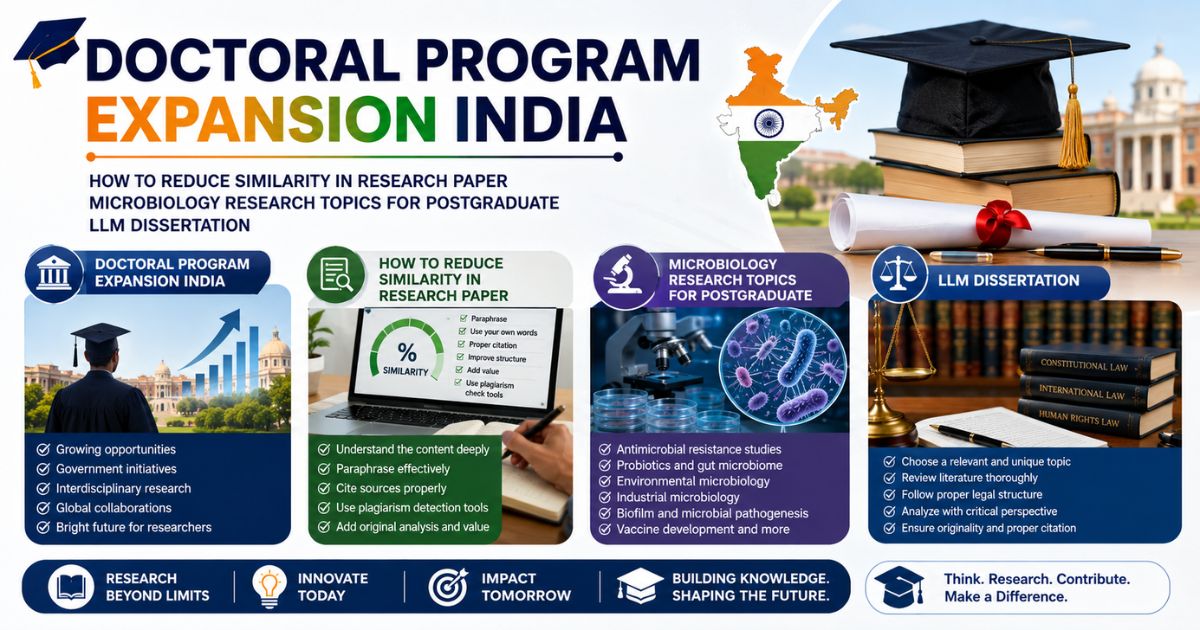
The Indian higher education system is evolving rapidly, creating new opportunities for students, researchers, and academicians. With the continuous doctoral program expansion in India, universities are introducing interdisciplinary research programs, advanced laboratories, international collaborations, and industry-oriented doctoral education. At the same time, researchers must maintain academic integrity by learning how to reduce similarity in research paper writing through ethical practices, proper citations, and original analysis. Students pursuing postgraduate and doctoral degrees also need relevant microbiology research topics for postgraduate studies and structured guidance for preparing a high-quality LLM dissertation. This comprehensive guide covers these essential aspects of academic research and publication.
Doctoral Program Expansion in India
India has witnessed significant growth in doctoral education over the past decade. Government initiatives, university reforms, and increased investment in research infrastructure have encouraged institutions to introduce new PhD programs across engineering, medicine, law, management, social sciences, life sciences, and emerging technologies.
The expansion of doctoral programs aims to strengthen innovation, improve research output, and develop highly skilled professionals capable of addressing national and global challenges. Many universities now offer interdisciplinary doctoral research opportunities that combine artificial intelligence, biotechnology, environmental science, healthcare, law, and data science. These developments provide scholars with better access to experienced supervisors, research funding, international collaborations, and modern laboratory facilities.
How to Reduce Similarity in a Research Paper
Maintaining originality is one of the most important aspects of academic writing. Understanding how to reduce similarity in research paper writing requires much more than replacing words with synonyms. Researchers should focus on presenting original ideas, interpreting previous studies critically, and contributing meaningful insights to their field of study.
Effective similarity reduction strategies include writing in your own academic style, paraphrasing after understanding the original concept, citing all sources accurately, avoiding unnecessary direct quotations, and adding independent analysis based on research findings. Reviewing the manuscript using plagiarism detection tools before submission also helps identify overlapping content and improve originality. Ethical writing practices not only reduce similarity scores but also enhance the credibility and publication potential of the research paper.
Microbiology Research Topics for Postgraduate Students
Choosing appropriate microbiology research topics for postgraduate studies is essential for producing valuable scientific research. A well-selected topic should address current research gaps while offering practical applications in healthcare, environmental science, agriculture, or biotechnology.
Popular postgraduate microbiology research areas include antimicrobial resistance, molecular microbiology, food microbiology, medical microbiology, industrial microbiology, microbial genetics, probiotics, vaccine development, environmental microbiology, infectious diseases, microbial biotechnology, bioinformatics, and pharmaceutical microbiology. Students should select topics based on current scientific trends, available laboratory facilities, faculty expertise, and future career goals to maximize the impact of their research.
LLM Dissertation Writing Guide
Preparing an LLM dissertation is one of the most important academic milestones for postgraduate law students. A successful dissertation demonstrates critical legal analysis, independent thinking, and the ability to interpret complex legal issues using reliable academic sources.
Students can explore contemporary legal research areas such as constitutional law, criminal justice, corporate governance, cyber law, intellectual property rights, international law, environmental law, arbitration, human rights, taxation, and artificial intelligence regulation. A strong LLM dissertation should include a clear research objective, comprehensive literature review, sound legal methodology, analytical discussion, and properly formatted citations according to university guidelines. Original legal arguments supported by statutes, case law, and scholarly publications significantly improve the quality of the dissertation.
Best Practices for Academic Research Writing
Regardless of the discipline, every researcher should follow a structured approach to academic writing. Begin by selecting a relevant research topic, conducting an extensive literature review, identifying research gaps, and developing a clear research methodology. Use credible academic databases and peer-reviewed journals while maintaining accurate citations throughout the manuscript.
Editing and proofreading are equally important. Reviewing grammar, formatting, references, and similarity reports before submission helps improve the overall quality of the manuscript and increases the chances of acceptance by universities and academic journals.
Conclusion
Academic success depends on originality, critical thinking, and systematic research. The ongoing doctoral program expansion in India provides researchers with greater opportunities for advanced education and innovation. At the same time, understanding how to reduce similarity in research paper writing ensures compliance with academic integrity standards. Selecting meaningful microbiology research topics for postgraduate studies and preparing a well-structured LLM dissertation further contribute to successful academic and professional careers. By combining ethical writing practices with strong research methodologies, students and scholars can produce high-quality research that makes valuable contributions to their respective fields.
Frequently Asked Questions
1. What is driving doctoral program expansion in India?
Government initiatives, increased research funding, industry collaboration, and the demand for skilled researchers are driving the growth of doctoral programs across Indian universities.
2. How can I reduce similarity in my research paper?
Write original content, paraphrase effectively, cite all references correctly, avoid excessive quotations, and include independent analysis instead of relying heavily on published literature.
3. Which microbiology research topics are best for postgraduate students?
Current topics include antimicrobial resistance, molecular diagnostics, medical microbiology, food safety, microbial biotechnology, environmental microbiology, probiotics, and vaccine research.
4. How do I choose an LLM dissertation topic?
Select a topic that aligns with your area of interest, addresses a current legal issue, has sufficient research material, and offers scope for original legal analysis.
5. Why is originality important in academic research?
Original research improves academic credibility, supports ethical scholarship, increases publication opportunities, and contributes new knowledge to the scientific and academic community.
website: https://thesislikho.com/