
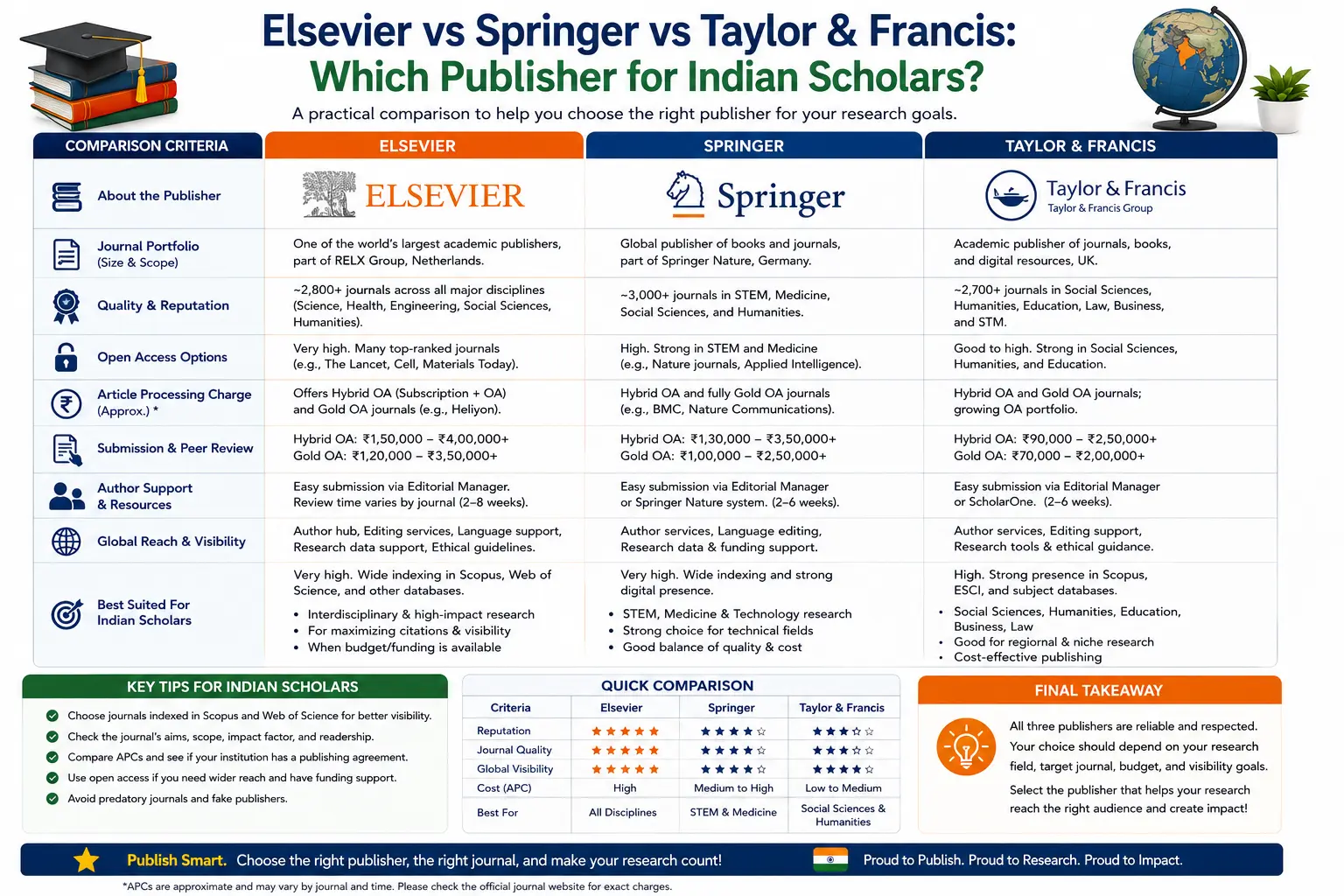
Introduction
Publishing research in a reputed international journal is one of the most important milestones for PhD scholars, faculty members, and researchers. For Indian scholars, choosing the right publisher can significantly impact academic recognition, citation count, career growth, and funding opportunities.
Among the world's leading academic publishers, Elsevier, Springer, and Taylor & Francis dominate the scholarly publishing landscape. Thousands of Indian researchers submit manuscripts to journals under these publishers every year.
However, many scholars face questions such as:
- Which publisher is easier to publish in?
- Which publisher has higher-impact journals?
- Which publisher is better for PhD scholars?
- What are the publication charges?
- Which publisher offers faster peer review?
This comprehensive guide compares Elsevier, Springer, and Taylor & Francis across various factors to help Indian scholars make informed publication decisions in 2026.
Understanding Academic Publishers
Before comparing these publishers, it is important to understand their role.
Academic publishers manage:
- Journal publication
- Peer-review processes
- Editorial management
- Research dissemination
- Indexing and archiving
- Open-access publishing
A publisher does not determine research quality alone. The quality largely depends on the specific journal.
Nevertheless, publisher reputation often influences visibility and trust within the academic community.
Overview of Elsevier
Elsevier is one of the world's largest scientific publishing companies.
Founded in 1880, Elsevier publishes thousands of journals covering:
- Engineering
- Medicine
- Computer Science
- Artificial Intelligence
- Business
- Social Sciences
- Environmental Sciences
Popular Elsevier Journals
- Applied Soft Computing
- Expert Systems with Applications
- Information Sciences
- Renewable Energy
- Journal of Cleaner Production
Strengths of Elsevier
- Large journal portfolio
- High-impact journals
- Strong Scopus indexing presence
- Global reputation
- Excellent citation visibility
Challenges
- Competitive acceptance rates
- Long review periods in some journals
- Higher publication charges in many open-access journals
Overview of Springer
Springer Nature is another major global academic publisher known for research journals, conference proceedings, books, and open-access publications.
Springer is particularly popular among Indian researchers due to its extensive journal collection and conference publication opportunities.
Popular Springer Journals
- Neural Computing and Applications
- Machine Learning
- Environmental Science and Pollution Research
- Education and Information Technologies
Strengths of Springer
- Strong engineering and technology journals
- Popular conference proceedings
- Good acceptance opportunities
- Wide subject coverage
- Extensive book publishing
Challenges
- APCs can be expensive
- Quality varies significantly across journals
- Review timelines differ considerably
Overview of Taylor & Francis
Taylor & Francis is a leading publisher particularly recognized in social sciences, humanities, management, education, and multidisciplinary research.
Its journal portfolio continues to expand across STEM fields as well.
Popular Taylor & Francis Journals
- International Journal of Human Resource Management
- Applied Economics
- Journal of Education for Teaching
- Journal of Marketing Management
Strengths of Taylor & Francis
- Strong social science journals
- Flexible publication options
- Global readership
- Strong humanities portfolio
Challenges
- Lower visibility in some technical fields compared to Elsevier
- Varying review timelines
- APC costs in open-access journals
Comparison: Elsevier vs Springer vs Taylor & Francis
1. Publisher Reputation
Elsevier
Widely regarded as one of the most prestigious publishers globally.
Best known for:
- Science
- Technology
- Engineering
- Medicine
Springer
Highly respected across engineering, science, and multidisciplinary research.
Particularly strong in:
- Computer Science
- Engineering
- Environmental Sciences
Taylor & Francis
Highly recognized in:
- Humanities
- Education
- Business
- Social Sciences
Winner
For overall global reputation:
Elsevier > Springer > Taylor & Francis
2. Journal Portfolio Size
Elsevier
Publishes more than 2,500 journals.
Springer
Publishes over 3,000 journals and numerous conference proceedings.
Taylor & Francis
Publishes over 2,700 journals.
Winner
Springer has the broadest publishing ecosystem due to journals, books, and conference proceedings.
3. Scopus and Web of Science Coverage
Indian universities increasingly require publications indexed in:
- Scopus
- Web of Science
- SCI
- SSCI
- ESCI
All three publishers maintain extensive indexing coverage.
Elsevier
Strongest presence in Scopus because Elsevier owns the Scopus database.
Springer
Excellent indexing coverage.
Taylor & Francis
Strong indexing, especially in social sciences.
Winner
Elsevier slightly leads due to its extensive Scopus representation.
4. Acceptance Rate
One of the biggest concerns for PhD scholars is acceptance probability.
Elsevier
Generally more competitive.
Many high-impact journals have low acceptance rates.
Springer
Moderate acceptance rates in many journals.
Taylor & Francis
Often offers relatively higher acceptance opportunities in social sciences and humanities.
Winner
Taylor & Francis and Springer are often considered more accessible for early-career researchers.
5. Review Speed
Publication speed matters for:
- Thesis submission
- Faculty promotions
- Funding requirements
Elsevier
Review periods often range from 3–8 months.
Springer
Many journals provide decisions within 2–6 months.
Taylor & Francis
Average review timelines vary between 2–7 months.
General Ranking
Springer often provides slightly faster processing for many journals.
6. Open Access Publishing
Open access increases visibility and citations.
Elsevier
Offers numerous hybrid and fully open-access journals.
Springer
Strong open-access ecosystem.
Includes the well-known BMC series.
Taylor & Francis
Expanding open-access options significantly.
Winner
Springer is often considered the strongest open-access publisher among the three.
7. Article Processing Charges (APCs)
Many Indian scholars have limited research funding.
Elsevier
Typically expensive.
APCs often range between ₹1.5 lakh and ₹4 lakh or more.
Springer
Moderate to high APCs.
Taylor & Francis
Similar range depending on journal category.
Important Note
Numerous journals under all three publishers charge zero APCs under traditional subscription models.
Researchers should verify APCs on individual journal websites before submission.
8. Citation Impact
Citation impact depends on:
- Journal quality
- Subject area
- Research relevance
Elsevier
Often achieves the highest citation visibility in STEM disciplines.
Springer
Strong citation performance across multiple disciplines.
Taylor & Francis
Particularly strong in social sciences and education.
Winner
Elsevier generally leads in STEM citation impact.
Comparison for Indian Research Fields
Engineering and Technology
Recommended:
- Elsevier
- Springer
- Taylor & Francis
Why?
Engineering journals under Elsevier and Springer often enjoy stronger visibility and citation rates.
Computer Science and Artificial Intelligence
Recommended:
- Springer
- Elsevier
- Taylor & Francis
Why?
Springer offers extensive conference proceedings and AI-related journals highly valued by Indian researchers.
Management and Business Studies
Recommended:
- Taylor & Francis
- Elsevier
- Springer
Why?
Taylor & Francis maintains a strong portfolio of management and business journals.
Education Research
Recommended:
- Taylor & Francis
- Springer
- Elsevier
Why?
Education journals under Taylor & Francis are globally recognized.
Medical and Health Sciences
Recommended:
- Elsevier
- Springer
- Taylor & Francis
Why?
Elsevier dominates medical publishing with many high-impact journals.
Environmental Sciences
Recommended:
- Elsevier
- Springer
- Taylor & Francis
Environmental researchers in India frequently publish with Elsevier and Springer.
Which Publisher Is Best for PhD Scholars in India?
The answer depends on your goals.
Choose Elsevier If You Want
- High-impact journals
- Maximum citation potential
- Strong academic recognition
- Top-tier international visibility
Choose Springer If You Want
- Balanced acceptance rates
- Conference publication opportunities
- Broad journal options
- Faster review in many cases
Choose Taylor & Francis If You Want
- Social science visibility
- Education research publications
- Management journals
- Humanities-focused publishing
Common Mistakes Indian Scholars Make
Choosing Based Only on Publisher Name
A low-quality journal from a famous publisher is not always better than a high-quality journal from another publisher.
Always assess:
- Impact Factor
- CiteScore
- Quartile Ranking
- Indexing
Ignoring Journal Scope
Many manuscripts are rejected because they do not fit the journal's aims and scope.
Focusing Only on Impact Factor
A journal's relevance to your research topic matters more than its impact factor alone.
Submitting Without Reviewing Recent Articles
Always examine recent publications to understand journal expectations.
How to Select the Right Journal
Before submission, ask:
Is the Journal Indexed?
Check:
- Scopus
- Web of Science
- UGC-approved requirements
What Is the Review Timeline?
Important for graduation deadlines.
What Is the APC?
Understand publication costs beforehand.
Does the Scope Match My Research?
The best journal is one that publishes work similar to yours.
Future Publishing Trends for Indian Researchers (2026 and Beyond)
Academic publishing is evolving rapidly.
Emerging trends include:
- Open-access publishing growth
- AI-assisted peer review
- Transparent review processes
- Research data sharing
- Increased interdisciplinary journals
Publishers like Elsevier, Springer, and Taylor & Francis are investing heavily in these developments.
Indian scholars who understand these trends can improve publication success and research visibility.
Conclusion
Elsevier, Springer, and Taylor & Francis are all respected academic publishers, but each serves different research needs.
For Indian scholars in 2026:
- Elsevier is ideal for high-impact STEM research and maximum citation visibility.
- Springer offers balanced opportunities, strong conference publications, and broad disciplinary coverage.
- Taylor & Francis excels in social sciences, education, humanities, and management research.
Rather than choosing a publisher first, researchers should identify the most suitable journal based on scope, indexing, impact, review speed, and publication requirements.
Ultimately, the best publisher is the one whose journal aligns closely with your research objectives and target audience.
FAQs
1. Which publisher is better for Indian PhD scholars?
Springer is often preferred for accessibility and conference opportunities, while Elsevier is preferred for high-impact publications.
2. Is Elsevier more prestigious than Springer?
In many STEM disciplines, Elsevier journals are often viewed as slightly more prestigious, although both are highly respected.
3. Which publisher has faster publication?
Many Springer journals offer comparatively faster review processes, but timelines vary by journal.
4. Is Taylor & Francis good for management research?
Yes. Taylor & Francis publishes many respected management, business, and education journals.
5. Do all Elsevier journals charge publication fees?
No. Many Elsevier journals allow publication without APCs under subscription-based models.
6. Which publisher is best for Computer Science research?
Springer and Elsevier are generally the most popular choices for Computer Science and Artificial Intelligence researchers.
7. Which publisher has more Scopus-indexed journals?
All three publishers have extensive Scopus-indexed portfolios, though Elsevier has a particularly strong presence because it owns the Scopus database.
8. Can Indian researchers publish in these journals without funding?
Yes. Many journals under Elsevier, Springer, and Taylor & Francis offer publication options without APCs through traditional subscription models.
Contact ThesisLikho Today
Call / WhatsApp: +91 96438 02216
Visit: ThesisLikho.com