
Introduction
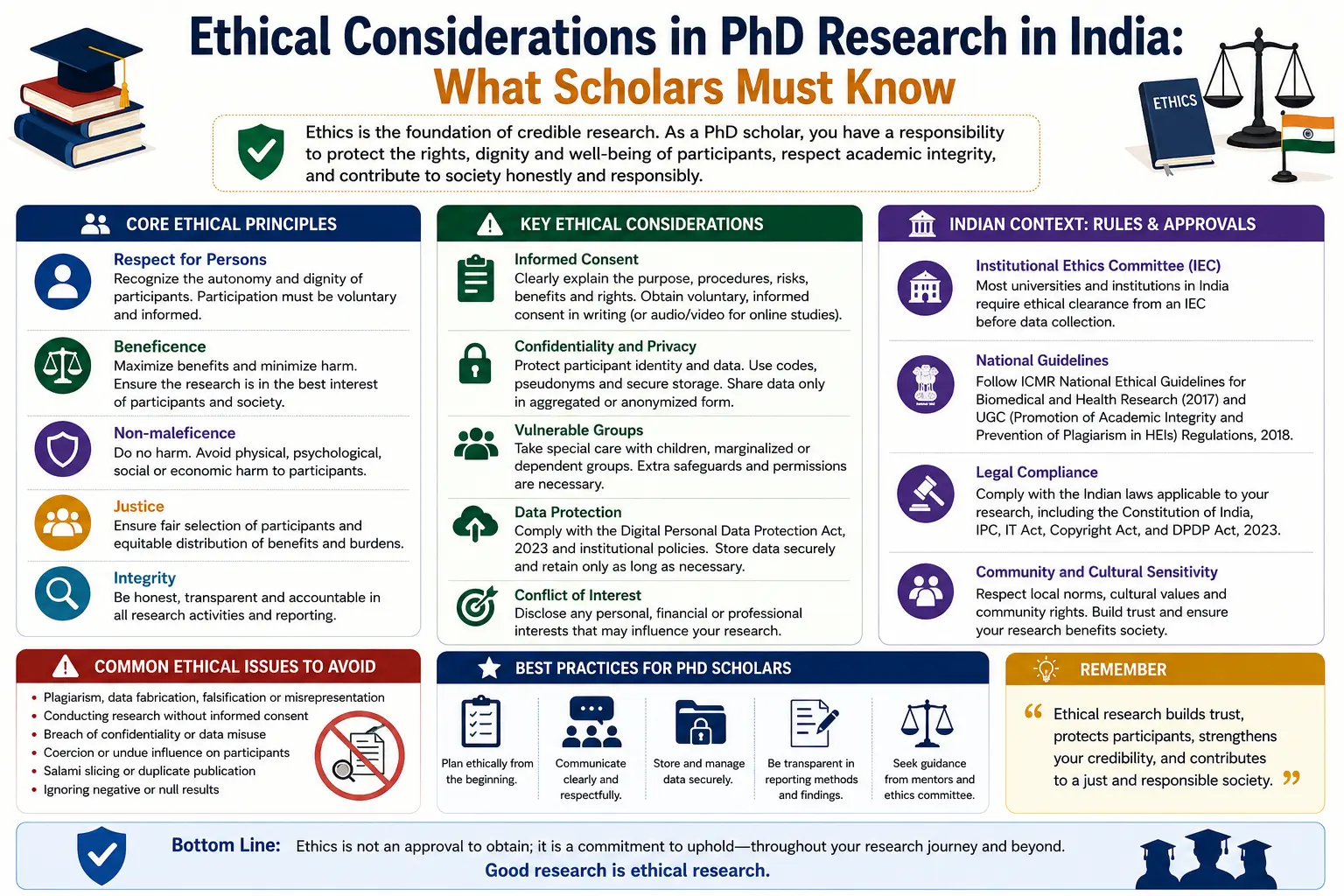
Ethics is the foundation of credible and responsible research. Regardless of the discipline—whether management, education, engineering, healthcare, social sciences, or technology—every PhD scholar must conduct research in a manner that respects participants, protects data, ensures honesty, and contributes positively to society.
In India, research ethics has gained significant attention in recent years due to increasing concerns about plagiarism, data fabrication, unethical data collection practices, predatory publishing, and the misuse of artificial intelligence tools in academic work. Universities, research institutions, and regulatory bodies now place greater emphasis on maintaining ethical standards throughout the research process.
For PhD scholars, understanding ethical considerations is not merely a procedural requirement for thesis submission. Ethical research practices enhance the credibility of findings, protect participants' rights, strengthen academic integrity, and improve the overall quality of scholarly work.
This comprehensive guide explains the key ethical considerations in PhD research in India, common ethical challenges, regulatory requirements, and best practices that every doctoral scholar should follow throughout their research journey.
What Is Research Ethics?
Research ethics refers to the moral principles and professional standards that guide the planning, conduct, analysis, and reporting of research.
These principles help ensure that research:
- Respects human dignity
- Protects participant rights
- Produces reliable findings
- Avoids harm
- Maintains transparency
- Upholds academic integrity
Ethics applies to every stage of research, including:
- Topic selection
- Literature review
- Data collection
- Data analysis
- Thesis writing
- Publication of findings
Ethical violations can result in thesis rejection, publication withdrawal, disciplinary action, and damage to a scholar's academic reputation.
Why Research Ethics Matters for PhD Scholars
Ethics is essential because research directly influences knowledge, policy, business decisions, healthcare practices, and social development.
Protects Participants
Research participants have rights that must be respected throughout the study.
Enhances Research Credibility
Ethically conducted research is more trustworthy and academically valuable.
Prevents Academic Misconduct
Following ethical guidelines reduces the risk of plagiarism, fabrication, and falsification.
Supports Institutional Compliance
Most Indian universities require ethical approval before collecting data involving human participants.
Promotes Responsible Knowledge Creation
Ethical research contributes positively to society and future scholarship.
Core Principles of Research Ethics
Most ethical frameworks are based on several fundamental principles.
Respect for Persons
Researchers must treat participants as autonomous individuals capable of making informed decisions.
This includes:
- Voluntary participation
- Informed consent
- Freedom to withdraw
Beneficence
Researchers should maximize potential benefits and minimize potential harm.
For example:
- Avoid emotional distress during interviews.
- Ensure sensitive information is protected.
Non-Maleficence
The principle of "do no harm" requires researchers to avoid causing physical, psychological, social, or economic harm.
Justice
All participants should be treated fairly.
Researchers must avoid exploiting vulnerable populations and ensure equitable participation opportunities.
Integrity
Researchers must conduct and report research honestly and accurately.
Informed Consent: A Fundamental Ethical Requirement
One of the most important ethical requirements in PhD research is obtaining informed consent.
What Is Informed Consent?
Informed consent means participants voluntarily agree to participate after receiving sufficient information about the study.
Participants should understand:
- Research purpose
- Procedures involved
- Potential risks
- Potential benefits
- Confidentiality measures
- Right to withdraw
Elements of an Effective Consent Form
A consent form should include:
- Research title
- Researcher's details
- Purpose of the study
- Participation requirements
- Confidentiality assurances
- Voluntary participation statement
- Signature section
Special Considerations
Additional safeguards may be required when working with:
- Children
- Elderly individuals
- Persons with disabilities
- Economically vulnerable groups
Confidentiality and Privacy Protection
Protecting participant information is a key ethical responsibility.
Confidentiality
Researchers should ensure that personal information is not disclosed without permission.
Examples include:
- Names
- Contact information
- Employment details
- Financial information
Privacy
Participants should control how their personal information is collected and used.
Researchers must respect participants' expectations regarding privacy.
Best Practices
- Use participant codes instead of names.
- Remove identifying information from reports.
- Store data securely.
- Limit access to research data.
Data Protection and Security
Modern research generates large amounts of digital data.
PhD scholars must ensure proper data management practices.
Data Storage
Research data should be stored securely using:
- Password-protected devices
- Secure cloud storage
- Institutional servers
Data Retention
Many institutions require researchers to retain data for a specific period after project completion.
Data Sharing
Researchers should only share data according to participant consent agreements and institutional policies.
Plagiarism: A Major Ethical Concern
Plagiarism is among the most common ethical violations in doctoral research.
What Is Plagiarism?
Plagiarism occurs when someone presents another person's work, ideas, words, or findings as their own without proper acknowledgment.
Types of Plagiarism
Direct Plagiarism
Copying text word-for-word without citation.
Mosaic Plagiarism
Mixing copied phrases with original writing.
Accidental Plagiarism
Failing to cite sources correctly.
Self-Plagiarism
Reusing previously published work without disclosure.
How to Avoid Plagiarism
- Cite all sources accurately.
- Use quotation marks when necessary.
- Paraphrase correctly.
- Maintain detailed reference records.
- Use plagiarism-checking software before submission.
Fabrication and Falsification of Data
Research integrity requires accurate data reporting.
Fabrication
Creating data that never existed.
Example:
Inventing survey responses.
Falsification
Manipulating data to achieve desired results.
Example:
Removing responses that contradict a hypothesis.
Consequences
Fabrication and falsification can lead to:
- Thesis rejection
- Degree cancellation
- Publication retraction
- Institutional penalties
Researchers must report findings honestly, even when results are unexpected.
Ethical Issues in Literature Reviews
Ethics also applies to reviewing existing research.
Researchers should:
- Cite original authors properly.
- Represent findings accurately.
- Avoid selective reporting.
- Acknowledge contradictory evidence.
A literature review should present a balanced and objective assessment of existing knowledge.
Ethical Considerations in Qualitative Research
Qualitative studies often involve direct interaction with participants.
Examples include:
- Interviews
- Focus groups
- Observations
- Ethnographic studies
Key Ethical Challenges
- Maintaining confidentiality
- Managing sensitive topics
- Protecting participant identities
- Handling emotional disclosures
Researchers must be prepared to address these issues responsibly.
Ethical Considerations in Quantitative Research
Quantitative research also presents ethical concerns.
Examples include:
- Survey research
- Experimental studies
- Statistical analysis
Researchers must ensure:
- Accurate measurement
- Honest reporting
- Voluntary participation
- Data security
Ethics Committee Approval in India
Many universities require approval from an ethics committee before data collection.
What Is an Ethics Committee?
An ethics committee reviews research proposals to ensure participant rights and welfare are protected.
Research Requiring Ethical Approval
Typically includes studies involving:
- Human participants
- Personal data
- Medical research
- Psychological research
- Educational interventions
Documents Commonly Required
- Research proposal
- Participant information sheet
- Consent form
- Data collection instruments
Obtaining approval before data collection is essential.
Ethical Considerations in Online Research
Digital research methods are increasingly common.
Examples include:
- Online surveys
- Social media analysis
- Virtual interviews
Ethical Issues
- Participant identity verification
- Digital consent
- Data security
- Platform privacy policies
Researchers should clearly inform participants about data usage and storage practices.
AI and Research Ethics in 2026
The growing use of artificial intelligence has created new ethical challenges for PhD scholars.
Responsible Use of AI
AI tools may assist with:
- Literature searches
- Grammar improvement
- Data organization
- Research planning
However, scholars remain responsible for all submitted work.
Ethical Risks
AI-Generated Content
Submitting AI-generated content as original scholarship may violate academic integrity policies.
Inaccurate Information
AI tools can generate incorrect references or misleading information.
Citation Issues
Researchers must verify and appropriately acknowledge AI-assisted work according to institutional guidelines.
Best Practice
Use AI as a support tool rather than a substitute for critical thinking and original research.
Publication Ethics for PhD Scholars
Many doctoral students publish research papers during their PhD.
Ethical publication practices include:
- Accurate authorship attribution
- Transparent reporting
- Avoiding duplicate publication
- Declaring conflicts of interest
Predatory Journals
Researchers should avoid predatory journals that:
- Lack proper peer review
- Promise rapid publication
- Charge excessive fees
- Have questionable editorial practices
Publishing in reputable journals strengthens academic credibility.
Authorship Ethics
Authorship should reflect genuine intellectual contribution.
Individuals who contribute significantly to:
- Research design
- Data collection
- Analysis
- Manuscript preparation
should receive appropriate recognition.
Gift authorship and ghost authorship are unethical practices.
Conflict of Interest
A conflict of interest occurs when personal, financial, or professional interests may influence research outcomes.
Researchers should disclose any potential conflicts transparently.
Examples include:
- Industry funding
- Financial investments
- Organizational affiliations
Ethical Challenges Commonly Faced by Indian PhD Scholars
Some common issues include:
- Pressure to publish quickly
- Limited awareness of ethical guidelines
- Data access challenges
- Inadequate citation practices
- Misuse of AI tools
- Pressure to obtain positive results
Awareness and training can help scholars avoid these challenges.
Best Practices for Ethical PhD Research
Plan Ethics Early
Consider ethical issues when designing the study.
Obtain Necessary Approvals
Secure ethics committee approval before data collection.
Maintain Transparency
Document research procedures carefully.
Protect Participants
Ensure privacy, confidentiality, and informed consent.
Report Findings Honestly
Present results accurately, regardless of expectations.
Follow Institutional Guidelines
Understand your university's research ethics policies.
Continue Ethical Learning
Research ethics evolves as technologies and methodologies change.
Ethical Checklist for PhD Scholars
Before starting research, ask:
- Have I obtained informed consent?
- Is participant confidentiality protected?
- Have I secured ethics approval?
- Are my citations accurate?
- Am I avoiding plagiarism?
- Is my data stored securely?
- Have I disclosed conflicts of interest?
- Are my findings reported honestly?
- Am I complying with university guidelines?
- Is my use of AI transparent and responsible?
A positive answer to these questions indicates strong ethical compliance.
Conclusion
Ethical considerations are an essential component of successful PhD research in India. Beyond fulfilling institutional requirements, ethical research reflects a scholar's commitment to integrity, honesty, responsibility, and respect for participants. From obtaining informed consent and protecting confidential information to avoiding plagiarism and ensuring accurate reporting, ethical practices strengthen the credibility and impact of doctoral research.
As research methods evolve and technologies such as artificial intelligence become more prevalent, maintaining ethical standards is more important than ever. PhD scholars who prioritize ethics not only protect themselves from academic misconduct but also contribute valuable, trustworthy knowledge to their disciplines and society as a whole.
By understanding and implementing ethical principles throughout the research process, doctoral scholars can ensure that their work meets the highest standards of academic excellence and research integrity.
Contact ThesisLikho Today
Call / WhatsApp: +91 96438 02216
Visit: ThesisLikho.com