
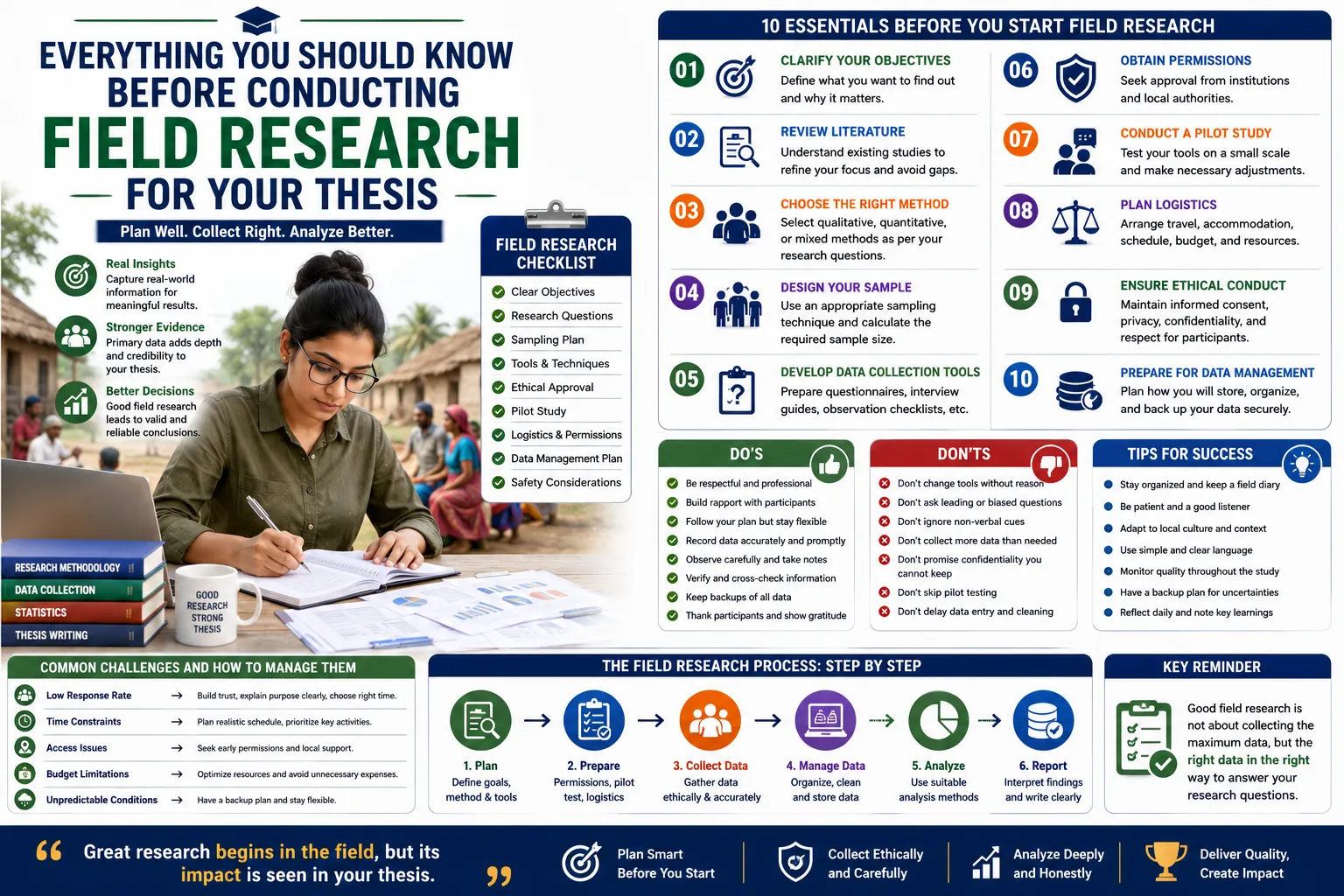
Introduction
Field research is one of the most rewarding yet challenging stages of any academic research project. Whether you are pursuing a PhD, MPhil, master's dissertation, or undergraduate thesis, collecting data directly from people, organizations, communities, or natural environments provides valuable insights that cannot always be obtained from books or online databases.
Unlike secondary research, which relies on existing literature and published datasets, field research involves gathering original (primary) data through surveys, interviews, observations, focus groups, experiments, or case studies. The quality of your fieldwork directly influences the credibility of your research findings, making careful planning and execution essential.
However, many students underestimate the complexity of field research. They often encounter unexpected challenges such as low participant response rates, logistical issues, ethical concerns, poor questionnaire design, incomplete data, or difficulties obtaining permissions. Without proper preparation, these obstacles can delay your research timeline and compromise the validity of your results.
This comprehensive guide explains everything you should know before conducting field research for your thesis. From defining objectives and selecting participants to ethical considerations, data collection techniques, and common mistakes to avoid, this article will help you conduct fieldwork confidently and effectively.
What Is Field Research?
Field research is the process of collecting original data directly from real-world settings rather than relying solely on existing publications or databases. Researchers observe, interact with, or gather information from participants in their natural environments to answer specific research questions.
Field research is widely used across disciplines, including:
- Social Sciences
- Education
- Business and Management
- Healthcare
- Psychology
- Agriculture
- Environmental Science
- Engineering
- Public Policy
- Economics
Depending on your study, field research may involve visiting schools, hospitals, businesses, villages, government offices, laboratories, industries, or communities.
Why Is Field Research Important for a Thesis?
Field research enables researchers to collect firsthand evidence that directly addresses their research objectives. Instead of relying on assumptions or outdated information, you gather current, context-specific data that strengthens your study.
Key benefits include:
- Collecting original and authentic data
- Understanding real-world problems and behaviors
- Testing hypotheses with primary evidence
- Improving the credibility of research findings
- Supporting practical recommendations
- Contributing new knowledge to your field
For many thesis topics, especially in applied disciplines, field research is essential for producing meaningful and impactful results.
Step 1: Clearly Define Your Research Objectives
Before entering the field, ensure your research objectives are precise and well-defined.
Ask yourself:
- What problem am I investigating?
- What information do I need?
- Who can provide this information?
- Which variables am I measuring?
- What outcomes do I expect?
Well-defined objectives guide every decision you make during fieldwork, from selecting participants to designing questionnaires and analyzing data.
Step 2: Choose the Right Research Design
Your research design determines how data will be collected and analyzed.
Quantitative Research
Quantitative research focuses on numerical data and statistical analysis. It commonly uses structured questionnaires, surveys, and experiments to test hypotheses and measure relationships between variables.
Qualitative Research
Qualitative research explores experiences, opinions, motivations, and behaviors through interviews, focus groups, observations, and case studies. It provides rich, detailed insights into complex issues.
Mixed Methods Research
Mixed methods combine quantitative and qualitative approaches, allowing researchers to gain both statistical evidence and contextual understanding.
Select the design that best aligns with your research objectives and the nature of your research questions.
Step 3: Identify Your Target Population
The target population consists of the individuals or organizations from whom you intend to collect data.
Examples include:
- University students
- School teachers
- Healthcare professionals
- Farmers
- Entrepreneurs
- Consumers
- Government officials
- Corporate employees
Clearly defining your target population ensures your findings are relevant and meaningful.
Step 4: Determine an Appropriate Sample
Since it is often impractical to study an entire population, researchers select a representative sample.
Common sampling methods include:
Probability Sampling
- Simple Random Sampling
- Stratified Sampling
- Systematic Sampling
- Cluster Sampling
These methods provide every individual an equal or known chance of selection and are preferred for quantitative studies.
Non-Probability Sampling
- Convenience Sampling
- Purposive Sampling
- Snowball Sampling
- Quota Sampling
These methods are commonly used in qualitative and exploratory research where participants possess specific knowledge or experiences.
Your sample size should be justified based on your research design, objectives, and statistical requirements.
Step 5: Develop Reliable Research Instruments
Your data collection instrument is one of the most critical components of field research.
Depending on your methodology, this may include:
- Questionnaires
- Interview guides
- Observation checklists
- Focus group discussion guides
- Measurement scales
An effective research instrument should:
- Align with research objectives
- Use clear and unbiased language
- Avoid double-barreled or leading questions
- Include appropriate response options
- Be easy to understand and complete
Whenever possible, adapt validated instruments from previous research and conduct a pilot study before full-scale data collection.
Step 6: Obtain Ethical Approval
Most universities require ethical clearance before field research begins.
Ethical approval demonstrates that your study protects participants' rights and complies with institutional research standards.
Key ethical principles include:
- Informed consent
- Voluntary participation
- Confidentiality
- Privacy protection
- Right to withdraw at any time
- Secure storage of research data
Participants should fully understand the purpose of the study and how their information will be used before agreeing to participate.
Step 7: Plan Your Fieldwork Logistics
Field research involves much more than collecting responses. Effective logistical planning saves time and minimizes disruptions.
Consider:
- Travel arrangements
- Accommodation (if required)
- Research materials and equipment
- Scheduling appointments
- Weather conditions
- Local customs and language
- Budget allocation
- Backup transportation
Creating a detailed fieldwork schedule helps ensure that activities are completed efficiently.
Step 8: Conduct a Pilot Study
A pilot study is a small-scale trial conducted before the main research.
Its purpose is to:
- Test questionnaires or interview guides
- Identify confusing questions
- Estimate completion time
- Detect technical issues
- Evaluate participant understanding
- Improve reliability and validity
Pilot testing allows researchers to refine their instruments and procedures, reducing the likelihood of errors during the main study.
Step 9: Build Rapport with Participants
Successful field research depends on participant cooperation.
To encourage honest and complete responses:
- Introduce yourself professionally
- Clearly explain the purpose of your study
- Be respectful and courteous
- Listen actively
- Maintain neutrality
- Respect cultural norms and local practices
Participants are more likely to provide accurate information when they feel comfortable and valued.
Step 10: Collect Data Systematically
Consistency is essential during fieldwork.
Whether conducting surveys, interviews, or observations:
- Follow standardized procedures.
- Ask questions in the same order whenever appropriate.
- Avoid influencing participants' responses.
- Record information accurately.
- Check completed forms for missing responses before leaving the site.
Maintaining consistency improves the reliability and comparability of your data.
Step 11: Manage Your Data Carefully
Good data management begins during fieldwork—not after it ends.
Best practices include:
- Label questionnaires clearly.
- Organize interview recordings systematically.
- Back up digital files regularly.
- Store consent forms separately from research data.
- Maintain secure, password-protected storage.
- Create a data log for tracking progress.
Proper organization reduces the risk of data loss and simplifies analysis later.
Common Challenges in Field Research
Even with careful planning, researchers often encounter unexpected difficulties.
Low Response Rates
Participants may decline to participate or fail to complete questionnaires.
Solution: Increase outreach efforts, provide flexible scheduling, and clearly communicate the value of the research.
Access Restrictions
Organizations or institutions may deny permission to conduct research.
Solution: Obtain official approval letters, explain the purpose of the study, and engage with gatekeepers early.
Incomplete Data
Respondents may skip questions or provide vague answers.
Solution: Review responses before concluding each session and clarify incomplete information where appropriate.
Time Constraints
Fieldwork often takes longer than expected.
Solution: Build additional time into your research schedule and prioritize critical tasks.
Environmental Factors
Weather, transportation issues, or local events may disrupt data collection.
Solution: Develop contingency plans and remain flexible.
Essential Equipment for Field Research
Depending on your study, useful fieldwork equipment may include:
- Printed questionnaires
- Notebook and pens
- Laptop or tablet
- Mobile phone
- Digital voice recorder
- Camera (where permitted)
- Power bank
- GPS device (for environmental studies)
- Identification documents
- Consent forms
Always carry backups of essential materials.
Tips for Conducting High-Quality Interviews
If interviews are part of your field research:
- Prepare open-ended questions.
- Avoid interrupting participants.
- Encourage detailed responses.
- Use follow-up questions for clarification.
- Maintain eye contact and active listening.
- Obtain permission before recording conversations.
- Take brief notes even when recording audio.
Effective interviewing produces richer and more reliable qualitative data.
Safety Considerations During Fieldwork
Researchers should prioritize personal safety throughout the data collection process.
Recommendations include:
- Inform your supervisor of your schedule.
- Avoid isolated locations when working alone.
- Respect local laws and customs.
- Carry emergency contact information.
- Stay aware of your surroundings.
- Protect confidential research materials.
Planning for safety is especially important when conducting research in unfamiliar environments.
Common Mistakes to Avoid
Many thesis researchers make preventable mistakes during fieldwork.
Avoid the following:
- Starting data collection without ethical approval
- Using poorly designed questionnaires
- Selecting an inappropriate sample
- Ignoring pilot testing
- Failing to obtain informed consent
- Recording incomplete information
- Leading participants toward specific answers
- Neglecting data backups
- Delaying data entry until fieldwork is complete
- Overlooking cultural sensitivities
Recognizing these pitfalls in advance can significantly improve the quality of your research.
Best Practices for Successful Field Research
To maximize the success of your fieldwork:
- Define clear research objectives.
- Choose a suitable research design.
- Select an appropriate sampling method.
- Use reliable and valid research instruments.
- Conduct pilot testing.
- Obtain ethical clearance.
- Build trust with participants.
- Collect data consistently.
- Maintain accurate records.
- Protect participant confidentiality.
- Back up your data regularly.
- Review field notes daily.
- Stay flexible and prepared for unexpected challenges.
Following these practices will help you gather trustworthy data and produce stronger research outcomes.
Conclusion
Field research is the foundation of many successful academic studies because it provides original evidence that directly addresses research questions. However, conducting effective fieldwork requires much more than simply distributing questionnaires or interviewing participants. It demands careful planning, ethical responsibility, methodological rigor, and strong organizational skills.
By defining clear objectives, selecting the right research design, choosing appropriate participants, developing reliable research instruments, obtaining ethical approval, and preparing thoroughly for logistical challenges, you can significantly improve the quality of your data and the credibility of your thesis.
Remember that field research is not just about collecting information—it is about collecting the right information in a way that is accurate, ethical, and systematic. Investing time in preparation will save countless hours during data analysis and thesis writing, while also increasing the likelihood that your research will make a meaningful contribution to your academic discipline.
Whether you are conducting surveys in educational institutions, interviewing healthcare professionals, observing workplace practices, or studying rural communities, thoughtful planning and disciplined execution are the keys to successful field research. By applying the principles outlined in this guide, you will be well-equipped to navigate the challenges of fieldwork and produce a thesis built on reliable, high-quality evidence.
Call / WhatsApp: +91 96438 02216
Website:www.ThesisLikho.com