
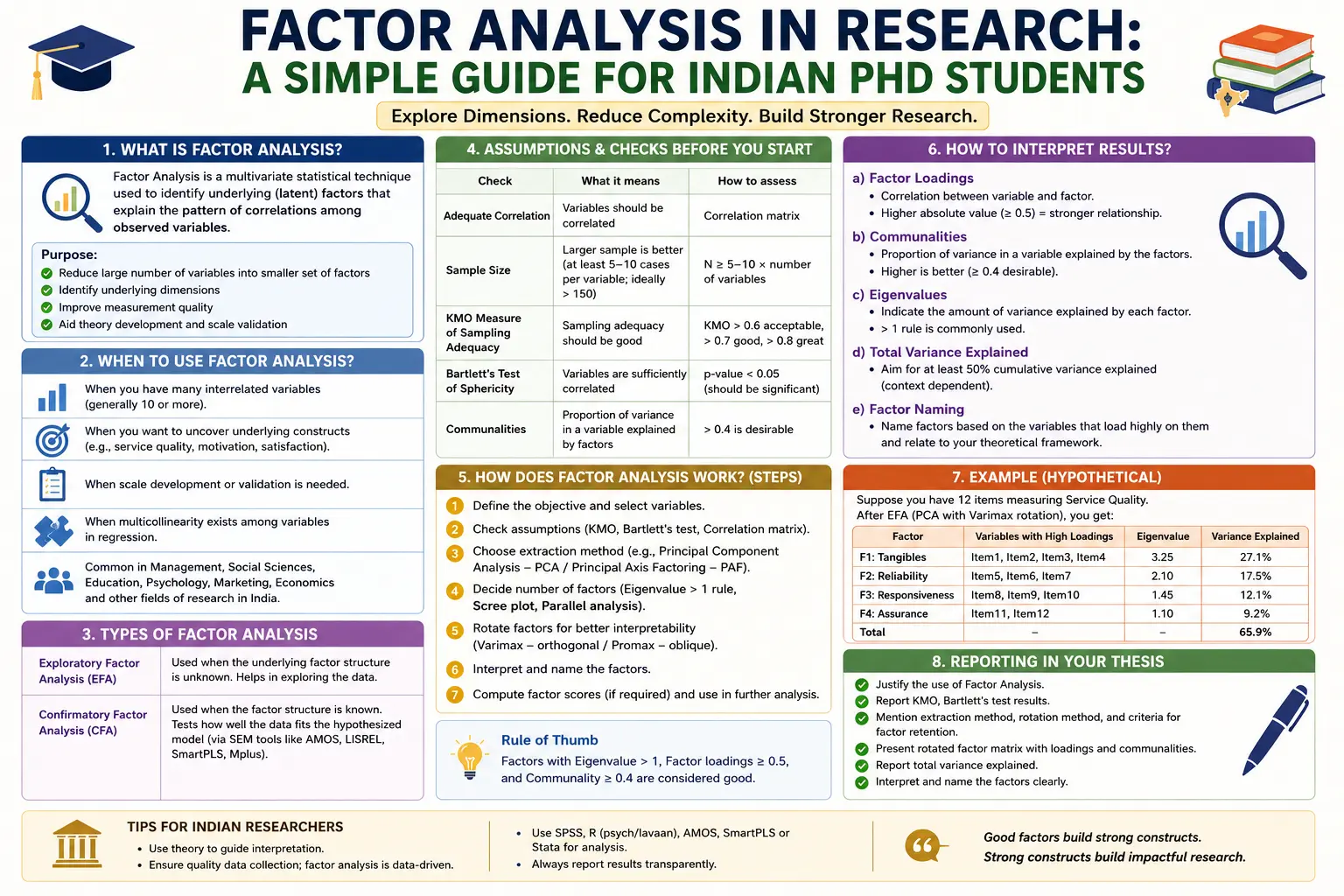
Factor analysis is one of the most powerful statistical techniques used in quantitative research, especially when working with questionnaires, surveys, and psychological or social science measurements. For many Indian PhD students, however, the term "factor analysis" can seem intimidating because it involves advanced statistics and unfamiliar concepts.
The good news is that factor analysis is much easier to understand when you focus on its purpose. At its core, factor analysis helps researchers identify hidden patterns or underlying dimensions within a large set of variables. Instead of analyzing dozens of individual questionnaire items, you can group related items into a smaller number of meaningful factors.
For example, if you are studying customer satisfaction using 30 survey questions, factor analysis may reveal that these questions actually measure just four underlying dimensions such as service quality, pricing, product quality, and customer support.
In this comprehensive guide, you'll learn what factor analysis is, why it is important, the different types of factor analysis, when to use it, its assumptions, step-by-step procedures, interpretation of results, and common mistakes to avoid. Whether you're pursuing a PhD in management, education, psychology, economics, healthcare, or social sciences, this guide will help you confidently apply factor analysis in your research.
What Is Factor Analysis?
Factor analysis is a multivariate statistical technique used to identify underlying relationships among a large number of observed variables. It reduces many correlated variables into a smaller set of unobserved variables known as factors.
These factors represent common characteristics shared by multiple variables, making it easier to understand complex datasets.
For example, suppose you conduct a survey with 25 questions about employee motivation. Instead of interpreting each question separately, factor analysis may show that the responses cluster into three broader factors:
- Work Environment
- Career Growth
- Financial Rewards
This simplifies analysis and improves the interpretation of research findings.
Why Is Factor Analysis Important in Research?
Modern research often involves collecting data through structured questionnaires containing many items. Analyzing each item individually can be time-consuming and may lead to redundant interpretations.
Factor analysis helps researchers by:
- Reducing data complexity.
- Identifying hidden constructs.
- Validating measurement scales.
- Improving questionnaire quality.
- Eliminating redundant variables.
- Supporting scale development.
- Preparing variables for advanced statistical analyses such as regression or structural equation modeling.
For PhD scholars, factor analysis enhances the scientific rigor of quantitative research by demonstrating that survey items accurately measure the intended concepts.
Real-Life Example of Factor Analysis
Imagine you're researching student satisfaction with online learning and have collected responses to 24 survey questions.
Some questions focus on:
- Internet connectivity
- Learning platform usability
- Video quality
- Instructor support
- Assessment methods
- Technical assistance
Rather than analyzing all 24 questions independently, factor analysis may identify four underlying dimensions:
- Technology Quality
- Teaching Effectiveness
- Assessment Experience
- Student Support Services
These factors provide a clearer and more meaningful representation of the data.
When Should You Use Factor Analysis?
Factor analysis is appropriate when:
- You have a large number of related variables.
- Your questionnaire measures abstract concepts such as satisfaction, motivation, trust, or anxiety.
- You want to identify underlying dimensions.
- You are developing or validating a new measurement scale.
- Your variables are moderately correlated.
- You need to reduce the number of variables before further analysis.
When Should You Avoid Factor Analysis?
Factor analysis may not be suitable if:
- Your dataset contains very few variables.
- Variables are largely unrelated.
- The sample size is too small.
- The research objective does not involve identifying latent constructs.
- The data are primarily categorical without appropriate estimation methods.
Applying factor analysis in these situations may produce unreliable or misleading results.
Types of Factor Analysis
There are two main types of factor analysis used in academic research.
1. Exploratory Factor Analysis (EFA)
Exploratory Factor Analysis is used when the underlying structure of the data is unknown.
Researchers use EFA to:
- Discover hidden factors.
- Explore relationships among variables.
- Develop new questionnaires.
- Identify clusters of related items.
Example
A PhD student develops a new employee engagement questionnaire containing 40 items. Since the dimensions have not been established, EFA is used to explore the factor structure.
Advantages
- Flexible.
- Suitable for new research instruments.
- Identifies latent dimensions without predefined assumptions.
2. Confirmatory Factor Analysis (CFA)
Confirmatory Factor Analysis tests whether collected data fit a previously established theoretical model.
Unlike EFA, researchers already know how variables are expected to group.
Example
A researcher adopts an established customer satisfaction scale consisting of four dimensions. CFA is performed to verify whether responses from Indian consumers support the expected structure.
Advantages
- Tests theoretical models.
- Validates existing scales.
- Frequently used before Structural Equation Modeling (SEM).
Assumptions of Factor Analysis
Before performing factor analysis, ensure that your data satisfy several important assumptions.
1. Adequate Sample Size
A larger sample generally produces more stable factor solutions.
Common recommendations include:
- Minimum of 150–200 respondents.
- Five to ten respondents per questionnaire item.
For example, a 30-item questionnaire typically benefits from a sample of 300 participants.
2. Sufficient Correlation Among Variables
Factor analysis requires meaningful relationships among variables.
A correlation matrix should reveal several moderate correlations.
4. Bartlett's Test of Sphericity
This test evaluates whether the variables are sufficiently correlated for factor analysis.
A statistically significant result (typically p < 0.05) indicates that factor analysis is appropriate.
5. Continuous or Ordinal Variables
Factor analysis is most commonly applied to continuous variables or Likert-scale survey items that approximate interval-level measurement.
Step-by-Step Process of Factor Analysis
Step 1: Collect Data
Administer your questionnaire to a sufficiently large and representative sample.
Ensure:
- Complete responses where possible.
- Minimal missing data.
- Reliable measurements.
Step 2: Clean the Dataset
Before analysis:
- Remove duplicate records.
- Address missing values.
- Identify outliers.
- Verify coding accuracy.
Clean data improve the stability of factor solutions.
Step 3: Check Assumptions
Evaluate:
- KMO statistic.
- Bartlett's Test of Sphericity.
- Correlation matrix.
Only proceed if these diagnostics support factor analysis.
Step 4: Extract Factors
Common extraction methods include:
- Principal Component Analysis (PCA) (often used for data reduction but technically distinct from factor analysis)
- Principal Axis Factoring (PAF)
- Maximum Likelihood (ML)
For identifying latent constructs, Principal Axis Factoring and Maximum Likelihood are generally preferred.
Step 5: Decide the Number of Factors
Several criteria help determine how many factors to retain:
Eigenvalues
A common rule is to retain factors with eigenvalues greater than 1.
Scree Plot
A scree plot displays eigenvalues in descending order. The point where the curve begins to level off ("the elbow") often indicates the appropriate number of factors.
Parallel Analysis
Many statisticians recommend parallel analysis as a more reliable method than relying solely on the eigenvalue > 1 rule.
Step 6: Rotate the Factors
Rotation improves interpretability by clarifying which variables load strongly onto each factor.
Common rotation methods include:
Varimax Rotation
- Assumes factors are independent.
- Produces simpler factor structures.
- Widely used in management and education research.
Oblimin Rotation
- Allows factors to be correlated.
- Appropriate when theoretical constructs are expected to influence one another.
Applications of Factor Analysis in Indian PhD Research
Factor analysis is widely used across disciplines, including:
Management
- Employee engagement
- Leadership
- Organizational culture
- Consumer behavior
Education
- Student satisfaction
- Teaching effectiveness
- Digital learning readiness
Psychology
- Personality assessment
- Anxiety scales
- Stress measurement
Healthcare
- Patient satisfaction
- Quality of life
- Mental health assessments
Social Sciences
- Social attitudes
- Community participation
- Public opinion studies
Marketing
- Brand perception
- Customer loyalty
- Purchase intention
Software Used for Factor Analysis
Several statistical software packages support factor analysis.
SPSS
Popular among beginners due to its menu-driven interface and built-in exploratory factor analysis procedures.
R
Offers advanced packages such as psych, lavaan, and factoextra for both EFA and CFA.
STATA
Provides robust exploratory and confirmatory factor analysis commands suitable for academic research.
AMOS
Frequently used for Confirmatory Factor Analysis and Structural Equation Modeling.
Mplus
Widely regarded for advanced latent variable modeling and complex CFA applications.
Common Mistakes to Avoid
Many research scholars make avoidable errors when applying factor analysis.
Some of the most common include:
- Using factor analysis with an inadequate sample size.
- Ignoring KMO and Bartlett's test results.
- Confusing Principal Component Analysis with Exploratory Factor Analysis.
- Retaining variables with very low factor loadings.
- Assigning misleading or arbitrary factor names.
- Failing to report rotation methods.
- Ignoring cross-loading variables (items that load strongly on multiple factors).
- Interpreting factors without theoretical justification.
Avoiding these issues strengthens the credibility and reproducibility of your findings.
Best Practices for Reporting Factor Analysis in a Thesis
When presenting factor analysis in your dissertation, include:
- Research objective for conducting factor analysis.
- Sample size and participant characteristics.
- KMO statistic.
- Bartlett's Test of Sphericity results.
- Extraction method used.
- Rotation method applied.
- Number of retained factors.
- Eigenvalues and percentage of variance explained.
- Factor loading table.
- Criteria for retaining or removing variables.
- Interpretation and naming of factors.
Transparent reporting allows supervisors, examiners, and journal reviewers to evaluate the quality of your analysis.
Frequently Asked Questions (FAQs)
Is factor analysis mandatory for every PhD thesis?
No. Factor analysis is only appropriate when your research involves identifying or validating underlying constructs measured through multiple related variables, such as questionnaire items.
What is the difference between PCA and factor analysis?
Principal Component Analysis (PCA) focuses on reducing the dimensionality of data by creating components that capture the maximum variance. Factor analysis, particularly Exploratory Factor Analysis, seeks to identify latent constructs that explain the correlations among observed variables.
What is a good factor loading?
While acceptable thresholds vary, loadings of 0.50 or higher are commonly considered meaningful. Higher loadings indicate stronger relationships between variables and their underlying factors.
Can factor analysis be used with Likert-scale data?
Yes. Factor analysis is commonly applied to Likert-scale questionnaire responses, especially in education, management, psychology, healthcare, and social science research.
Which software is best for beginners?
SPSS is often recommended for beginners because of its intuitive interface. Researchers planning to conduct Confirmatory Factor Analysis or Structural Equation Modeling may also consider AMOS or R, depending on their analytical needs.
Conclusion
Factor analysis is an essential statistical technique for researchers working with questionnaires, surveys, and multidimensional constructs. By reducing large numbers of related variables into a smaller set of meaningful factors, it simplifies data interpretation, strengthens measurement validity, and enhances the quality of quantitative research.
For Indian PhD students, understanding when and how to apply Exploratory Factor Analysis and Confirmatory Factor Analysis can significantly improve the methodological rigor of a thesis. The key to successful factor analysis lies in collecting an adequate sample, checking assumptions such as KMO and Bartlett's Test, selecting appropriate extraction and rotation methods, and interpreting factor loadings in light of both statistical evidence and theoretical understanding.
When applied thoughtfully and reported transparently, factor analysis not only strengthens your dissertation but also increases the credibility of your findings, making your research more suitable for publication in high-quality academic journals.
Website: www.thesislikho.com
Call/WhatsApp: +91 96438 02216