
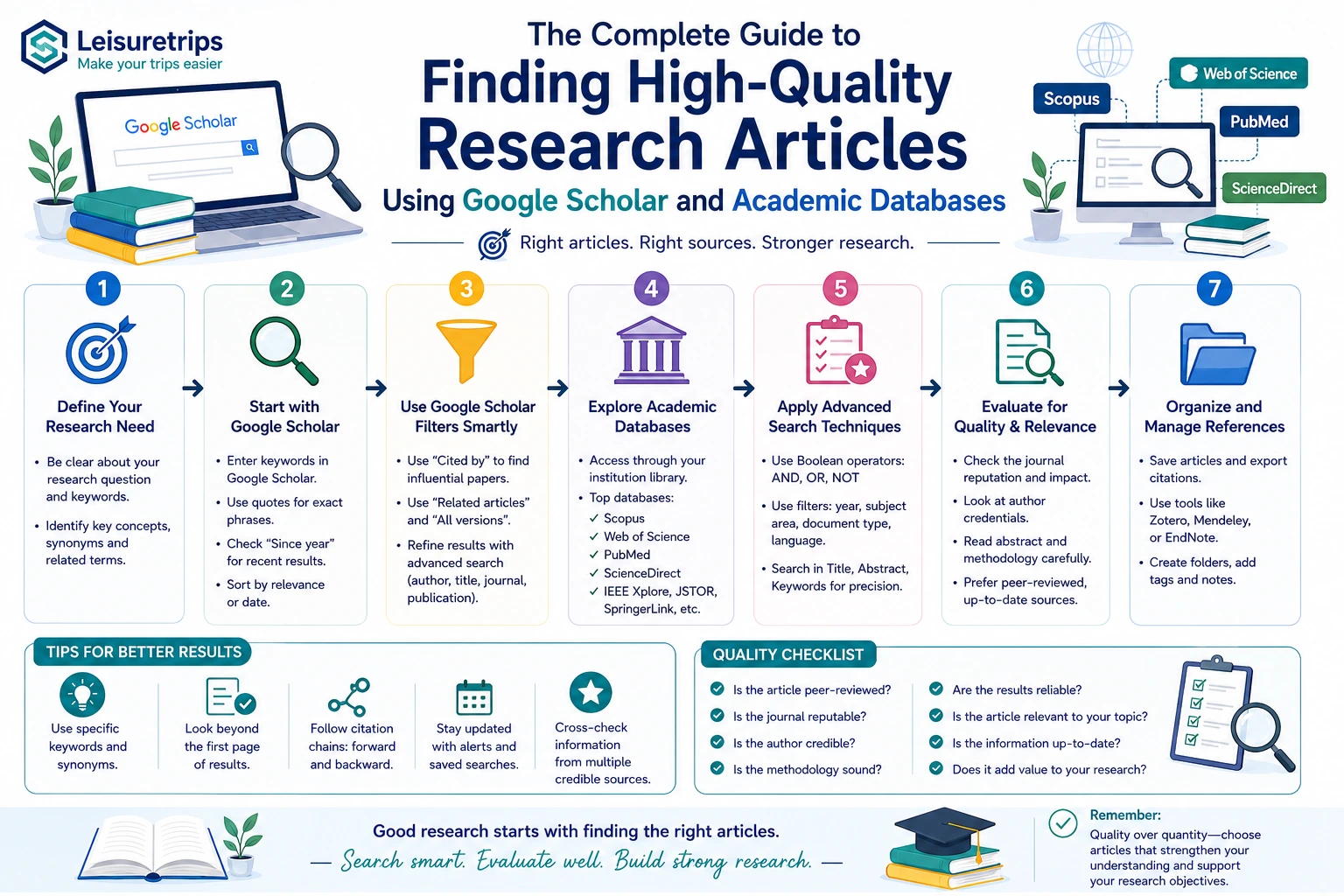
Finding high-quality research articles is the foundation of every successful PhD thesis, dissertation, or academic research project. Whether you're preparing a literature review, writing a research proposal, identifying a research gap, or analyzing previous studies, the quality of your references directly impacts the credibility and originality of your work.
However, many research scholars—especially those beginning their PhD journey—struggle to locate reliable academic literature. Searching Google with broad keywords often returns blogs, commercial websites, or outdated information rather than peer-reviewed research. As a result, scholars waste valuable time reading irrelevant sources or miss important studies that could strengthen their research.
The solution is to use Google Scholar strategically and complement it with trusted academic databases such as Scopus, Web of Science, JSTOR, ScienceDirect, SpringerLink, IEEE Xplore, PubMed, and Shodhganga. These platforms provide access to peer-reviewed journals, conference papers, books, theses, and scholarly publications from around the world.
In this comprehensive guide, you'll learn how to search efficiently, evaluate the quality of research articles, use advanced search operators, and organize your references for a strong literature review.
Why High-Quality Research Articles Matter
A PhD thesis is judged not only by the originality of its findings but also by the quality of the literature that supports it.
Using credible research articles helps you:
- Build a strong literature review.
- Identify research gaps.
- Understand existing theories.
- Compare research methodologies.
- Strengthen your arguments with evidence.
- Avoid misinformation.
- Increase the credibility of your thesis.
- Publish in reputable journals.
Poor-quality sources can weaken your research and may even be rejected by supervisors or journal reviewers.
What Makes a Research Article High Quality?
Not every article found online is academically reliable.
A high-quality research article generally has the following characteristics:
- Published in a peer-reviewed journal.
- Written by recognized researchers or institutions.
- Published by reputable academic publishers.
- Includes a clear research methodology.
- Contains reliable data and analysis.
- Provides complete references.
- Has been cited by other researchers.
- Is relevant to your research topic.
Always prioritize quality over quantity.
Understanding Different Types of Academic Sources
Knowing the different types of academic publications helps you select the right source.
Journal Articles
These are the most commonly cited sources in PhD research.
They usually include:
- Original research
- Literature reviews
- Case studies
- Experimental findings
Conference Papers
Useful for emerging topics where research is still developing.
Common in:
- Engineering
- Computer Science
- Artificial Intelligence
- Information Technology
Books
Helpful for:
- Theoretical frameworks
- Historical background
- Foundational concepts
Review Articles
Summarize findings from multiple studies.
Ideal for quickly understanding a research area.
Doctoral Theses
Provide detailed methodologies and literature reviews.
In India, Shodhganga is an excellent source for doctoral dissertations.
Why Google Scholar Is Essential
Google Scholar is one of the most widely used academic search engines.
It indexes:
- Journal articles
- Books
- Conference papers
- Theses
- Patents
- Technical reports
- Court opinions (in some regions)
Unlike a standard search engine, it focuses on scholarly content.
How to Search Effectively in Google Scholar
Many researchers type long sentences into Google Scholar, leading to poor results.
Instead, use concise keywords.
Example
Instead of:
"How does artificial intelligence affect customer satisfaction in Indian banks?"
Search:
- Artificial Intelligence customer satisfaction banking India
This improves search accuracy.
Use Advanced Search Operators
Google Scholar supports several search techniques.
Quotation Marks
Search for exact phrases.
Example:
"Digital Financial Inclusion"
Only articles containing that exact phrase will appear.
AND Operator
Search for multiple concepts.
Example:
Leadership AND Innovation
OR Operator
Find articles using alternative terms.
Example:
SMEs OR MSMEs
Minus Sign (-)
Exclude unwanted topics.
Example:
Blockchain -Cryptocurrency
Author Search
Find publications by a specific researcher.
Example:
author:"Ashish Arora"
Journal Search
Limit results to a specific journal.
Example:
source:"Journal of Business Research"
Use Filters to Improve Results
Google Scholar allows you to refine results.
Useful filters include:
Year of Publication
For fast-changing fields, prioritize articles from the last five to seven years while still including seminal studies where appropriate.
Sort by Relevance
Best when exploring a new topic.
Sort by Date
Useful for identifying the latest developments.
Language
Choose articles in your preferred language if available.
Understanding Google Scholar Features
Google Scholar provides several helpful options below each search result.
Cited By
Shows how many times an article has been cited.
Highly cited papers are often influential.
Related Articles
Helps you discover similar research.
Versions
Shows different copies of the same paper, including institutional repositories.
Cite
Generates citations in multiple formats.
You can export references to citation managers.
Save
Allows you to bookmark articles in your Google Scholar library.
Best Academic Databases for PhD Research
While Google Scholar is an excellent starting point, academic databases provide more precise search tools and curated content.
Scopus
Scopus is one of the largest abstract and citation databases.
Best for:
- Citation analysis
- Literature reviews
- Interdisciplinary research
- Identifying influential authors
Web of Science
Known for high-quality indexed journals.
Useful for:
- Citation tracking
- Impact analysis
- Systematic reviews
ScienceDirect
Managed by Elsevier.
Excellent for:
- Engineering
- Medicine
- Social Sciences
- Business
- Environmental Science
SpringerLink
Offers access to:
- Books
- Journals
- Conference proceedings
Widely used in science and technology disciplines.
JSTOR
Ideal for:
- Humanities
- Social Sciences
- Economics
- History
- Political Science
IEEE Xplore
Essential for:
- Computer Science
- Electronics
- Artificial Intelligence
- Electrical Engineering
PubMed
The preferred database for:
- Medicine
- Public Health
- Pharmacy
- Nursing
- Biomedical Sciences
Wiley Online Library
Provides access to multidisciplinary journals and books across science, business, education, and healthcare.
Taylor & Francis Online
A valuable source for social sciences, management, education, and humanities research.
Shodhganga
An important repository of Indian doctoral theses.
Useful for:
- Understanding thesis structures.
- Reviewing methodologies.
- Identifying research gaps in the Indian context.
Evaluate the Quality of Research Articles
Before adding an article to your literature review, ask:
- Is it peer-reviewed?
- Is it published in a reputable journal?
- Is the methodology appropriate?
- Are the findings supported by data?
- Is the article recent?
- Has it been cited by other researchers?
- Is it relevant to my research objectives?
These questions help ensure you're building your thesis on reliable evidence.
How to Read Research Articles Efficiently
You do not need to read every paper from beginning to end.
A practical approach:
- Read the title and abstract.
- Review the introduction.
- Check the methodology.
- Examine the results.
- Read the conclusion.
- Note the limitations.
- Record key findings and relevance.
This strategy helps you identify valuable papers without spending unnecessary time.
Organize Your Research Articles
Downloading articles is only the first step.
Create a folder structure such as:
Research Articles
Literature Review
Methodology
AI Studies
Banking
Marketing
Thesis References
Conference Papers
Rename files consistently.
Example:
Sharma_2025_DigitalBanking.pdf
Instead of:
paper1.pdf
Use Reference Management Software
Managing hundreds of references manually is difficult.
Recommended tools include:
Zotero
- Free and open source
- Browser integration
- PDF annotation
- Automatic citation generation
Mendeley
- Reference management
- Cloud synchronization
- PDF highlighting
- Collaboration features
EndNote
Suitable for large research projects with advanced reference organization.
These tools automatically generate citations in styles such as APA, MLA, Chicago, IEEE, and Harvard.
Common Mistakes Researchers Make
Avoid these common errors.
Using General Google Instead of Academic Databases
General search results often include unreliable or non-peer-reviewed content.
Downloading Every Article
Focus on relevance and quality rather than volume.
Ignoring Review Articles
Review papers provide an excellent overview of a research field and often point to key primary studies.
Relying Only on One Database
Each database has different coverage. Searching multiple sources improves the completeness of your literature review.
Not Recording Citation Details
Always save:
- Author
- Year
- Journal
- Volume
- Issue
- Pages
- DOI
This prevents citation problems later.
Tips for Indian PhD Scholars
Researchers in India can strengthen their literature search by:
- Including both international and Indian studies.
- Reviewing doctoral theses available through Shodhganga.
- Checking whether journals are recognized by their university or discipline.
- Following their institution's recommended citation style.
- Creating a weekly schedule for searching, reading, and organizing research papers.
- Discussing key articles with supervisors to confirm their relevance.
A Weekly Literature Search Workflow
A consistent workflow makes research more manageable.
Monday: Search Google Scholar and academic databases using updated keywords.
Tuesday: Screen abstracts and select the most relevant papers.
Wednesday: Read and annotate key studies.
Thursday: Summarize findings and update your literature matrix.
Friday: Organize references in your citation manager and identify research gaps.
Following this routine helps you build a strong literature review gradually instead of rushing before submission.
Frequently Asked Questions (FAQs)
Is Google Scholar enough for a PhD literature review?
Google Scholar is an excellent starting point, but it should be complemented with discipline-specific academic databases such as Scopus, Web of Science, IEEE Xplore, PubMed, or JSTOR to ensure comprehensive coverage.
How recent should research articles be?
For most topics, prioritize studies published within the last five to seven years while also including foundational or highly influential papers that remain relevant.
How can I tell if a journal is reputable?
Look for peer review, publisher reputation, editorial standards, citation impact, and whether the journal is indexed in respected academic databases relevant to your field.
Should I use books or journal articles more often?
Journal articles should generally form the core of your literature review because they contain the latest research. Books are particularly useful for theoretical foundations and background information.
What is the best way to organize research articles?
Use a reference management tool such as Zotero, Mendeley, or EndNote, create topic-based folders, rename downloaded PDFs consistently, and maintain a literature matrix to compare studies efficiently.
Conclusion
Finding high-quality research articles is one of the most important skills for any PhD scholar. A thorough and well-organized literature search lays the foundation for a credible research proposal, a strong literature review, and a successful thesis. By combining the broad coverage of Google Scholar with the precision of academic databases such as Scopus, Web of Science, ScienceDirect, SpringerLink, IEEE Xplore, PubMed, JSTOR, and Shodhganga, you can access reliable and relevant scholarly literature across disciplines.
Remember that effective literature searching is not about collecting the largest number of papers—it is about identifying the most relevant, credible, and impactful studies that support your research objectives. Use advanced search techniques, evaluate each article critically, organize your references systematically, and review the literature regularly as your research evolves.
For Indian PhD scholars, developing a disciplined approach to literature searching will not only improve the quality of your thesis but also strengthen your research skills, increase publication opportunities, and contribute to meaningful academic work. A strong literature review begins with a smart search strategy, and mastering that strategy is an investment that will benefit every stage of your research journey.
Call / WhatsApp: +91 96438 02216
Website:www.ThesisLikho.com