
India stands at a pivotal demographic and political crossroads. With over 65% of its population under the age of 35, the nation possesses the world's largest youth cohort. Traditional Political Science frameworks in India — historically anchored in formal state institutions, high-electoral calculus, and macro-sociological categorisation — frequently fail to capture the lived political realities of this generation.
Young citizens today navigate a landscape defined by gig-economy precarity, algorithmic campaign targeting, recurring public-examination integrity failures, and structural shifts in global labour markets. At the same time, political parties are radically altering their cadre recruitment, digital outreach, and policy manifestos to capture this volatile vote bank.
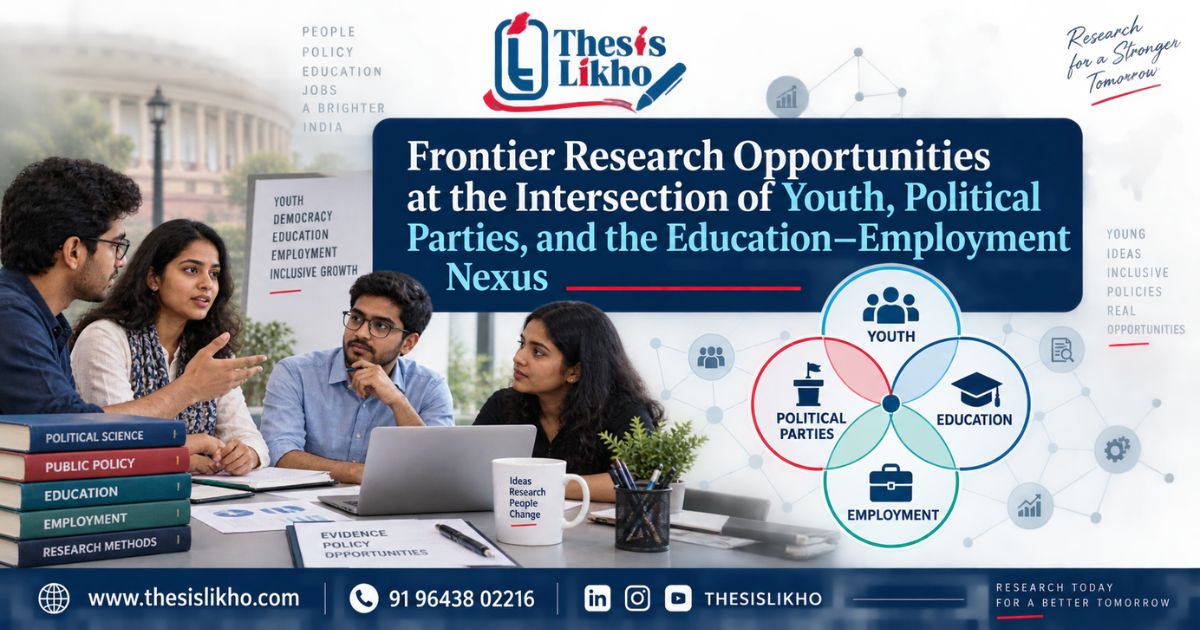
This document outlines fifteen transformative research domains situated at the intersection of Youth, Political Parties, and Education–Employment Policy. Designed for independent scholars, early-career researchers, and academic strategists, each domain presents a breakdown of its contemporary significance, scope, concrete research objectives, methodological approach, and societal benefit.
The Tri-Fold Conceptual Framework
Understanding political dynamics in modern India requires moving beyond isolated institutional analysis. The interaction between Youth Agency, Political Party Dynamics, and the Education–Employment Ecosystem forms a continuous feedback loop that governs contemporary Indian statecraft:
Youth Citizenry
Aspirations, digital mobilisation, and economic precarity drive youth demands and shape vote choice, while parties respond with algorithmic, data-driven outreach.
Education & Employment Ecosystem
The National Education Policy, examination integrity, gig work, and skilling programmes intersect with policy and statecraft, generating the material conditions that youth respond to politically.
Political Parties
Recruitment, cadre building, election manifestos, and campaign funding are increasingly reshaped by the need to respond to youth demands emerging from the education–employment ecosystem.
Three propositions follow from this framework:
• Youth as dynamic political actors — young Indians are not passive recipients of state policy or voter-turnout statistics; they actively shape political discourse through digital networks, street protest, and informal labour organisation.
• Party adaptation and technocracy — political parties are caught between traditional clientelism and caste patronage on one hand, and the need to offer technocratic solutions to youth employment and skilling on the other.
• The education–employment bottleneck — the friction between rising educational attainment and stagnant formal job creation is the primary engine of modern political mobilisation, social unrest, and electoral realignment in India.
Fifteen Frontier Research Areas
Each domain below is structured for direct use in a research proposal, RAC presentation, or thesis prospectus: real-time context and significance, scope, concrete objectives, expected deliverables, and societal advantage.
1. Digital Algorithmic Mobilization & Youth Political Polarization
Context & Contemporary Significance
Political communication in India has shifted from mass rallies to hyper-targeted algorithmic feeds on platforms such as WhatsApp, Instagram Reels, YouTube Shorts, and X. Party "IT Cells" now use demographic and behavioural data to deliver tailored political content directly to first-time voters. The digital campaigns run during the 2024 Lok Sabha elections and subsequent state assembly elections — including viral short-form video content and deepfake political avatars — illustrate how these tools are being used to shape youth perceptions of identity, employment, and national security.
Scope
Interdisciplinary research combining computational political science, media studies, and behavioural survey analysis across urban and peri-urban voter segments.
Research Objectives
• Map the operational architecture of major political party IT Cells and their algorithmic micro-targeting workflows aimed at voters aged 18–25.
• Quantify first-time voters' exposure to polarising versus policy-oriented digital narratives during election cycles.
• Analyse the psychological and civic impact of echo-chamber algorithms on youth democratic participation and tolerance for dissent.
Expected Deliverables
A multi-method dataset tracking viral political communications, a peer-reviewed monograph, and policy briefs on political advertising transparency.
Societal Advantage
Provides empirical data to inform digital literacy interventions, counter online radicalisation, and help institutions such as the Election Commission of India update model codes of conduct for algorithmic and AI-driven campaigning.
2. The Gig Economy & Politics of Precarity
Context & Contemporary Significance
India's urban economy increasingly runs on platform-based gig workers in delivery, ride-hailing, and quick-commerce — predominantly educated young men and women facing economic precarity. Lacking traditional trade union structures, these workers are forming hyper-local digital networks to organise against algorithmic pay cuts and poor working conditions. The Rajasthan Platform Based Gig Workers (Registration and Welfare) Act, 2023 marked a historic policy shift, and gig-worker rights have since become an active electoral promise in states such as Karnataka and Telangana.
Scope
Comparative political economy analysing urban labour governance, gig platforms, and state legislative responses.
Research Objectives
• Evaluate the implementation efficiency of welfare boards created under gig-worker legislation across different states.
• Investigate how political parties incorporate gig-worker demands into labour policy and electoral strategy.
• Map the emergence of informal, non-party gig-worker unions and their capacity to negotiate with platforms and state authorities.
Expected Deliverables
Fieldwork-based comparative case studies of state-level gig-worker legislation and actionable social-security policy frameworks.
Societal Advantage
Helps establish sustainable labour laws, protects young workers from algorithmic exploitation, and guides parties toward realistic urban employment policy.
3. Political Party Recruitment & Youth Leadership Pathways
Context & Contemporary Significance
Despite India's young median age (around 28 years), Parliament and state assemblies remain dominated by older legislators. Youth wings often function as event-management channels rather than talent incubators, with entry into mainstream politics largely controlled by dynastic linkages, financial capital, or student-union muscle power. The rise of independent youth candidates in municipal elections reflects growing frustration with these bottlenecks.
Scope
Organisational political science and elite studies focused on internal party democracy across national and regional parties.
Research Objectives
• Trace the backgrounds and career trajectories of politicians under 40 elected to state assemblies over the past 15 years to quantify dynastic versus grassroots entry rates.
• Assess the structural and financial barriers preventing young, non-dynastic individuals from securing party nominations.
• Compare the efficacy of party-led candidate-selection programmes (talent hunts, leadership academies) against traditional cadre promotion.
Expected Deliverables
A biographical dataset of youth political leaders in India and a scorecard evaluating internal party democracy across major parties.
Societal Advantage
Encourages structural reform within parties, lowers entry barriers for qualified youth leaders from non-privileged backgrounds, and improves the representative quality of Indian democracy.
4. The Political Economy of NEP 2020 Implementation Across States
Context & Contemporary Significance
Education is a concurrent subject under the Constitution, making its governance an arena of federal cooperation and conflict. The National Education Policy (NEP) 2020 aims to re-engineer higher education through credit banks, multi-disciplinary pathways, and structural overhauls. Implementation has exposed sharp partisan fault lines: BJP-governed states have accelerated rollout, while several opposition-ruled states — Tamil Nadu and Karnataka among them — have rejected components of the policy or proposed alternative state education policies, citing centralisation, language mandates, and commercialisation concerns.
Scope
Public policy, federalism, and higher-education governance across diverse state administrations.
Research Objectives
• Measure regional disparities in budgetary allocation and infrastructure readiness for NEP 2020 implementation.
• Analyse party-line political narratives and ideological debates around curriculum frameworks and university autonomy.
• Evaluate student and faculty satisfaction across early-adopting versus resistant state university systems.
Expected Deliverables
A state-by-state policy tracker on educational decentralisation and a comparative report on federal higher-education governance.
Societal Advantage
Provides non-partisan, empirical evidence to resolve federal-state deadlocks in education so students are not disadvantaged by inter-governmental contestation.
5. Examination Corruption, Paper Leaks, and Youth Political Backlash
Context & Contemporary Significance
Recruitment and entrance-examination integrity has become a primary political issue for Indian youth. High-profile controversies surrounding NEET-UG 2024, together with paper leaks and exam cancellations in state public service commission tests in Rajasthan, Uttar Pradesh, Gujarat, and Telangana, have disrupted the lives of millions of aspirants. Youth mobilisation — street demonstrations, Supreme Court litigation, and political pressure campaigns — forced the passage of the Public Examinations (Prevention of Unfair Means) Act, 2024.
Scope
Public administration, anti-corruption governance, and youth-led political mobilisation.
Research Objectives
• Map the political economy of the coaching-examination ecosystem and trace administrative failure points in test delivery.
• Document how paper leaks function as catalysts for spontaneous, non-party youth political coalitions.
• Assess the political and electoral consequences of exam scandals for incumbent state governments.
Expected Deliverables
An administrative vulnerability-audit model for public testing agencies and a study on the political life cycle of student protest movements.
Societal Advantage
Drives administrative transparency, strengthens legislative anti-leak frameworks, and restores public trust in institutional meritocracy.
6. Student Politics in Non-Metropolitan and Tier-2/3 Universities
Context & Contemporary Significance
Scholarship on Indian student politics has historically focused on prominent central universities such as JNU, Delhi University, and Jamia Millia Islamia. Yet over 80% of Indian university students are enrolled in state universities and regional colleges in Tier-2 and Tier-3 cities — Gorakhpur, Patna, Ranchi, Kolhapur, Madurai, among others — which serve as the primary grounds for grassroots political socialisation, caste-network consolidation, and regional party cadre building.
Scope
Political sociology, field ethnography, and regional politics.
Research Objectives
• Conduct ethnographic fieldwork across regional college campuses to map student-union election machinery and patron-client relationships.
• Analyse how caste, regional identity, and local-language political discourse shape student-union leadership selection.
• Track the career pathways of Tier-2/3 student-union leaders into local government, panchayat systems, and mainstream parties.
Expected Deliverables
A multi-site ethnographic archive of non-metropolitan student politics and a comparative monograph on regional youth leadership formation.
Societal Advantage
Decentralises political science scholarship beyond capital cities and highlights the true engine of India's grassroots political leadership.
7. Brain Drain, Overseas Migration, and Local Political Accountability
Context & Contemporary Significance
In states such as Punjab, Haryana, Andhra Pradesh, and Gujarat, youth unemployment and limited career mobility have spurred large-scale legal and irregular migration to Western nations. Entire rural and semi-urban economies are being reshaped by visa consultants, IELTS coaching centres, and land sales that fund overseas transit, and mass deportations of undocumented Indian youth have underscored the human costs involved.
Scope
International political economy, migration studies, and local electoral accountability.
Research Objectives
• Investigate how the departure of educated youth alters local civic engagement, voter turnout, and pressure on municipal and panchayat leaders.
• Examine how local parties respond to youth migration in campaigns — as an achievement or as a governance failure.
• Map the political economy of the irregular-migration industry and its links to local political patronage.
Expected Deliverables
Field data on the impact of youth outflow on local governance performance and policy frameworks for economic retention in high-emigration districts.
Societal Advantage
Informs economic-development policy to retain domestic talent, protects families from predatory migration networks, and pushes local governments toward job-creation accountability.
8. Skilling Welfare Programmes vs. Real Employment Outcomes
Context & Contemporary Significance
Successive governments have launched flagship skilling schemes — the Pradhan Mantri Kaushal Vikas Yojana (PMKVY), the National Apprenticeship Promotion Scheme (NAPS), and various state skill missions — through which millions of citizens have received certification. A significant gap remains, however, between certified skill acquisition and long-term, well-paying formal employment, raising questions about policy design, corporate absorption capacity, and state accountability.
Scope
Public policy evaluation, labour economics, and state administrative efficiency.
Research Objectives
• Conduct longitudinal tracking of skilling-programme graduates across select districts to determine employment rates, wage trajectories, and job retention.
• Evaluate structural linkages between private-sector demand, industrial clusters, and government training centres.
• Analyse how parties use skill-certification figures as electoral performance metrics against voter perceptions of job availability.
Expected Deliverables
An independent policy-impact assessment of state skilling programmes and a blueprint for employer-integrated vocational education.
Societal Advantage
Identifies waste in public welfare spending, encourages industry-aligned curriculum design, and helps align youth skills with actual labour-market demand.
9. Women's Political Participation Beyond the "Sarpanch Pati" Paradigm
Context & Contemporary Significance
India presents a striking paradox: female voter turnout now rivals or exceeds male turnout in many elections, yet young women remain underrepresented in party leadership, candidate lists, and legislative seats. Local-governance reservations (50% in Panchayats) introduced millions of women to local politics, but real administrative power has often been exercised by male relatives — the "Sarpanch Pati" phenomenon. A new generation of educated, digitally connected young women is beginning to challenge these informal structures, aided by statutory quotas such as the Nari Shakti Vandan Adhiniyam (Women's Reservation Act, 2023).
Scope
Gender politics, local governance, and institutional reform.
Research Objectives
• Measure the administrative agency and decision-making independence of young female leaders elected to rural and urban local bodies.
• Identify the internal organisational hurdles young women face within parties when seeking leadership positions or election tickets.
• Analyse how women-centric welfare schemes (direct cash transfers such as Ladli Behna, Gruha Lakshmi) translate into independent political agency.
Expected Deliverables
A quantitative index measuring political agency among female local representatives and targeted recommendations for candidate-selection reform.
Societal Advantage
Accelerates genuine gender equality in governance, dismantles patriarchal administrative proxies, and promotes policy tailored to young women's security and independence.
10. Caste Dynamics, Reservation Politics, and the Educated Youth
Context & Contemporary Significance
The intersection of caste and political mobilisation is being reshaped by the aspirations of educated youth. Mass mobilisations for reservation benefits by traditionally agrarian communities — the Maratha agitation led by Manoj Jarange Patil in Maharashtra, alongside demands by Kapus, Patidars, and Jats — reflect agrarian distress and a shortage of formal public-sector jobs. At the same time, educated OBC, SC, and ST youth are using digital media and legal avenues to demand rigorous implementation of existing quotas and sub-categorisation, making the caste census a central national issue.
Scope
Political sociology, constitutional law, and affirmative-action policy.
Research Objectives
• Deconstruct how young citizens across caste categories perceive affirmative action against a backdrop of declining public-sector job growth.
• Analyse how parties adapt coalition strategies and manifestos to address youth demands for quota restructuring and caste censuses.
• Study interactions between educated SC/ST/OBC youth networks and new-age social-justice movements.
Expected Deliverables
A field study on modern caste consciousness among university-educated youth and a policy paper on modernising affirmative-action frameworks.
Societal Advantage
Fosters informed public debate on social justice, reduces social friction, and offers policy options for equitable opportunity distribution.
11. Climate Politics, Just Transition, and Youth Advocacy
Context & Contemporary Significance
Young Indians face severe environmental risks — toxic air quality across northern urban belts, heatwaves, and coastal flooding — that directly affect long-term livelihoods and health. Localised youth climate advocacy, such as protests against urban deforestation (Aarey forest), air-pollution activism in Delhi-NCR, and community-led conservation, is beginning to demand political accountability, and parties are starting to incorporate "green jobs" and renewable-energy promises into their youth manifestos.
Scope
Environmental governance, youth social movements, and political economy.
Research Objectives
• Track how climate change and air quality rank among youth voter priorities across socio-economic strata.
• Evaluate the degree to which parties integrate climate action and "just transition" labour guarantees into youth and economic manifestos.
• Analyse the organisational strategies, funding, and impact of grassroots youth-led environmental movements on state development policy.
Expected Deliverables
A national survey dataset on youth climate priorities and a policy framework for incorporating green employment into state planning.
Societal Advantage
Elevates environmental sustainability into mainstream electoral discourse and helps ensure India's renewable-energy transition safeguards young workers.
12. Public vs. Private Sector Job Aspirations and the "Exam-Hub" Ecosystem
Context & Contemporary Significance
In cities such as Prayagraj, Mukherjee Nagar (Delhi), Patna, and Kota, millions of young Indians spend critical years preparing intensively for government-job exams (UPSC, state PSCs, banking, railways, SSC). This coaching-hub economy represents a distinct socio-political ecosystem in which young citizens defer economic production in pursuit of permanent public employment. Regulatory crackdowns on unsafe coaching-centre infrastructure, following tragic flooding incidents in Delhi, have exposed this demographic's vulnerability and sparked protests against administrative neglect.
Scope
Political psychology, urban governance, and labour-market economics.
Research Objectives
• Map the socio-economic profiles and political attitudes of young citizens undergoing multi-year public-exam preparation in major coaching hubs.
• Quantify the economic and demographic costs of delayed labour-market entry among young adults in prolonged exam-preparation cycles.
• Analyse how parties address public-sector vacancies and coaching-hub regulation in youth outreach.
Expected Deliverables
A sociological study of coaching-hub ecosystems and recommendations for reforming public-recruitment schedules to prevent multi-year career delays.
Societal Advantage
Informs labour-policy reform to diversify youth career choices, reduces demographic waste, and improves safety and infrastructure in education hubs.
13. Political Finance, Campaign Costs, and Youth Candidacy
Context & Contemporary Significance
The rising cost of contesting elections poses a structural challenge to youth political entry. Competitive campaigns require substantial capital, often leading parties to favour wealthy candidates, real-estate developers, or dynastic heirs. For young, non-wealthy or independent candidates, funding a campaign is a primary obstacle — though micro-donations, crowdfunding platforms, and open-source digital campaigning are offering new pathways.
Scope
Political finance, electoral reform, and democratic inclusion.
Research Objectives
• Document the actual, off-the-books campaign expenditure required for young candidates at local, assembly, and national levels.
• Analyse the viability and legal parameters of digital crowdfunding and micro-donation platforms for youth political campaigns.
• Evaluate existing statutory spending caps and proposals for state-funded elections or youth-candidate subsidies.
Expected Deliverables
A campaign-expenditure field report focused on young candidates and a policy model for democratising campaign finance for first-time entrants.
Societal Advantage
Promotes campaign-finance transparency, reduces the influence of money power in elections, and enables talented young citizens from modest backgrounds to enter politics.
14. Hyper-Local Governance and Youth Participation in Ward Committees
Context & Contemporary Significance
The 73rd and 74th Constitutional Amendments decentralised governance by mandating Gram Sabhas and Urban Ward Committees, but these bodies frequently suffer from low citizen engagement. Young Indians express high interest in local issues — road quality, waste management, public safety, and park maintenance — yet remain disconnected from formal municipal decision-making. Emerging experiments with participatory budgeting, youth ward councils, and civic-tech platforms offer new avenues for engagement.
Scope
Urban governance, civic participation, and local democracy.
Research Objectives
• Measure participation rates of young citizens (18–30) in formal local-governance bodies across contrasting urban and rural settings.
• Assess the impact of municipal civic-tech platforms on government responsiveness to youth-reported infrastructure issues.
• Evaluate pilot participatory-budgeting programmes that empower young residents to allocate municipal funds.
Expected Deliverables
An urban civic-engagement diagnostic toolkit and a framework for establishing formal Youth Ward Committees in municipal corporations.
Societal Advantage
Strengthens grassroots democracy, improves municipal service delivery, and instils civic responsibility in young citizens.
15. The Political Consciousness of First-Generation Higher-Education Learners
Context & Contemporary Significance
The expansion of state, private, and polytechnic institutes over the past two decades has brought millions of first-generation higher-education learners into the system — students whose parents had no formal access to college. These students carry intense family expectations for social mobility while often facing poor campus infrastructure, language barriers, and limited placement networks. Their rising political consciousness is reshaping campus politics, vote choices, and expectations of state support.
Scope
Political sociology, education policy, and social stratification.
Research Objectives
• Conduct longitudinal studies tracking changes in first-generation students' political values, voting choices, and social attitudes from entry to graduation.
• Examine how first-generation status interacts with caste, gender, and class to influence political mobilisation on state university campuses.
• Evaluate the effectiveness of state welfare support (student credit cards, post-matric scholarships, hostel subsidies) in enabling civic empowerment.
Expected Deliverables
A foundational dataset on first-generation student demographics and political attitudes, with policy memos on higher-education equity.
Societal Advantage
Supports targeted educational-equity policy, aids first-generation students in achieving socio-economic mobility, and fosters social integration.
Comparative Matrix of Research Domains
The table below summarises all fifteen domains for quick cross-comparison of method, empirical target, and societal benefit.
#
Research Area
Primary Method
Key Policy / Empirical Target
Major Societal Benefit
1
Algorithmic Mobilization
Computational & Surveys
Platform algorithms, ECI code of conduct
Protects democratic deliberation from polarization
2
Gig Economy Politics
Comparative Case Study
State Gig Worker Welfare Boards
Secures social protection for informal platform labour
3
Party Recruitment Pipelines
Elite Analysis & Interviews
Internal party democracy, nomination rules
Lowers entry barriers for non-dynastic youth leaders
4
NEP 2020 Implementation
Federal Comparative Analysis
State education budgets & credit banks
Prevents educational disruption from federal-state friction
5
Exam Leaks & Protest Movements
Administrative Auditing
Public Testing Agency integrity protocols
Restores trust in public-sector meritocracy and exams
6
Tier-2/3 Campus Politics
Multi-Site Ethnography
State university governance structures
Decentralizes scholarship to grassroots youth reality
7
Youth Migration & Accountability
Local Political Economy
District economic retention policies
Drives local job creation, curtails illegal migration
8
Skilling vs. Job Outcomes
Longitudinal Tracking
PMKVY & State Skill Missions
Eliminates wasteful spending in skill certification
9
Women's Political Agency
Mixed-Methods Fieldwork
Local government agency & ticket allocation
Advances genuine, non-proxy female political leadership
10
Caste & Quota Dynamics
Sociological Surveys
Affirmative action frameworks & caste censuses
Fosters social cohesion, modernizes quota policies
11
Climate & Green Jobs
Environmental Policy Analysis
Party manifestos & green employment planning
Integrates climate resilience into youth economic policy
12
Coaching-Hub Ecosystems
Urban Ethnography & Surveys
Exam hub regulations & recruitment timelines
Protects youth health, prevents career stagnation
13
Campaign Finance & Youth
Financial Auditing & Legal
Campaign spending caps & crowdfunding laws
Reduces influence of money power in candidate selection
14
Hyper-Local Ward Politics
Participatory Action Research
Municipal Ward Committees & Civic Tech
Directs youth energy into local civic problem-solving
15
First-Gen College Learners
Panel Surveys & Interviews
Post-matric scholarships & campus support
Enhances social mobility and educational inclusion
Methodological Roadmap for Independent Researchers
To execute high-impact research in these areas, independent scholars should adopt a structured, four-phase methodology designed for publication in high-impact journals and for generating actionable policy briefs.
Phase 1 — Conceptualisation & Literature Gap Mapping
• Identify micro-frictions rather than broad topics — for example, "How algorithmic pay structures influence gig-worker strike patterns in Bengaluru" rather than "Youth Politics in India."
• Anchor political analysis in concrete legislative acts, policy mandates, or constitutional provisions (Article 243, NEP 2020, state Gig Worker Bills, and similar instruments).
Phase 2 — Mixed-Method Data Collection Architecture
• Quantitative baseline: open-source data from CMIE, the Periodic Labour Force Survey, ECI electoral rolls, and public testing-agency disclosures.
• Qualitative depth: semi-structured interviews, focus group discussions, and multi-sited field ethnography.
• Computational layer: ethical web scraping and social-media API tracking (X, YouTube, Telegram) to capture real-time digital campaign dynamics, with strict adherence to privacy and data-protection standards.
Phase 3 — Analytical Rigour & Triangulation
• Cross-examine digital survey findings against ground-level qualitative fieldwork to avoid urban digital bias.
• Apply comparative regional frameworks — for example, Southern versus Northern state administration models — to separate systemic variables from localised anomalies.
Phase 4 — Policy Translation & Stakeholder Engagement
• Academic outputs: target peer-reviewed journals such as the Journal of Democracy, Asian Survey, Economic & Political Weekly, and India Review.
• Non-academic translation: convert findings into concise, two-page policy memos for think tanks (CPR, Observer Research Foundation), legislative research teams (PRS Legislative Research), and youth advocacy networks.
Conclusion: A Strategic Imperative for Indian Political Science
Political Science in India stands at a critical juncture. Relying solely on historical analytical models risks rendering the discipline disconnected from the aspirations and challenges of the country's youth majority.
By directing research toward the fifteen domains outlined in this document, scholars can build an empirically grounded, methodologically robust, and socially relevant body of work. Researching the intersections of Youth Agency, Political Party Adaptation, and Education–Employment Policy offers more than academic advancement — it provides the analytical foundation needed to strengthen India's democratic institutions, optimise public policy, and ensure that its youth demographic dividend yields long-term social and economic progress.
How ThesisLikho Can Support Your Research Journey
Turning any of the fifteen domains above into a completed thesis, dissertation chapter, or publishable paper involves far more than identifying a good question. ThesisLikho works alongside scholars at every stage of that journey, so that strong research ideas translate into rigorous, submission-ready academic work.
Where ThesisLikho Adds Value
Topic Refinement & Proposal Development
Converting a broad research area — such as those outlined in this document — into a sharply defined, defensible research problem, complete with objectives, hypotheses, and a synopsis ready for Research Advisory Committee (RAC) review.
Literature Review & Gap Analysis
Systematic review of Indian and international political science literature to position the study accurately within existing scholarship and to establish a credible, citable research gap.
Research Design & Methodology
Support in selecting and justifying mixed-method designs — surveys, ethnography, comparative case studies, and computational/data-driven approaches — appropriate to political science and public policy research.
Data Analysis
Assistance with quantitative analysis (survey data, election and labour-market datasets such as CMIE and PLFS) and qualitative analysis (thematic coding of interviews and field notes), using standard academic software and tools.
Academic Writing & Editing
Chapter-by-chapter drafting support, language and structural editing, and alignment with university and journal formatting requirements, including citation styles such as APA, MLA, and Chicago.
Plagiarism-Free, Original Work
Every deliverable is checked for originality before submission, with detailed similarity reports provided for the scholar's own records.
Formatting, Referencing & Compliance
Preparation of manuscripts to match university thesis guidelines, RAC and viva presentation requirements, and target-journal submission checklists.
Journal Publication Support
Guidance on journal selection, manuscript formatting, and revision handling for scholars aiming to publish in peer-reviewed outlets.
Confidentiality & Timely Delivery
All research and drafts are handled under strict confidentiality, with milestones and delivery timelines agreed upfront so scholars can plan around university deadlines and RAC review cycles.
Who This Is For
PhD scholars and postgraduate students working on political science, public policy, governance, or interdisciplinary social-science research; academic researchers preparing RAC seminar presentations, synopses, or full dissertations; and independent researchers translating field-level data into publishable, policy-relevant scholarship.
For scholars ready to take any of the fifteen research domains in this document forward — from an initial concept note to a completed, defensible thesis — ThesisLikho offers structured, end-to-end research and writing support tailored to the Indian academic ecosystem.
WhatsApp: +91 96438 02216
Website: https://thesislikho.com/