
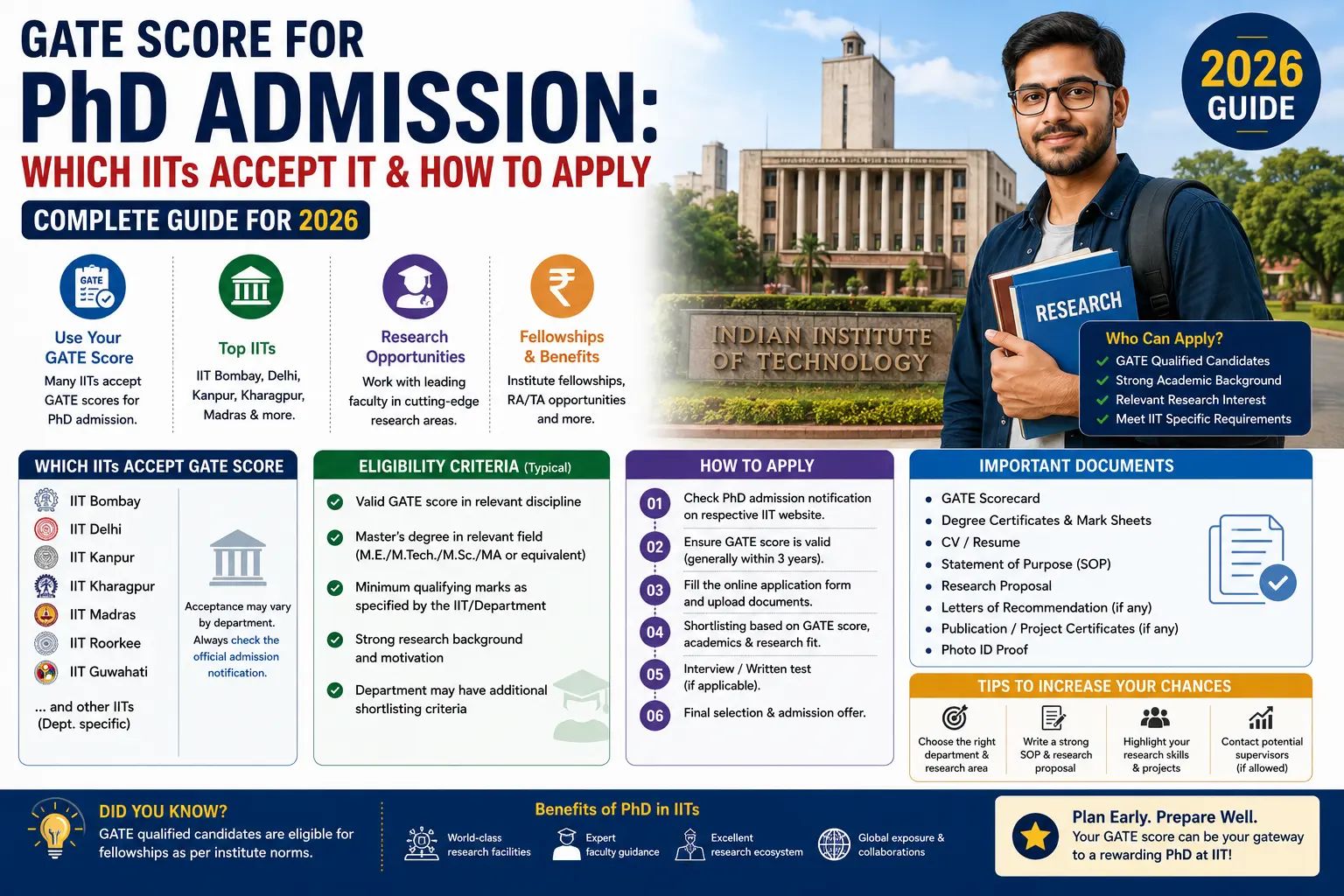
For students and professionals aspiring to pursue doctoral research in India, the Graduate Aptitude Test in Engineering (GATE) is more than just an entrance examination for M.Tech admissions. Today, a valid GATE score for PhD admission is accepted by several prestigious institutions, including the Indian Institutes of Technology (IITs), Indian Institute of Science (IISc), National Institutes of Technology (NITs), and other leading research universities.
As India continues to strengthen its research ecosystem under the National Education Policy (NEP) and various innovation initiatives, PhD programs have become increasingly competitive. A strong GATE score can significantly enhance your chances of securing admission, obtaining fellowships, and working with renowned researchers.
However, many aspirants remain confused about which IITs accept GATE scores for PhD admission, the eligibility criteria, application process, minimum score requirements, and available scholarships.
In this comprehensive guide, we will explain everything you need to know about GATE score for PhD admission in India 2026, including top IITs accepting GATE, admission procedures, fellowships, preparation tips, and career prospects.
What is GATE and Why Is It Important for PhD Admission?
The Graduate Aptitude Test in Engineering (GATE) is a national-level examination that assesses a candidate's understanding of undergraduate subjects in engineering, technology, architecture, science, humanities, and social sciences.
The exam is jointly conducted by:
- IITs
- IISc Bangalore
A valid GATE score is widely accepted for:
- M.Tech admissions
- ME admissions
- PhD admissions
- Research assistantships
- Government jobs
- PSU recruitment
For PhD aspirants, GATE serves as evidence of:
- Strong subject knowledge
- Research aptitude
- Analytical ability
Many IITs use GATE scores as part of their PhD admission criteria.
Can You Get Direct PhD Admission Through GATE?
Yes.
Many IITs allow candidates with a valid GATE score to apply directly for PhD programs without requiring a separate written entrance examination.
However, candidates must still clear:
- Research proposal evaluation
- Personal interview
- Departmental selection process
A good GATE score improves your chances but does not guarantee admission.
Benefits of Using GATE Score for PhD Admission
There are several advantages to applying through GATE.
1. Exemption from Entrance Tests
Many IITs waive departmental written tests for GATE-qualified candidates.
2. Better Selection Chances
A strong GATE score strengthens your application profile.
3. Fellowship Opportunities
GATE-qualified students may become eligible for:
- Institute assistantships
- Research fellowships
- Teaching assistantships
4. Access to Top Research Institutions
GATE opens doors to:
- IITs
- IISc
- NITs
- IIITs
- Research laboratories
5. Strong Research Foundation
GATE preparation itself develops:
- Subject expertise
- Problem-solving skills
- Analytical thinking
These skills are essential for doctoral research.
Eligibility for PhD Admission Through GATE
Eligibility criteria vary across institutions but generally include:
Educational Qualification
Candidates should possess:
Master's Degree
OR
Four-Year Bachelor's Degree
in relevant disciplines such as:
- B.Tech
- BE
- M.Tech
- ME
- MSc
- MCA
- MBA (for management disciplines)
Minimum Academic Performance
Typically:
- 55% marks or equivalent CGPA
Reserved category candidates may receive relaxation according to institutional policies.
Valid GATE Score
Most institutions require:
- A valid GATE scorecard
- Relevant discipline score
The score should generally remain valid during the admission cycle.
Which IITs Accept GATE Score for PhD Admission?
Almost all IITs accept GATE-qualified candidates for PhD admissions in various departments.
IIT Bombay
IIT Bombay accepts GATE scores for PhD admissions in:
- Engineering
- Sciences
- Interdisciplinary research
- Management
Selection generally includes:
- Academic evaluation
- Interview
IIT Delhi
IIT Delhi considers GATE-qualified applicants for doctoral admissions in:
- Engineering departments
- Applied sciences
- Management studies
Many departments exempt GATE-qualified candidates from written tests.
IIT Madras
IIT Madras offers PhD admissions through:
- GATE
- UGC NET
- CSIR NET
Strong research facilities make it one of India's top doctoral destinations.
IIT Kharagpur
IIT Kharagpur accepts GATE scores across:
- Engineering
- Technology
- Sciences
- Humanities
Candidates are typically shortlisted for interviews.
IIT Kanpur
PhD admissions at IIT Kanpur often consider:
- GATE scores
- Academic records
- Research interests
The final selection usually involves interviews.
IIT Roorkee
IIT Roorkee accepts GATE-qualified candidates for:
- Full-time PhD
- Sponsored PhD
- Part-time PhD
depending on departmental requirements.
IIT Guwahati
GATE-qualified candidates can apply across multiple research disciplines.
Admission generally includes:
- Application review
- Interview process
IIT Hyderabad
Known for strong research programs in:
- Artificial Intelligence
- Data Science
- Engineering
- Sciences
GATE-qualified candidates receive preference in many departments.
IIT Indore
Accepts GATE scores in various disciplines and provides research assistantship opportunities.
IIT BHU (Varanasi)
GATE-qualified candidates can apply for doctoral programs across engineering and science departments.
Other Institutes Accepting GATE Scores for PhD Admission
Beyond IITs, several institutions accept GATE-qualified applicants.
Indian Institute of Science (IISc Bangalore)
One of India's premier research institutions.
Accepts:
- GATE
- NET
- JRF
for doctoral admissions.
National Institutes of Technology (NITs)
Most NITs consider GATE-qualified candidates for:
- PhD programs
- Research assistantships
Indian Institutes of Information Technology (IIITs)
Several IIITs use GATE scores during doctoral admissions.
Central Universities
Some universities accept GATE-qualified candidates directly into PhD programs.
Minimum GATE Score Required for PhD Admission
There is no universal cutoff.
Requirements depend on:
- Department
- Research area
- Competition level
- Number of seats
Generally:
Highly Competitive Departments
May prefer:
- High GATE percentile
- Strong All India Rank (AIR)
Emerging Research Areas
May have relatively lower score requirements.
Remember:
Interview performance remains extremely important.
How to Apply for PhD Admission Through GATE
The process typically involves the following steps.
Step 1: Identify Research Interests
Choose your preferred specialization.
Examples:
- Artificial Intelligence
- Machine Learning
- Civil Engineering
- Renewable Energy
- Biotechnology
- Data Science
Step 2: Shortlist Institutions
Research:
- Faculty expertise
- Research facilities
- Ongoing projects
- Funding opportunities
Step 3: Check Eligibility Criteria
Visit the official admission portal and verify:
- Academic qualifications
- GATE requirements
- Application deadlines
Step 4: Prepare Documents
Commonly required documents include:
- GATE scorecard
- Degree certificates
- Mark sheets
- Resume/CV
- Research proposal
- Category certificates
- Identity proof
Step 5: Submit Online Application
Complete the online application before the deadline.
Ensure:
- Accurate information
- Proper document uploads
- Payment of application fees
Step 6: Attend Interview
Shortlisted candidates are invited for:
- Technical interview
- Research discussion
- Faculty interaction
Step 7: Final Selection
Selection depends on:
- GATE score
- Academic performance
- Research potential
- Interview performance
Do You Need a Research Proposal for IIT PhD Admission?
Many departments require applicants to submit:
- Statement of Purpose (SOP)
- Preliminary research proposal
A strong proposal should explain:
Research Problem
What issue will be studied?
Objectives
What will the research achieve?
Methodology
How will the study be conducted?
Expected Contribution
How will the research add value?
Fellowships Available for GATE-Qualified PhD Students
One major advantage of qualifying GATE is financial support.
Institute Assistantships
Most IITs provide:
- Monthly stipend
- Contingency support
to eligible scholars.
Research Assistantships
Students working on funded projects may receive additional support.
Sponsored Research Fellowships
Industry-sponsored projects often offer financial assistance.
Government Research Grants
Several ministries fund doctoral research initiatives.
How to Improve Your Chances of Selection
Maintain Strong Academics
Good grades complement your GATE score.
Develop Research Experience
Participate in:
- Research projects
- Internships
- Publications
Prepare a Strong SOP
Clearly explain:
- Research interests
- Career goals
- Program fit
Contact Potential Supervisors
Many successful applicants communicate with faculty before applying.
Prepare Thoroughly for Interviews
Review:
- Core subjects
- Research methods
- Recent developments
Common Mistakes to Avoid
Applying Without Research Alignment
Ensure faculty interests match your goals.
Weak Research Proposal
Poor proposals reduce selection chances.
Ignoring Departmental Requirements
Each department has unique criteria.
Poor Interview Preparation
Many candidates underestimate interview importance.
Missing Application Deadlines
Always monitor admission notifications carefully.
Career Opportunities After a PhD Through IITs
A PhD from an IIT can lead to diverse career paths.
Academic Careers
Roles include:
- Assistant Professor
- Associate Professor
- Professor
Research Careers
Opportunities exist in:
- DRDO
- ISRO
- CSIR Laboratories
- International research centers
Corporate R&D
Industries hire PhD graduates for:
- Innovation
- Product development
- Data science
- AI research
Consulting and Entrepreneurship
Many scholars establish:
- Technology startups
- Research consultancies
- Innovation ventures
Salary After PhD from IITs
Approximate salary ranges:
Position Salary Range
Assistant Professor ₹8–18 LPA
Research Scientist ₹10–30 LPA
Data Scientist ₹12–40 LPA
R&D Engineer 10–35 LPA
Industry Consultant ₹15–50 LPA
Compensation depends on specialization, experience, and employer.
Future Scope of PhD Admissions Through GATE
India's focus on:
- Artificial Intelligence
- Semiconductor research
- Clean energy
- Biotechnology
- Advanced manufacturing
is creating unprecedented demand for doctoral researchers.
GATE-qualified PhD candidates are expected to play a major role in India's research-driven growth strategy over the next decade.
Conclusion
A valid GATE score for PhD admission can significantly enhance your chances of entering some of India's most prestigious research institutions, including IITs, IISc, NITs, and IIITs. Beyond serving as an admission criterion, GATE demonstrates academic competence, research readiness, and analytical capability—qualities that are highly valued in doctoral programs.
To maximize your chances of success, identify your research interests early, target institutions with strong faculty alignment, prepare a compelling SOP and research proposal, and perform well during interviews. With increasing investment in research and innovation across India, pursuing a PhD through the GATE route can open doors to rewarding careers in academia, industry, and advanced research.
Frequently Asked Questions (FAQs)
1. Can I apply for a PhD in IITs using a GATE score?
Yes. Most IITs accept valid GATE scores for PhD admissions across engineering, science, and interdisciplinary research programs.
2. Is GATE mandatory for PhD admission in IITs?
Not always. Some departments also accept UGC NET, CSIR NET, JRF, or institute-specific qualifications.
3. Which IITs accept GATE scores for PhD admissions?
IIT Bombay, IIT Delhi, IIT Madras, IIT Kanpur, IIT Kharagpur, IIT Roorkee, IIT Guwahati, IIT Hyderabad, IIT Indore, and IIT BHU are among the institutions that consider GATE-qualified candidates.
4. What GATE score is required for PhD admission?
There is no fixed score requirement. Cutoffs vary by department, specialization, competition level, and seat availability.
5. Can B.Tech students apply directly for PhD programs using GATE?
Some IITs allow exceptionally qualified B.Tech graduates with strong academic records and valid GATE scores to apply for direct PhD programs.
6. Do GATE-qualified PhD students receive stipends?
Yes. Eligible candidates often receive institute assistantships, research fellowships, or project-based funding.
7. Is an interview required after applying through GATE?
Yes. Most IITs conduct interviews and research discussions before making final admission decisions.
8. Do I need a research proposal for IIT PhD admission?
Many departments require a Statement of Purpose (SOP) and preliminary research proposal during the application process.
9. Can working professionals apply for PhD programs using GATE scores?
Yes. Several institutions offer part-time, sponsored, and external PhD programs for working professionals.
10. Is a PhD through GATE worth pursuing in 2026?
Absolutely. With growing opportunities in research, innovation, academia, and industry, a PhD from a leading institution remains a highly valuable qualification for long-term career growth.
Contact ThesisLikho Today
Call / WhatsApp: +91 96438 02216
Visit: ThesisLikho.com