
Introduction
Selecting the right research methodology is one of the most important decisions in any PhD journey. For scholars conducting qualitative research, choosing an approach that aligns with their research objectives can significantly influence the quality and impact of their study. Among the most influential qualitative research methodologies is Grounded Theory, a systematic approach designed to generate theories directly from data rather than testing existing theories.
Grounded Theory has become increasingly popular across disciplines such as management, education, sociology, healthcare, psychology, information systems, and organizational studies. It is particularly useful when researchers seek to understand complex social processes, human behaviors, organizational practices, or emerging phenomena where existing theories are insufficient.
Unlike traditional research approaches that begin with a predefined theoretical framework, Grounded Theory allows researchers to develop new theories based on observations, interviews, and other forms of qualitative data. This makes it an excellent choice for PhD scholars investigating areas that are underexplored or rapidly evolving.
In this comprehensive guide, we will explore what Grounded Theory is, its history, principles, methodology, coding processes, advantages, limitations, and when it should be used in PhD research.
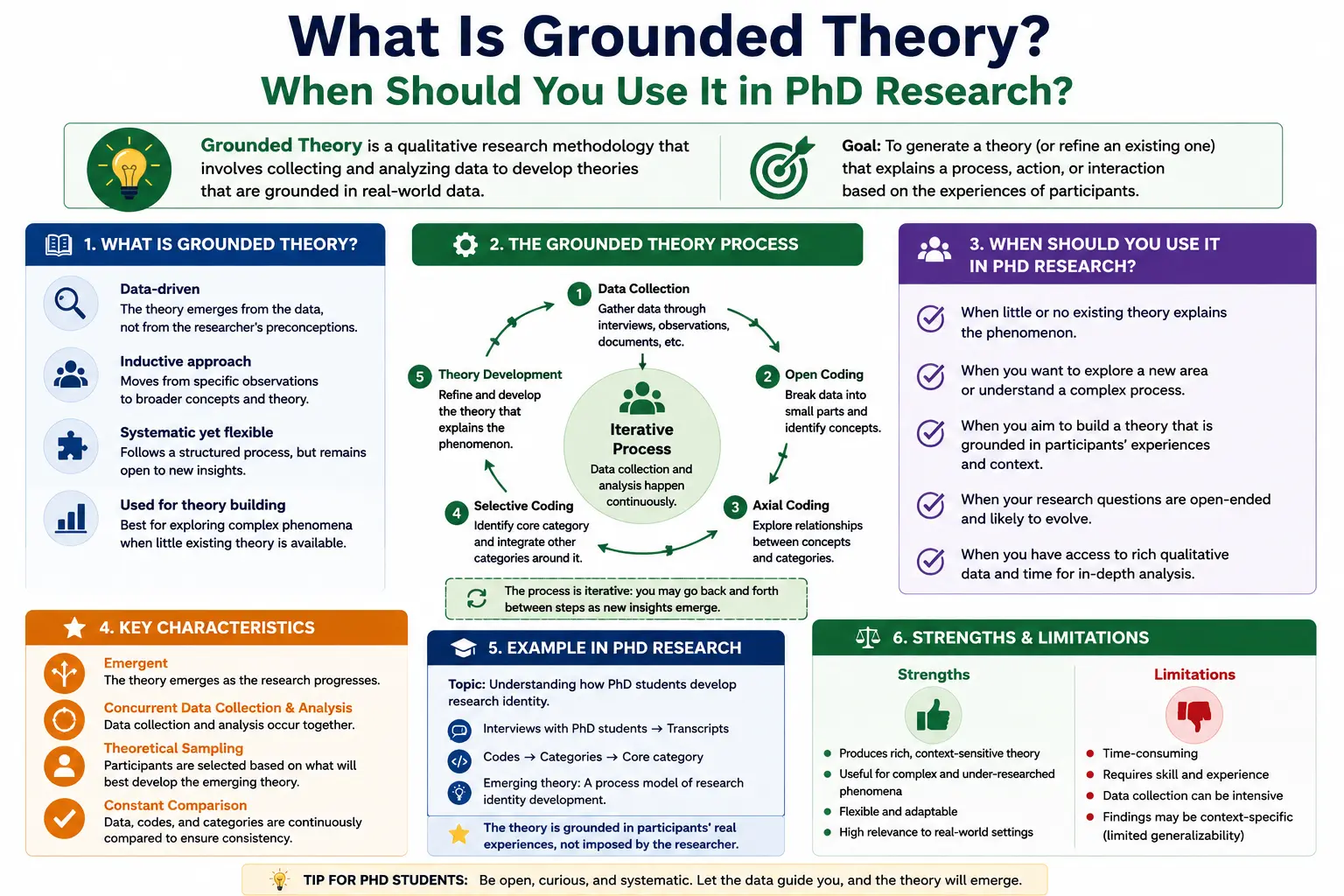
What Is Grounded Theory?
Grounded Theory is a qualitative research methodology that aims to develop theories grounded in empirical data collected from participants or real-world observations.
The central idea behind Grounded Theory is simple:
Instead of starting with a theory and testing it, researchers collect data first and allow theories to emerge from that data.
The approach was originally developed by sociologists Barney Glaser and Anselm Strauss in 1967 through their influential book The Discovery of Grounded Theory.
Their objective was to provide researchers with a systematic process for generating theories directly from empirical observations rather than relying solely on existing theoretical frameworks.
Why Is It Called "Grounded" Theory?
The term "grounded" refers to the fact that theories are firmly rooted in actual data.
Instead of imposing preconceived assumptions on participants, researchers:
- Collect qualitative data
- Analyze data systematically
- Identify patterns and concepts
- Develop categories
- Build theoretical explanations
As a result, the final theory emerges from the evidence itself.
Why Grounded Theory Is Important in PhD Research
Many doctoral studies seek to understand new, complex, or insufficiently explored phenomena.
Grounded Theory is valuable because it helps scholars:
- Generate new theories
- Explore emerging topics
- Understand social processes
- Explain human behavior
- Investigate organizational phenomena
- Develop conceptual frameworks
For example, a Management PhD scholar studying how employees adapt to artificial intelligence tools may find limited existing theories. Grounded Theory allows the researcher to develop a new theoretical explanation based on employee experiences.
Key Characteristics of Grounded Theory
Grounded Theory differs from many traditional research approaches due to several defining characteristics.
1. Theory Generation
The primary goal is to create new theories rather than test existing ones.
2. Inductive Approach
Grounded Theory follows inductive reasoning.
Researchers move from:
Data → Concepts → Categories → Theory
3. Simultaneous Data Collection and Analysis
Unlike many research methods, data collection and analysis occur together.
Researchers continuously analyze data while collecting additional information.
4. Constant Comparative Method
Data is constantly compared across participants, interviews, and observations.
This comparison helps identify similarities, differences, and emerging patterns.
5. Theoretical Sampling
Participants are selected based on emerging theoretical needs rather than predetermined sampling plans.
6. Emergent Design
Research evolves as new insights emerge from the data.
History and Development of Grounded Theory
Grounded Theory was introduced in 1967 by Glaser and Strauss as a response to the dominance of theory-testing research.
They argued that many social science researchers relied too heavily on existing theories and neglected opportunities to generate new knowledge directly from empirical observations.
Over time, Grounded Theory evolved into several variations:
Classic Grounded Theory
Developed by Glaser.
Focuses on allowing theory to emerge naturally from data.
Straussian Grounded Theory
Developed by Strauss and Corbin.
Provides more structured analytical procedures.
Constructivist Grounded Theory
Advanced by Kathy Charmaz.
Emphasizes the co-construction of meaning between researcher and participants.
Today, all three approaches are widely used in doctoral research.
When Should You Use Grounded Theory in PhD Research?
Grounded Theory is not suitable for every research project.
It is particularly useful under specific circumstances.
1. When Existing Theories Are Limited
If little theoretical knowledge exists, Grounded Theory can help generate new explanations.
Example
Studying the impact of generative AI on doctoral supervision practices.
2. When Exploring New Phenomena
Emerging topics often require exploratory investigation.
Example
Employee experiences with virtual reality-based workplace training.
3. When Understanding Social Processes
Grounded Theory excels at explaining processes and interactions.
Example
How organizational change affects employee identity.
4. When Research Questions Focus on "How"
Examples:
- How do entrepreneurs develop resilience?
- How do employees adapt to remote work environments?
5. When Theory Development Is the Goal
If your primary objective is creating a conceptual model or theoretical framework, Grounded Theory is highly appropriate.
When Grounded Theory May Not Be Suitable
Grounded Theory is not ideal when:
- Existing theories already explain the phenomenon adequately.
- Research aims to test hypotheses.
- Quantitative analysis is the primary focus.
- Experimental designs are required.
- The objective is measurement rather than theory generation.
In such cases, deductive or quantitative methodologies may be more suitable.
Research Questions Suitable for Grounded Theory
Grounded Theory research questions are usually broad and exploratory.
Examples include:
- How do startup founders navigate uncertainty?
- How do healthcare professionals manage workplace stress?
- How do doctoral students develop research identities?
- How do consumers build trust in AI-powered services?
Notice that these questions focus on processes, experiences, and interactions.
The Grounded Theory Research Process
Grounded Theory follows a systematic process.
Step 1: Identify a Research Area
Researchers begin with a broad area of interest rather than a specific hypothesis.
Example
Digital transformation in organizations.
Step 2: Collect Initial Data
Common data collection methods include:
- Interviews
- Focus groups
- Observations
- Documents
- Field notes
Step 3: Conduct Initial Coding
Researchers examine data line-by-line and assign codes.
Example Interview Statement
"I felt overwhelmed when AI tools were first introduced."
Possible Code:
- Technology anxiety
Step 4: Constant Comparison
Researchers compare:
- Participant responses
- Codes
- Categories
The goal is to identify recurring patterns.
Step 5: Develop Categories
Related codes are grouped into categories.
Example:
Codes:
- Technology anxiety
- Fear of job loss
- Learning challenges
Category:
- Employee adaptation concerns
Step 6: Theoretical Sampling
Researchers collect additional data to refine emerging categories.
This process continues until categories are fully developed.
Step 7: Identify Core Categories
A central category emerges that connects all major themes.
Example:
"Adaptation through continuous learning"
Step 8: Develop Theory
Researchers integrate categories into a coherent theoretical explanation.
Understanding Coding in Grounded Theory
Coding is the heart of Grounded Theory analysis.
Open Coding
Initial coding process.
Researchers break data into smaller units.
Example:
Participant statement:
"I constantly sought help from colleagues."
Code:
- Peer support
Axial Coding
Researchers identify relationships between categories.
Example:
Category A:
Technology anxiety
Category B:
Peer support
Relationship:
Peer support reduces technology anxiety.
Selective Coding
Researchers integrate categories around a central concept.
Example:
Core category:
Organizational adaptation
What Is Theoretical Sampling?
Theoretical sampling is a unique feature of Grounded Theory.
Participants are selected based on emerging analytical needs.
Example
Initial interviews suggest leadership influences employee adaptation.
Researchers then intentionally recruit managers to explore leadership perspectives.
The process continues until theoretical saturation is achieved.
What Is Theoretical Saturation?
Theoretical saturation occurs when additional data no longer produces new insights.
At this point:
- Categories are fully developed
- Relationships are clear
- Theory is sufficiently refined
Saturation signals that data collection can stop.
Data Collection Methods in Grounded Theory
Several methods can be used.
Interviews
Most commonly used.
Benefits:
- Rich insights
- Detailed experiences
- Flexibility
Observations
Researchers observe behaviors and interactions.
Benefits:
- Real-world understanding
- Contextual insights
Documents
Examples:
- Reports
- Policies
- Emails
- Organizational records
Focus Groups
Useful for exploring shared experiences.
Advantages of Grounded Theory
Generates Original Theory
Creates new theoretical contributions.
Highly Flexible
Research evolves naturally as insights emerge.
Rich Contextual Understanding
Captures complexity and depth.
Suitable for Emerging Topics
Ideal when little prior research exists.
Strong Practical Relevance
Often produces findings applicable to real-world problems.
Limitations of Grounded Theory
Time-Intensive
Requires extensive data collection and analysis.
Large Amounts of Data
Managing and coding qualitative data can be challenging.
Researcher Subjectivity
Interpretations may vary across researchers.
Requires Analytical Skills
Coding and theory development demand expertise.
Difficult for Beginners
The iterative process can be challenging for novice researchers.
Example of Grounded Theory in Management Research
Research Topic
Employee Adaptation to Artificial Intelligence Technologies
Research Question
How do employees adapt to AI-driven workplace changes?
Data Collection
- 30 interviews
- Workplace observations
- Organizational documents
Emerging Categories
- Technology anxiety
- Peer learning
- Leadership support
- Continuous skill development
Core Category
Adaptive learning behavior
Resulting Theory
Employees successfully adapt to AI when organizations create supportive learning environments and encourage peer collaboration.
Tips for PhD Scholars Using Grounded Theory
Avoid Starting With Strong Theoretical Assumptions
Allow concepts to emerge naturally.
Maintain Detailed Memos
Document analytical insights throughout the research process.
Use Constant Comparison
Continuously compare data and categories.
Focus on Theory Development
Remember that theory generation is the primary goal.
Be Patient
Grounded Theory requires time, reflection, and iterative analysis.
Common Mistakes to Avoid
- Treating Grounded Theory as simple thematic analysis
- Collecting all data before analysis
- Ignoring theoretical sampling
- Stopping before saturation
- Forcing data into existing theories
- Failing to document coding decisions
Avoiding these mistakes improves research quality and rigor.
Conclusion
Grounded Theory is one of the most powerful qualitative research methodologies available to PhD scholars. Unlike traditional approaches that begin with established theories, Grounded Theory allows researchers to develop new theoretical insights directly from empirical data. This makes it particularly valuable for studying emerging phenomena, complex social processes, and underexplored research areas.
For doctoral researchers in management, education, healthcare, sociology, information systems, and other fields, Grounded Theory offers a structured yet flexible framework for understanding how people experience, interpret, and respond to real-world situations. Through systematic coding, constant comparison, theoretical sampling, and theory development, scholars can generate meaningful contributions to both academic knowledge and practical applications.
When the goal is to explore a phenomenon deeply and create a theory grounded in evidence, Grounded Theory remains one of the most effective methodologies in modern PhD research.
Contact ThesisLikho Today
Call / WhatsApp: +91 96438 02216
Visit: ThesisLikho.com