
Introduction
Walk into any Indian university library — from IIT Delhi to Jadavpur University, from TISS Mumbai to Banaras Hindu University — and you will find research papers, dissertations, and theses citing sources in wildly different ways. Some use Harvard. Some use APA. Some use MLA. A few use none of them consistently.
For Indian scholars navigating the world of academic research, citation style is often treated as an afterthought — something to fix before submission rather than a deliberate intellectual choice. That approach leads to inconsistency, errors, and sometimes outright rejection from journals and supervisors.
Understanding referencing styles is not a bureaucratic formality. Citations tell your reader where your ideas come from, allow them to verify your sources, and demonstrate your engagement with existing scholarship. The way you cite is shaped by the discipline you work in, the audience you write for, and — in India's case — the institutional conventions that govern your department.
This guide explains what Harvard, APA, and MLA are, breaks down their key differences, and gives Indian scholars a clear, practical framework for deciding which one to use.
Why Referencing Styles Matter in Indian Academic Context
India's higher education system is vast and heterogeneous. With over 1,000 universities and more than 40,000 colleges, there is no single national standard for citation. Unlike the United States — where APA dominates in social sciences and MLA in humanities with reasonable consistency — Indian institutions often set their own departmental norms, sometimes informally.
This creates genuine confusion for Indian scholars, especially at three key moments:
During postgraduate and doctoral research — Supervisors often have personal preferences or departmental conventions that may not be clearly communicated. Students default to whatever they encountered in their undergraduate textbooks.
When submitting to journals — Indian and international journals each specify a citation style in their author guidelines. Submitting with the wrong style is a common reason for desk rejection.
During competitive examinations and fellowships — UGC-NET, ICSSR fellowships, and other grant applications sometimes require formal research proposals with correctly formatted citations.
Getting this right matters. The first step is understanding what each style actually is.
What Is the Harvard Referencing Style?
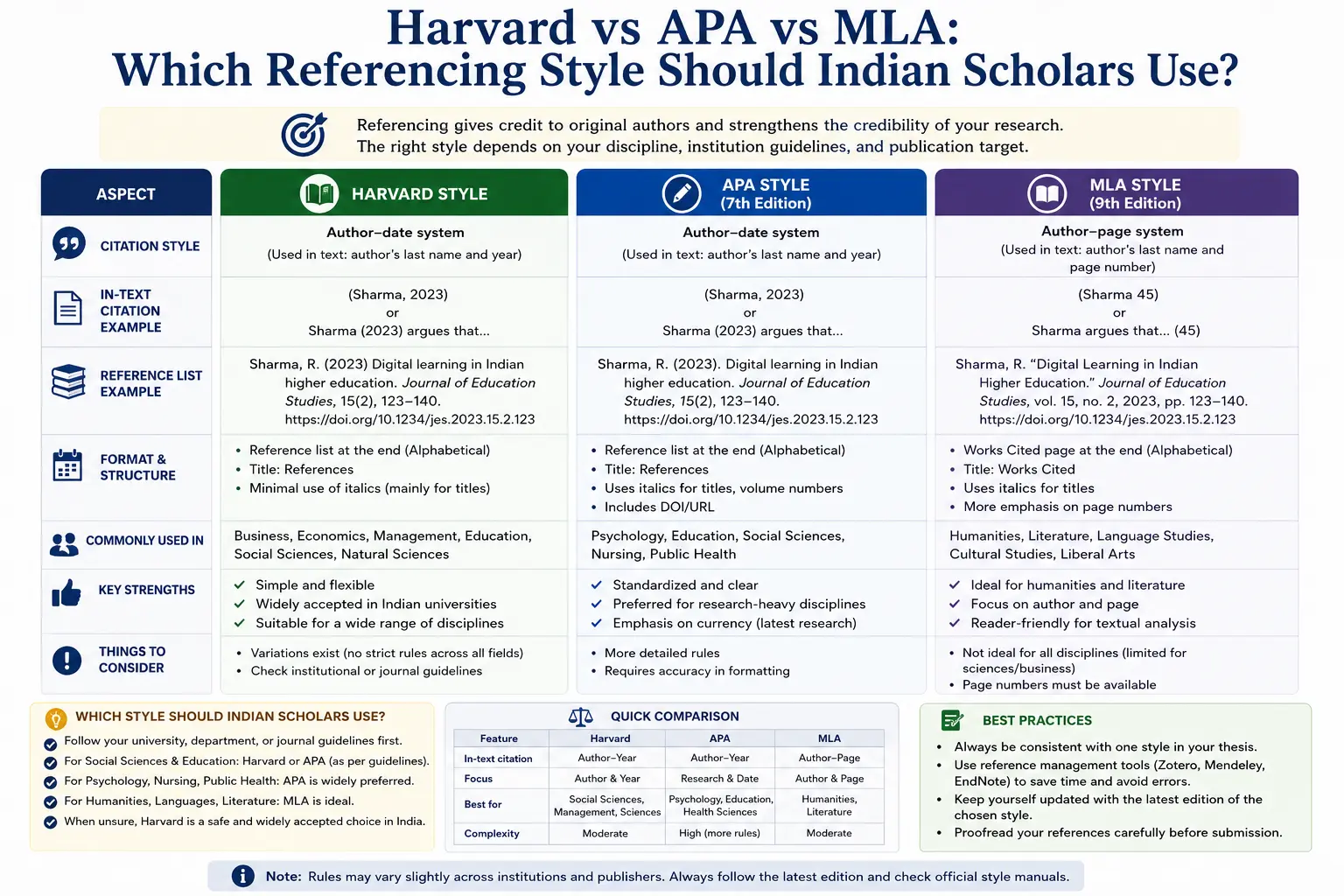
Harvard referencing — more precisely called the Harvard author-date system — is not a single, standardized style published by one organization. It is a broad family of referencing conventions that use the author's surname and year of publication in parentheses within the text, with a full reference list at the end.
Because there is no single governing body for Harvard referencing (unlike APA, which is published by the American Psychological Association), different institutions have their own versions. The University of Leeds, Anglia Ruskin University, and various Indian universities have all published their own Harvard guides that differ in minor formatting details.
In-text citation example (Harvard): Research in South Asian urban planning suggests that informal settlements require community-led governance models (Sharma, 2019).
Reference list example (Harvard): Sharma, R. (2019) Urban Informality and Governance in Indian Cities. New Delhi: Oxford University Press India.
Key characteristics of Harvard:
- Author-date format: (Surname, Year)
- Reference list alphabetically ordered by author surname
- No footnotes for citations (though footnotes may be used for additional commentary)
- Widely used in the natural sciences, social sciences, business, economics, and increasingly in Indian universities that require a simple, author-date system
Harvard referencing is popular in Indian institutions partly because it is perceived as "international" and partly because it is straightforward to learn. Many Indian universities that do not specify APA or MLA default to a Harvard-style format.
What Is APA Referencing Style?
APA stands for the American Psychological Association, which publishes the Publication Manual of the American Psychological Association — currently in its 7th edition (2020). Unlike Harvard, APA is a rigorously defined, regularly updated, and centrally governed system.
APA is the dominant citation style in psychology, education, sociology, nursing, public health, linguistics, and most behavioural and social sciences globally. It is also the style used by a large number of international peer-reviewed journals that Indian social science and education researchers aspire to publish in.
In-text citation example (APA 7th): Community health interventions have been shown to reduce maternal mortality in rural India (Patel & Krishnamurthy, 2021).
Reference list example (APA 7th): Patel, S., & Krishnamurthy, M. (2021). Community health interventions and maternal outcomes in rural India. Journal of Public Health Research, 10(3), 45–58. https://doi.org/10.4081/jphr.2021.2234
Key characteristics of APA 7th:
- Author-date format: (Surname, Year) — similar to Harvard in basic in-text structure
- Detailed, specific rules for nearly every source type (journal articles, books, websites, social media, government reports, dissertations)
- Running head required in manuscripts submitted to journals (not in student papers under APA 7th)
- Digital Object Identifiers (DOIs) included where available
- Use of sentence case for article and chapter titles; title case for journal and book names
- Designed primarily for manuscript preparation and journal submission
The 7th edition of APA introduced significant changes, including the removal of the requirement for a publisher's location, simplified rules for group authors, and greater inclusivity in language guidelines. Indian scholars submitting to international journals should ensure they are using APA 7th, not the older 6th edition.
What Is MLA Referencing Style?
MLA stands for the Modern Language Association, which publishes the MLA Handbook — currently in its 9th edition (2021). MLA is the standard citation style for the humanities: literature, languages, cultural studies, film studies, philosophy, comparative religion, theatre, and related disciplines.
Unlike Harvard and APA — which use an author-date in-text citation — MLA uses an author-page format in the text, with a Works Cited list at the end.
In-text citation example (MLA): The relationship between caste and narrative form in Hindi literature has been extensively theorized (Dalmia 112).
Works Cited example (MLA 9th): Dalmia, Vasudha. The Nationalization of Hindu Traditions: Bharatendu Harischandra and Nineteenth-Century Banaras. Oxford UP, 1997.
Key characteristics of MLA:
- Author-page format: (Surname Page Number) — no year in the in-text citation
- Works Cited list at the end, alphabetically ordered
- Titles of longer works italicized; shorter works in quotation marks
- 9th edition introduced a flexible "core elements" framework adaptable to new source types
- Primarily used for literary analysis, textual criticism, and humanities scholarship
MLA is widely used in English departments across Indian universities, particularly for dissertations and papers in English literature, comparative literature, linguistics, and cultural studies. It is also the default style for many humanities journals published in India and internationally.
Which Referencing Style Should Indian Scholars Use? A Discipline-by-Discipline Guide
Sciences and Engineering (IITs, NITs, CSIR Institutes)
Most science and engineering research in India follows journal-specific citation styles rather than Harvard, APA, or MLA. IEEE style is dominant in engineering; Vancouver style is common in medicine and pharmacy. If your department asks for a general style and does not specify further, Harvard is widely accepted and easy to apply consistently. APA is also acceptable in life sciences and environmental science.
Social Sciences (Sociology, Political Science, Economics, Psychology)
APA 7th edition is the most appropriate choice for Indian social science scholars who intend to publish internationally. Journals indexed in Scopus and Web of Science in these fields typically require APA. Within Indian universities, many departments in psychology, education, social work, and sociology explicitly mandate APA. If your institution specifies Harvard, use Harvard — but if you are free to choose, APA's specificity and international currency give it an edge.
Education and Teacher Training (NCERT, DIET, B.Ed. Programmes)
APA is the standard in education research internationally. The National Council of Educational Research and Training (NCERT) and many state education research bureaux follow APA conventions for their publications. Indian scholars in education pursuing research for international journals, UGC-CARE listed publications, or ICSSR-funded projects will benefit from mastering APA.
Humanities (English Literature, Hindi, Comparative Literature, History, Philosophy)
MLA is the appropriate style for literary and humanistic scholarship. English departments across Indian universities — from Delhi University to Hyderabad Central University — commonly require MLA for M.A. and M.Phil. dissertations. For history, some departments prefer Chicago/Turabian style (with footnotes), so confirm with your supervisor. For philosophy, APA is sometimes preferred, especially for analytic philosophy.
Law
Indian legal scholarship traditionally uses the Bluebook citation system or OSCOLA (Oxford University Standard for the Citation of Legal Authorities), neither of which is covered by Harvard, APA, or MLA. If you are a law researcher writing for a non-law interdisciplinary journal, APA is typically acceptable.
Business and Management (IIMs, Business Schools)
Harvard is widely used in Indian business schools, partly because of its association with Harvard Business School case study methodology. APA is also common for management research published in academic journals. Check the specific journal's author guidelines.
Journalism and Mass Communication
APA is increasingly standard in media studies and communication research. Some programmes default to MLA for media criticism and cultural analysis.
What Indian Journals and UGC Guidelines Say
The University Grants Commission (UGC) does not mandate a single citation style across all disciplines. However, the UGC-CARE list of approved journals includes publications that follow their own style guides, and many are APA or MLA based.
For UGC-sponsored research projects and ICSSR grants, the research proposal and final report format often follows a Harvard-style author-date system, though specific guidelines are provided with each funding call.
For Shodhganga — the UGC's national repository of Indian theses and dissertations — the format varies by university. Most universities that have published their PhD thesis guidelines specify either APA or a Harvard variant.
The practical takeaway: always check your specific journal's author guidelines, your university's PhD handbook, and your supervisor's instructions before deciding on a citation style. When none of these provide direction, APA is the safest default for social sciences and education; MLA for humanities; and Harvard for a general-purpose, widely accepted alternative.
Common Referencing Mistakes Made by Indian Scholars (and How to Avoid Them)
Mixing styles within a single document. This is the most common error — using APA in-text citations but a Harvard-formatted reference list, or switching between author-date and author-page formats. Choose one style and apply it consistently throughout.
Using outdated editions. Many Indian scholars are still using APA 6th edition or MLA 8th edition. Publishers and journals increasingly require APA 7th and MLA 9th. Update your knowledge of the current edition.
Ignoring DOIs. In APA 7th, DOIs are required where available and are no longer formatted as URLs starting with "http" — they are formatted as hyperlinks (https://doi.org/xxxxx). Indian scholars who omit DOIs from journal article citations are departing from APA requirements.
Formatting book titles incorrectly. In MLA, book titles are italicized. In APA, they are italicized and in sentence case (only the first word and proper nouns capitalized). In Harvard, conventions vary by institution. Incorrect capitalization is a persistent error.
Citing secondary sources without acknowledgment. If you are citing a study you found referenced in another work — and have not read the original — you must indicate this. In APA: (as cited in Sharma, 2020). Passing off secondary citations as primary is academically dishonest.
Not citing Indian language sources correctly. When citing sources in Hindi, Tamil, Bengali, or other Indian languages, use the same citation framework but transliterate or translate the title as required by your style guide. APA 7th provides specific guidance on non-English sources.
Useful Tools for Indian Scholars Managing Citations
Manual citation formatting is error-prone and time-consuming. These tools can help:
Zotero — Free, open-source reference management software that supports Harvard, APA, MLA, and hundreds of other styles. Integrates with Microsoft Word and Google Docs. Highly recommended for PhD scholars managing large bibliographies.
Mendeley — Popular in Indian research institutions, especially sciences. Supports automatic citation generation in multiple styles and allows PDF annotation.
EndNote — Widely available through institutional subscriptions at IITs, IISc, and central universities. Powerful for large-scale research projects.
Google Scholar — Provides basic citation export in MLA, APA, and Chicago formats for individual papers, though accuracy should always be verified manually.
Cite This For Me / BibGuru — Web-based tools useful for quick citation generation, though they should be checked against official style guides.
Final Thoughts
For Indian scholars, the question "Which referencing style should I use?" does not have a single universal answer — but it does have a clear decision framework.
Start with your discipline. Social sciences and education point toward APA. Humanities and literature point toward MLA. Sciences, business, and general research often accept Harvard.
Then check your institution and journal. Your PhD handbook, supervisor, or target journal's author guidelines will often settle the question definitively.
Then master your chosen style. Do not skim the surface. Understand how to cite journal articles, books, book chapters, government reports, theses, websites, and — increasingly important — social media and online sources. The details matter.
Indian scholarship is increasingly visible on the global academic stage. Rigorous, consistent, and correctly formatted citations are part of the professional standard that comes with that visibility. Whether you choose Harvard, APA, or MLA, choose intentionally — and apply it with precision.
Contact ThesisLikho Today
Call / WhatsApp: +91 96438 02216
Visit: ThesisLikho.com