
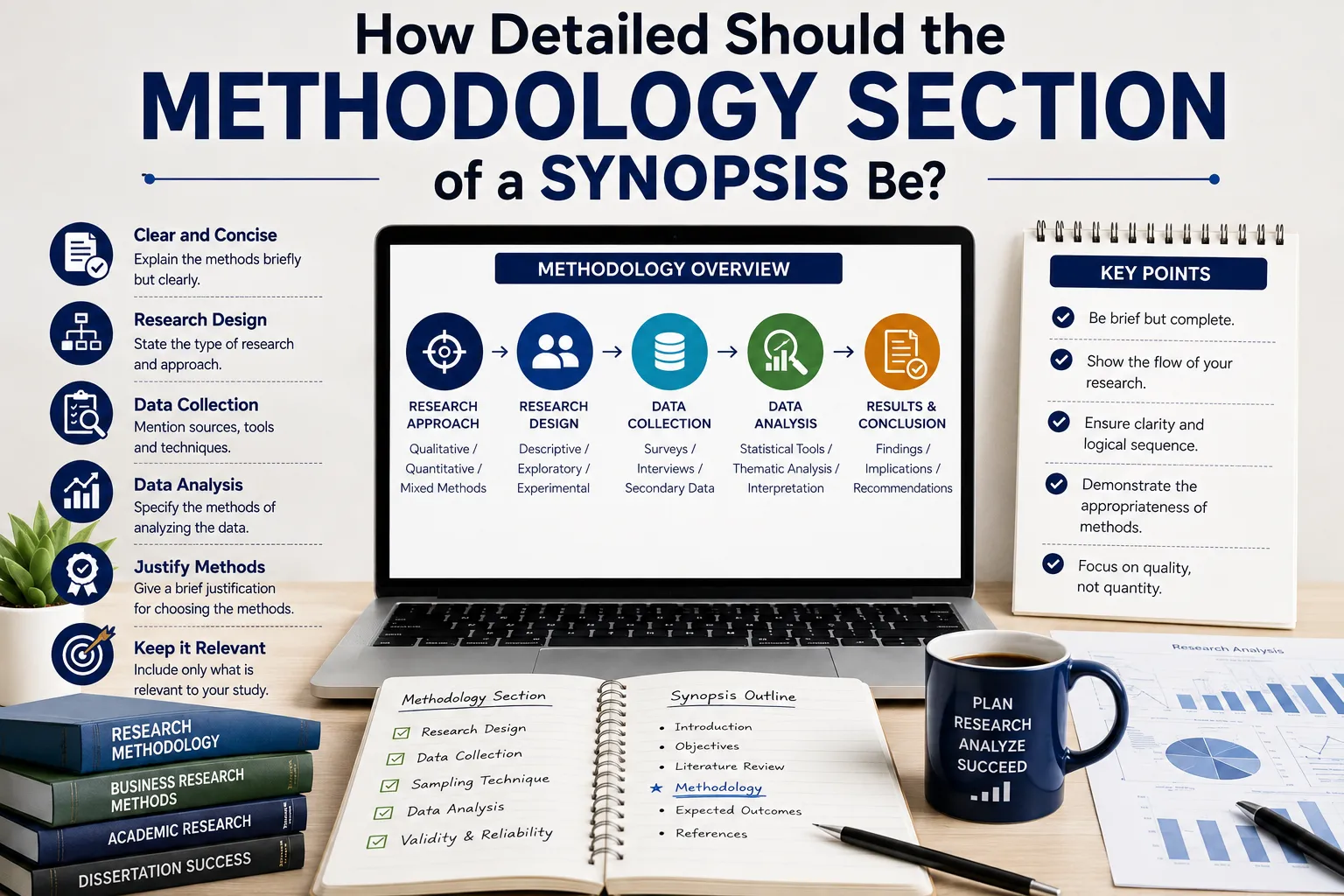
You know your methodology inside out — you could talk about it for an hour. The problem is your synopsis gives you a few hundred words, not an hour. Figuring out exactly how much detail belongs in this section, and how much to save for later, is one of the more common points of confusion at the synopsis stage. This guide answers how detailed the methodology section of a synopsis should actually be, with a specific benchmark to work from and clear guidance on what to include versus what to defer.
A widely cited benchmark for the methodology section within a synopsis is 400–600 words. Within that tight range, the section needs to justify your philosophical approach (positivism, interpretivism, or pragmatism) and your specific research design (qualitative, quantitative, or mixed-methods). That's a demanding amount of substance to pack into a few hundred words — which is exactly why this section is widely regarded as the most technically demanding and most heavily scrutinized part of the entire synopsis, disproportionate to its actual length.
Why This Section Gets More Attention Than Its Word Count Suggests
The methodology section isn't judged on how much you wrote — it's judged on how much genuine methodological thinking is compressed into what you wrote. A committee reading 500 words on your research design isn't expecting exhaustive procedural detail; they're checking whether you can justify your philosophical paradigm, your design, your method, and your analysis approach clearly and specifically within that limited space. A section that only names these elements without brief justification for each is considered underdeveloped, even if the word count technically fits the target range.
The Synopsis Methodology vs. the Research Proposal Methodology
If you submitted a research proposal to gain admission, it's worth understanding how the synopsis methodology needs to differ from what you wrote back then. A research proposal submitted before PhD admission is typically 1,500–3,000 words and gives a general overview of planned research. A synopsis, submitted after admission for formal registration approval, is meaningfully more detailed — typically 3,000–5,000 words overall — including a thorough literature review, a detailed methodology, and a defensible research gap.
This distinction matters practically: one of the most common synopsis-writing mistakes is failing to update the methodology from the proposal stage. By the time you're writing your synopsis, your methodology should reflect real development since your admission-stage proposal — more specific about your design, your sample, and your analysis approach — not a copy-pasted version of what got you admitted in the first place.
What Belongs in the Synopsis Methodology Section
Within your 400–600 word allocation, prioritize these elements, each addressed briefly but specifically:
- Philosophical paradigm — name your approach (positivism, interpretivism, pragmatism) and briefly state why it fits your research question
- Research design — quantitative, qualitative, or mixed-methods, with a sentence on why this design suits your specific objectives
- Method — your specific data collection approach (survey, interview, experiment, case study, secondary data analysis)
- Sample or population — who or what you'll study, with an approximate sample size if applicable
- Analysis approach — how you'll analyze your data (statistical tests, thematic analysis, etc.), named specifically rather than left vague
For a quantitative study specifically, make sure your hypotheses are included, even briefly — omitting hypotheses in a quantitative study's synopsis methodology is flagged as a specific, avoidable error that committees notice.
What Doesn't Belong Yet — Save It for the Full Methodology Chapter
The full methodology chapter in your eventual completed thesis is where exhaustive justification, detailed procedural steps, and comprehensive literature-grounded defense of every methodological choice belongs. The synopsis-stage methodology section is explicitly a preview and a commitment, not the final, fully elaborated treatment. This means you should generally leave out:
- Detailed step-by-step data collection procedures
- Extensive justification citing multiple methodological sources for each design choice
- Full instrument development details (though a brief mention that an instrument will be developed or adapted is appropriate)
- Comprehensive discussion of alternative methods you considered and rejected
If you find yourself writing several paragraphs justifying a single methodological choice, that level of detail almost certainly belongs in the full thesis chapter, not the synopsis.
Write in Future Tense — It Signals the Right Level of Detail
The methodology section should be written in future tense throughout, since the research is being proposed rather than already conducted. This isn't just a grammatical formality — it's a useful check on your level of detail. Future tense naturally keeps you focused on your plan ("Data will be collected via a structured questionnaire administered to 250 respondents") rather than drifting into the kind of exhaustive procedural specificity that belongs in a completed methodology chapter written in past tense.
Balancing Specificity With Realism
Clear goals paired with realistic procedures contribute significantly to a synopsis's acceptance. This means your methodology section's level of detail needs to strike a genuine balance: specific enough that the committee can judge feasibility and rigor, but realistic enough that what you're proposing is actually achievable within your timeline and resources. A methodology section promising more procedural sophistication than a scholar could realistically execute is just as problematic as one that's too vague to evaluate.
The Long-Term Stakes of Getting This Right
It's worth remembering that your approved synopsis becomes the reference document for your entire PhD. Every chapter, objective, and methodology decision in your eventual thesis will be evaluated against what you promised in the synopsis. This is a strong reason to be specific and honest about what your research will and will not do in this section, rather than vague or overly ambitious — a synopsis methodology that overpromises creates problems for you later when your actual thesis needs to match what you committed to at approval.
Step-by-Step: Calibrating Your Methodology Section's Detail Level
- Draft your methodology section without a word limit first, covering paradigm, design, method, sample, and analysis in full
- Identify which elements genuinely need justification at synopsis stage versus which can be named with minimal elaboration
- Cut procedural detail that belongs in the full methodology chapter — step-by-step instructions, extensive literature justification, instrument development specifics
- Convert the section to future tense throughout
- Check that hypotheses are included if your study is quantitative
- Confirm your final draft falls within the 400–600 word range while still addressing paradigm, design, method, sample, and analysis
- Read it back and ask: could a committee member judge feasibility and rigor from this alone? If not, identify the specific gap and add only what's needed to close it
Practical Checklist: Is Your Synopsis Methodology Section Detailed Enough?
- Falls within the 400–600 word benchmark range
- Philosophical paradigm is named and briefly justified
- Research design (quantitative/qualitative/mixed) is named and justified
- Specific data collection method is named
- Sample or population and approximate size are specified
- Analysis approach is named specifically, not left vague
- Hypotheses are included, if the study is quantitative
- Written entirely in future tense
- Doesn't include exhaustive procedural detail that belongs in the full thesis chapter
- Methodology reflects genuine development since the admission-stage proposal, not a copy-pasted earlier version
Two Practical Scenarios
Scenario 1 — Trimming an Over-Detailed Draft A scholar drafted a 1,400-word methodology section for their synopsis, including a full page justifying their choice of Likert scale format with citations to five different methodological sources. After reviewing the 400–600 word benchmark, the scholar moved the extensive Likert scale justification to a note reserved for the full methodology chapter, keeping only a single sentence in the synopsis naming the instrument type — bringing the section down to 520 words while still covering paradigm, design, method, sample, and analysis clearly.
Scenario 2 — Adding Missing Specificity to an Under-Detailed Draft A scholar's initial synopsis methodology section named their approach as "quantitative research using survey methodology" in just two sentences, well under the target length. A committee member flagged this as too vague to evaluate. The scholar expanded it to specify the philosophical paradigm (positivism), the exact sample (300 employees across five manufacturing firms), the analysis approach (multiple regression), and included the study's core hypotheses — bringing the section to 480 words with the level of specificity the committee expected, without exceeding the appropriate synopsis-stage detail level.
Common Mistakes Scholars Make With Synopsis Methodology Detail
- Writing an exhaustive methodology section that duplicates content meant for the full thesis chapter, well beyond the 400–600 word benchmark.
- Leaving the methodology too vague, naming an approach without justifying the paradigm, design, method, or analysis choice.
- Copying the methodology directly from the earlier admission-stage proposal without updating it to reflect the greater development expected at synopsis stage.
- Omitting hypotheses in a quantitative study's methodology section.
- Writing in past or present tense instead of future tense, blurring the distinction between a research plan and a completed study.
Frequently Asked Questions
How detailed should the methodology section of a synopsis be?
It should typically run 400–600 words, briefly but specifically justifying your philosophical paradigm, research design, data collection method, sample, and analysis approach — detailed enough for a committee to judge feasibility and rigor, but not as exhaustive as the full methodology chapter that comes later in the completed thesis.
Why does the level of detail in a synopsis methodology section matter?
Too little detail leaves the committee unable to evaluate feasibility, while too much detail duplicates content meant for the full thesis chapter and can make the section read as unfocused — getting the balance right signals genuine methodological readiness.
How does methodology detail level affect a synopsis's approval chances?
A methodology section that names key elements without brief justification is considered underdeveloped and can lead to committee pushback, while one padded with excessive procedural detail can obscure the core design choices a reviewer needs to evaluate quickly.
How long does it take to complete a synopsis using this approach?
Scholars who calibrate their methodology section to the appropriate detail level from the start typically avoid the back-and-forth revision that either overly vague or overly exhaustive drafts tend to trigger.
Is professional help available for determining how detailed the methodology section of a synopsis should be?
Yes. ThesisLikho's PhD-qualified mentors have guided 10,000+ scholars through synopsis methodology drafting, appropriate detail calibration, and complete thesis writing assistance tailored to individual university requirements.
Get Expert Guidance on Your Synopsis Methodology Section
Striking the right balance of detail in your methodology section — specific enough to be credible, concise enough to fit your synopsis's tight scope — takes practiced judgment. If you'd like expert input on calibrating this section of your synopsis, ThesisLikho's PhD-qualified team offers methodology drafting support, detail-level guidance, and complete thesis writing assistance. If you need expert guidance with your synopsis methodology, research design, or overall structure, you can explore our Synopsis Writing Assistance service.
Get Synopsis Help Now → https://thesislikho.com/writing-services/synopsis-writing