
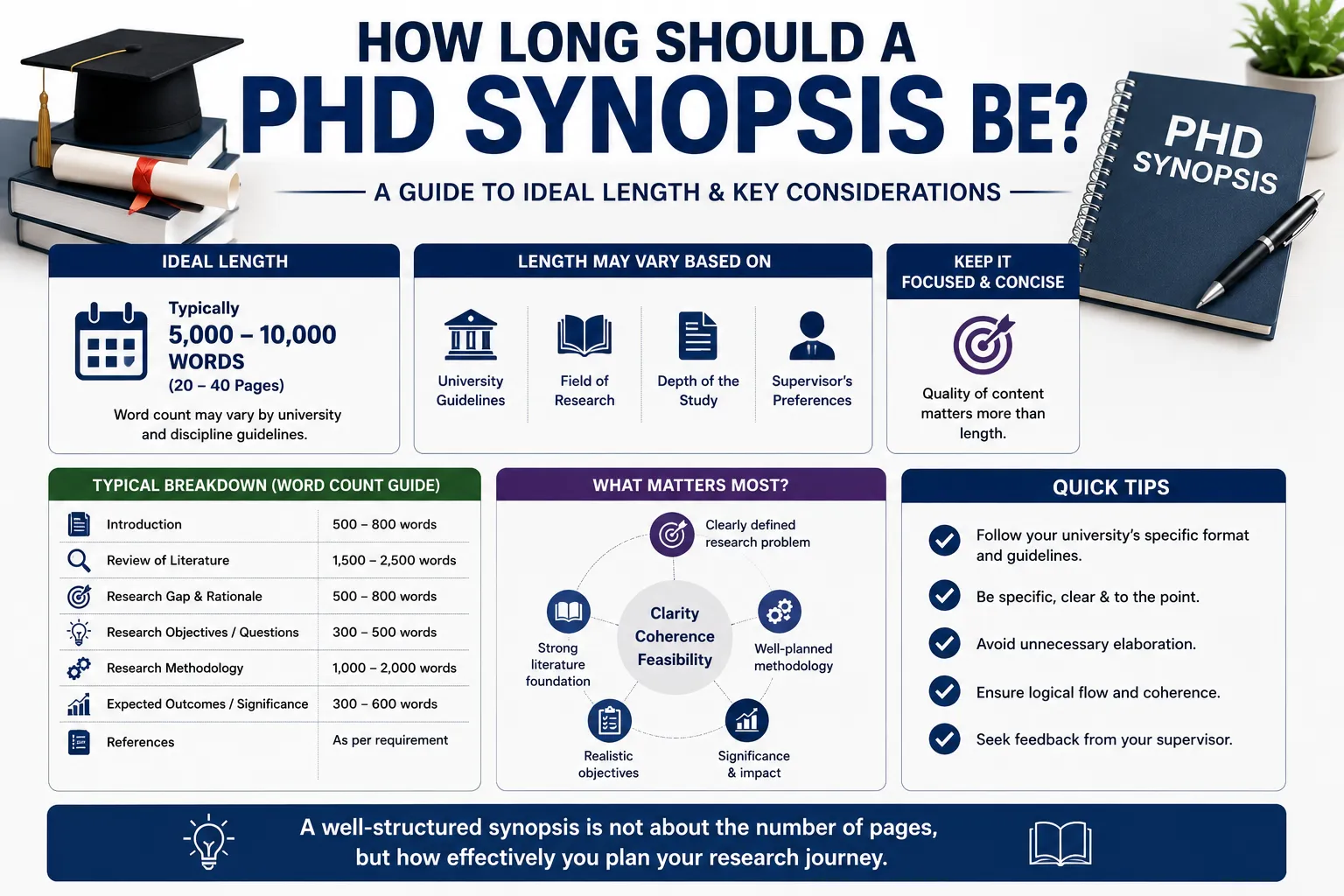
You've written a draft, then cut it, then wondered if you cut too much — or not nearly enough. Length anxiety is one of the most common, least discussed stress points at the synopsis stage. This guide answers how long a PhD synopsis should be with real benchmarks, explains why the range varies so much between universities, and shows you how to allocate your word count across sections so nothing gets shortchanged.
The Short Answer
Most Indian universities require a PhD synopsis of 2,000 to 5,000 words, with some institutions specifying a page limit instead — typically 15–25 pages including references. A separate widely cited benchmark narrows this further specifically for PhD-level synopses: 10–15 pages, compared to 6–10 pages for a Master's thesis synopsis — a useful reminder that length expectations scale with degree level even at this early, condensed stage.
If your specific university hasn't given you an exact figure, planning around 3,000–4,000 words / 12–15 pages is a reasonable working target — narrow enough to force real prioritization, generous enough to cover every required section properly.
Why the Range Varies So Much
Formatting Choices Change What a Word Count Looks Like on the Page
Standard formatting conventions — Times New Roman 12pt, 1.5 or double line spacing, 1-inch margins — directly affect how a given word count translates into page count. A 4,000-word synopsis at double spacing can look noticeably longer on paper than the same 4,000 words at single spacing, which is why some universities specify pages rather than words, and others do the reverse.
Your Discipline Shapes the Expected Length
For context on the full thesis this synopsis eventually previews: a complete PhD thesis in India typically runs 70,000–1,00,000 words (roughly 200–350 pages). That means your synopsis is intentionally a highly condensed 3–7% preview of the eventual full document — not a scaled-down first draft of it.
This same discipline pattern that shapes full-thesis length tends to echo at the synopsis stage: STEM and engineering theses trend toward the shorter end of the full-length range (60,000–80,000 words), while humanities and social science theses run longer (80,000–100,000 words). In practice, this often means STEM synopses lean more concise and methodology-heavy, while humanities and social science synopses allocate proportionally more space to literature and theoretical framing.
Your Specific University's Documentation Is the Only Reliable Source
The most reliable source for the exact figure you should target is always your own institution's documentation — the programme handbook or Doctoral Research Committee (DRC) regulations — not general guidance, since departmental rules frequently differ from broader university-level norms. Treat every published range, including the ones in this article, as a planning benchmark to work from until you confirm your specific university's exact requirement.
How to Allocate Your Word Count Across Sections
Planning the word count for each section before writing helps maintain a balanced and well-structured synopsis. The following benchmarks are commonly used for a 3,500-word research synopsis.
Abstract: Allocate 150–300 words (approximately 6% of the total word count) to briefly summarize the research problem, objectives, methodology, and expected outcomes.
Introduction/Background: Reserve 200–400 words (around 9%) to introduce the research topic, provide context, and explain its importance.
Literature Review: Dedicate 500–1,000 words (about 21%) to critically review existing studies and identify the research gap.
Research Gap: Use 150–250 words (approximately 6%) to clearly explain the gap in existing literature that your study aims to address.
Objectives: Allocate 100–200 words (around 4%) to present 2–4 clear research objectives.
Hypotheses/Research Questions: Spend 100–200 words (about 4%) outlining the hypotheses or key research questions that guide the study.
Methodology: Reserve 300–500 words (approximately 11%) to describe the research design, sampling, data collection methods, and analysis techniques.
Chapter Scheme: Allocate 200–400 words (around 9%) to briefly outline the structure and content of each proposed thesis chapter.
Significance of the Study: Use 150–300 words (approximately 6%) to explain the academic, practical, or societal value of the research.
References/Bibliography: The reference list is not usually included in the prescribed word count, and its length depends on the number of sources cited.
Step-by-Step: Getting Your Synopsis to the Right Length
Step 1: Confirm Your Exact Institutional Requirement First
Before writing a single section, check your programme handbook or ask your DRC directly for the exact word or page limit. Don't assume a general figure applies to your specific department.
Step 2: Allocate a Word Budget Per Section Before Drafting
Use the table above as a starting allocation, then adjust based on your discipline — STEM scholars may want to shift more of their budget toward methodology, while humanities and social science scholars may need more room in the literature review.
Step 3: Write the Abstract Last, Even Though It Appears First
The abstract must be able to stand alone and summarize the whole document (Source: prior university synopsis/thesis format guidelines). It's far easier to write an accurate, complete abstract after the rest of the synopsis is drafted than to write it first and hope the rest matches.
Step 4: Cut Background, Not Substance, When Over Length
If you're over your word count, the introduction/background section is almost always the safest place to cut — it exists to set context, not to carry the argument. Protect your research gap, objectives, and methodology sections first.
Step 5: Check Page Count Against Your Actual Formatting
Once your draft is complete, format it exactly as your university requires (font, spacing, margins) before checking whether it fits a page-based limit — word count alone won't tell you this reliably.
Step 6: Confirm the Reference List Doesn't Count Against Your Limit
Most universities exclude the bibliography from the stated word or page limit — confirm this explicitly so you don't cut content unnecessarily to accommodate a reference list that wasn't counted in the first place.
Practical Checklist: Is Your Synopsis Length On Target?
- Confirmed the exact word or page limit from your specific university's documentation
- Allocated a word budget per section before drafting
- Abstract stands alone and was finalized after the rest of the synopsis
- Formatting (font, spacing, margins) matches institutional requirements exactly
- Reference list confirmed as excluded (or included) in the stated limit
- Research gap, objectives, and methodology sections weren't cut to save space
- Final draft checked in both word count and formatted page count
Two Practical Scenarios
Scenario 1 — A STEM Scholar Cutting the Wrong Section A biotechnology scholar drafted a synopsis at 5,200 words against a 4,000-word institutional limit. Initially planning to trim the methodology section to save space, the scholar instead cut the introduction/background from 600 words to 250, preserving the full methodology detail that a science-focused DRC was most likely to scrutinize — bringing the synopsis to 4,100 words without weakening its most important section.
Scenario 2 — A Humanities Scholar Confirming Page vs. Word Limits A scholar assumed their university's "15-page" limit meant roughly 4,500 words, based on a general online benchmark. After confirming directly with their DRC, they learned the university's required formatting (double spacing, 1-inch margins) meant 15 pages actually accommodated closer to 3,200 words — a meaningful difference that would have caused an over-length submission had they not checked the specific formatting requirement first.
Common Mistakes Scholars Make With Synopsis Length
- Assuming a general online word-count range applies to their specific university without checking the actual DRC or handbook requirement.
- Writing the abstract first, then struggling to keep it accurate as the rest of the synopsis changes during drafting.
- Cutting the research gap or methodology to save space, when the introduction/background is almost always the safer place to trim.
- Confusing word limits with page limits without accounting for their university's specific required formatting.
- Including the reference list in their own word count, unnecessarily cutting content that wasn't counted against the limit in the first place.
Frequently Asked Questions
How long should a PhD synopsis be? Most Indian universities require 2,000–5,000 words or roughly 10–25 pages including references, though the specific figure varies significantly by institution and discipline — always confirm the exact requirement with your programme handbook or Doctoral Research Committee.
Why does PhD synopsis length matter?
A synopsis that's too short may fail to demonstrate sufficient literature engagement or methodological detail, while one that's too long may signal poor prioritization — both can lead to committee pushback or delayed approval.
How does synopsis length affect a synopsis's approval chances?
Committees generally expect the synopsis to be tightly scoped and complete within the required limit; submissions significantly over or under the expected length can raise concerns about whether the scholar has clearly prioritized the most essential content.
How long does it take to complete a synopsis using this approach?
Allocating a word budget per section before drafting typically speeds up the writing process, since it removes the need for major restructuring later to fit an institutional limit.
Is professional help available to determine how long a PhD synopsis should be?
Yes. ThesisLikho's PhD-qualified mentors have guided 10,000+ scholars through synopsis structuring, section-by-section length planning, and complete thesis writing assistance tailored to individual university requirements.
Get Expert Guidance on Your PhD Synopsis Length
Getting your synopsis to the right length — not just close to it — takes careful section-by-section planning and a clear understanding of your specific university's exact requirement. If you'd like expert input on structuring your synopsis within your institution's word or page limit, ThesisLikho's PhD-qualified team offers synopsis structuring support, research methodology guidance, and complete thesis writing assistance. If you need expert guidance with your synopsis length, structure, or overall thesis planning, you can explore our Synopsis Writing Assistance service.
Get Synopsis Help Now → https://thesislikho.com/writing-services/synopsis-writing