
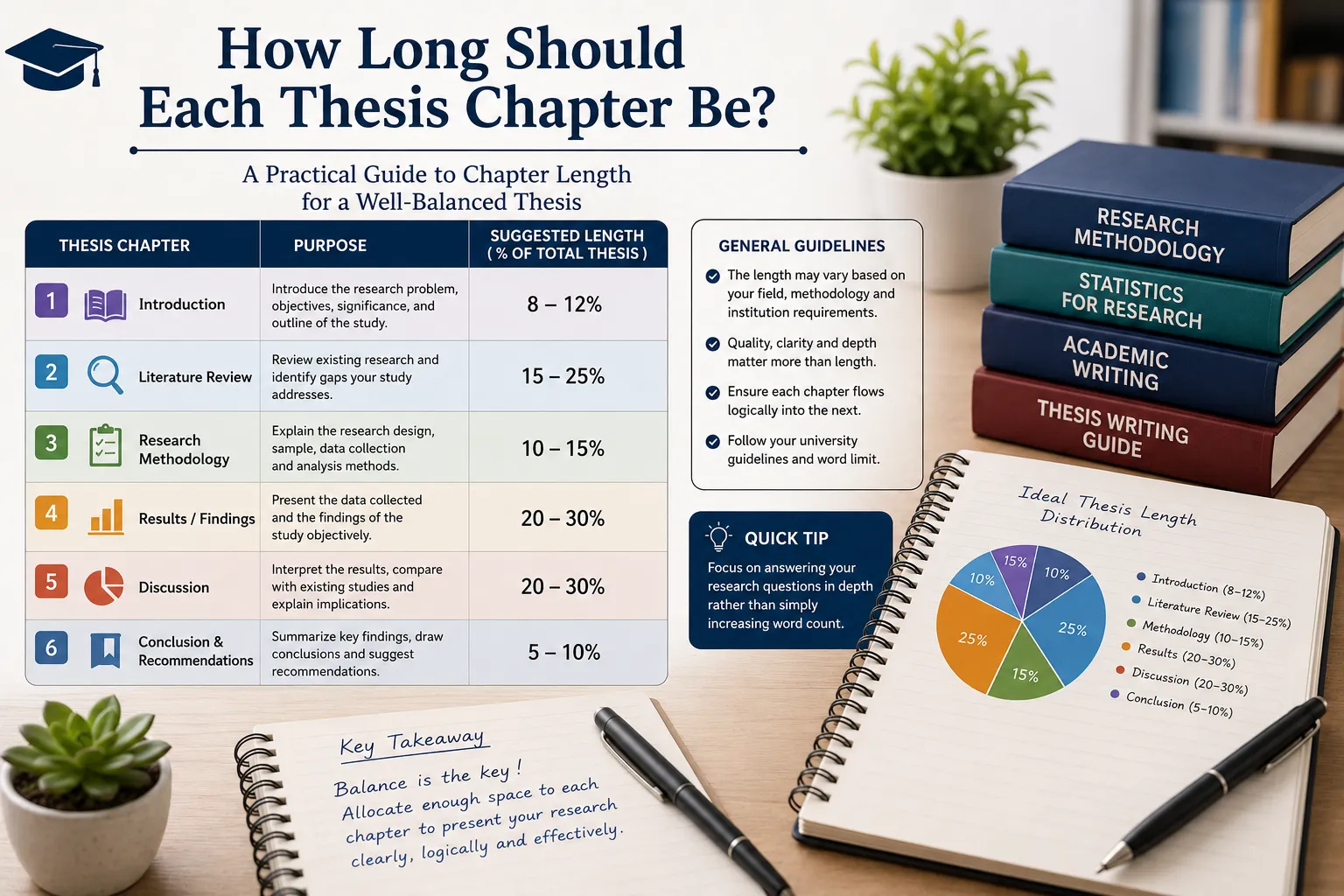
You know your total word count target. What you're less sure about is how to actually divide it — should your literature review be twice as long as your methodology? Is a short introduction a problem, or exactly what it's supposed to be? This guide breaks down how long each thesis chapter should actually be, with real percentage benchmarks you can apply directly to your own word count target.
Why Chapters Aren't Divided Equally — And Shouldn't Be
A thesis's word count is never split evenly across chapters, and it shouldn't be. Some chapters — your literature review and your results/discussion — carry substantially more analytical weight and naturally need more space. Others — your introduction and conclusion — are deliberately kept tight, since their job is orientation and synthesis, not exhaustive development. Understanding this uneven distribution upfront is what lets you plan realistically, rather than discovering three-quarters of the way through that your methodology chapter has ballooned to the size your results chapter should be.
A Representative Chapter-by-Chapter Breakdown
For an 80,000-word PhD thesis, a clean, representative allocation looks like this:
- Introduction: 8,000 words (10%)
- Literature review: 16,000 words (20%)
- Methodology: 12,000 words (15%)
- Results: 20,000 words (25%)
- Discussion: 16,000 words (20%)
- Conclusion: 8,000 words (10%)
The literature review and results chapters carry the most weight in this model, while introductions and conclusions are intentionally kept short. For a 25,000-word master's thesis, scale these same proportions down directly.
An Alternative Breakdown for Dissertations With Primary Research
A commonly cited alternative allocation for dissertations involving primary research — where you've collected and analyzed your own data — looks slightly different: introduction 10%, literature review 25%, methodology 15%, results/findings 20%, discussion 22%, conclusion 8%. In this model, the discussion chapter is often considered the single highest-value chapter, since it's where you interpret your findings against the existing literature. Under-writing the discussion is one of the most common reasons dissertations lose marks — it's worth protecting this chapter's word allocation even if you need to trim elsewhere.
A Genuinely Different Shape for Theoretical Dissertations
If your dissertation has no primary data collection — a purely theoretical or literature-based thesis — the proportional shape shifts substantially: introduction 12%, an extended literature review or background around 40%, an analysis/themes chapter of 30%, a shorter discussion of 10%, and a conclusion of 8%. This is a genuinely different distribution from an empirical thesis, reflecting how the analytical weight in a theoretical dissertation sits in engaging deeply with existing scholarship rather than presenting original data.
Chapter-by-Chapter Detail: What Each Range Actually Looks Like
Introduction: 3,000–5,000 Words (4–6%), or ~10% in Some Models
Your introduction sets up the research question, justifies the study, outlines the thesis's structure, and states your central argument or hypothesis. This should be concise and compelling — your examiner forms their first impression here, so tightness matters more than exhaustiveness.
Literature Review: 10,000–15,000 Words (15–20%)
This is typically the longest chapter for most dissertations. It should critically analyze existing research, identify gaps, and position your study within the field — not simply summarize sources one after another, but show how they connect to your specific research question.
Methodology: 5,000–8,000 Words (6–10%)
Describes and justifies your research design, data collection methods, and analysis approach, in enough detail that another researcher could, in principle, replicate your study. This chapter tends to be more compact than your literature review or results chapter — precision matters more here than length.
Results/Findings: 8,000–15,000 Words (10–18%, Sometimes Up to 25%)
Presents your data and findings without interpretation, using tables, figures, and charts to present data efficiently. This chapter's length varies dramatically by discipline and by how much data you've collected — a study with extensive quantitative output will naturally run longer than one built around a smaller set of qualitative themes.
Discussion: Typically 20–22% of Total Word Count
Interprets your results in depth, connecting them explicitly to your literature review and explaining what they mean for your field. As noted above, this chapter deserves particular protection from cutting, since under-writing it directly weakens your thesis's overall argument.
Conclusion: 8–10% of Total Word Count
Synthesizes your overall findings, states your contribution, and recommends future research — deliberately shorter than your discussion, since it shouldn't re-interpret data in detail, only draw the argument together.
How This Scales at Smaller Word Counts
These proportions hold consistently even for much shorter dissertations. For a 10,000-word dissertation, a representative breakdown might allocate roughly 800–1,000 words to the introduction, 2,500–3,000 words to the literature review, and 1,500–2,000 words to the methodology — the same relative weighting as the 80,000-word PhD example, just scaled down.
A Different Model Entirely: Publication-Format Theses
If your program allows a publication-format ("stapled" or "thesis by published works") PhD structure — increasingly accepted at UK STEM departments, and increasingly in business and economics — the chapter breakdown looks fundamentally different. This format typically includes: an integrative introduction (8,000–12,000 words), combined background literature (8,000–10,000 words), three to five standalone papers (each roughly 8,000–12,000 words, independently submittable to a target journal), and an integrative discussion/conclusion (8,000–12,000 words). If your department offers this option, confirm directly with your supervisor whether it fits your research and discipline before assuming the standard monograph breakdown applies to you.
Practical Pacing and Monitoring
A Realistic Writing Timeline
At a target of 500–800 words per writing day, an 80,000-word PhD thesis takes roughly 160 writing days at 500 words/day — a realistic 9–12 months of drafting once your underlying research is largely complete. Use this as a planning anchor when mapping your own timeline against your specific word count target.
Understand Your Safety Margin
Most universities allow some flexibility around the stated word limit — being within roughly 10% of the limit, either over or under, is generally considered safe. Going beyond that margin risks your examiners refusing the submission on formatting or length grounds. This limit typically covers body text plus in-text citations only; bibliography, appendices, abstract, acknowledgments, and table of contents are usually excluded from the count. Confirm your specific institution's exact policy rather than assuming this general guidance applies exactly.
Monitor Chapter Length Weekly, Not at the End
Paste each chapter into a word counter weekly to catch imbalances early. A literature review that's ballooned well beyond its target allocation is a clear early warning sign of overall overshoot — and the right time to address it is as soon as you notice it, not three months before submission when restructuring becomes far more disruptive.
Step-by-Step: Planning Your Chapter Word Counts
- Confirm your total word count limit directly from your institution's guidelines
- Determine whether your thesis is empirical (primary research), theoretical/literature-based, or publication-format, since the proportional model differs meaningfully across these
- Apply the appropriate percentage breakdown to your specific total word count
- Set a target word count for each chapter based on this allocation
- Track your actual word count against your target weekly as you write
- If a chapter is significantly overshooting its target, address the imbalance immediately rather than waiting
- Protect your discussion chapter's allocation specifically, since under-writing it is a commonly flagged weakness
- Confirm your final total falls within your institution's safety margin (typically ±10%) before submission
Practical Checklist: Are Your Chapter Lengths On Target?
- Total word count limit confirmed directly from institutional guidelines
- Thesis type identified (empirical, theoretical, or publication-format) to select the right proportional model
- Target word count set for each individual chapter based on the appropriate percentage breakdown
- Literature review and results/discussion chapters allocated the largest shares
- Introduction and conclusion kept deliberately tight relative to other chapters
- Discussion chapter's allocation specifically protected from cutting
- Chapter lengths tracked weekly against targets, not only checked at the end
- Final total falls within the institution's safety margin (commonly ±10%)
Two Practical Scenarios
Scenario 1 — Catching an Overgrown Literature Review Early
A PhD scholar targeting an 80,000-word thesis set a literature review target of 16,000 words. Checking their word count weekly, they noticed the chapter had reached 22,000 words by the halfway point of drafting, well ahead of schedule for its target length. Recognizing this early, the scholar reviewed the draft, identified sections that had drifted into content better suited to the discussion chapter, and restructured before the imbalance became a much larger problem to fix later.
Scenario 2 — Adjusting Proportions for a Theoretical Dissertation
A scholar initially planned their dissertation using the standard empirical-research proportions, allocating only 20% to their literature review. Recognizing partway through planning that their research had no primary data component and was entirely literature-based, they shifted to the theoretical-dissertation proportions instead, expanding their literature review/background allocation to around 40% and reducing their results-equivalent analysis chapter accordingly — a structural adjustment that better matched the actual nature of their research.
Common Mistakes Thesis Writers Make With Chapter Length
- Assuming all chapters should be roughly equal length, rather than following the naturally uneven distribution that reflects each chapter's actual analytical weight.
- Applying empirical-research proportions to a theoretical dissertation, or vice versa, resulting in a mismatched structure.
- Under-writing the discussion chapter to protect word count elsewhere, when this chapter specifically carries high analytical weight.
- Checking word count only near submission, missing the chance to catch and correct chapter-length imbalances early.
- Not confirming what counts toward the official word limit, risking confusion about whether appendices, bibliography, or footnotes are included.
Frequently Asked Questions
How long should each thesis chapter be?
As a general guide for an empirical thesis: introduction and conclusion each around 8–10%, literature review around 20–25%, methodology around 15%, and results plus discussion together around 40–45% of the total word count — though theoretical and publication-format theses follow meaningfully different proportions.
Why does chapter length distribution matter for a thesis?
Chapters carry different analytical weight, and under-writing a high-value chapter like the discussion (where findings are interpreted against the literature) is a commonly flagged reason theses lose marks, regardless of how strong the underlying research is.
How does chapter length affect a thesis's overall quality?
A thesis with proportions matching its type (empirical, theoretical, or publication-format) reads as coherently structured, while one with mismatched proportions — an overlong introduction, an underdeveloped discussion — can signal to examiners that the writer hasn't planned the document's overall shape deliberately.
How long does it take to complete a thesis using this approach?
At a pace of roughly 500–800 words per writing day, an 80,000-word PhD thesis typically takes 9–12 months of drafting once the underlying research is largely complete — planning chapter-by-chapter word targets in advance helps keep this timeline realistic.
Is professional help available to plan how long each thesis chapter should be?
Yes. ThesisLikho's PhD-qualified mentors have guided 10,000+ scholars through chapter length planning, word count allocation, and complete thesis writing assistance tailored to individual disciplines and thesis types.
Get Expert Guidance on Your Thesis Chapter Lengths
Planning realistic chapter-by-chapter word count targets — and catching imbalances early rather than near submission — takes careful, ongoing tracking against your total word count limit. If you'd like expert input on allocating your thesis's word count across chapters, ThesisLikho's PhD-qualified team offers chapter planning support, word count guidance, and complete thesis writing assistance. If you need expert guidance with your chapter structure, word count planning, or overall thesis writing, you can explore our Thesis Writing Assistance service.
Talk to a Thesis Expert → https://thesislikho.com/writing-services/thesis-writing