
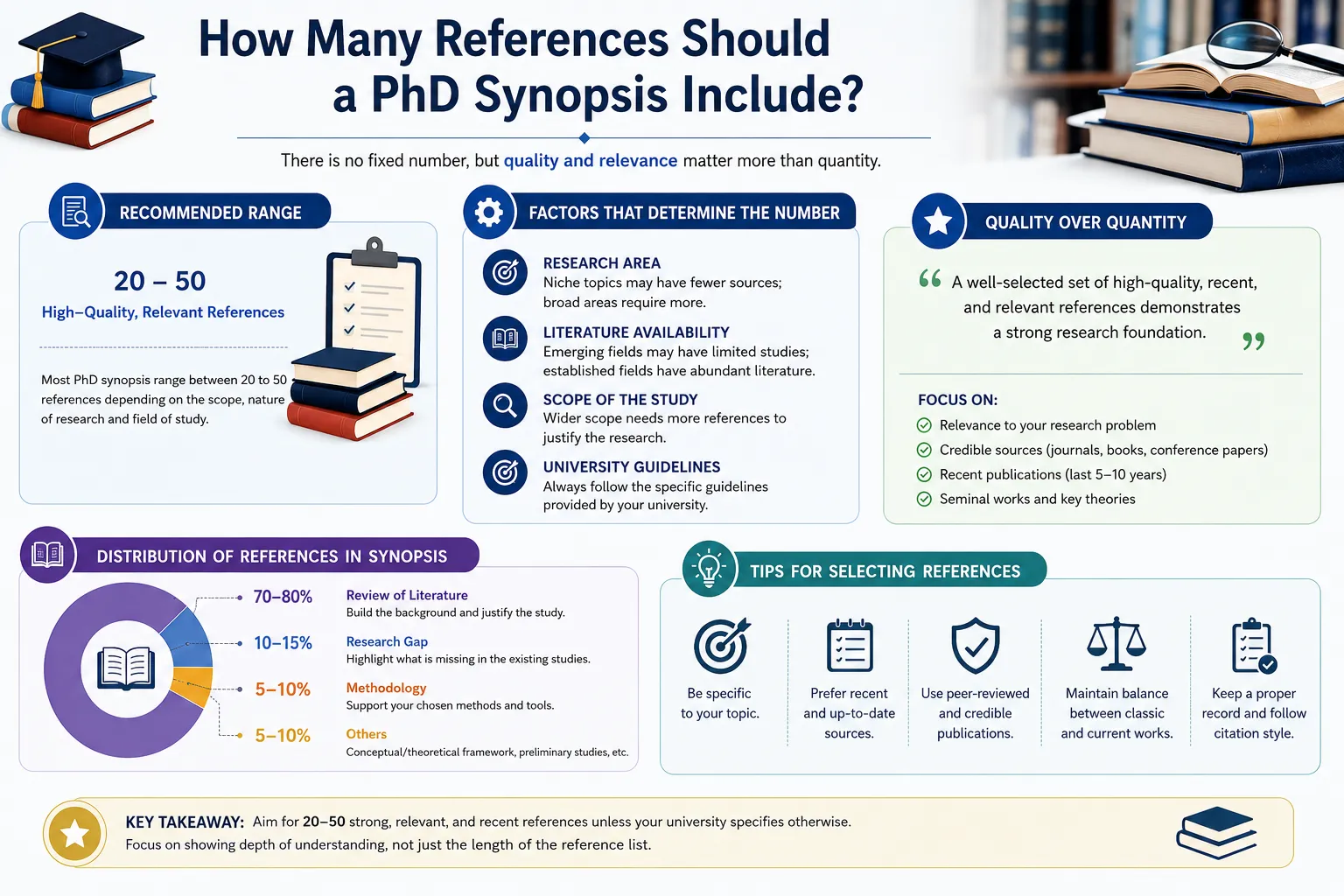
It's one of the most common questions scholars type into Google right before a synopsis submission deadline: "how many references should a PhD synopsis include?" And it's a fair question — too few, and your Research Committee will wonder if you've actually surveyed the field; too many, and you risk looking like you've padded a bibliography instead of demonstrating genuine command of the literature.
The honest, slightly unsatisfying answer is: there's no single magic number. But there is a defensible range, a clear logic for landing inside it, and a set of quality signals that matter more than the count itself. This guide walks through all of that — the way an experienced research supervisor would, across a candid conversation rather than a rulebook.
At ThesisLikho, our PhD-qualified mentors have guided more than 10,000 scholars through synopsis writing, literature review structuring, and Research Committee presentations across disciplines. What follows draws on that mentoring experience, checked against current guidance on PhD synopsis structure and reference-count benchmarks used across Indian and international universities.
One thing worth saying upfront: if you've searched this question because your first draft came back from your supervisor with a comment like "add more references" or "this feels thin," you're not alone, and it's rarely about the number alone — it's usually a signal that the literature review hasn't yet demonstrated full command of the field. This guide addresses both the number and that underlying signal.
1. Why This Question Doesn't Have One Universal Answer
Ask ten experienced researchers "how many references should a synopsis have," and you'll likely get ten different numbers, because the honest answer depends on your field, your specific topic's literature volume, your university's own guidelines, and what your synopsis is actually trying to demonstrate. There genuinely isn't a fixed mathematical formula here — what matters is whether your reference list is comprehensive enough to show you've engaged seriously with the existing body of knowledge, without padding it with tangential citations just to inflate the count.
That said, "it depends" isn't a useful answer on its own when you're staring at a submission deadline. So the rest of this guide gives you actual, defensible ranges, the reasoning behind them, and — more importantly — how to judge whether your own list is doing its job, regardless of the exact number you land on.
2. What a PhD Synopsis Actually Is (and Isn't)
Before getting to numbers, it's worth being precise about what a synopsis is. In the Indian PhD system, a synopsis is a pre-registration document submitted to a university's Research Committee (often called the Doctoral Committee or Research Advisory Committee, depending on the institution) for approval before a scholar formally registers for doctoral research. It typically covers the research problem, a review of relevant literature, the research gap, objectives, proposed methodology, and expected outcomes.
Critically, a synopsis is not a full literature review chapter, and it's not your final thesis bibliography. It's a condensed, persuasive case for why your proposed research is necessary, feasible, and grounded in what's already known — which is exactly why its reference list should look different from your eventual thesis reference list in both size and purpose. A synopsis reference list needs to demonstrate awareness of the field and clearly establish your gap; it doesn't need to exhaustively catalogue every paper you'll eventually cite across your full thesis.
3. Reasonable Reference Count Ranges by Context
With that framing in place, here are practical, evidence-informed ranges rather than a single number:
For a PhD synopsis specifically, a commonly cited practical benchmark suggests at least 15–30 quality, peer-reviewed papers, ideally published within the last decade, is a reasonable floor for demonstrating genuine engagement with current literature — though this varies by university and field.
For comparison, a general dissertation literature review chapter (a longer, more exhaustive document than a synopsis) is often benchmarked around 20–35 references as a starting point, with the understanding that selecting truly significant sources matters more than hitting a specific number.
For a full PhD thesis (the complete final document, not the synopsis), reference counts run considerably higher — rough field-based benchmarks suggest roughly 150–400 or more references across a full STEM or social science thesis, with humanities theses often running even higher due to the discipline's reliance on close reading of primary and secondary texts.
The key takeaway: your synopsis reference list should be meaningfully smaller and more tightly curated than your eventual full thesis bibliography — it's a persuasive case-building document, not the final catalogue of everything you'll eventually engage with.
4. Why Discipline Changes the Number Significantly
Reference count benchmarks vary considerably by field, and understanding why helps you judge your own list more intelligently than chasing a fixed target would:
- STEM/experimental disciplines (physics, chemistry, engineering) tend toward more focused literature reviews — often in the range of 60–200 sources across a full thesis — because the relevant, directly comparable prior work is often narrower and more tightly scoped around specific experimental methods or results.
- Social sciences and management disciplines often run higher — commonly 100–300 sources across a full thesis — because these fields draw on broader theoretical literatures, multiple competing frameworks, and often more contextual/background material.
- Humanities disciplines frequently run the highest — 200–500 sources isn't unusual across a full thesis — because close reading and interpretive historical work typically requires engaging with many primary and secondary texts rather than a narrower set of empirical studies.
- Interdisciplinary topics tend to need more references than a single-discipline study of similar scope, simply because you're establishing credibility across multiple bodies of literature rather than one.
For your synopsis specifically, this same relative logic holds even though the absolute numbers are much smaller — an interdisciplinary or social-science-adjacent synopsis will typically need a slightly larger, more varied reference list than a narrowly scoped experimental physics or chemistry synopsis, even though both might be similarly compliant with their university's minimum requirement.
What If Your Topic Genuinely Has Limited Existing Literature?
Scholars working on a genuinely novel or emerging topic sometimes worry that a shorter reference list will be read as a weakness rather than a reflection of the field's actual size. This is a legitimate concern, but it has a legitimate solution: broaden your search across adjacent fields before assuming the literature simply doesn't exist. A topic that looks under-studied within one discipline's terminology often has substantial relevant work sitting in an adjacent field under different vocabulary — a management scholar studying a novel digital business model, for instance, might find far more directly relevant work by also searching information systems, economics, and even computer science literature under different keywords than by searching management journals alone.
If, after a genuinely thorough cross-disciplinary search, your topic really does have a thin literature base, say so explicitly in your synopsis rather than trying to disguise it — framing the limited existing literature itself as part of your research gap ("this area remains under-studied, with existing work concentrated in X and Y, leaving Z largely unaddressed") is a stronger, more credible move than quietly padding the list with tangentially related sources to avoid the appearance of a gap in your own research.
5. Quality Signals That Matter More Than the Count
Research Committees and examiners consistently report that they notice obvious gaps in coverage — missing key theoretical frameworks, missing major empirical studies, missing the work of scholars likely to examine the thesis — far more readily than they count your total references. A few quality signals worth prioritizing over raw count:
- Recency — the bulk of your references, especially in fast-moving fields, should be reasonably current (commonly the last 5–10 years), with a smaller set of genuinely foundational older works cited where they're still the defining reference point for a concept.
- Source type balance — a healthy mix of peer-reviewed journal articles, credible books, and, where relevant, conference proceedings; over-reliance on websites or non-peer-reviewed sources is a common, easily flagged weakness. A commonly cited rule of thumb is keeping at least half your references as journal articles or books rather than web sources.
- Coverage of contradictions and debates, not just supportive citations — a reference list that only cites work agreeing with your proposed direction can read as selective or cherry-picked, whereas engaging with conflicting findings signals genuine critical engagement.
- Direct relevance — every citation should be doing real work in your synopsis, either establishing context, supporting your problem statement, or building your research gap; citations included purely to inflate the count are easy for an experienced reviewer to spot and tend to undermine credibility rather than build it.
- Accuracy of citation — a small number of correctly, carefully cited sources reads as more credible than a large number with sloppy or inconsistent formatting, and errors in fundamental/classic citations are particularly noticeable to experienced reviewers.
6. How Reference Count Relates to Synopsis Word Count
Reference count should scale roughly with your synopsis's overall length and scope, though not on a rigid formula. A typical PhD synopsis word count in India runs approximately 3,000–5,000 words, excluding the reference list itself — though this varies meaningfully by university, and some institutions specify a page limit (commonly 10–20 pages) instead of a word count, so always check your specific institution's guideline before finalizing scope.
Within that length, your literature review section typically forms a substantial portion of the document — often the single most heavily scrutinized section by the Research Committee, alongside your methodology. If your literature review section is proportionally thin relative to your reference count (or vice versa — a long literature review section citing very few sources), that mismatch itself is a red flag worth fixing before submission, regardless of whether your absolute reference count falls in an acceptable range.
7. A Practical Framework for Deciding Your Own Number
Rather than chasing a specific number, use this sequence to arrive at a defensible reference list for your synopsis:
- Check your university's specific guideline first. Many Indian universities specify a minimum reference count, word count, or page limit in their PhD ordinance or synopsis format guidelines — this should be your starting constraint, not a range from a generic online source (including this one).
- Map your literature into three groups: foundational/theoretical works establishing your framework, closely related empirical studies establishing your specific gap, and broader contextual works establishing why your topic matters. A synopsis needs meaningful representation from all three, not just a long list from one group.
- Check coverage against recent examiner-facing work in your subfield — look at recently approved synopses or published theses in your department (many universities archive these) to see roughly what's typical for your specific research area, since departmental norms often matter more than generic cross-field benchmarks.
- Prioritize the last 5–10 years heavily, supplemented by a smaller set of genuinely foundational older sources — a synopsis citing mostly decade-plus-old literature signals to a committee that you may not be current on your field.
- Cut before you pad. If you're unsure whether a citation belongs, the safer default is usually to cut it rather than include it defensively — a tightly curated list of 20 genuinely relevant sources reads better than 40 with several tangential inclusions.
7a. Does Citation Style Affect How References Are Counted or Perceived?
Your citation style itself doesn't change how many references you "should" have, but it does affect how your reference list reads to a Committee, and it's worth getting right regardless of your target count.
APA-style reference lists (common in social sciences, education, and management) use author-date in-text citations and an alphabetized, hanging-indent reference list — this format makes it easy for a reviewer to quickly gauge recency, since publication years sit right in the in-text citation itself. IEEE-style numbered citations (common in engineering and computer science) instead reference sources by bracketed number, which means recency isn't visible at a glance in the text — worth keeping in mind if your field's committee places weight on demonstrating currency, since you may need to make that explicit in your prose rather than relying on the citation format to signal it.
Whichever format your university or department specifies, apply it with total consistency from your very first draft. A synopsis where some entries follow APA and others drift toward a different format (a common issue when scholars copy citations directly from database export tools without cleaning them up) reads as careless, regardless of how well-chosen the underlying sources are — and it's one of the easiest things for a Committee to flag as needing revision before deeper feedback on content.
8. Common Mistakes Scholars Make With Synopsis References
- Padding the list to hit a perceived "safe" number — reviewers notice uncited or barely-relevant references, and padding usually backfires by diluting the perceived depth of your engagement.
- Relying too heavily on secondary sources or web content instead of primary peer-reviewed literature, particularly review articles cited instead of the original studies they summarize.
- Citing outdated foundational work without connecting it to current developments — a synopsis that leans entirely on older literature without showing awareness of the last few years' developments reads as out of touch with the current state of the field.
- Ignoring departmental or university-specific formatting and count requirements in favor of generic online advice — always verify your own institution's specific synopsis guidelines before finalizing.
- Failing to represent contradicting viewpoints or competing frameworks, making the literature review read as one-sided rather than critically balanced.
- Inconsistent citation formatting across the reference list, which is one of the most common and entirely avoidable issues flagged during synopsis review.
- Treating reference count as the whole quality metric — a Committee evaluating a thin, uncritical review of 30 sources will flag it faster than a tightly argued review of 22 well-chosen ones.
9. How to Organize and Manage Your Reference List
Given how much back-and-forth typically happens between a first synopsis draft and Research Committee approval, using a reference management tool from the outset saves substantial rework:
- Track every source as you read it, not just the ones you're confident you'll cite — this avoids the common last-minute scramble to relocate a source you vaguely remember reading weeks earlier.
- Standardize your citation style early (APA, IEEE, or your university's specified format) rather than reformatting the entire list right before submission.
- Tag sources by theme or sub-argument as you build your literature review, so you can quickly verify balanced coverage across your three groups (foundational, empirical, contextual) discussed above.
- Keep a short note on why each source is included — this single habit makes it far easier to spot and cut tangential citations before they weaken your list, and makes revising after committee feedback considerably faster.
10. What Your Research Committee Is Actually Evaluating
It helps to step back from the reference count question and remember what the Committee is really assessing through your literature review and reference list: do you understand where your field currently stands, have you identified a genuine, specific gap rather than a vague one, and is your proposed research a logical, feasible next step given what's already known?
Your reference list is the evidence trail for that argument, not a standalone deliverable to be evaluated on volume. A committee member skimming your synopsis is essentially asking: "has this scholar actually read and understood the key work in this area, or have they assembled a list that looks comprehensive at a glance?" The clearest way to pass that test is a well-organized, critically engaged literature section — with a reference count that naturally follows from doing that work properly, rather than being engineered backwards from a target number.
It's also worth knowing that Research Committees vary in how formally they specify this. Some departments provide an explicit minimum reference count in their synopsis format guideline; others leave it to supervisor discretion and departmental convention, expecting the scholar to gauge an appropriate range by looking at recently approved synopses in the same department. If your department falls into the second category, the safest approach is asking your supervisor directly, or requesting to see one or two recently approved synopses from your specific research area — departmental norms, more than any generic online benchmark, are what your actual Committee will be calibrated against.
If you'd like a second set of eyes on whether your synopsis literature review and reference list strike the right balance before submission, our Synopsis Writing service works through exactly this stage with scholars.
11. Two Realistic Case Studies
Case Study 1 — Fixing an Overloaded but Shallow Reference List
A scholar preparing a management PhD synopsis submitted a first draft with 55 references, assuming a larger list would signal thoroughness. On review, the supervisor pointed out that nearly a third of the citations were only tangentially related to the actual research gap, and several were older review articles cited instead of the original empirical studies they summarized. After trimming the list to 28 tightly relevant sources — organized clearly across foundational theory, closely related empirical work, and contextual background — the synopsis read as considerably more focused and was approved without a request for revision on the literature section.
Case Study 2 — Recognizing a Genuinely Thin Reference List
A first-time scholar in an interdisciplinary environmental-policy topic submitted a synopsis with only 12 references, believing the topic's relative novelty meant little prior literature existed. A structured search across adjacent fields — environmental science, public policy, and economics — surfaced considerably more relevant work than the scholar had initially found by searching only within one discipline's terminology. Expanding to 24 well-chosen references across all three adjacent fields directly addressed the Committee's initial concern that the literature review hadn't adequately established the research gap. Notably, the scholar also rewrote the framing of the gap itself to explicitly acknowledge the literature's concentration in policy analysis relative to its thinner coverage of implementation-level economic impact — turning what had initially read as an oversight into a deliberately identified, well-supported gap.
Case Study 3 — Aligning Reference Count to Departmental Norms
A scholar in a computer science department was unsure whether their 20-reference synopsis was sufficient, since generic online guidance suggested ranges as high as 30. Rather than padding the list defensively, the scholar asked their supervisor to share two recently approved synopses from the same department and found both had used 18–22 IEEE-style references, tightly focused on directly comparable prior algorithms and system designs rather than broad contextual literature. This confirmed that the department's actual norm — shaped by the discipline's tendency toward narrower, more technical literature reviews — was already well aligned with the scholar's draft, and no further padding was needed.
FAQs
How do I decide how many references should a PhD synopsis include?
Start with your university's specific synopsis guideline if one exists, then aim for a reference list — commonly in the range of 15–30 quality sources for most disciplines — that clearly represents foundational theory, closely related empirical studies, and contextual background, prioritizing recent (last 5–10 years) literature alongside genuinely foundational older work.
Why should I care about how many references a PhD synopsis includes?
Because your reference list is the evidence trail for your literature review argument — too few references can suggest incomplete engagement with the field, while a padded list of tangentially relevant citations can undermine credibility just as much. Getting this right affects whether your Research Committee approves your synopsis without revision requests.
When should you finalize your reference count for a synopsis?
Treat it as something that emerges from doing the literature mapping properly (see the framework in Section 7), rather than a number you decide upfront and then pad or trim toward. Finalize it only after checking coverage across your foundational, empirical, and contextual source groups.
How long does it take to complete a synopsis using this approach?
Timelines vary by university and topic complexity, but building a well-organized reference list alongside your literature review — rather than assembling references reactively at the end — typically takes a few focused weeks and meaningfully reduces the risk of a Committee sending your synopsis back for literature-review revisions.
Is professional help available to reference should a PhD synopsis include correctly?
Yes — support with literature review structuring, reference list curation, and synopsis formatting to your specific university's requirements is available through services such as Synopsis Writing.
Ready to get your synopsis literature review and reference list Committee-ready? Get Synopsis Help Now from ThesisLikho's PhD-qualified mentors.