
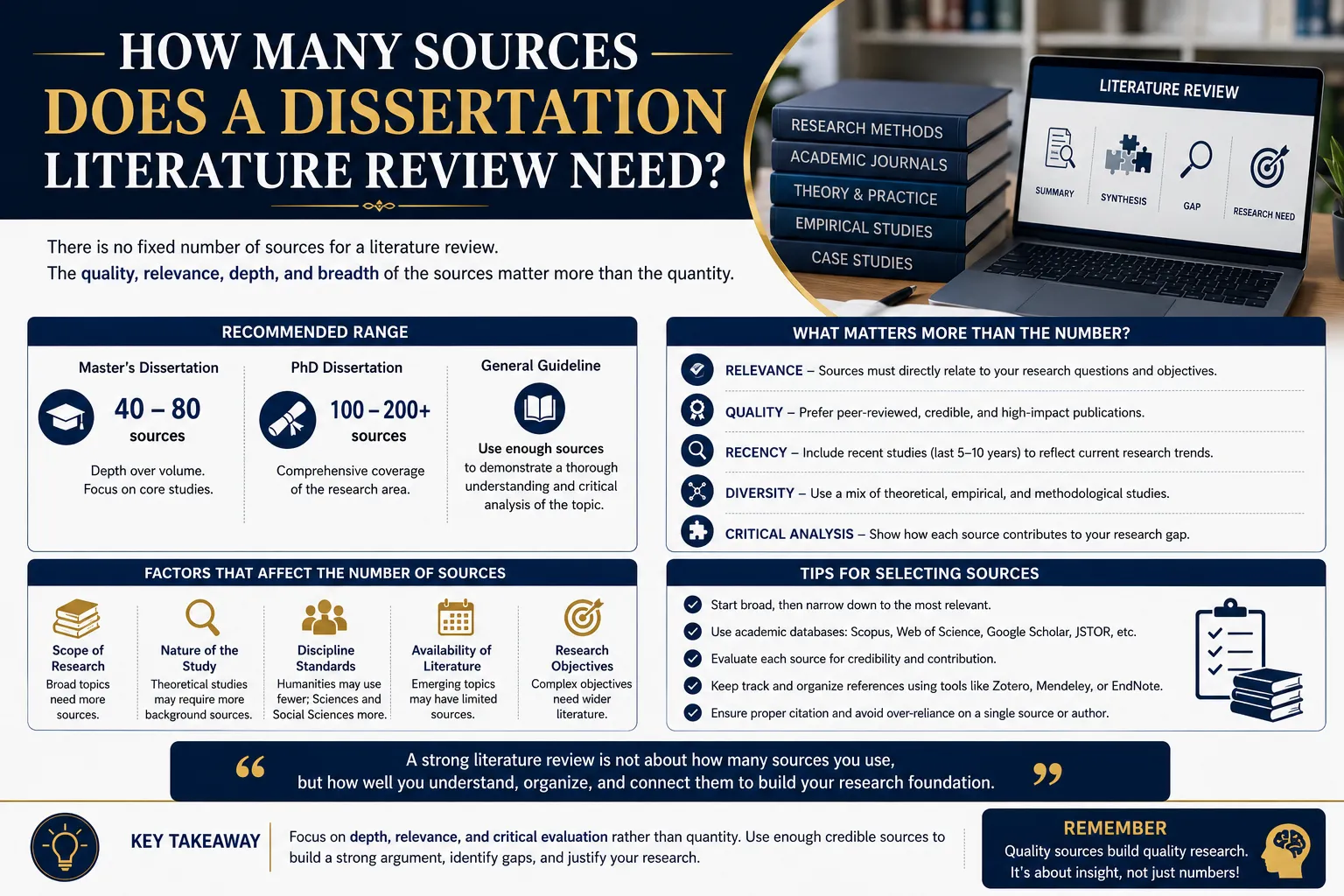
You've been reading for weeks, your reference manager is overflowing, and you still can't tell if you have enough sources — or too many. This is one of the most common anxieties at the literature review stage, and unfortunately, there's no single magic number that applies to every dissertation. This guide breaks down how many sources a dissertation literature review actually needs, using real benchmarks by academic level and discipline, and explains why the quality of your engagement matters more than the count on your reference list.
The Short Answer: It Depends on Level, Length, and Discipline
There is no universal figure, but consistent patterns emerge across academic guidance. Undergraduate and master's-level literature reviews commonly cite 60–120 sources, while doctoral literature reviews commonly cite 150–400+ sources, depending heavily on discipline. A separate, frequently cited PhD-specific benchmark narrows this further: most PhD literature reviews cite between 100 and 300 sources — with the important caveat that the number matters less than the quality of critical engagement with each one.
If those ranges feel too broad to plan around, a more practical anchor ties source count directly to your dissertation's length: roughly 8–10 significant sources for an 8,000-word dissertation, scaling up to 20 major sources for a 12,000–15,000-word dissertation (Source: University of Kent, "Writing a Literature Review"). This scaling logic — more words, more sources, in rough proportion — is a more reliable planning tool than any single fixed number.
Source Count Benchmarks by Academic Level
- Undergraduate dissertation (8,000–15,000 words): typically 8–20 sources. At this level, fewer well-engaged sources beat many shallow ones.
- Master's dissertation (15,000–25,000 words): typically 30–120 sources. The range varies widely by discipline, with humanities trending toward the higher end.
- PhD dissertation (60,000–100,000 words): typically 100–300+ sources, with some fields citing up to 400+. At this level, quality of engagement with each source matters more than the raw count.
How Your Literature Review's Word Count Shapes Source Count
For a master's thesis of 15,000–25,000 words, the literature review chapter typically accounts for 20–25% of the total — roughly 3,000–6,000 words — and generally requires 25–50 sources engaged with real depth. For at least the 10 most important sources in your review, you should be able to discuss their methodology, sample size, limitations, and how their findings relate to other work in the field.
For a full PhD dissertation of 60,000–100,000 words, the literature review typically makes up 10–20% of the total word count, often organized into 5–8 major sections — frequently structured around a theoretical framework used as a lens to evaluate and connect the literature. A PhD literature review typically takes 3–6 months to write, including reading, drafting, and multiple rounds of supervisor revision, and it's often the chapter that goes through the most iterations before it's considered complete.
Why the Number Alone Doesn't Tell the Whole Story
Too Few Sources Signals Weak Grounding
Too few sources signals insufficient engagement with the existing literature and raises doubts about whether your argument is actually grounded in the field. Committees and examiners read a thin reference list as a warning sign, regardless of how well-written the surrounding prose is.
Too Many Sources Signals Padding
Too many sources — particularly ones only tangentially related to your topic — suggests padding and can obscure the clarity of your argument (. "Reference stuffing," where sources are added to the bibliography without genuine engagement just to inflate the count, is increasingly easy for examiners and citation-analysis tools to detect, and is treated as a credibility risk rather than a clever shortcut.
Balance Between Foundational and Recent Sources Matters
A reference list skewed entirely toward very recent publications suggests you've missed foundational work in your field. A list skewed entirely toward older sources suggests your literature review is outdated. A well-balanced review engages both the classic, formative texts that shaped your field and the recent developments that show you're current.
Step-by-Step: Building the Right Number of Sources for Your Literature Review
Step 1: Check Your Department's Specific Guidance First
Some departments specify minimum reference counts or expected literature review length directly — check your handbook or ask your supervisor before relying on general benchmarks.
Step 2: Use Your Word Count as a Planning Anchor
Apply the word-count-to-source ratios above as a starting point, then adjust based on your discipline's citation norms — humanities and social sciences typically cite more sources than STEM fields, which often rely more heavily on a smaller number of directly relevant technical papers.
Step 3: Build Your Initial List Through Systematic Database Search
Start with your key databases (Google Scholar, discipline-specific repositories) using your core keywords, prioritizing recent systematic reviews and meta-analyses that already synthesize a body of work.
Step 4: Expand Through Snowball Sampling
Read your key texts closely and examine their reference lists for related work — following these citation trails, known as snowball sampling, is one of the most effective ways to surface additional relevant sources beyond your initial database search.
Step 5: Filter for Genuine Relevance, Not Just Topical Overlap
Scan abstracts, introductions, and keywords to filter out sources that only tangentially relate to your topic. A source that isn't genuinely engaged with in your argument shouldn't be in your final list, regardless of how it affects your total count.
Step 6: Check Your Balance of Foundational vs. Recent Work
Once your list is substantially built, review it specifically for balance — are you missing the field's foundational texts? Are you missing work from the last 2–3 years? Both gaps weaken a literature review independently of total source count.
Step 7: Confirm Depth on Your Most Important Sources
For your 8–10 most central sources, make sure you can speak to their methodology, sample size, limitations, and relationship to other work — this depth matters more to examiners than the total number on your reference list.
Practical Checklist: Do You Have the Right Number of Sources?
- Checked your specific department or supervisor's guidance on expected reference count
- Source count is roughly proportional to your dissertation's word count
- Literature review section length matches the 10–25% benchmark for your academic level
- Every source is genuinely engaged with, not just listed for count
- Reference list includes both foundational/classic texts and recent (last 2–3 years) work
- Your 8–10 most central sources can be discussed in depth (methodology, limitations, relevance)
- Snowball sampling has been used to catch sources missed by initial database searches
- No sources feel tangentially related or added purely to inflate the count
Two Practical Scenarios
Scenario 1 — A Master's Scholar With Too Few Sources A scholar writing a 20,000-word social sciences master's thesis had compiled only 22 sources for their literature review, all published within the last two years. Their supervisor flagged both the low count relative to the 30–120 benchmark for master's-level work and the complete absence of foundational texts. By using snowball sampling on their strongest recent sources, the scholar identified several classic works cited repeatedly across their existing list, bringing their final count to 58 sources with a much stronger balance between foundational and recent work.
Scenario 2 — A PhD Scholar With Padding Concerns A scholar preparing a PhD literature review had compiled 340 sources — within the upper range of the 100–300+ PhD benchmark, but their supervisor noted that roughly a third were only tangentially related to the core research question. After reviewing the list specifically for genuine relevance, the scholar removed around 90 marginally related sources, bringing the review to a tighter 250 sources that were all genuinely engaged with in the text — resulting in a clearer, more focused chapter despite the lower total count.
Common Mistakes Scholars Make With Literature Review Source Counts
- Chasing a specific number without checking department-specific guidance, when the "right" count varies significantly by discipline and institution.
- Padding the reference list with tangentially related sources to hit a perceived target, which examiners increasingly notice.
- Citing only recent sources, missing the foundational texts that establish command of the field.
- Treating source count as more important than depth of engagement, when examiners weigh genuine critical analysis more heavily than raw numbers.
- Skipping snowball sampling, missing relevant sources that database keyword searches alone don't surface.
Frequently Asked Questions
How many sources does a dissertation literature review need?
It varies by academic level and discipline: undergraduate work typically needs 8–20 sources, master's dissertations commonly cite 30–120, and PhD dissertations commonly cite 100–300 or more — but the quality of engagement with each source matters more than hitting a specific number.
Why does the number of sources in a literature review matter?
Too few sources signals weak engagement with existing scholarship, while too many tangentially related sources suggests padding — both weaken the credibility of your argument in the eyes of examiners.
How does source count affect a dissertation's overall quality?
A well-balanced reference list, engaging both foundational and recent work with genuine depth, is one of the clearest signals to examiners that a scholar has command of their field — a factor that shapes evaluation well beyond just the raw count.
When should you finalize the source count for a dissertation literature review?
Source count should stabilize naturally as your review reaches saturation — when new searches consistently surface sources you've already found or ones with only marginal relevance — rather than being fixed to an arbitrary number from the outset.
Is professional help available to determine how many sources a dissertation literature review needs?
Yes. ThesisLikho's PhD-qualified mentors have guided 10,000+ scholars through literature review structuring, source selection, and complete dissertation writing assistance tailored to individual university requirements.
Get Expert Guidance on Your Dissertation Literature Review
Building a literature review with the right balance of breadth, depth, and genuine engagement takes more than hitting a target number — it takes a structured approach to searching, filtering, and synthesizing sources. If you'd like expert input on whether your literature review has the right scope and source balance for your academic level, ThesisLikho's PhD-qualified team offers literature review support, research methodology guidance, and complete dissertation writing assistance. If you need expert guidance with your literature review, source selection, or overall dissertation structure, you can explore our Dissertation Writing Assistance service.
Get Dissertation Help Now → https://thesislikho.com/writing-services/dissertation-writing