
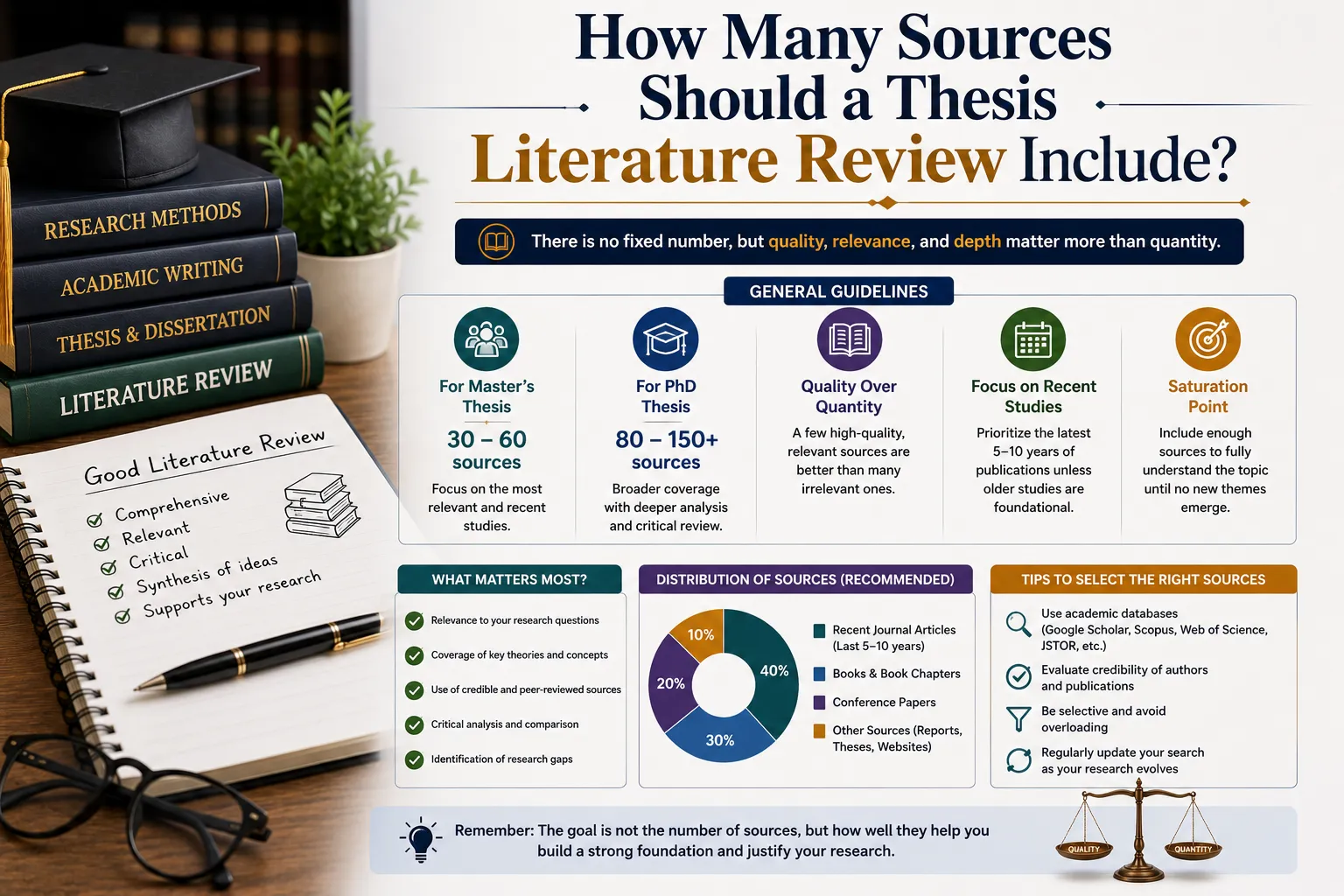
If you're staring at your reference manager wondering whether 40 sources is embarrassingly thin or 150 is excessive padding, you're asking the question almost every thesis scholar eventually asks — and the honest answer is that there's no single magic number. How many sources a thesis literature review should include depends far more on your academic level, your field, and how well those sources actually cover the territory than on hitting any specific count.
This guide breaks down realistic source-count ranges by degree level and discipline, explains why coverage matters more than raw quantity, and walks through how to tell whether your literature review is genuinely thorough or just long — the way an experienced thesis supervisor would talk you through it before your review goes to committee.
Why "How Many Sources" Doesn't Have One Right Answer
It's tempting to want a single target number you can hit and move on — but every honest answer to this question starts with the same caveat: there is no universal correct count. What matters is whether your literature review covers the existing knowledge background for your specific research problem, and whether it includes the sources that actually informed your approach and methodology, not whether it reaches a particular total.
That said, "it depends" isn't useful on its own either, which is why the ranges below exist — not as rules to hit mechanically, but as realistic benchmarks to sanity-check your review against, especially if you're a first-time scholar with no prior sense of what "enough" looks like in your field.
Realistic Source Ranges by Academic Level
Academic level is the single biggest driver of expected source count, because it roughly tracks how comprehensive your engagement with the field needs to be.
At the undergraduate level, a literature review or research paper typically draws on somewhere around 8 to 20 scholarly sources, since the goal is usually summarizing and synthesizing existing research rather than demonstrating exhaustive command of a field.
At the master's level, that range expands considerably — commonly cited figures run from roughly 20–50 sources on the lighter end up to 60–150 on the more comprehensive end, depending heavily on discipline and how interdisciplinary the topic is. A master's dissertation demands more depth and a broader understanding of the surrounding literature than an undergraduate paper, which is why the range widens so much.
At the PhD/doctoral level, expectations rise again substantially — many sources place a thorough doctoral literature review at 50–200+ sources, while others place typical PhD thesis reference counts at 150–400+, with real variation by field. The doctoral standard isn't really about a number at all: a doctoral thesis is expected to demonstrate comprehensive command of its field, meaning the more useful question is whether the review has engaged with the key theoretical frameworks, the major empirical studies, the active debates, and the work of the scholars most likely to actually examine the thesis.
How Discipline Changes the Number
Field matters almost as much as academic level. STEM-focused theses — laboratory sciences, engineering, computer science — tend to cite somewhat fewer sources overall, often in the 100–250 range at the doctoral level, reflecting a literature that's more concentrated on recent empirical papers rather than a long historical tail of scholarship. Social science theses commonly fall somewhere in the 150–250 range. Humanities theses frequently exceed 300 references, since they typically draw on primary sources, archival material, and a much broader span of secondary scholarship across a longer historical period.
Topic breadth matters independently of discipline too: narrow, highly specialized topics generally need fewer sources because there's genuinely less directly relevant literature to draw from, while broad or interdisciplinary topics need a wider source base simply to cover the different fields the research touches.
Coverage Matters More Than Count
It's worth stating plainly: reference count matters for real reasons, but it's a symptom, not the actual goal. Too few references signals insufficient engagement with existing literature and raises real doubts about whether your argument is properly grounded in the field. Too many references — particularly ones that are only tangentially related to your actual research problem — suggests padding, and can actively obscure the clarity of your argument rather than strengthening it.
This is why experienced reviewers tend to care less about hitting a target number and more about a different, harder-to-fake question: does the review show mastery of the core debates, the landmark studies, and the most recent high-quality work relevant to the specific research question — not just a long list of tangentially related citations.
Step 1: Define Your Scope Before You Count Anything
A clear, specific research question or problem statement is what actually limits what you need to search for and include — trying to estimate a source count before your scope is settled puts the process backwards. If your topic is still described broadly ("employee motivation" rather than "employee motivation among remote sales teams in mid-sized Indian firms"), any source count you land on will be either arbitrarily inflated or arbitrarily thin, because you haven't yet defined what "complete coverage" actually means for your specific study.
Once your scope is locked, the right question becomes much more answerable: given this specific research problem, what body of existing literature genuinely needs to be represented for a reader to trust that you know the field?
Step 2: Search Systematically So the Number Reflects Real Coverage
A source count built on a systematic, traceable search process is fundamentally more defensible than the same number built from casual browsing — even if the final totals look identical on paper. Two techniques make a real difference in getting genuine coverage rather than a scattered pile of loosely related papers.
Start with core sources: seminal, foundational works and key reviews in your area, then use citation-tracking tools to follow forward from those papers to see how the theory or debate has evolved since. Follow the reference lists and citing papers of the sources you've already found — a technique often called snowball searching — to catch related work your initial keyword searches missed, particularly work that uses different terminology to describe the same underlying concept.
A review built this way tends to land at a defensible count naturally, because you're following the actual shape of the literature rather than stopping arbitrarily once you've hit a number that feels sufficient.
Step 3: Know When a Systematic Review Changes the Rules
If your literature review methodology is a formal systematic review rather than a traditional narrative review, the source-count logic shifts meaningfully. In a systematic review, you include all studies meeting your explicitly stated inclusion and exclusion criteria — the resulting count can vary enormously, from a dozen studies in a narrow, specialized area to several hundred in a broad or long-established one, and what matters far more than the final number is the transparency of your search and selection process.
This is where a structured reporting framework like the PRISMA statement becomes genuinely useful, even outside its original health-sciences context. Its core discipline — documenting how many sources were identified, how many were screened, how many were included, and exactly why others were excluded — gives your literature review chapter a transparency and defensibility that a purely narrative "these are the papers I found relevant" summary simply doesn't have. You don't need to follow a formal systematic-review methodology to borrow this habit: even a simple screening record (search terms used, initial hits, sources excluded and why) strengthens your review's credibility regardless of discipline.
Step 4: Watch for the Warning Signs of Too Few or Too Many
Rather than fixating on a target number, watch for these more diagnostic signals:
Signs you likely have too few sources: your review can't point to more than a couple of studies addressing any given sub-theme of your topic; you're citing sources primarily from a single research group or author; recent work (from the last two to three years) is largely absent from your review, suggesting an incomplete or outdated search.
Signs you likely have too many, or the wrong kind: a meaningful share of your citations are only tangentially related to your actual research question; you're citing sources you haven't genuinely engaged with, just to inflate the count; your review reads as a long, undifferentiated list rather than a synthesized argument organized around themes or debates.
Both extremes point to the same underlying fix: go back to your defined scope and check whether each source you're including — or each gap you're leaving unaddressed — is actually justified by that scope, rather than by a target number you're trying to hit.
Step 5: Balance Foundational and Recent Sources
A strong literature review deliberately balances two kinds of sources: foundational, often older works that established the core theories or debates in your area, and recent, high-quality work that shows you're engaging with where the conversation stands today. A review built entirely from sources published in the last two years can look current but often lacks real theoretical grounding; a review built entirely from decades-old foundational work risks looking out of touch with the field's current state.
A commonly cited rule of thumb worth checking against your own review: aim to have the clear majority of your sources be peer-reviewed journal articles and academic books, rather than relying heavily on general web content — with foundational and current sources both represented rather than clustering at one end of the timeline.
A Real Example: Fixing a Literature Review That Was Long but Thin
One master's scholar we worked with submitted a literature review with 74 sources cited — comfortably within the commonly cited range for a master's-level review — and was still asked by their supervisor to substantially revise it. On paper, the number looked fine. In practice, the review read as thin.
Here's exactly what the count was hiding: of the 74 sources, more than half were brief, one-sentence citations supporting minor, tangential claims, while the actual core debate the thesis was engaging with — competing theories of consumer trust in online marketplaces — was represented by only four or five sources, none published within the last three years. The review had genuinely wide coverage of loosely adjacent topics but shallow coverage of the one debate the thesis actually needed to stand on.
The fix wasn't adding more sources overall — it was rebalancing. The scholar removed roughly fifteen tangential citations that weren't earning their place, and used forward citation tracking from the four core trust-theory papers to find eight additional recent studies directly engaging with that same debate. The final review had a slightly lower total source count than the original draft, but far stronger, more defensible coverage of the specific theoretical debate the thesis depended on — which is exactly the kind of change a supervisor notices immediately.
If you'd like expert guidance in scoping and strengthening your literature review's source coverage, you can check out our Thesis Writing Service.
Common Mistakes Scholars Make Around Source Count
Mistake 1: Chasing a specific number instead of coverage. Scholars sometimes stop searching the moment they hit a round number like 50 or 100, regardless of whether the core debates in their field are actually represented yet.
Mistake 2: Padding with tangentially related sources. Adding citations that only loosely touch the research topic inflates the count without adding real depth, and experienced reviewers tend to notice this pattern quickly.
Mistake 3: Relying too heavily on recent sources at the expense of foundational ones. A review that reads as current but has no grounding in the field's established theoretical base can look thin on genuine scholarly depth, even with a healthy source count.
Mistake 4: Not tracking why each source was included or excluded. Without a running record of search terms and inclusion decisions, it becomes very difficult to defend your literature review's completeness if a committee member asks why a particular well-known study wasn't addressed.
Best Practices If You Have No Research Background
If you're building your first serious literature review, a few adjustments make judging "enough sources" far more manageable:
- Look at 3–5 recently completed theses in your specific sub-area and count their reference lists as a real-world benchmark, rather than relying purely on general online guidelines that may not reflect your specific department's norms.
- Ask your supervisor directly what range they'd expect, since many departments have informal norms that aren't written down anywhere but strongly shape how a review gets evaluated.
- Track your search process from the start — search terms used, number of results, why sources were included or excluded — even informally. This record becomes invaluable both for defending your review's completeness and for writing your methodology section later.
- Revisit your source list against your defined scope periodically, rather than only at the end. It's much easier to notice a thin sub-theme or an overrepresented tangent while you're still actively searching than after the chapter is fully drafted.
If any part of this process — defining scope precisely, searching systematically, or judging whether your review's coverage is genuinely complete — feels difficult to gauge alone, that's exactly where a structured, expert-guided process helps first-time scholars move from guessing at a number to building a literature review that actually holds up to scrutiny.
FAQs
How many sources should a thesis literature review include?
It depends heavily on academic level and discipline: roughly 8–20 for undergraduate work, 20–150 for a master's thesis depending on depth and interdisciplinarity, and anywhere from 50 to 400+ for a doctoral thesis depending on field. STEM fields tend toward the lower end of doctoral ranges, humanities toward the higher end. The more reliable measure is whether your review covers the key theories, major studies, and active debates in your specific area — not whether it hits a particular number.
Why does the number of sources in a thesis literature review matter?
Because too few sources signals insufficient engagement with your field and raises doubts about whether your research is properly grounded, while too many tangentially related sources can look like padding and obscure your actual argument. The count itself matters less than what it reflects about your review's genuine coverage.
How does the number of sources affect a thesis's approval?
A source count that's clearly out of step with your field and academic level — either far too thin or bloated with irrelevant citations — is one of the more visible signals a committee uses to judge whether your literature review is genuinely thorough. It's rarely the sole reason for rejection, but it often triggers closer scrutiny of whether key debates and recent work have actually been covered.
How long does it take to complete a thesis using this approach?
Building a well-scoped, systematically searched literature review typically takes several weeks to a few months depending on academic level and field, and rushing this stage to hit a target source count usually costs more time later when gaps are flagged during review. Prioritizing genuine coverage over speed at this stage tends to prevent larger revision cycles down the line.
Is professional help available for structuring a thesis literature review's source coverage?
Yes. Many scholars, particularly those new to formal research, work with experienced thesis mentors to judge whether their literature review's source count and coverage genuinely match their field's expectations. ThesisLikho's PhD-qualified writers have supported thousands of scholars through exactly this stage, helping rebalance reviews that look complete on paper but are thin where it actually counts.
If you're unsure whether your literature review has genuine coverage or just a long reference list, it helps to get an experienced second opinion before it goes to your committee. Talk to a Thesis Expert for guidance on scoping, searching, and strengthening your literature review's source coverage.