
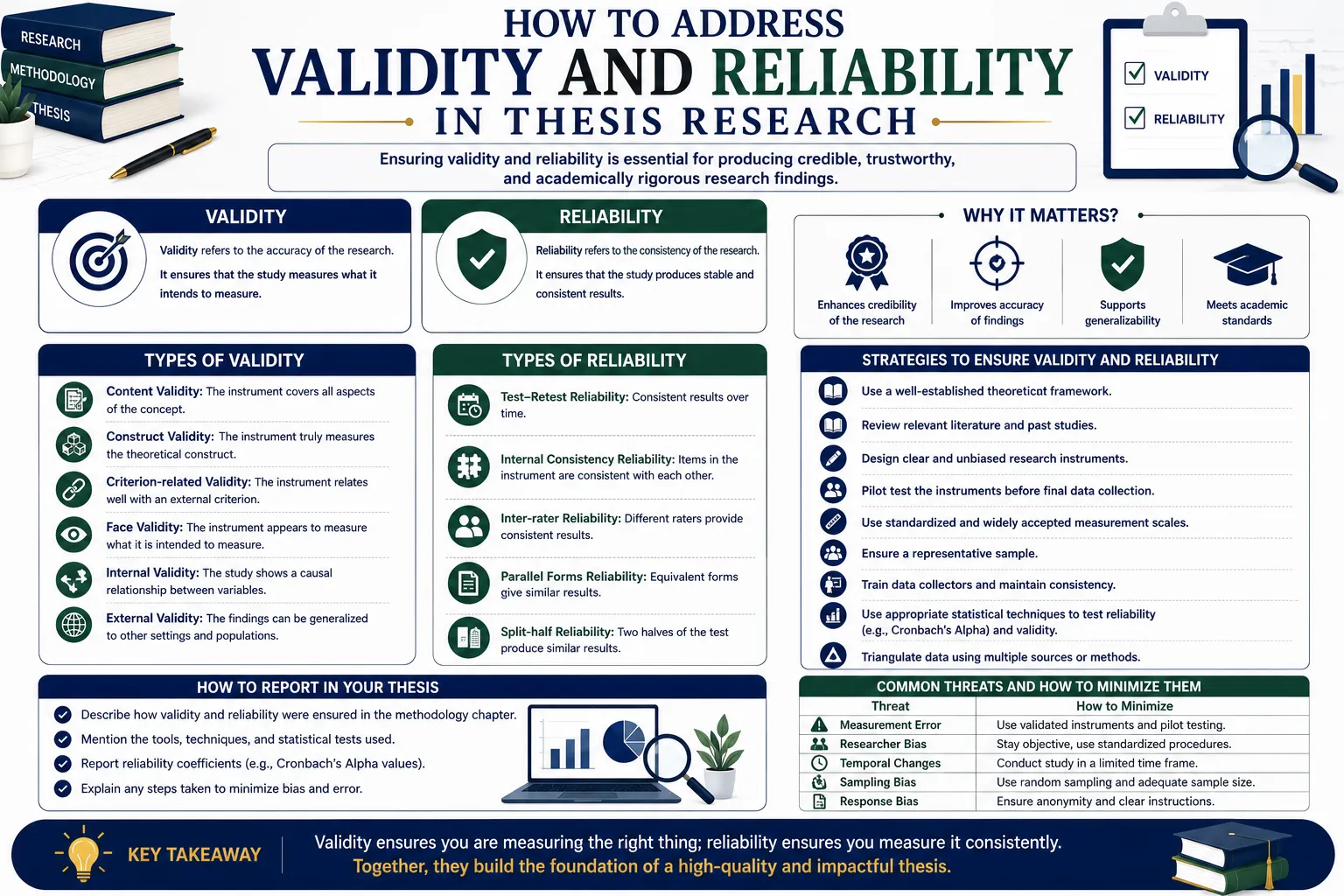
Every methodology chapter eventually reaches the same uncomfortable question: how do you know your findings are actually trustworthy? This is exactly what validity and reliability sections exist to answer — and getting them right (or wrong) can shape how much confidence your committee places in everything that follows. This guide walks through how to address validity and reliability in thesis research, covering both the quantitative and qualitative frameworks, since the two require genuinely different vocabulary and strategies.
Quantitative research rests on a shared, well-established vocabulary: a measure is reliable if it produces consistent results, and valid if it measures what it actually claims to measure. These concepts assume a single, stable, measurable reality — which is exactly why they don't transfer cleanly to qualitative research, where meaning is often context-dependent and co-constructed rather than fixed. If your thesis includes both quantitative and qualitative components, you'll need to address both frameworks explicitly, using the correct vocabulary for each rather than blending them together.
Addressing Validity and Reliability in Quantitative Research
Understanding the Two Main Categories of Validity
Validity in quantitative research splits into two main categories. Inference validity applies to the whole study and asks whether you can trust its conclusions — this splits further into internal validity (whether your cause-and-effect conclusions are sound) and external validity (whether your findings generalize beyond your specific study). Construct validity applies specifically to your measured variables, asking whether what you measured actually represents the concept you intended to study.
Internal Validity: Can You Trust Your Cause-and-Effect Claims?
Internal validity concerns the structure of your study and the accuracy of conclusions drawn about causality. It's the degree to which you can say your independent variable genuinely produced the observed effect, rather than some other uncontrolled factor. You can strengthen internal validity by controlling extraneous variables, using standardized instructions and procedures across all participants, counterbalancing conditions where relevant, and eliminating demand characteristics or investigator effects that might unconsciously influence responses.
External Validity: Do Your Findings Generalize?
External validity concerns whether your results can be generalized beyond your specific sample — to other settings, other populations, or other time periods. You can strengthen external validity by designing your study to reflect naturalistic, real-world conditions rather than an artificial lab setting, and by using random sampling to select participants wherever feasible, since random samples are more likely to represent the broader population you're generalizing to.
Construct Validity: Are You Measuring the Right Thing?
Construct validity asks whether your measurement tool genuinely represents the concept you're trying to measure. It divides further into two branches:
- Translation validity — whether your measure is a good "translation" of the underlying concept, which includes face validity (does the measure appear, on its face, to assess the intended variable?) and content validity (does the measure comprehensively cover the full domain of the construct, not just part of it?)
- Criterion-related validity — whether your measure behaves the way it should in relation to other variables, which includes predictive validity, concurrent validity, convergent validity, and discriminant validity
Content validity is worth particular attention if you're using a questionnaire: it specifically asks whether your items cover the full domain of content relevant to your construct. If you're measuring, say, employee engagement, content validity checks whether your items capture all the recognized dimensions of engagement — not just one or two convenient aspects.
Addressing Reliability Alongside Validity
Reliability is more straightforward: it asks whether your measure produces consistent results under similar conditions. For instruments using scaled items (such as Likert-scale questionnaires), reliability is typically reported using Cronbach's Alpha, calculated from pilot testing data before full-scale data collection begins. Report this figure directly in your methodology chapter, along with a brief note on whether it meets the accepted threshold for your type of study.
Addressing Trustworthiness in Qualitative Research
Why You Can't Just Borrow Quantitative Vocabulary
Applying quantitative validity metrics directly to qualitative work creates what researchers describe as a category error — it can distort both how you design your study and how it should be evaluated. Qualitative research embraces multiple realities and context-dependent meaning, which requires a different set of standards aligned with its own philosophical foundations, rather than an awkward attempt to force interpretivist work into positivist terminology.
The Lincoln and Guba Framework
Egon Guba and Yvonna Lincoln formalised the term "trustworthiness" in their 1985 book Naturalistic Inquiry, proposing four parallel criteria to replace the positivist concepts of internal validity, external validity, reliability, and objectivity:
- Credibility (parallel to internal validity) — do your findings accurately reflect the perspectives and experiences of your participants?
- Transferability (parallel to external validity) — could your findings be meaningfully applied to other similar contexts?
- Dependability (parallel to reliability) — is your research process logical, traceable, and well-documented?
- Confirmability (parallel to objectivity) — are your findings shaped by participants' responses rather than your own biases or assumptions?
A fifth criterion, authenticity, was added later, focused on ethical considerations — whether your research fairly represents different viewpoints and contributes to genuine understanding rather than distortion.
These four (or five) criteria are widely regarded as the gold standard for establishing rigor in qualitative research, and most universities require a dedicated section addressing trustworthiness somewhere in a qualitative thesis — typically in the methodology chapter, the findings chapter, or both.
Practical Strategies for Establishing Each Criterion
- For credibility: use triangulation across multiple data sources, hold iterative team discussions on emerging themes if working with co-researchers, and present representative verbatim quotes from participants as direct evidence supporting your interpretations
- For transferability: provide thick, detailed description of your research context and participants, giving readers enough information to judge whether your findings might apply to their own context
- For dependability: maintain a clear audit trail documenting your analytical decisions, and consider using a code-recode process if you conducted thematic analysis
- For confirmability: keep a reflexive journal noting your own assumptions and positionality throughout the research process, and be transparent about how your own perspective may have shaped your interpretations
Triangulation deserves particular emphasis, since it's one of the most widely used and broadly applicable strategies: it involves searching for convergence among multiple, different sources of information to form themes or categories in your study — for example, comparing interview data with document analysis and direct observation to see whether a consistent picture emerges.
Step-by-Step: Writing Your Validity and Reliability Section
- Identify whether your study is quantitative, qualitative, or mixed methods, since this determines which vocabulary framework applies
- For quantitative components, address internal validity, external validity, and construct validity separately, with specific strategies used for each
- Report your reliability coefficient (e.g., Cronbach's Alpha) if you used a scaled instrument
- For qualitative components, address credibility, transferability, dependability, and confirmability separately, using Lincoln and Guba's vocabulary rather than quantitative terms
- For mixed-methods theses, keep the two frameworks clearly separated rather than blending their terminology
- Name the specific strategies you used for each criterion (triangulation, member checking, standardized procedures, random sampling, etc.) rather than simply listing the criteria names
- Acknowledge any limitations honestly — if certain strategies weren't fully possible (e.g., limited time preventing prolonged engagement in the field), say so and explain how other strategies helped compensate
Practical Checklist: Is Your Validity and Reliability Section Complete?
- Correct vocabulary framework (quantitative or qualitative) matches your actual research design
- Internal and external validity are addressed separately for quantitative components
- Construct validity (including content and face validity, if using a questionnaire) is addressed
- Reliability coefficient is reported for scaled quantitative instruments
- Credibility, transferability, dependability, and confirmability are addressed separately for qualitative components
- Specific strategies (triangulation, member checking, audit trail, standardized procedures) are named, not just the criteria themselves
- Mixed-methods theses keep quantitative and qualitative vocabulary clearly separated
- Limitations are acknowledged honestly, with a note on how they were managed
Two Practical Scenarios
Scenario 1 — Strengthening Construct Validity in a Quantitative Study A scholar measuring digital literacy among rural students used an existing questionnaire but hadn't checked whether it covered all recognized dimensions of digital literacy relevant to their specific population. After reviewing the construct against current literature, they identified a missing dimension (offline troubleshooting skills) and added items to address it, strengthening the content validity of their measure before proceeding to full data collection.
Scenario 2 — Demonstrating Credibility in a Qualitative Study A scholar conducting interview-based research on healthcare worker burnout addressed credibility by triangulating interview data with reflective journals kept by a subset of participants and by presenting representative verbatim quotes throughout the findings chapter, directly linking each major theme to specific participant language. This gave examiners a clear, traceable connection between raw data and interpreted findings, satisfying the credibility criterion without borrowing quantitative terminology.
Common Mistakes Thesis Writers Make With Validity and Reliability
- Using quantitative terminology (validity, reliability) for a qualitative study, creating a conceptual mismatch examiners are trained to notice.
- Listing the criteria names without naming specific strategies used, leaving the section feeling generic rather than tailored to the actual study.
- Reporting a reliability coefficient without interpreting it, leaving the reader to guess whether the figure meets an acceptable threshold.
- Addressing only credibility while ignoring transferability, dependability, and confirmability, leaving the trustworthiness discussion incomplete.
- Failing to acknowledge limitations honestly, when a brief, honest acknowledgment paired with a compensating strategy is generally viewed more favorably than an unrealistic claim of flawless rigor.
Frequently Asked Questions
How do you address validity and reliability in thesis research?
For quantitative research, address internal validity, external validity, and construct validity separately, and report a reliability coefficient like Cronbach's Alpha for scaled instruments. For qualitative research, use Lincoln and Guba's trustworthiness framework — credibility, transferability, dependability, and confirmability — naming specific strategies like triangulation and audit trails used to establish each.
Why does addressing validity and reliability matter for thesis research?
This section is where you demonstrate that your findings can genuinely be trusted, and a poorly addressed or mismatched framework (using quantitative vocabulary for qualitative work, for example) can undermine an examiner's confidence in the rest of the thesis, regardless of how strong the underlying research actually is.
How does validity and reliability affect a thesis's overall credibility?
A well-addressed validity and reliability section signals methodological maturity and gives examiners concrete evidence — not just assertions — that your conclusions are well-grounded, which directly affects how favorably the rest of your findings are received.
When should you address validity and reliability in a thesis?
Typically in the methodology chapter, though qualitative theses often revisit trustworthiness again in the findings or discussion chapter to demonstrate how each criterion was actually achieved in practice, not just planned for.
Is professional help available to address validity and reliability in thesis research?
Yes. ThesisLikho's PhD-qualified experts have guided 10,000+ scholars through validity and reliability planning, trustworthiness strategy development, and complete thesis writing assistance across quantitative, qualitative, and mixed-methods designs.
Get Expert Guidance on Your Validity and Reliability Section
Addressing validity and reliability convincingly takes more than naming the right criteria — it requires matching the correct framework to your research design and demonstrating, with specific strategies, exactly how each criterion was met. If you'd like expert input on strengthening this section of your methodology chapter, ThesisLikho's PhD-qualified team offers validity and reliability planning support, trustworthiness strategy guidance, and complete thesis writing assistance. If you need expert guidance with your methodology, research design, or overall thesis structure, you can explore our Thesis Writing Assistance service.
Talk to a Thesis Expert → https://thesislikho.com/writing-services/thesis-writing