
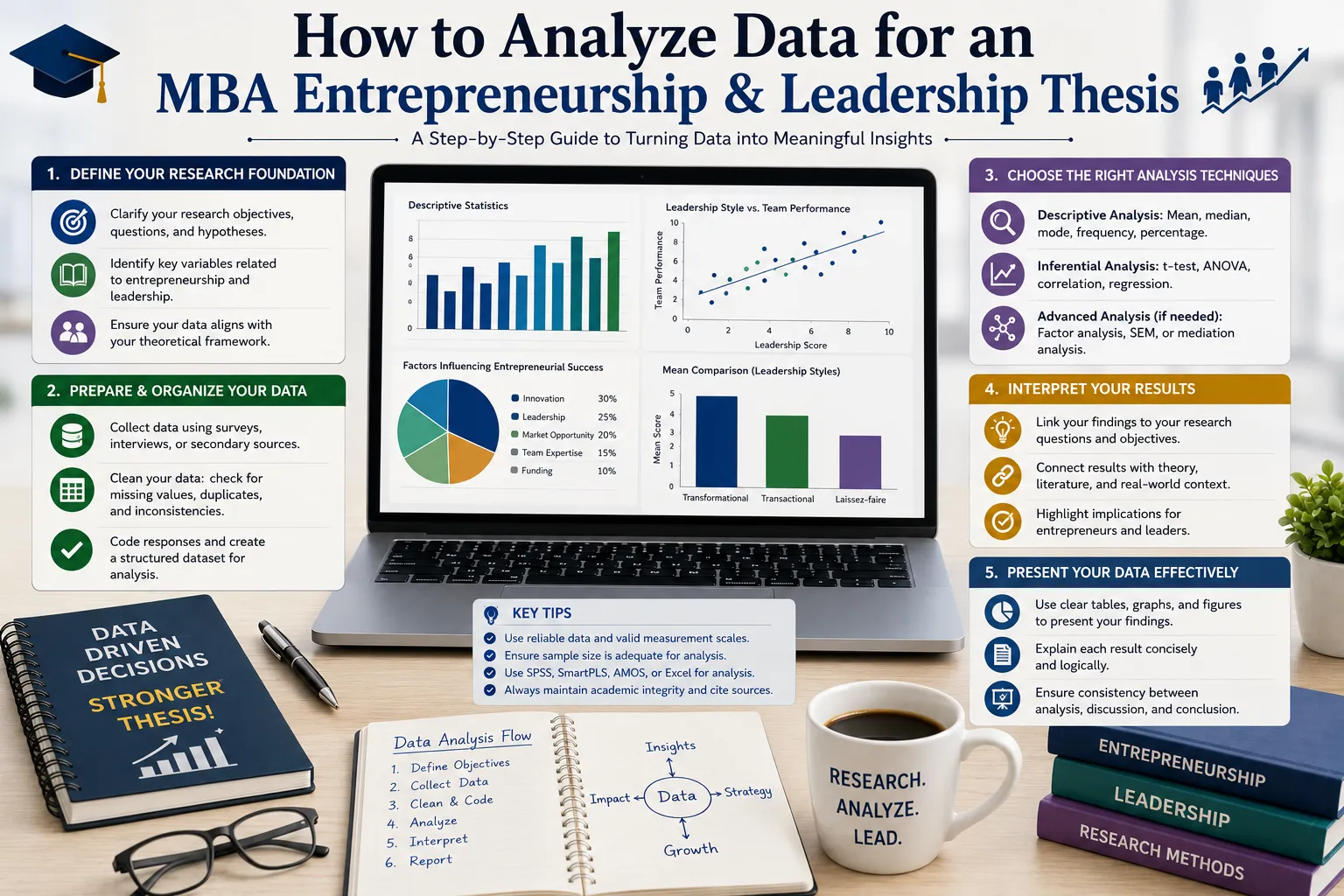
Once your interviews are recorded and transcribed, the real analytical work begins — and it's genuinely different from the statistical analysis most MBA data-analysis guides focus on. Entrepreneurship and leadership research relies heavily on interview and case study data, which means thematic analysis is often the core analytical technique your thesis needs. This guide walks through how to analyze data for an MBA entrepreneurship and leadership thesis using thematic analysis, the most widely adopted qualitative method for exactly this kind of research.
Why Thematic Analysis Fits This Field So Well
Thematic analysis has become one of the most widely adopted approaches in qualitative research, largely thanks to the foundational work of Virginia Braun and Victoria Clarke. It offers a flexible yet systematic framework for identifying, analyzing, and reporting patterns of meaning within qualitative data — interview transcripts, case study documentation, or open-ended survey responses. For entrepreneurship and leadership research specifically, where you're often trying to understand how founders make decisions or why certain leadership behaviors emerge, thematic analysis gives you a structured way to move from raw interview transcripts to genuine, defensible findings.
Understanding Reflexive Thematic Analysis
Braun and Clarke's particular emphasis on reflexivity — the ongoing critical examination of how your own background, assumptions, and decisions shape the analytical process — has led them to term their specific approach "Reflexive Thematic Analysis." Their central insight is worth internalizing before you begin: themes do not passively "emerge" from data on their own. They are actively produced by you, the researcher, through your systematic engagement with the dataset. This matters practically — it means your methodology chapter should acknowledge your own role in shaping the analysis, rather than presenting themes as if they were simply waiting to be discovered.
The Six Phases of Thematic Analysis
The Braun and Clarke framework moves through six phases: familiarization with the data, generating initial codes, searching for themes, reviewing themes, defining and naming themes, and producing the report. While these are distinct phases, you'll move through them iteratively and recursively in practice, not in a strict linear sequence — it's completely normal to return to an earlier phase as your understanding deepens.
Phase 1: Familiarization
Familiarization means immersing yourself in the dataset before making any analytical marks at all. Read every transcript at least twice. The first reading should be passive — absorb the content, notice your own reactions, register what surprises you. The second reading should be active — make marginal notes about initial impressions, striking passages, and apparent connections between interviews.
This step takes real time: for a 20-interview study, familiarization alone typically requires 15–20 hours. This investment is genuinely non-negotiable. Analysts who skip familiarization and move directly to coding tend to produce shallow, surface-level themes, because they haven't developed the intuitive understanding of the dataset that informs good coding decisions later on.
Phase 2: Generating Initial Codes
Coding means highlighting sections of your text — usually phrases or sentences — and assigning shorthand labels, or "codes," describing their content. Codes capture singular aspects of the data related to your research focus and function as the essential building blocks for your later themes. Important distinction to keep in mind: a code is not yet a theme. At this stage, you're simply labeling interesting or relevant segments across your entire dataset, not yet grouping them into larger patterns.
Phase 3: Searching for Themes
Once you have a full set of codes across your dataset, group related codes together to form potential themes. A theme captures something important about the data in relation to your research question, and represents a patterned response or meaning across the dataset — not just something one participant happened to mention once.
Phase 4: Reviewing Themes
Check each candidate theme against two things: whether it fits the specific coded extracts it was built from, and whether it fits your entire dataset as a whole. A theme that seemed compelling based on a handful of codes might not hold up once checked against the full breadth of your data — this review phase is where weaker or overlapping themes get refined, merged, or discarded.
Phase 5: Defining and Naming Themes
Clearly define what each surviving theme actually represents, and give it a name that reflects its core meaning precisely. Vague theme names ("Challenges," "Leadership Issues") do less analytical work than specific ones ("Navigating Investor Skepticism During Early Fundraising") — precision here strengthens your entire findings chapter.
Phase 6: Producing the Report
Write up your themes for your findings chapter, using selected participant quotes to illustrate each one and directly link your abstract thematic claims back to concrete data. This is where your analysis becomes readable, evidenced argument rather than an internal coding exercise only you can see.
Deciding Between Inductive and Deductive Coding
Before you begin coding, decide explicitly between two approaches. An inductive approach stays open to themes emerging from the data itself, without a predetermined framework — appropriate when your research question is genuinely exploratory. A deductive approach analyzes your data through a pre-established theoretical lens — appropriate when you're testing or extending an existing theoretical framework against your data. This decision shapes your entire analysis, and stating it explicitly in your methodology chapter (rather than leaving your approach ambiguous) signals genuine methodological awareness to your committee.
Managing Coding Consistency, Especially With Co-Researchers
If you're working with a research partner or committee-required second coder, a practical, feasible approach to establishing consistency doesn't require double-coding every single transcript. A workable model: one researcher codes the majority of interviews, a second researcher codes the remainder, then both cross-check a subset of transcripts and themes together, discussing and resolving any discrepancies collaboratively. This gives you genuine consistency-checking without the impractical burden of full duplicate coding across your entire dataset.
Should You Calculate Inter-Coder Reliability?
This is a genuine methodological choice, not an automatic requirement. Braun and Clarke's specific philosophical stance on reflexive thematic analysis treats coding as an interpretive, researcher-driven process rather than a reliability exercise — consistent with an interpretivist research orientation. Some researchers explicitly choose not to pursue formal inter-coder reliability statistics, instead maintaining rigor through analytic memo-writing during coding, participant member-checking, and explicit statements of their own positionality. If your research is grounded in an interpretivist paradigm, this approach is defensible and increasingly common — but state your choice explicitly and justify it, rather than leaving it unaddressed.
Use a Self-Audit Checklist Before Finalizing
Braun and Clarke's widely used 15-point checklist for good thematic analysis covers the full analytical process — transcription quality, coding rigor, analysis depth, overall quality, and final report clarity. Running your own analysis against this checklist before finalizing your findings chapter is a genuinely useful self-audit step, catching gaps before your committee does.
Practical Tools for Managing Your Analysis
For entrepreneurship and leadership research involving interview transcripts, qualitative analysis software like NVivo or MAXQDA is commonly used to organize codes, track themes across a large dataset, and manage the iterative revision process that thematic analysis requires. For smaller studies, careful manual coding using a structured spreadsheet or document-based system is also a legitimate, widely used approach — choose based on your dataset size and comfort with the available tools.
Step-by-Step: Conducting Your Thematic Analysis
- Transcribe all interviews accurately and completely before beginning any analysis
- Familiarize yourself with the full dataset through at least two readings — one passive, one active
- Decide and state explicitly whether your coding approach is inductive or deductive
- Generate initial codes across the entire dataset, labeling relevant segments consistently
- Group related codes into candidate themes
- Review each theme against its source extracts and against the full dataset
- Define and precisely name each surviving theme
- If working with a co-researcher, cross-check a subset of coding and resolve discrepancies collaboratively
- Write your findings chapter, illustrating each theme with selected, representative participant quotes
- Audit your completed analysis against a recognized quality checklist before finalizing
Practical Checklist: Is Your Thematic Analysis Ready?
- Full dataset transcribed accurately before analysis began
- Familiarization completed through multiple readings, not skipped or rushed
- Inductive vs. deductive approach decided and stated explicitly in the methodology
- Codes generated systematically across the entire dataset, not just selected portions
- Themes built by grouping related codes, not assumed in advance
- Each theme reviewed against both its source extracts and the full dataset
- Themes are precisely defined and named, not left vague
- If using a co-researcher, coding consistency was cross-checked and discrepancies resolved
- Findings chapter illustrates each theme with representative participant quotes
- Analysis approach (reflexive, with or without formal inter-coder reliability) is stated and justified
Two Practical Scenarios
Scenario 1 — Refining an Overly Broad Theme
A scholar analyzing interviews with startup founders initially grouped several codes into a broad theme labeled "Challenges." On review against the full dataset, this theme turned out to contain genuinely distinct patterns — funding-related challenges, team management challenges, and personal psychological challenges — that didn't actually represent one coherent theme. Splitting the original theme into three more precisely defined and named themes ("Navigating Investor Skepticism," "Managing Early Hiring Mismatches," and "Coping With Founder Isolation") produced a findings chapter with far more analytical precision than the original single, overly broad category.
Scenario 2 — Establishing Coding Consistency With a Co-Researcher
Two scholars co-authoring a study on entrepreneurial leadership divided coding responsibilities, with one researcher coding twelve interviews and the second coding the remaining eight. Rather than assuming consistency, they cross-checked three overlapping transcripts together, discovering a meaningful disagreement in how one of them had coded references to "resilience" versus "adaptability." Discussing and resolving this discrepancy collaboratively before finalizing their full coding scheme improved consistency across the remainder of the dataset.
Common Mistakes MBA Entrepreneurship & Leadership Thesis Writers Make Analyzing Data
- Skipping or rushing familiarization, moving directly to coding without developing genuine understanding of the dataset first.
- Leaving the inductive-versus-deductive decision unstated, obscuring an important methodological choice from the reader.
- Treating a single code as a theme, without the grouping and review process that distinguishes the two.
- Presenting themes without illustrative quotes, leaving abstract claims disconnected from the actual data.
- Not stating whether or why inter-coder reliability was (or wasn't) pursued, leaving an important methodological choice unjustified.
Frequently Asked Questions
How do you analyze data for an MBA entrepreneurship and leadership thesis?
Use thematic analysis following the Braun and Clarke six-phase framework — familiarization, initial coding, theme searching, theme review, theme definition and naming, and report writing — deciding explicitly between an inductive or deductive approach based on your specific research question.
Why does thematic analysis matter for entrepreneurship and leadership research specifically?
Much of this field's research relies on interview and case study data capturing complex human behavior and decision-making, which thematic analysis is specifically designed to handle systematically, rather than the statistical techniques better suited to numerical data.
How does data analysis quality affect an MBA thesis's overall contribution?
Skipping familiarization, leaving methodological choices unstated, or presenting themes without evidence weakens the credibility of qualitative findings regardless of how interesting the underlying interviews were — thorough, transparent analysis is what makes the findings defensible.
How long does it take to complete an MBA thesis using this approach?
Thematic analysis is genuinely time-intensive — familiarization alone can take 15–20 hours for a 20-interview study — so factor this realistically into your thesis timeline rather than underestimating the analytical phase relative to data collection.
Is professional help available to analyze data for an MBA entrepreneurship and leadership thesis?
Yes. ThesisLikho's PhD-qualified experts have guided 10,000+ scholars through thematic analysis, qualitative coding support, and complete MBA thesis writing assistance tailored to individual research designs.
Get Expert Guidance on Your MBA Entrepreneurship & Leadership Data Analysis
Conducting a genuinely rigorous thematic analysis takes careful, unhurried attention to each phase — from deep familiarization through to precise theme definition and evidenced reporting. If you'd like expert input on your coding process, theme development, or findings chapter, ThesisLikho's PhD-qualified team offers thematic analysis support, qualitative coding guidance, and complete MBA thesis writing assistance. If you need expert guidance with your data analysis, findings chapter, or overall thesis structure, you can explore our MBA Thesis Assistance service.
Get Free MBA Thesis Consultation → https://thesislikho.com/writing-services/thesis-assistance-mba